Your Meltdowns and Your Impulsivity Are Having a Fight and Neither One Is Winning

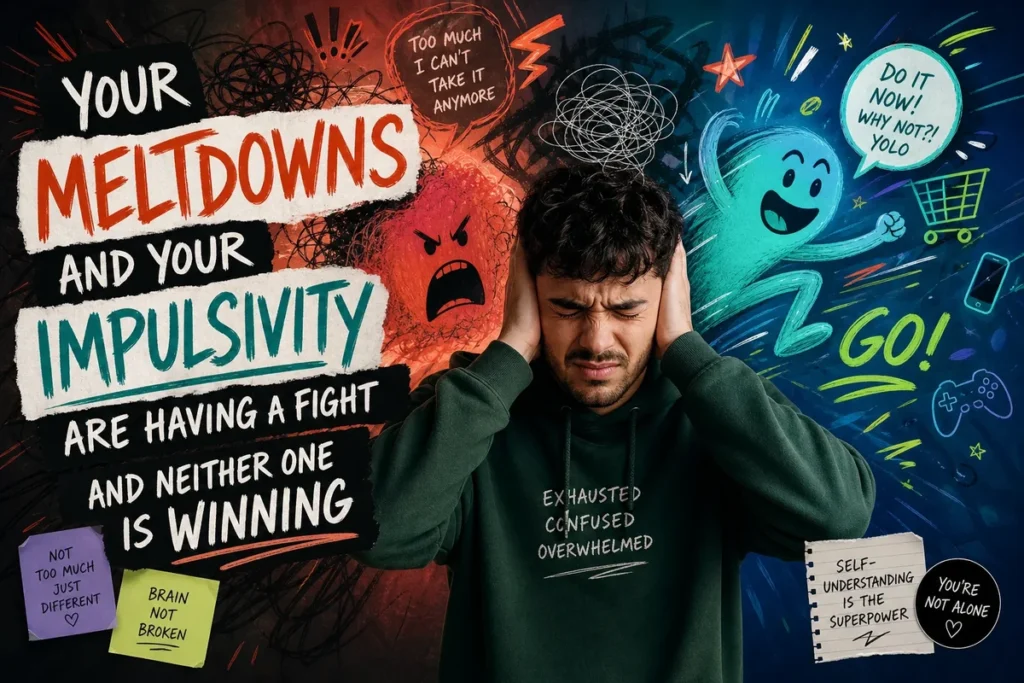
You are in a crowded place, or a conversation just shifted in a way that felt wrong, or a sound hit the wrong frequency at the wrong moment. Something in your system trips. And then two things happen at once: one part of you wants to go completely offline, to close every window and disappear from the world. Another part of you wants to say something sharp, move fast, react immediately. These two drives hit simultaneously, and neither gets to finish its job. The result does not look like a textbook autistic meltdown or a classic ADHD outburst. It looks like something messier, harder to explain, and impossible to justify to anyone who has not felt it themselves. If you are AuDHD, this collision is not a personality flaw or a failure of emotional maturity. It is the neurological signature of carrying two conditions whose emotional response systems are pulling in opposite directions at the same time.
Why This Is a Different Problem Than Simply Having Both Conditions
Most content about AuDHD describes the coexistence of autism and ADHD as a list of traits that happen to overlap in the same person. It covers the contradiction between needing routine and craving novelty, or the way hyperfocus locks in and cannot release. Those framings are real and important. But they miss the specific, moment-to-moment warfare that happens inside emotional and sensory response systems, and that warfare is its own distinct problem.
The autistic nervous system and the ADHD nervous system do not simply coexist. They generate opposing survival responses to the same triggering event. Autism orients the nervous system toward withdrawal, predictability, and conservation when inputs exceed a threshold. ADHD orients the nervous system toward reactivity, urgency, and externalization of distress. When you have both, the same trigger that tells your autistic system to go offline simultaneously tells your ADHD system to fire outward. The result is not the sum of two responses. It is a neurological stalemate that tends to produce a third, more chaotic outcome.
Research on co-occurring autism and ADHD increasingly points to this as a distinct profile: “impulsivity and attentional inconsistency characteristic of ADHD interact with the rigidity, sensory sensitivities, and social-cognitive differences associated with ASD, amplifying executive, emotional, and social-communication difficulties” (Autism Spectrum Disorder and ADHD Overlap and Comorbidity in Adults, peer-reviewed synthesis).
The clinical literature has historically treated these as two parallel sets of traits. The lived reality for AuDHD adults is that the traits are not parallel. They are in active conflict with each other, and that conflict is happening in real time, during the exact moments when regulated response is most needed.
What Causes a Meltdown, and What Causes Impulsive Reactivity: These Are Not the Same Mechanism
Understanding why these two drives collide requires being clear about what is driving each of them separately before they meet in the same brain.
An autistic meltdown is not a tantrum and it is not the same as losing your temper. It is the result of cumulative sensory or cognitive load exceeding the nervous system’s capacity to regulate. Research on autistic burnout and overwhelm consistently describes a threshold model: the autistic nervous system absorbs input, manages masking, processes sensory data, and navigates unpredictability until it simply cannot anymore. At that point, the system does one of two things. It erupts, producing what looks like explosive distress: crying, shouting, physical dysregulation. Or it shuts down, going into a protective low-power mode where communication, movement, and processing become unavailable. Both responses are driven by the same mechanism: overload, not choice. A qualitative study of autistic adults described autistic burnout as a simultaneous “powering down of their minds and bodies” alongside “overactivation” involving heightened sensory sensitivity, restlessness, and increased frustration (Ali et al., 2026, Autism).
ADHD emotional impulsivity is a different mechanism entirely. Research on adults with ADHD consistently identifies what Barkley (2010) described as a core deficit in inhibiting emotional responses, particularly those involving frustration, impatience, and social threat. The ADHD brain often generates a strong initial emotional response and then fails to apply the brake that neurotypical regulation would normally engage. This is not a failure to feel the right things. It is a failure of the inhibitory circuit that sits between feeling and acting. Research into emotion dysregulation and emotional impulsivity in adult ADHD found that dysregulation scores mediated the relationship between core ADHD traits and emotionally impulsive behavior, suggesting that dysregulation is not a side effect of ADHD but part of its core architecture (from a preliminary study on emotion dysregulation and emotional impulsivity among adults with ADHD, published in a peer-reviewed journal). The emotional signal fires at full volume, and the system that would ordinarily modulate it is running below capacity.
Two completely different mechanisms, one triggering moment: Autistic meltdown comes from an overload threshold being crossed, the system shuts down or erupts because it has absorbed too much. ADHD emotional impulsivity comes from inadequate inhibitory braking, a strong emotion fires and nothing catches it in time. In AuDHD, the same event can activate both simultaneously, which is why the response can look incoherent even to the person experiencing it.
What Actually Happens When Both Systems Fire at Once
Here is the scenario that textbooks do not describe clearly enough. You are in a situation where sensory or social load has been building for a while, perhaps for hours before a visible incident occurs. Your autistic nervous system is already approaching its threshold. The load is invisible to everyone else. You have been managing, which is what autistic adults do: absorbing, suppressing, continuing to function while the internal cost accumulates.
Then something specific happens. A loud sound, a change in plan, a comment that lands wrong, a request that arrives without warning. In an autistic-only nervous system, this would be the event that crosses the threshold and triggers shutdown or meltdown: the system cannot absorb any more, and it responds accordingly.
In an AuDHD nervous system, the same event also activates the ADHD reactivity circuit. The emotional signal fires immediately and fully. Impulsivity means the ADHD brain does not wait for the autistic brain to finish its shutdown sequence. It wants to respond, right now, to whatever caused that overload. This is the moment the two drives collide.
The autistic shutdown drive says: withdraw, go offline, reduce input, stop engaging. The ADHD impulsivity drive says: say something, move, react, externalize what is happening inside. Neither drive can complete its natural arc because the other is actively interfering. Shutdown requires disengagement, impulsivity requires engagement. You cannot do both at once. What often happens is a fragmented version of both: an outburst that cuts off mid-sentence, a physical reaction followed by sudden freezing, raised affect followed by a bewildering silence, or words that come out in a way the person cannot fully account for afterward because neither system was coherent enough to produce a clean output.
A participant in research on late-discovered women with AuDHD described the day-to-day version of this tension clearly: “My autism creates a need for order, formality, structure, routines, repetition, solitude, and intense interests, all of which are disrupted by my ADHD’s chaotic impulse towards newness, variety, inconsistency, and inattention. So I am forever starting routines and habits (autism) but I can never stick to them because I lose motivation and get bored (ADHD).” (Craddock, 2025, Health, navigating residual diagnostic categories in women diagnosed with autism and ADHD in adulthood)
What this quote captures for day-to-day life is equally true for acute moments of crisis. In a moment of emotional or sensory overwhelm, the autistic system and the ADHD system do not negotiate. They run their separate programs simultaneously and produce something that neither program was designed to output.
The Aftermath: Why You Feel Like a Different Person After It Happens
One of the most disorienting features of this collision is what it feels like afterward. People who experience autistic meltdowns often describe a period of exhaustion and disorientation following the event: a kind of depleted calm where the nervous system has expended everything it had. People who experience ADHD emotional impulsivity often describe shame and confusion in the aftermath, a sense of having done something they cannot fully explain, responding in a way that does not match their actual values or intentions.
When both systems collide, the aftermath tends to carry both of these qualities at once. There is the physical depletion of the autistic system having been pushed past threshold. There is the ADHD shame response that arrives once the inhibitory brake finally engages, too late to have prevented the outburst but perfectly on time to produce a verdict about who you are as a person. And underneath both of those, there is often a bewildered sense that neither of those responses was really what you wanted to do. The shutdown would have been fine. The impulse to react, in isolation, might have been proportionate. But the two running together produced something that served neither function.
This is why AuDHD emotional regulation is not simply harder than managing emotion with either condition alone. It is structurally different. The regulatory architecture is dealing with two competing failure modes that do not respond to the same interventions. Techniques designed to manage autistic shutdown (reducing input, creating exit routes, reducing demand) and techniques designed to manage ADHD impulsivity (pause strategies, working memory supports, emotional labeling) are sometimes in direct contradiction with each other. Reducing input during an autistic overload episode, for example, requires pulling back from engagement. ADHD impulsivity is simultaneously pushing for engagement. Telling someone in this state to “take a moment” ignores that two contradictory drives are both competing for that moment at the same time.
From the community: “My partner has autism and ADHD and I love him so dearly so this is really hard for me. He can get extremely overwhelmed by strong smells, loud sounds, large groups of people, bright fluorescent light, etc. But there’s been so many instances where he gets overstimulated and lashes out at me… in the moment I will be very calm, listen, not yell back… But I mean no one likes to be yelled at. And then he’ll usually need to be alone… Then he’ll come back and apologize and say he’s the worst person”, r/neurodiversity thread
What the Neuroscience of Emotional Regulation Actually Shows
The prefrontal cortex is the region most implicated in both autistic and ADHD emotional dysregulation, but it plays somewhat different roles in each. In ADHD, the prefrontal circuits involved in emotional inhibition tend to show reduced engagement during regulation tasks. The inhibitory control failures that drive emotional impulsivity in ADHD are, in part, failures of these prefrontal circuits to adequately dampen subcortical reactivity, particularly responses to frustration and threat.
In autism, the regulatory picture involves a different kind of difficulty. Autistic individuals tend to rely more on suppression and less on adaptive strategies like cognitive reappraisal, meaning that emotional and sensory experience is absorbed and held rather than reprocessed. Research on AuDHD emotion regulation has described this as a situation where difficulty reading social and emotional cues, cognitive rigidity, and heightened sensory sensitivity make autistic individuals more susceptible to emotional overwhelm and less able to manage it effectively (Berkeley Scientific Journal, Spring 2024). The emotional overload that leads to meltdown is not the same as ADHD’s failure to brake: it is more like a dam that has been filling slowly and eventually gives way.
In AuDHD, both dynamics are present simultaneously. The dam fills faster because the autistic system’s suppression-heavy regulation style accelerates the accumulation of unprocessed load. At the same time, the inhibitory brake is unreliable because of how ADHD affects prefrontal regulation. This means overload reaches threshold faster, and when it does, the circuit that might otherwise contain the output is already underperforming. The two mechanisms do not cancel each other out. They compound.
The same peer-reviewed preliminary research on emotion dysregulation in adults with ADHD found that dysregulation mediated the path from core ADHD traits to emotionally impulsive behavior: dysregulation is not a downstream consequence but an intrinsic part of how the ADHD system operates. When autism is also present, the suppression-dominant regulation style means the baseline emotional load is already elevated before any acute trigger occurs. There is less regulatory reserve available at the moment of collision.
Why Standard Advice Often Fails for AuDHD Emotional Crises
Advice designed for ADHD emotional regulation tends to focus on the inhibitory gap: slow the response, name the emotion, create a pause between feeling and action. This is well-supported for ADHD alone. For someone who is simultaneously in autistic overload, inserting a pause is often functionally unavailable: the autistic system has already exceeded its capacity and is past the point where higher-order strategies can operate. Cognitive reappraisal requires prefrontal resources, at overload threshold, those resources are not reliably accessible.
Advice designed for autistic meltdown prevention tends to focus on reducing load before threshold is reached: pacing sensory input, building exit strategies, reducing the cumulative cost of masking. This is also well-supported for autism alone. For someone whose ADHD impulsivity is already activated, withdrawal strategies create a specific kind of frustration: the ADHD system experiences forced disengagement as its own form of dysregulation. Too little input can be dysregulating for the ADHD nervous system for the same reason that too much input is dysregulating for the autistic nervous system. Both are real, and in AuDHD they can occur simultaneously.
This is the practical consequence of the internal war. You cannot simply apply the autism toolkit or the ADHD toolkit. You need an understanding of which drive is dominant in a given moment, how far into the overload cycle the autistic system is, and what state the ADHD inhibitory system is in, before you can identify what might actually help. That is a significant cognitive load to place on a nervous system already in crisis, which is exactly why the crisis often runs its course before any strategy can intervene.
The goal for AuDHD emotional regulation is not to prevent all acute episodes. It is to build conditions, in advance, that reduce how often the two drives arrive at the same collision point simultaneously.
What Actually Helps: Working With Both Drives Rather Than Against One
Because the two systems have opposing needs during a crisis, the most effective strategies tend to be those that interrupt the collision before it fully develops, rather than those that attempt to manage it once both systems are fully activated. Pre-event load management matters more for AuDHD emotional regulation than for either condition alone. If the autistic system enters a high-demand situation already close to threshold, the window before ADHD impulsivity also fires is extremely narrow. Protecting sensory and cognitive reserves before predictably difficult events is not a luxury. It is what creates the difference between a situation that stays manageable and one that produces the full collision.
Physical regulation anchors can serve both systems simultaneously in a way that cognitive strategies often cannot. Grounding in a physical sensation, cold water, a textured surface, a specific pressure input, provides the autistic nervous system with a concrete, predictable input without increasing social or cognitive demands. It also gives the ADHD system something real and immediate to orient toward, which can interrupt the urgency to externalize before the impulse fully escalates. This is not a solution to the underlying architecture. It is a way to create a small gap between first trigger and full system collision.
Named exit routes are specifically useful for the AuDHD collision state in a way they often are not for either condition alone. For the autistic system, having a pre-established, pre-explained way to leave a situation reduces the shame and social cost of withdrawal, which is one of the pressures that keeps the autistic system from taking the exit it needs before threshold is crossed. For the ADHD system, knowing the exit is available reduces the urgency to escalate: if there is a legitimate way out, the impulsive drive to force the situation to end through outburst becomes slightly less compelling. The exit does not have to be physical withdrawal. It can be a scripted phrase, a pre-negotiated signal, or any clear and socially acknowledged move that does not require in-the-moment ADHD impulsivity to force the issue.
If you are navigating ADHD burnout and nervous system regulation, the AuDHD collision state is worth understanding as a distinct energy drain. The autistic system’s sustained suppression and the ADHD system’s sustained activation both draw on the same finite capacity, and the recovery period after a collision episode tends to require more deliberate rest than either a standard meltdown or a standard ADHD emotional outburst alone would generate. This is not weakness. It is the arithmetic of two regulatory systems both running past their limits at the same time.
The Identity Piece Nobody Talks About Enough
There is a specific kind of self-alienation that comes from experiencing the meltdown-impulsivity collision repeatedly without understanding what it is. Many AuDHD adults have been told, at different points in their lives, that they are unpredictable, explosive, oversensitive, dramatic, or out of control. These are the external labels that get applied when the output of the collision is visible but the mechanism is not.
What tends not to get said is that the output does not represent what the person intended or wanted to do. The autistic part wanted to withdraw. The ADHD part wanted to react. Neither drive was malicious. Neither was a character decision. The collision produces something that belongs to neither drive cleanly, and so the person is left trying to explain something that does not yet have a clean explanation available to them.
Understanding the internal war does not make the collision stop happening. But it changes the interpretive frame from “I am chaotic and unreliable” to “two of my neurological systems are fighting over how to respond to overwhelm, and neither one is wrong about what it needs.” That shift is not trivial. It is the difference between shame-led self-management, which tends to make regulation harder because shame is its own emotional load, and needs-led self-management, which starts from an accurate map of what is actually happening.
For AuDHD adults who came to both diagnoses late, this reframe is often one of the most practically significant pieces of their neurodivergent identity work: not just naming the two conditions, but understanding how they interact at the level of moment-to-moment emotional experience. The conditions are not parallel columns to be read separately. They are in conversation with each other, in conflict with each other, and producing outcomes that neither would generate alone.
Building a Personal Map of the Collision
Because the collision between autistic meltdown drive and ADHD impulsivity drive is somewhat predictable once you understand your own pattern, it is possible to build a map of where your collisions tend to happen. This is not about predicting every episode or holding yourself to a standard of perfect prevention. It is about identifying the specific conditions that tend to produce the collision: particular environments, particular social dynamics, particular load patterns, particular times of day or week when reserves are already low.
Most AuDHD adults, once they begin paying attention through this frame, find that their collision episodes cluster around recognizable conditions. They tend to happen when sensory load has been accumulating without adequate recovery time. They tend to happen when a social demand arrives without warning, which activates both the autistic rigidity response and the ADHD frustration response simultaneously. They tend to happen later in days when masking has been active for extended periods, because the autistic system’s reserves are lower and the inhibitory system has been depleted by sustained regulation effort throughout the day.
Stimulant medication, where appropriate and prescribed, can reduce the ADHD impulsivity component of the collision by improving inhibitory control and reducing the reactivity gap. However, research has noted that stimulant effects can be paradoxical in people with co-occurring autism, with some individuals experiencing increased irritability or emotional amplification rather than the smoothing effect seen in ADHD-only presentations (Berkeley Scientific Journal, Spring 2024). This is clinically significant: medication that helps the ADHD component may, in some AuDHD individuals, change the balance of the collision rather than simply reducing both drives. Anyone navigating this should raise it explicitly with their prescriber as an AuDHD-specific concern, not just an ADHD concern.
The internal war between your meltdowns and your impulsivity is not going to disappear because you understand it. But it is considerably harder to navigate without knowing what it is. These are not random episodes of dysregulation. They are a predictable outcome of two nervous systems with opposing threat responses occupying the same body. Naming that is the beginning of working with it, rather than just surviving it and apologizing afterward.
Quick Dopamine Hits:
- When you feel the first spike of overwhelm, set a physical 90-second timer and put your hands flat on a cold or textured surface, this gives the autistic nervous system a concrete sensory anchor before the ADHD impulse fires.
- After a meltdown-impulsivity episode, write one sentence about which drive won and what it cost you, not to judge yourself, but to build a map of your own pattern over time.
- Before any high-stimulus event (crowded place, difficult conversation, schedule change), pre-plan exactly one exit route you can use without explanation, giving the autistic shutdown drive a legitimate option reduces the pressure that forces the ADHD impulsivity to escalate instead.
Rate this article
Was this a useful hit?