Your Hormones Are Hijacking Your ADHD Every Month and Nobody Told You That Was Happening

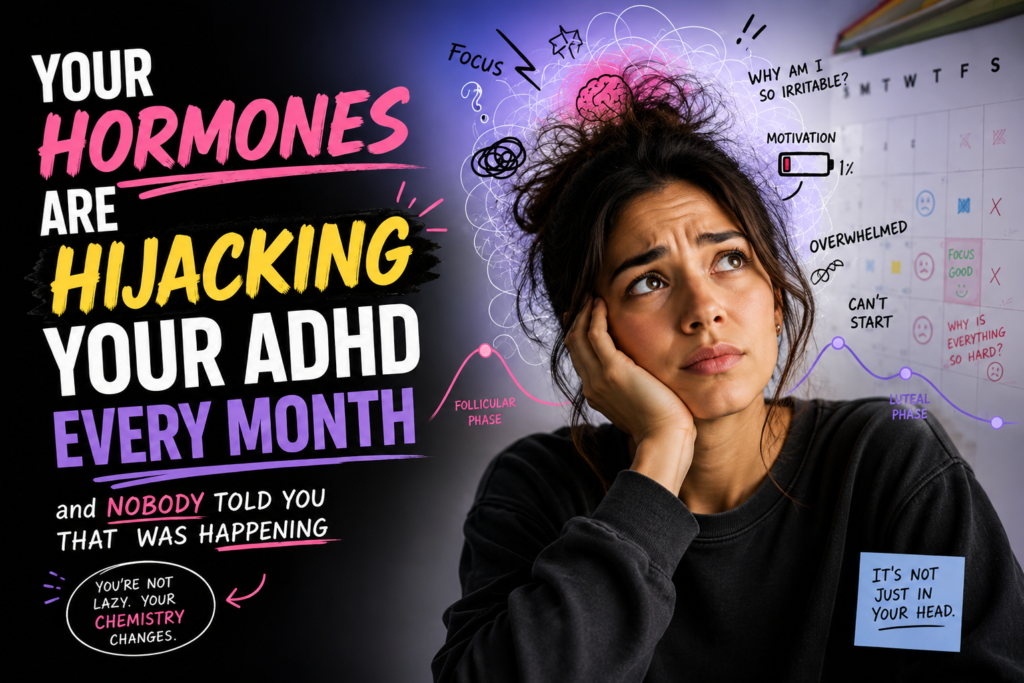
Estrogen is not a reproductive footnote. It is one of the most powerful modulators of the dopamine system your ADHD already depends on, and for most women with ADHD and hormonal fluctuation, that connection has never once been mentioned by a doctor, a psychiatrist, or a prescribing nurse. Not when your focus fell apart in your teens. Not when your medication stopped working for two weeks every month. Not when postpartum felt less like baby blues and more like your entire brain had been confiscated. Not when your symptoms became genuinely disabling in your late thirties or forties. The hormonal hijacking of ADHD is one of the most well-documented and systematically under-communicated findings in the field, and the cost of that silence has been paid, in exhaustion and shame and misdiagnosis, almost entirely by women.
Estrogen Is Running Your Dopamine System Whether You Know It or Not
To understand why hormones can turn ADHD from manageable to catastrophic in days, you need to understand one fundamental relationship. Estrogen does not just regulate reproduction. It acts as a direct modulator of dopaminergic neurotransmission, particularly in the prefrontal cortex, the region that governs working memory, attention regulation, impulse control, and executive function.
Research by Jacobs and D’Esposito, published in the Journal of Neuroscience in 2011, demonstrated that estrogen actively shapes dopamine-dependent cognitive processes, with direct implications for women’s cognitive health across the hormonal cycle. Shanmugan and Epperson, writing in Human Brain Mapping in 2014, extended this finding to executive function specifically, showing that declining estrogen levels directly compromise the prefrontal capacities that ADHD already taxes.
When oestrogen is low or declining in individuals with already dysregulated dopamine, these shortages reinforce each other, explaining mood and cognitive deterioration during hormonal fluctuation periods. (Kooij, 2025, Frontiers in Global Women’s Health)
This is not a subtle effect. For a neurotypical brain, the cognitive cost of falling estrogen is measurable but manageable. For an ADHD brain, which operates with a chronically under-functioning dopamine system as a baseline, the estrogen withdrawal is a compounding deficit landing on a system that had almost no margin to begin with. The result is not PMS with some concentration problems. It is a neurobiologically distinct collapse of executive function, emotional regulation, and working memory, arriving predictably, repeatedly, and with no explanation ever offered to the person experiencing it.
The double-deficit mechanism: ADHD brains already produce and regulate dopamine less efficiently than neurotypical brains. Estrogen amplifies dopamine signalling in the prefrontal cortex. When estrogen falls during the late luteal phase, perimenopause, or the postpartum drop, that amplification is withdrawn from a system already running at reduced capacity. The functional impairment is not additive. It is multiplicative.
What Nobody Told You About Puberty and Your ADHD
Many women with ADHD look back at puberty as the point where things genuinely fell apart. Grades that were manageable in primary school became chaotic. Social relationships that felt workable became overwhelming. Emotional dysregulation intensified dramatically. If you were diagnosed at all during this period, it was often framed as anxiety, depression, or simply the difficulty of adolescence.
What was almost certainly not mentioned: puberty activates a completely new hormonal cycle, and with it, a cycle of estrogen fluctuation that the ADHD brain is poorly equipped to absorb. Research reviewed by Kooij et al. in 2025 identifies puberty as a critical hormonal transition point where ADHD traits and mood disturbances frequently intensify in girls, and where the diagnostic picture often shifts in ways that obscure rather than reveal the underlying condition. Because girls’ ADHD is already more likely to be internalised, masked, and missed, the hormonal amplification of traits during puberty frequently gets categorised as emotional instability or anxiety rather than neurobiological deterioration under new hormonal conditions.
The consequence of this misread is significant. Girls who might have been identified in childhood, or who might have received a late discovery that made sense of their experience, instead reach adulthood having absorbed years of the message that their struggles are character-based rather than neurological. The hormonal dimension never enters the conversation, which means it stays invisible for decades.
How Does the Menstrual Cycle Affect ADHD Symptoms?
The short answer: directly, predictably, and at every phase where estrogen moves.
During the follicular phase, roughly days one through fourteen, rising estrogen enhances dopamine signalling in the prefrontal cortex. Medication tends to work better. Focus is more accessible. Executive function feels less like wading through mud. Then, after ovulation, estrogen begins to fall. By the mid-to-late luteal phase, approximately days fifteen through twenty-eight, the withdrawal of estrogen’s amplifying effect hits an ADHD brain that has no reserve capacity to compensate. Working memory degrades. Emotional dysregulation spikes. Rejection sensitivity sharpens. The brain fog is not psychological. It is neurochemical.
Wynchank, de Jong, and Kooij, writing in European Psychiatry in 2026, found that many women with ADHD report cyclical variations in symptom intensity, with reduced psychostimulant efficacy specifically during the late luteal phase of the menstrual cycle. This is a clinically meaningful finding: the same dose of medication that provides adequate coverage in week two of your cycle may provide significantly less coverage in week three. The drug has not stopped working. The hormonal context in which it is working has changed.
Research also documents that women with ADHD report premenstrual depressive traits at a significantly elevated rate, 45% compared to a 28% population baseline, and that the co-occurrence of ADHD with premenstrual dysphoric disorder is substantially higher than in the general population (Dorani et al., 2021, Journal of Psychiatric Research). If you have been treated for PMDD without anyone ever noting that ADHD and PMDD share a dopamine-serotonin substrate and tend to amplify each other, you have experienced exactly the kind of siloed clinical thinking this field is still working to correct.
For a deeper look at the specific neurobiological mechanics of cycle-phase symptom shifts, the monthly pattern piece covers the follicular-to-luteal transition in detail.
The Postpartum Window Is an Estrogen Cliff
After delivery, estrogen levels fall sharply and rapidly. This is among the most dramatic hormonal withdrawals the human body experiences outside of medical intervention. For a neurotypical woman, this drop is significant and can trigger mood disturbances in its own right. For a woman with ADHD, whose dopamine system was already relying on estrogen’s amplification just to function at baseline, the postpartum estrogen cliff is a neurological crisis that rarely gets named as such.
Kooij et al. (2025) report that mothers with ADHD have a five to six times higher risk of developing postpartum depression and anxiety compared to mothers without ADHD. The research is unambiguous on the direction of the problem: it is not that depression is making the ADHD worse. It is that the sudden removal of estrogen’s dopaminergic support, in a brain that depended on it heavily, generates a combined profile that is simultaneously an ADHD crisis and a mood crisis, and that neither condition is typically treated with the estrogen-ADHD connection in mind.
Women who discontinue ADHD stimulant medication during pregnancy, which many do for clinical reasons, often return postpartum to find that their standard dose is no longer effective in an estrogen-depleted environment. The postpartum period is one of the most hormonally volatile phases of a woman’s life, and it is frequently managed as though hormones and ADHD are unrelated variables. The estrogen cliff piece goes further on what that means for medication efficacy and how to approach the conversation with your care team.
The undiagnosed risk multiplier: Women with undiagnosed ADHD face significantly elevated vulnerability to PMDD, postpartum depression, and cardiovascular disease during perimenopause. Not because ADHD causes these conditions directly, but because the hormonal triggers for each map precisely onto the dopaminergic instability that ADHD creates. Late discovery changes the risk profile by making intervention possible. (Kooij, 2025, Frontiers in Global Women’s Health)
Why Perimenopause May Be the Most Impairing Phase of Your Life
Perimenopause is not a single hormonal state. It is a multi-year period of erratic fluctuation, where estrogen levels swing unpredictably before eventually declining. For a brain that experiences every estrogen drop as a reduction in dopamine support, this is not a gradual adjustment. It is years of neurochemical instability landing on a system that was already working at a deficit.
In an ADDitude survey of women with ADHD, 94% reported that their ADHD traits grew more severe during perimenopause and menopause. That figure is not a statistical anomaly. It reflects a mechanistic reality: when estrogen declines, the dopamine amplification that was quietly compensating for ADHD, sometimes for decades, withdraws, and the underlying deficit becomes impossible to mask.
Research published in European Psychiatry in 2025 found that perimenopausal experiences begin up to ten years earlier in women with ADHD compared to neurotypical women, with the most severe reported difficulties occurring between ages 35 and 39 rather than the typical range of 45 to 50. Women with ADHD in their late thirties who feel like they are suddenly falling apart, relationships suffering, careers destabilising, emotional regulation disintegrating, are frequently told they are burnt out, anxious, or depressed. What they are often experiencing is early perimenopause interacting with an ADHD brain in a system where nobody connected the dots.
The conclusion drawn consistently across clinical observation and community experience is the same: estrogen was quietly compensating for the ADHD deficit. When it began to fluctuate and decline, the compensation withdrew, and the underlying neurology became, for the first time, impossible to dismiss or work around.
The cognitive picture is equally serious. Shanmugan and Epperson (2014) document meaningful executive function decline across the menopause transition, including degradation in working memory, attention, and verbal recall. These are not ageing effects superimposed on ADHD. They are the direct expression of an estrogen-dopamine system losing its primary support structure.
Hormonal Contraception: A Variable That Changes Everything
If you are on hormonal contraception and have noticed your ADHD feels different, sometimes better, sometimes worse, sometimes radically altered by switching pill formulations, you have not been imagining it. Combined oral contraceptives suppress the natural hormonal cycle and replace it with a synthetic one. The implications for an ADHD brain that depends on estrogen’s dopaminergic effects are complex and not yet fully mapped by research, but the emerging picture is clinically important.
A large Swedish cohort study analysed by Kooij et al. (2025), involving over 763,000 women without ADHD and nearly 30,000 with an ADHD diagnosis, examined depression risk associated with hormonal contraceptive use. Women with ADHD using both combined oral contraceptives and progesterone-only preparations showed elevated depression risk compared to non-users with ADHD. The mechanism is not fully understood, but the working hypothesis involves the interaction between synthetic hormones, natural estrogen suppression, and the dopaminergic dysregulation already present in ADHD brains.
Progesterone, specifically, appears to work against estrogen’s dopamine-amplifying effects in some women. The relationship between progesterone-only formulations and mood deterioration in women with ADHD is a clinically important area where the evidence is still developing. What is already clear is that switching contraceptive methods can meaningfully alter how ADHD traits present, how well medication works, and how stable mood regulation feels across the month. If your ADHD trajectory changed noticeably when you started, stopped, or switched hormonal contraception, that is a data point worth raising explicitly with both your prescriber and your gynaecologist, because the cross-system literacy to interpret it is rarely present in either consultation alone.
Cyclical fluctuations in estrogen and progesterone during the menstrual cycle modulate dopaminergic transmission, influencing the peak efficacy and duration of ADHD medications. Dynamic dose adjustments aligned with menstrual phases are recommended to optimise therapeutic outcomes.
Why the Medical System Keeps Missing This
There are structural reasons why the estrogen-ADHD connection has remained so poorly integrated into clinical practice, and they are worth naming rather than glossing over.
The first is that ADHD research has historically been conducted predominantly on male populations. The diagnostic criteria that still govern clinical assessment today were developed largely from studies of boys and men, whose ADHD does not involve the same hormonal overlay. The result is a diagnostic and treatment framework that treats ADHD as a fixed, stable condition, when in fact, for women, it is a condition whose expression is continuously modulated by a hormonal cycle that the framework was never designed to account for.
The second is siloing. Gynaecologists manage hormones. Psychiatrists manage ADHD medications. Almost nobody is trained to sit at the intersection of both systems and see how they interact. Women who raise ADHD trait worsening with their gynaecologist are told that is not really a gynaecological matter. Women who raise hormonal cycles with their ADHD prescriber are often met with blank incomprehension. The clinical gap is not a failure of individual practitioners so much as a structural failure to train clinicians in a cross-system literacy that has become essential.
The third is the problem of misattribution. When ADHD traits worsen cyclically, or during perimenopause, or after childbirth, the most available explanations are psychological ones: stress, anxiety, emotional regulation difficulties, life circumstances. Many women are skilled at internalising these explanations, because they have been offered them for their entire lives. The hormonal mechanism gets bypassed in favour of a narrative of personal inadequacy that is easier to reach for and harder to refute without the right diagnostic language.
What better clinical practice looks like: Wynchank, de Jong, and Kooij (European Psychiatry, 2026) recommend that ADHD clinicians routinely note the first day of last menstruation and average cycle length at every assessment, determine the current menstrual phase when contextualising symptom severity, and track ADHD and mood daily for at least two months to identify cyclical patterns. These are straightforward steps that make a material difference. They are not yet standard practice, but they need to be.
What You Can Actually Do With This Information
The research gap is real, and the absence of formal clinical protocols tailored to hormonal fluctuation means that right now, many women are navigating this without adequate institutional support. That is not a reason to do nothing. It is a reason to become systematically informed about your own pattern, because pattern data is the most powerful thing you can bring into a clinical conversation.
Cycle tracking for ADHD is not about wellness trends. It is about generating the kind of longitudinal, self-documented evidence that can change a clinical conversation. A two-month daily log of ADHD trait severity against cycle day, combined with notes on medication efficacy, sleep quality, and emotional regulation, gives a clinician something concrete to work with. It also gives you something concrete: the knowledge that the terrible weeks are not a verdict on who you are. They are a predictable neurobiological event with a name and a mechanism.
For the perimenopausal window, the clinical conversation increasingly involves hormone replacement therapy as an adjunct to ADHD medication, not as an alternative. Patricia Quinn, one of the pioneering clinicians in this space, has argued that estrogen therapy during perimenopause should be understood as neurological support for women with ADHD, not just a physical comfort measure for hot flashes. The evidence base is still developing, but the mechanistic rationale is clear: restoring estrogen levels restores some portion of the dopaminergic amplification that the ADHD brain was relying on.
For medication timing across the cycle, a growing body of clinical work suggests that dose adjustments timed to the late luteal phase, when estrogen-driven dopamine support is lowest, may help reduce the cyclical breakthrough that many women experience. This is not yet standard practice, but it is the direction the research is pointing (Wynchank, de Jong and Kooij, 2026, European Psychiatry). Documenting your pattern and raising it with your prescriber is a legitimate and increasingly evidence-supported clinical conversation to initiate.
The Bigger Picture You Were Never Given
The story of ADHD in women is not only a story about late discovery or diagnostic bias, though it is absolutely that too. It is a story about a condition whose severity and expression are directly shaped by a hormonal system that nobody in the treatment pipeline was adequately trained to account for. It is a story about women spending decades wondering why they fall apart on a schedule, why the strategies that work in week two stop working in week three, why perimenopause felt like a neurological emergency that nobody around them recognised as one.
The estrogen-dopamine connection is not speculative. It is documented by researchers including Jacobs and D’Esposito (2011), Shanmugan and Epperson (2014), Dorani et al. (2021), and a body of work led by researchers like Sandra Kooij whose 2025 position paper in Frontiers in Global Women’s Health describes the absence of hormonal awareness in ADHD clinical practice as a systemic failure with measurable consequences for women’s health across the lifespan.
Understanding how your hormones modulate your ADHD does not fix the structural problems in how the condition is treated. But it does something immediately and concretely valuable: it replaces the narrative of personal failure with an accurate one. The weeks where everything collapses are not proof that you are too broken to function. They are proof that your brain is responding exactly as neuroscience predicts, to a hormonal shift that nobody warned you was coming, in a system that was never built to manage the interaction.
That is worth knowing. It changes the self-assessment. It changes the clinical conversation. And it is, finally, starting to change the research agenda. For a comprehensive look at how body-level variables connect to burnout, nervous system regulation, and recovery, the ADHD Body hub covers the full terrain.
Quick Dopamine Hits:
- For one full cycle, log your ADHD symptom severity (1, 10) every evening alongside the day of your cycle. Two months of data gives you a pattern you can take to any clinician.
- On days 18, 28 of your cycle, reduce your cognitive load deliberately: defer non-urgent decisions, schedule high-demand tasks for the follicular window instead, and treat this phase the way you’d treat a sick day, not laziness, just neurobiology.
- If you are in perimenopause and your ADHD medication has stopped working the way it used to, write that exact sentence down and bring it to your next appointment. Request a hormone panel alongside any stimulant review.
Rate this article
Was this a useful hit?