ADHD Relationships Break Down in Slow Motion — and Both People Feel Alone in It

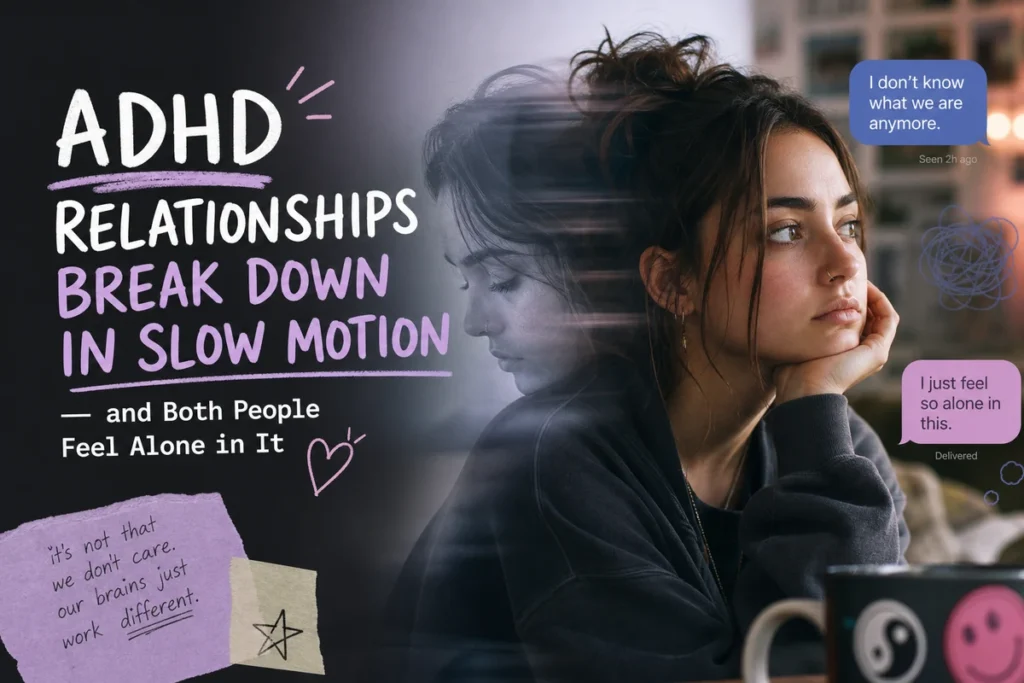
ADHD relationships don’t collapse in a single dramatic moment. They erode. Over months and years, the same patterns repeat: forgotten commitments, emotional surges, inconsistent follow-through, and a deepening sense on both sides that something is fundamentally broken. The person with ADHD feels like a perpetual disappointment. Their partner feels like an unpaid project manager. Neither person is villainous. Both are exhausted. And the specific mechanics of how ADHD reshapes intimate relationships, from the inside out, are rarely described with enough honesty to help either person actually change anything.
This article does not take sides. It takes both, simultaneously, because that is the only approach that reflects what is actually happening neurologically and relationally. Understanding ADHD’s impact on partnerships requires holding the ADHD partner’s experience of shame and the non-ADHD partner’s experience of exhaustion in the same frame, without minimizing either.
Why ADHD Relationships Feel Different From the Very Start
The beginning is usually the problem in disguise. ADHD brains are highly responsive to novelty and emotional interest, which means the early stages of a relationship are often where the ADHD partner shines most intensely. The hyperfocus that makes ADHD so disabling in the workplace can make a new romantic partner feel like the most seen, heard, and pursued person in the world. Texts answered within seconds. Plans made with creativity and enthusiasm. Attention that feels absolute.
Then the novelty fades, as it biologically must, and the hyperfocus lifts. Researchers studying romantic relationships in adults with ADHD found that participants themselves identified this pattern, describing the challenge of “needing novelty for stimulation and how they would feel bored and impulsive once the honeymoon phase had ended” (O’Brien et al., 2026, Journal of Marital and Family Therapy). For the non-ADHD partner, this shift can feel like a bait-and-switch. The attentiveness that characterized early courtship does not return consistently. It appears in flashes, usually when the relationship itself becomes novel again through conflict, a significant event, or a perceived threat of loss.
The person who hyperfocused on you at the start did not stop loving you. Their nervous system stopped registering the relationship as new information requiring urgent attention. This is not a choice. It is neurological. It is also genuinely painful for both people to live inside.
This early dynamic sets up the long-term asymmetry that defines many ADHD partnerships. One person’s emotional investment appears to fluctuate widely. The other person, trying to make sense of the inconsistency, begins doing more of the relational labor to compensate.
The Shame-Exhaustion Loop Neither Person Can Name
The central engine of ADHD relationship breakdown is not poor communication, though communication problems are real. It is a specific feedback loop: the ADHD partner accumulates shame from repeated perceived failures, and the non-ADHD partner accumulates exhaustion from carrying disproportionate responsibility. These two states feed each other in a way that makes direct, productive conversation nearly impossible without intervention.
Research published in the Journal of Marital and Family Therapy in 2026 captured this dynamic with unusual clarity. Participants with ADHD described an “over-reliance on partner for emotional labour” and recognized that managing the day-to-day logistics of a shared life had become deeply unequal, with one noting: “It is exhausting for both of us” (O’Brien et al., 2026). What makes this particularly corrosive is that the ADHD partner is usually aware of the imbalance. They feel it as guilt, often a generalized, chronic guilt that settles into something resembling shame and starts to affect how they see themselves not just as a partner but as a person.
Barkley and Murphy (2010) demonstrated that poor emotional self-control in adults with ADHD adds significant predictive power to marital dissatisfaction, above and beyond core inattentive and hyperactive-impulsive traits. This matters because it reframes the problem: it is not just about the forgotten anniversary or the overflowing inbox. It is about the emotional register of daily life being chronically dysregulated, which wears on everyone in close proximity.
What the research actually shows: Partners of individuals with ADHD report significantly lower intimacy and marital satisfaction compared to control groups (Ben-Naim et al., 2017). A 2024 umbrella review synthesizing 125 studies on ADHD outcomes identified divorce as one of the documented social risks associated with the condition (Hall et al., 2024, Frontiers in Psychiatry). These are not minor inconveniences. They are structural pressures that compound over time without appropriate understanding and support.
How the ADHD Partner Experiences Shame in Real Time
For the person with ADHD, the experience of relationships is rarely one of deliberate neglect. It is one of repeated, bewildering failure. They wanted to make the dinner reservation. They meant to follow up on the thing their partner mentioned. They were fully present in the conversation until they weren’t, and they cannot always identify exactly when that happened or why. The maddening part is that the effort was genuine.
Over time, this gap between intention and execution builds into a particular kind of shame, one that is not about a specific incident but about the identity conclusion it appears to confirm: that they are unreliable, selfish, not enough. Research participants in the O’Brien et al. (2026) study articulated this precisely, with one noting: “I just accepted that I was a rotten girlfriend and wife” and another stating “I had no idea what I was doing.” These are not dramatic confessions. They are the quiet, accumulated verdicts that adults with unrecognized or poorly managed ADHD absorb across years of relational friction.
Rejection sensitive dysphoria compounds this significantly. ADHD is associated with heightened rejection sensitivity (Müller et al., 2024), which means that when a partner raises a concern, even gently, the ADHD person’s nervous system can register it as a devastating verdict rather than a piece of information. The prefrontal cortex, already under-resourced, becomes further compromised under emotional threat. What the non-ADHD partner experiences as a reasonable conversation can become, for the ADHD partner, an experience of being fundamentally condemned. This is not manipulation. It is a neurological misfiring that can look, from the outside, like defensiveness or deflection.
From the community: “These are words my partner said to me last night. For context I was trying to open up about how difficult everything has been feeling lately due to burnout and being newly diagnosed and those are the words she said to me: ‘I could live a day in your shoes and prove it’s not that hard.'”, r/ADHD thread
That moment captures something research alone cannot fully convey. The ADHD partner is trying to be honest about a genuine neurological struggle. The non-ADHD partner, exhausted and frustrated, responds with disbelief. Both people leave the conversation feeling more alone than before. This is not a communication failure in the ordinary sense. It is two people operating from completely different maps of the same terrain.
What the Non-ADHD Partner Actually Goes Through
The experience of the non-ADHD partner is not primarily about the big failures. It is about the accumulation of small ones. A plan that fell apart. A task that never got done unless they asked. An emotional conversation that went sideways before they could finish their first sentence. A household where the mental load became, gradually and without any formal agreement, entirely theirs.
What makes this particularly isolating is that non-ADHD partners are often told, directly or indirectly, that ADHD explains everything. Once a diagnosis is in the picture, every grievance can feel delegitimized. They are expected to understand and accommodate, and when their own exhaustion leaks out, they risk being cast as unsympathetic. This is an unfair position. The validity of the ADHD partner’s neurological reality does not negate the validity of the non-ADHD partner’s real and mounting burden.
Understanding the reason for a behavior does not automatically make it easier to live with. Both things are true at once: the ADHD partner is not doing this on purpose, and the non-ADHD partner is genuinely affected by it. Neither truth cancels the other.
One of the most documented relational patterns in ADHD partnerships is what clinicians sometimes call the parent-child dynamic, where the non-ADHD partner assumes a management and reminder role that gradually erodes the romantic equality of the relationship. This is not what either person wanted. It typically develops because the most obvious short-term fix to ADHD-driven inconsistency is for the non-ADHD partner to compensate, and compensating consistently over years transforms them from partner to coordinator. The non-ADHD partner resents the role. The ADHD partner resents being managed. Both resentments are legitimate.
Does ADHD Actually Cause Relationship Problems? What the Evidence Says
Yes, and more specifically than most people acknowledge. Interpersonal functioning in adults with ADHD is significantly affected across romantic partnerships, family dynamics, and social networks, with evidence confirming that greater ADHD trait severity is associated with lower relationship quality across multiple domains. A comprehensive 2024 umbrella review of 125 studies on ADHD outcomes identified divorce as a social risk associated with the condition (Hall et al., 2024, Frontiers in Psychiatry).
The mechanisms are not mysterious. Working memory differences can mean partners feel unheard and unremembered. Time blindness can create the impression of chronic disrespect even when none is intended. Emotional dysregulation can turn ordinary conflicts into disproportionate crises that damage trust over time. Hyperfocus inconsistency can produce a whiplash quality to the relationship, where periods of intense engagement alternate with periods of apparent indifference. None of these are character flaws, but they produce real relational damage unless they are identified and addressed.
The absence of a diagnosis plays an enormous role in how much damage accumulates. Participants in the O’Brien et al. (2026) study consistently described how understanding ADHD retrospectively changed their interpretation of past relationship breakdowns. One stated: “I lost a relationship because of what I now know as ADHD traits.” Another noted: “Not understanding that I have RSD made everything so much harder.” The clarity that arrives, often late, does not undo the damage. But it does allow both partners to stop attributing patterns to character flaws, which is where genuine change can begin.
The Intimacy Problem Nobody Talks About Directly
Emotional intimacy and physical intimacy in ADHD relationships are affected in ways that rarely get discussed with the specificity they deserve. For the ADHD partner, staying present during intimate moments is not guaranteed. Research participants described “issues staying focused while being intimate,” with partners interpreting this inattention as disinterest or emotional absence (O’Brien et al., 2026). For the ADHD brain, this is not about desire. It is about a nervous system that can struggle to stay anchored to any single stimulus for long, including ones it cares about deeply.
The non-ADHD partner, reading that distraction as rejection or indifference, often withdraws. The ADHD partner, detecting the withdrawal and interpreting it through their rejection sensitivity, either escalates or shuts down. Physical and emotional distance accumulate in parallel, and by the time either person names it, months of small disconnections have built a wall neither fully noticed being constructed.
How common is this? In a large survey by ADDitude Magazine, nearly 80% of readers reported that ADHD complicated their experience with sex and intimacy. This is not a fringe issue. It sits at the center of many ADHD relationships and is almost never addressed in couples therapy unless the therapist has specific ADHD literacy.
Where Late Discovery Changes Everything, and Where It Does Not
A late ADHD discovery is one of the most significant relationship events that rarely gets treated as one. For the person who receives it, it provides a framework that recontextualizes years of relational difficulty, not as personal failure, but as the output of an unrecognized neurological difference. Research consistently describes the relief that accompanies this reframing (O’Brien et al., 2026, Ramsay, 2010). Participants described no longer having to “pretend my way through the day” once their partner understood their ADHD. Others described the discovery as the first time they stopped accepting the identity of “rotten partner” as accurate.
For the non-ADHD partner, the discovery can land differently. It can bring genuine relief and understanding, or it can arrive with a complicated mixture of grief and frustration. Relief that there is a name for what they have been living through. Frustration that the name arrived after so many years. Uncertainty about whether things will actually change, or whether the diagnosis will simply become the new explanation that does not produce different behavior.
This is a legitimate concern. Understanding is not the same as change. The research is clear that self-knowledge, while necessary, is not sufficient on its own. What actually improves relational outcomes is the combination of self-understanding, concrete systems that compensate for executive dysfunction, and both partners being willing to rebuild the roles they have drifted into. The ongoing work of navigating ADHD in partnerships does not end with a diagnosis. It begins there.
The diagnosis is the beginning of a different conversation, not the end of a difficult one. Both people still have to decide what to do with the information.
What Actually Helps Both Sides
The interventions that help ADHD relationships are specific, not generic. “Communicate better” is not a strategy. “Understand each other more” is a goal, not a plan. What the evidence supports is considerably more concrete.
For the ADHD partner, the most impactful shift is moving from explanation to system. A partner who has heard the explanation many times already does not need to hear it again. What they need to see is a structural change: a trigger-based task system that does not rely on remembering, a written shared logistics document that externalizes the mental load, a consistent signal that indicates when emotional flooding is happening alongside a request for a pause before continuing the conversation. The ADHD shame spiral is most effectively interrupted not by self-criticism but by building external scaffolding that reduces the number of failures that generate shame in the first place. The ADHD systems pillar covers low-friction approaches to exactly this kind of structure.
For the non-ADHD partner, the most important reframe is separating intent from impact. The ADHD partner’s behavior has real effects. Those effects deserve to be named and addressed. They do not, however, reflect indifference or contempt, and treating them as evidence of character failure compounds the shame loop that makes change less likely, not more. Research on rejection sensitive dysphoria in ADHD partnerships specifically recommends approaching sensitive conversations with curiosity rather than judgment, planning structured times for relational discussion rather than raising concerns reactively, and giving the ADHD partner time to prepare rather than initiating difficult conversations without warning (Dodson, ADDitude, 2020).
Couples therapy can help significantly, but only with a therapist who has genuine ADHD literacy. Generic relationship therapy that treats ADHD behaviors as willful choices, or that focuses on communication styles without accounting for the neurological underpinnings, can inadvertently reinforce the shame the ADHD partner already carries. ADHD-informed couples therapy reframes the dynamic structurally: not one person at fault, but two people navigating a neurological asymmetry that neither chose and both are affected by.
Finally, both people benefit from naming the parent-child dynamic explicitly when it has developed, and from making a conscious agreement to dismantle it. This means the ADHD partner accepting full ownership of specific domains rather than partial, unreliable ownership of everything, and the non-ADHD partner tolerating a different standard of execution in those domains rather than stepping back in and compensating. It is uncomfortable. It is also the kind of structural change that actually breaks the cycle. The alternative is a relationship where one person manages and the other is managed, and both people are quietly grieving the partnership they thought they were building. For anyone recognizing their own patterns in this, the work on the ADHD shame spiral covers what happens when self-blame becomes the default response to relational failure, and how to interrupt it before it does further damage.
Quick Dopamine Hits:
- Before a difficult conversation with your partner, write down one specific behavior (not a character judgment) you want to discuss, then wait 20 minutes before raising it. This pause disrupts both the ADHD emotional flooding reflex and the non-ADHD partner’s accumulated frustration.
- If you’re the ADHD partner, pick one recurring domestic task that is 100% yours and plan it with a trigger rather than a time, such as ‘when I make coffee in the morning, I check if the bin needs emptying.’ This reduces mental-load imbalance without requiring constant reminders.
- If you’re the non-ADHD partner feeling like a manager, schedule one week where you do not remind about anything. Observe what happens without judgment. This reveals which tasks the ADHD partner owns organically versus which ones exist only in your working memory.
Rate this article
Was this a useful hit?