Postpartum Isn’t the Baby Blues. It’s an Estrogen Cliff That Takes Your ADHD Medication With It.

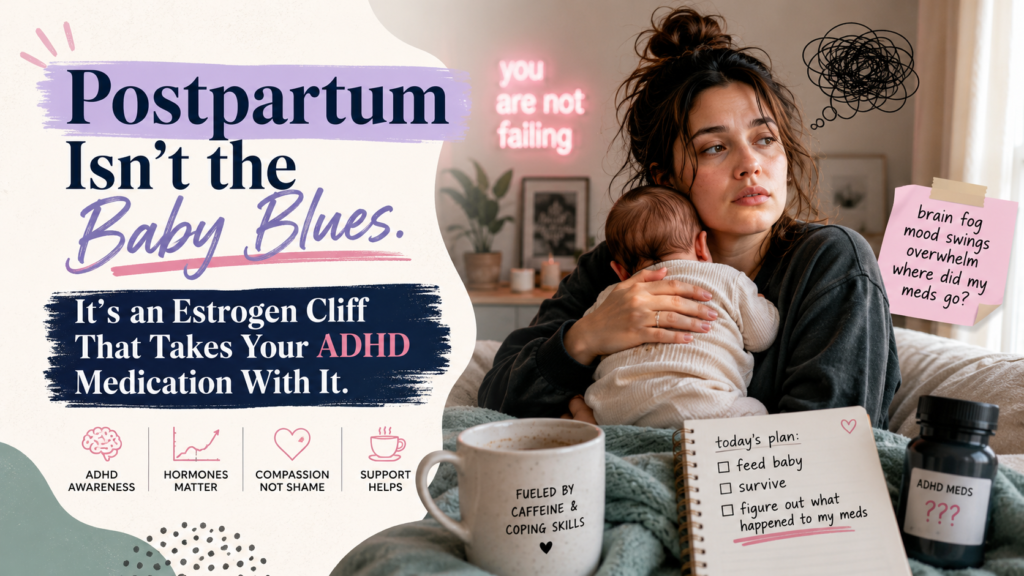
In the 72 hours after you give birth, your oestrogen levels fall by roughly 99 percent. Not gradually, not cyclically the way they dip before a period. Vertically. From the physiological peak of late pregnancy, where oestrogen is at the highest concentration it will ever reach in your body, to a level that rivals the lowest point of menopause, all within three days. If you have ADHD, that hormonal collapse does not just affect your mood. It pulls away one of the key biological mechanisms that made your stimulant medication work in the first place. The result is a brain trying to function with ADHD-level dopamine dysregulation, no hormonal scaffolding, acute sleep deprivation, and a newborn who cannot understand any of this. What most practitioners call “the baby blues” is, for women with postpartum ADHD, something considerably more specific: a pharmacological and neurological crisis that almost no one is trained to recognise.
Why Estrogen and Dopamine Are Not Separate Systems
To understand what happens postpartum, you first need to understand a relationship that medical training rarely teaches clearly. Oestrogen is not purely a reproductive hormone. It is a neuromodulator, and one of its primary roles in the brain is to enhance dopaminergic transmission in the prefrontal cortex. That is the region responsible for working memory, attention regulation, impulse control, and almost everything else that the executive function framework describes as impaired in ADHD.
Research by Jacobs and D’Esposito published in the Journal of Neuroscience (2011) demonstrated directly that oestrogen shapes dopamine-dependent cognitive processes, with direct implications for women’s cognitive health across reproductive transitions. Shanmugan and Epperson (2014), writing in Human Brain Mapping, extended this specifically to executive function, showing that declining oestrogen levels compromise the prefrontal cortex activity that underpins the executive skills ADHD already taxes. When oestrogen is high, it amplifies dopamine signalling. When it falls, that amplification disappears.
When oestrogen is low or declining in individuals with already dysregulated dopamine, these shortages reinforce each other, explaining mood and cognitive deterioration during hormonal fluctuation periods. (Kooij, 2025, Frontiers in Global Women’s Health)
This is the mechanism behind cyclical ADHD symptom worsening before a period, behind the brutal cognitive fog of perimenopause, and behind the postpartum crash. The difference is that a premenstrual oestrogen drop is a relative dip. The postpartum drop is a near-total removal. For a brain that was already running on reduced dopamine efficiency because of ADHD, losing oestrogen’s amplifying effect is not a minor inconvenience. It is a compounding deficit landing on a system with almost no margin left.
What Does Postpartum ADHD Actually Feel Like?
The experience is often described as a sudden loss of the cognitive floor. Tasks that were manageable during pregnancy, even with reduced medication or no medication, feel inaccessible. Working memory, which was already a weaker area, collapses to the point where a simple instruction heard two minutes ago is completely gone. Emotional dysregulation sharpens into something that feels like raw circuitry exposed. Time blindness, which for many adults with ADHD is a persistent background challenge, becomes acute and disorientating in the sleep-fragmented chaos of newborn care.
The difficult irony is that this happens at exactly the moment when the demands on executive function are highest. A newborn requires constant tracking: feeding schedules, medical appointments, nappy changes timed carefully, medication for the baby, sleep windows that close quickly if missed. For a neurotypical brain, this is overwhelming. For a brain with ADHD navigating near-zero oestrogen and severe sleep deprivation, it can feel like cognitive system failure.
The 5x risk nobody mentions: Mothers with ADHD have a significantly higher risk, five to six times that of the general population, of developing postpartum depression and anxiety disorders. Research suggests this elevated risk is not coincidental. It is mechanistically connected to the oestrogen-dopamine relationship that ADHD already stresses. (Kooij et al., 2025, Frontiers in Global Women’s Health)
What makes postpartum ADHD particularly invisible is that its presentation overlaps almost entirely with what the medical system expects new mothers to experience anyway. Exhaustion, difficulty concentrating, emotional volatility, struggling to keep track of things: these are treated as universal features of new parenthood, not as neurological signals worth investigating. Women with ADHD are therefore left to absorb a clinically significant worsening as though it is simply the ordinary difficulty of having a baby.
What Happens to Your Medication When Estrogen Drops
Stimulant medications for ADHD work by increasing dopamine and noradrenaline availability in the prefrontal cortex. Methylphenidate blocks the reuptake of dopamine, amphetamine-based medications additionally promote its release. Both approaches are working with the brain’s existing dopaminergic infrastructure. And that infrastructure is partially hormone-dependent.
Research confirms that cyclical fluctuations in oestrogen and progesterone modulate dopaminergic transmission, influencing both the peak efficacy and duration of ADHD medications. Dynamic dose adjustments aligned with hormonal phases have been recommended as a result. But what this body of evidence describes for the menstrual cycle, a predictable dip in drug effectiveness during the low-oestrogen luteal phase, happens in a far more extreme form postpartum. The hormonal floor that oestrogen was providing for your stimulant’s mechanism of action is simply gone.
The practical consequence is that a dose calibrated during pregnancy, or before pregnancy, or even during breastfeeding a few months in as hormones begin to restabilise, is now operating in a radically different neurological environment. Many women describe their medication as feeling like it has stopped working entirely in the first weeks postpartum. Some assume this reflects tolerance, or stress, or sleep deprivation masking the effects. All of those factors are real contributors. But the hormonal substrate matters enormously, and it is almost never part of the clinical conversation.
A Canadian study analysing nearly 900,000 pregnancies in Ontario found an almost 11-fold increase in ADHD stimulant medication use during pregnancy between 2000 and 2021, with a high rate of discontinuation during pregnancy and only partial resumption postpartum. (Kooij et al., 2025, citing Canadian registry data, Frontiers in Global Women’s Health)
That partial resumption figure matters. It suggests that many women are returning to medication postpartum but not returning to an effective dose, because the clinical conversation around postpartum ADHD medication almost never accounts for the hormonal context they are resuming into. The article on why ADHD medication can feel like it stops working covers the general mechanisms of this in more detail, but the postpartum hormonal factor is a specific layer that deserves its own recognition.
The Breastfeeding Decision Layer
For women with ADHD who are breastfeeding or considering it, the medication question becomes genuinely complex. Most stimulant medications transfer to breast milk, though at relatively low levels. Ornoy and Koren (2021), writing in Current Neuropharmacology, reviewed the effects of ADHD medications on pregnancy outcomes and breastfeeding, noting that the field lacks robust controlled data on infant outcomes during maternal stimulant use while nursing, and that individual risk-benefit decisions are therefore highly contextual.
This creates a situation in which women with ADHD face a decision about their own neurological functioning with almost no specialised guidance available. The general advice from most practitioners is either to avoid stimulants while breastfeeding entirely, or to make a personalised risk-benefit assessment. Neither position accounts for what it actually means to manage ADHD with near-zero oestrogen, extreme sleep deprivation, and no functioning medication, while being the primary caregiver for a newborn.
The gap between what women with ADHD need during this transition and what practitioners are trained to offer is not a matter of inadequate care from individual clinicians. It is a structural absence in the research base. As Kooij (2025) notes explicitly in setting out the research agenda for female ADHD, there is a pressing need for studies on the peripartum period specifically, and treatment strategies targeted at women with ADHD in the postpartum phase remain largely absent from clinical guidelines.
Why Postpartum Looks Like Depression but Needs a Different Response
The presentation that emerges when postpartum ADHD crashes without hormonal or pharmacological support looks a great deal like clinical depression. Flat affect, inability to initiate tasks, withdrawal from interaction, emotional numbness alternating with explosive reactivity. These are also the exact presentation of untreated or under-treated ADHD in a brain under maximum stress. The diagnostic overlap matters because the interventions differ significantly.
Antidepressants, the default clinical response to postpartum mood disturbance, do not address the dopaminergic deficit at the core of ADHD. Selective serotonin reuptake inhibitors work primarily on serotonin pathways, with more modest effects on dopamine and noradrenaline. A woman with ADHD whose primary crisis is a collapsed oestrogen-dopamine system may experience some emotional stabilisation on an antidepressant, but her executive function, working memory, and task initiation are likely to remain severely compromised. She may still be unable to function in the way she needs to function to care for her baby and herself.
This does not mean antidepressants are wrong for every person in this situation. Postpartum depression is a real, serious condition, and having ADHD does not provide protection against it. As noted, the risk is dramatically elevated for women with ADHD. What it means is that a presentation consistent with postpartum depression in a woman with ADHD should trigger a parallel conversation about ADHD medication status, not treat the two as entirely separate issues.
Undiagnosed women have increased vulnerability to premenstrual dysphoric disorder, postpartum depression, and cardiovascular disease during perimenopause. The same hormonal-neurological mechanism threads through all three. (Kooij et al., 2025, Frontiers in Global Women’s Health)
Sleep Deprivation as a Third Compounding Factor
Oestrogen loss and medication disruption are two parts of the postpartum picture for ADHD brains. The third is sleep deprivation, and the combination is not simply additive. Sleep deprivation independently impairs dopaminergic signalling in the prefrontal cortex. Research on sleep loss consistently shows that even partial sleep restriction reduces working memory performance, impulse regulation, and sustained attention, the same functions already compromised by ADHD and by low oestrogen. When all three converge, the result is a level of executive dysfunction that can be genuinely disabling.
Adults with ADHD often have disrupted sleep architectures at baseline, a reality explored in depth across the ADHD energy and nervous system recovery resources on this site. The circadian rhythm disruption of newborn feeding schedules, which fragments sleep into segments that rarely allow the deep restorative stages, compounds this significantly. What the new parent experience demands neurologically, sustained vigilance, rapid task-switching, tracking multiple time-sensitive demands simultaneously, is precisely what a sleep-deprived, low-oestrogen, under-medicated ADHD brain is among the least equipped to provide.
What the Clinical System Is Missing
Women with ADHD entering the postpartum period face a healthcare system that was not designed to see them in this specific context. Obstetric providers are not trained in ADHD. Psychiatrists who manage ADHD medication are often not specialists in reproductive psychiatry. General practitioners are caught between the two. The result is that the specific combination of postpartum hormonal collapse and ADHD pharmacology is rarely addressed in any clinical setting, because no single specialty currently owns the intersection.
In an ADDitude survey of women with ADHD across the perimenopause transition, a period that involves a slower version of the same oestrogen decline, only a minority of respondents found their medical providers receptive to discussing hormone-related impacts on ADHD treatment. The postpartum period, which involves a faster and more extreme version of that same process, generates even less clinical attention because the default frame is baby blues or postpartum depression, not ADHD medication recalibration.
The research framework is explicit about this gap. Kooij (2025) identifies the postpartum period as a priority research area, specifically citing the need to understand risks of postpartum depression and impaired mother-infant bonding in women with ADHD, and to develop early interventions. The evidence base that would allow clinicians to offer evidence-grounded postpartum ADHD management does not yet exist in adequate form. Women are navigating this largely alone, in the most demanding weeks of their lives.
A note on what “scarce evidence” actually means: When a 2025 position paper from a leading researcher in female ADHD describes the peripartum period as having “scarce evidence,” that is not a reason to dismiss the hormonal mechanism. The oestrogen-dopamine relationship is well-established across multiple research lines. What is scarce is the clinical trial data on optimal postpartum ADHD management specifically. For now, this means advocating clearly with your own healthcare team rather than waiting for guidelines to catch up.
What to Actually Do in This Window
The postpartum period is not a time for building complex systems. Executive function is compromised at baseline, and the strategies that work for ADHD in ordinary circumstances require executive function to implement. What matters in this window is reducing the number of decisions, reducing friction, and making the most critical information visible and external rather than relying on working memory that has been compromised by multiple converging mechanisms.
The single most useful thing you can do before delivery is have an explicit, documented conversation with your prescriber about what happens to your medication after birth. This conversation almost never happens by default. Your prescriber is unlikely to initiate it. You will need to bring it up, ideally in the third trimester, and put the plan in writing. The plan should address: what your current dose is and whether it was adjusted during pregnancy, what your decision is regarding breastfeeding and how that affects resumption, what presentation would indicate a dose needs reassessment in the first six weeks, and who is responsible for monitoring your ADHD specifically in the postpartum period as distinct from whoever is managing standard postpartum mood screening.
If you are already postpartum and this conversation never happened, the version that matters now is: bring documented symptom data to your next appointment rather than an impression. Clinicians respond differently to a record of six weeks of severity ratings than to “I feel like my medication isn’t working.” The former is a clinical data point. The latter can be absorbed into the general noise of new parent adjustment. Framing the issue around the hormonal context and medication efficacy reframes it from a mood problem to a recalibration problem, which is a more accurate description and often a more productive clinical conversation.
For women who are not breastfeeding, the evidence base for how oestrogen modulates stimulant efficacy suggests that a dose adjustment may be warranted in the low-oestrogen postpartum window, rather than waiting for hormones to restabilise on their own over weeks or months. This is not an argument for higher doses as a default. It is an argument for a prescription that reflects your actual neurological environment, not the one you were in nine months ago. As hormones begin to return, that prescription may need reassessing again. This is not treatment failure. It is the body requiring dynamic calibration across a physiological transition that clinical protocols have not yet caught up with.
This Is the Same Storm, Earlier in the Timeline
If this resonates and you have not yet read about the longer, slower version of this same process, the perimenopause transition involves the same underlying oestrogen-dopamine mechanism stretched across years rather than days. The piece on cyclical ADHD symptom worsening across the menstrual cycle covers the shorter recurring version of this dynamic, and understanding that pattern helps explain why the postpartum version lands so hard: it is the same mechanism, applied at a vertical angle and a magnitude the body has never experienced before.
The postpartum period is not a temporary inconvenience that resolves when the baby sleeps through the night. For women with ADHD, it is a neurological transition requiring active clinical management that almost no one is currently being offered. Naming what is happening, at a mechanistic level, to yourself and to your healthcare team is not being demanding or difficult. It is filling a gap that the system has not yet filled for you.
Quick Dopamine Hits:
- Track your three most impairing symptoms daily for the first six weeks postpartum using a simple 1, 5 scale, this gives your prescriber real data to act on instead of a single memory-dependent appointment.
- Before delivery, write a one-page ‘medication plan’ note with your current dose, what worked, and your decision on breastfeeding, hand it to your prescriber at your first postpartum appointment so the conversation starts with information, not from zero.
- If your stimulant feels like it stopped working in the first weeks postpartum and you are not breastfeeding, explicitly name the estrogen-dopamine connection to your doctor, most are unaware, and framing it as a calibration issue rather than a dose request changes the conversation.
Rate this article
Was this a useful hit?