Your ADHD Medication Stopped Working. Here’s What’s Actually Happening.

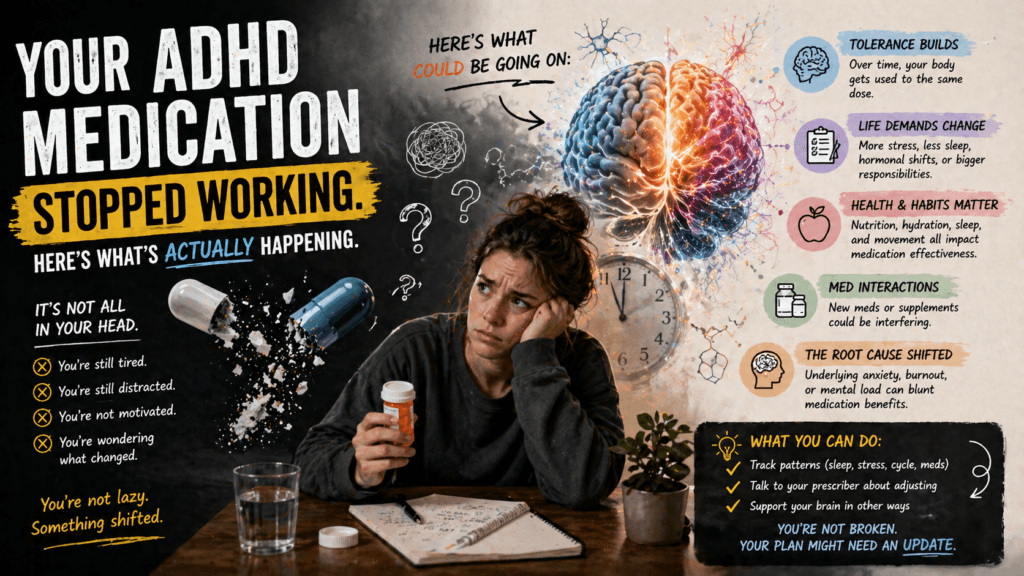
You remember what it felt like the first time your medication worked. The noise in your head dropped to a manageable volume. Tasks that used to require a heroic act of will just happened. Then, at some point, that clarity started to fade. Maybe it happened gradually over weeks. Maybe it felt like someone slowly turned the dial back down. Now you’re sitting here wondering if you’ve built up a tolerance, whether your dose needs to go up again, or whether the medication was ever really doing what you thought it was. This experience, ADHD medication not working the way it used to, is one of the most common and least well-explained phenomena in ADHD treatment. And the answer is almost never as simple as “tolerance.”
What Tolerance Actually Means in the Context of Stimulants
The word “tolerance”, gets used loosely, and that looseness creates confusion. In pharmacology, tolerance means your body has adapted to a substance so that the same dose produces a weaker effect over time. This does happen with stimulant medications, but it is far less common and far less dramatic than most people assume. True pharmacological tolerance to amphetamine-based or methylphenidate-based stimulants, where the brain’s receptor sensitivity genuinely downregulates in response to therapeutic doses, typically develops slowly if at all at standard prescribed amounts.
What the research shows is more nuanced. A 2016 review in CNS Drugs (Faraone et al., 2016) noted that while some patients report reduced efficacy over time, controlled studies do not consistently support the development of classic tolerance at therapeutic doses. That gap between patient experience and controlled data is a signal worth paying attention to. It suggests that something else is often responsible for the perceived plateau, and the culprits are usually sitting right in your daily habits and biology.
When your medication seems to stop working, the most productive question isn’t “how do I get a higher dose?”, It’s “what has changed in my life since it was working?”
The Dose Calibration Problem Nobody Talks About
Stimulant dosing for ADHD is not a set-it-and-forget-it situation. The effective dose for any individual is a moving target, shaped by body weight changes, hormonal fluctuations, age-related neurological changes, and shifts in the baseline demands on your executive function. If you started a medication dose three years ago and your life now involves significantly more cognitive load, more chronic stress, or a substantially different body composition, the same milligrams are working in a very different context.
Body weight is the factor most people know about, but hormonal cycling is equally important and far less discussed, particularly for people with menstrual cycles, a phenomenon explored in depth in how estrogen affects medication efficacy, and, and your birth control choices affect this equation directly. Research published in Pharmacology, Biochemistry and Behavior (Justice &, de Wit, 1999) demonstrated that estrogen levels influence dopaminergic sensitivity, meaning the brain’s responsiveness to dopamine-acting medications can shift predictably across the menstrual cycle. Many women with ADHD find their medication feels significantly less effective in the week or two before menstruation, when estrogen drops. This is not tolerance. It is a calibration issue with a biological driver.
The fix is not automatically a higher dose. It is a more granular conversation with your prescriber about timing, cycling strategies, and whether the current formulation matches where you are now physiologically. Extended-release versus immediate-release formulations respond differently to these variables, and switching between them sometimes resolves the plateau without any dose increase at all.
What “dose calibration”, means in practice: If your life circumstances, body, or hormonal status have shifted significantly since your last medication adjustment, you may not need more medication. You may need a more accurate prescription for who you are right now. That requires updated information, not just a dose bump.
Sleep Is Not a Lifestyle Factor. It’s a Pharmacological Variable.
This is the part that most people, including many prescribers, underweight: the quality of your sleep the night before is one of the most powerful modulators of how your stimulant medication will perform the next day. This is not a soft wellness claim. It is a hard neurochemical reality.
Stimulant medications work primarily by increasing the availability of dopamine and norepinephrine at synapses in the prefrontal cortex and striatum. Sleep is when your brain restores the precursor pools and clears metabolic waste that would otherwise blunt receptor sensitivity. When you are sleep-deprived, the brain’s dopaminergic system is already under stress. Research by Volkow et al. (2012, Journal of Neuroscience) showed that sleep deprivation reduces dopamine D2/D3 receptor availability in the striatum and thalamus, precisely the regions where stimulants do much of their work in ADHD. In practical terms, taking your Adderall or Vyvanse on top of four hours of sleep is like trying to inflate a tire that has a slow leak. The medication is doing something, but the substrate it depends on is degraded.
Adults with ADHD are already at higher baseline risk for disrupted sleep due to circadian rhythm dysregulation, racing thoughts at bedtime, and the rebound effects of stimulants wearing off in the evening. When sleep quality erodes and medication feels weaker, the instinct is often to take the medication earlier, take more, or add a booster dose, none of which address the root cause. Restoring sleep architecture often produces a more dramatic improvement in perceived medication effectiveness than a dose increase does.
Sleep deprivation reduces dopamine receptor availability in the exact brain regions stimulants target. Poor sleep doesn’t just make you tired. It chemically undermines your medication before you’ve even taken it.
Food Timing and Absorption: The Variables You Control Every Morning
The relationship between what you eat, when you eat it, and how your stimulant medication is absorbed is better documented than most people realize. And the morning routines that feel harmless are frequently the reason medication feels inconsistent.
Amphetamine-based medications, including mixed amphetamine salts and lisdexamfetamine, are pH-sensitive. Their absorption in the gastrointestinal tract is significantly influenced by urine and gut pH. Acidifying agents, which include vitamin C, citrus juice, and carbonated drinks, reduce the absorption and urinary reabsorption of amphetamines. This is not a marginal effect. Research has shown that concurrent vitamin C consumption can reduce amphetamine bioavailability meaningfully, which in practical terms means your morning orange juice or your large coffee with citrus flavoring, taken within an hour of your dose, may be blunting the medication before it even reaches therapeutic levels.
High-fat meals delay the absorption of some extended-release formulations but do not reduce total bioavailability, whereas taking medication on a completely empty stomach can produce a sharper, shorter peak with a harder crash. Protein in the morning matters for a different reason: the amino acids tyrosine and phenylalanine are precursors to dopamine. A protein-forward breakfast is not a cure for ADHD, but it does support the neurochemical environment your medication is working in. If your breakfast is coffee and nothing else, your medication is working in a nutritionally depleted substrate.
Chronic Stress and the Cortisol-Dopamine Interference Problem
Here is a mechanism that almost never gets explained to patients, despite being well-supported by the neuroscience: chronic psychological stress interferes with dopaminergic function in the prefrontal cortex in a way that directly counteracts what stimulant medications are trying to do.
The prefrontal cortex, the brain region most impaired in ADHD and most targeted by stimulant treatment, is exquisitely sensitive to stress hormones. When cortisol is chronically elevated, it promotes a shift from prefrontal cortex-governed, deliberate control toward more automatic, reactive processing in the amygdala and striatum. Research by Arnsten (2015, Nature Reviews Neuroscience) established that even moderate uncontrollable stress impairs prefrontal function through norepinephrine and dopamine receptor mechanisms, effectively reducing the cognitive gains that stimulants are designed to produce.
In practical terms, a person going through a high-stress period at work, navigating a difficult relationship, or managing financial anxiety may find that their previously effective medication dose accomplishes significantly less. The stress is not just making them feel worse. It is chemically suppressing the prefrontal response that their medication depends on. Addressing that stressor, or building in structured decompression practices, often restores medication effectiveness more efficiently than any dose adjustment would.
The stress interference loop: Chronic stress elevates cortisol, which suppresses prefrontal dopamine signaling, which makes your ADHD symptoms worse, which increases stress. Stimulant medications are working against this loop, not with it. Managing the stress source is part of the treatment, not a nice-to-have.
When to Reassess Your Medication vs. When to Fix the Conditions First
This is where the practical framework matters. Not every plateau requires a prescriber visit, and not every plateau can be fixed by cleaning up your sleep and diet. Knowing which situation you are in saves time, avoids unnecessary dose escalation, and prevents the frustration of bouncing through medication changes without addressing the underlying variables.
The case for fixing lifestyle conditions first is strongest when the plateau appeared gradually, correlates with a specific life change such as a new job, relationship stress, or a shift in sleep schedule, or when you are experiencing it inconsistently, meaning some days the medication works fine and other days it feels absent. Inconsistent response is almost never pharmacological tolerance. True tolerance would produce a consistent, flat reduction across all days and circumstances. Variability across days points to variability in the conditions: sleep quality, meal timing, stress load, hydration.
The case for reassessing the medication itself is stronger when the plateau is consistent regardless of sleep, stress, and food conditions, when you have gained significant body weight, when you are moving through a hormonal transition such as perimenopause or a post-partum period, or when you have been on the same formulation for several years and your life demands have changed substantially. These are the conversations to have with your prescriber, armed with specific observations rather than just the complaint that it stopped working.
What does “armed with specific observations”, mean? It means tracking the variables. Note your sleep hours and quality, your meal content and timing relative to doses, your stress level that day, and your experienced medication effectiveness on a simple scale. Two weeks of that data gives your prescriber something actionable to work with. It also frequently reveals to you, before the appointment, exactly what is driving the problem.
The most useful thing you can bring to your prescriber is not “it stopped working.”, It’s a two-week log showing that it works fine when you sleep seven hours and fails when you sleep five. That’s not a medication problem. That’s a solvable equation.
The Role of Medication Holidays and Receptor Sensitivity
Some clinicians recommend periodic medication holidays, planned breaks from stimulant use, partly for growth and appetite management in children, but also with the rationale that brief breaks might restore receptor sensitivity. The evidence on receptor sensitivity restoration at therapeutic doses in adults is not strong enough to make firm recommendations, but the clinical experience of many adults with ADHD suggests that a drug holiday of several days, taken during a lower-demand period such as a vacation week, sometimes produces a noticeable improvement in response when medication resumes.
This is worth discussing with your prescriber if you are in a situation where dose escalation feels like the only option being considered. The risk of medication holidays is real: for many adults with ADHD, the days off medication are genuinely impairing and carry their own costs in missed deadlines and emotional dysregulation. The decision involves a real trade-off, not a clean solution. But it is a lever that exists, and it is underutilized in conversations about the medication plateau.
What Gets Missed: Comorbidities That Mimic Medication Failure
There is a category of situations where the medication has not actually lost effectiveness, but something new has developed in the clinical picture that is not being treated. Anxiety and depression both impair executive function through mechanisms that stimulants cannot overcome. Sleep disorders, particularly undiagnosed sleep apnea, rob the brain of the restorative sleep it needs for medication to work effectively. Thyroid dysfunction affects energy, focus, and mood in ways that look identical to under-medicated ADHD.
If you are experiencing what feels like medication failure and you have also noticed changes in mood, sleep quality, energy levels outside of medication hours, or physical symptoms that are new, the plateau may be a signal that something else needs clinical attention. ADHD medication is not a broad-spectrum neurological fix. It works within a specific mechanistic lane, and when other systems are compromised, the medication cannot compensate for those losses.
This is also where the experience of adults who discover later in life that they have co-occurring conditions becomes relevant. Research suggests that among adults diagnosed with ADHD, rates of co-occurring anxiety disorders, depressive disorders, and sleep disorders are substantially elevated compared to the general population (Kessler et al., 2006, American Journal of Psychiatry). A medication plateau is sometimes the first signal that a co-occurring condition has developed or worsened, and it deserves a full clinical evaluation rather than just a dose adjustment conversation.
Having the Right Conversation with Your Prescriber
The appointment where you say “my medication stopped working”, is one of the least productive conversations you can have, not because the concern is invalid but because the information is too thin to act on. Prescribers operating under time pressure will often default to a dose increase, which may or may not be appropriate and may introduce new side effects or dependency risk without solving the actual problem.
Coming in with specifics changes the conversation. What changed in your life around the time the medication felt less effective? What does your sleep look like on nights before days when it works versus days when it doesn’t? What is your typical morning routine including meal timing? Have you noticed any mood changes, anxiety shifts, or new physical symptoms? Have you gained or lost significant weight? Are you taking any new supplements, particularly vitamin C or antacids or zinc, which can affect absorption and metabolism?
These are not difficult questions, but they require some advance preparation. The habit of tracking your medication response, even loosely, over a two to four week period before an appointment is one of the highest-leverage things you can do for your own ADHD treatment. It converts a vague complaint into clinical data. And clinical data drives better decisions than frustration does.
The medication plateau is real, it is frustrating, and it deserves a serious answer. But the serious answer rarely begins and ends with the medication itself. It begins with the entire system your brain is operating in: how you are sleeping, how you are eating, how much stress is chronically running in the background, and what else might be happening neurologically that deserves attention. Fix the substrate first. Then reassess what the medication is actually doing inside it.
Quick Dopamine Hits:
- Tonight, set a consistent wake time for tomorrow and protect the 90 minutes before bed from screens. Sleep architecture directly affects how your brain responds to stimulants the next day.
- Before your next dose, eat a protein-forward meal or snack. Vitamin C and high-acid foods consumed within an hour of your medication blunt absorption significantly, so time citrus and coffee for later in the day.
- Open your notes app and log three things: your current sleep average, your stress level this week on a 1-10 scale, and whether your medication timing has shifted. Bring this to your next prescriber appointment instead of just saying ‘it stopped working.’
Rate this article
Was this a useful hit?