You Started a New Pill and Your ADHD Got Worse. That’s Not a Coincidence.

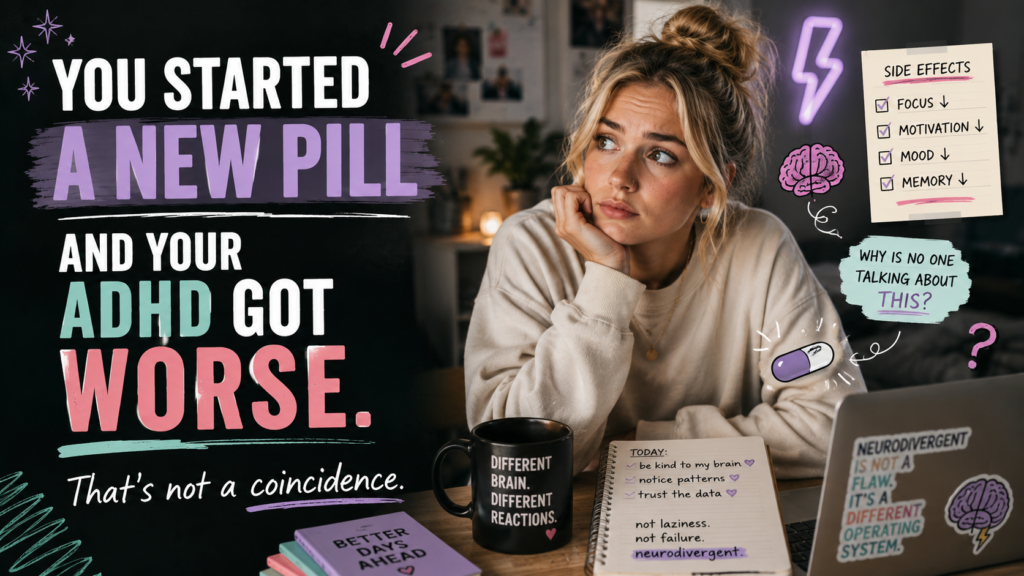
You start a new pill. A few weeks pass. Your ADHD medication seems to have stopped working. You are irritable in a way that feels neurological, not emotional. Brain fog has moved in as a permanent resident. You go back to your doctor and describe the symptoms. The prescription gets adjusted. Nobody asks what else changed. Nobody mentions that the contraceptive you just started has a direct biochemical relationship with the dopamine system your ADHD already struggles to regulate. That conversation, according to a 2025 position paper by J.J. Sandra Kooij in Frontiers in Global Women’s Health, is one that most women with ADHD have never had. The cost of that silence shows up in years of unexplained symptom worsening, medication adjustments that miss the point, and the quiet assumption that the problem is simply you.
Why Hormones and ADHD Are the Same System
To understand why hormonal contraception can alter your ADHD so significantly, you need to understand one relationship that most medical training handles poorly: estrogen and dopamine are not separate systems. They are deeply interdependent, and in the ADHD brain, that interdependence is a clinical variable that matters.
Estrogen acts as a direct modulator of dopaminergic neurotransmission, particularly in the prefrontal cortex. Research by Jacobs and D’Esposito, published in the Journal of Neuroscience in 2011, demonstrated that estrogen actively shapes dopamine-dependent cognitive processes with direct implications for women’s cognitive performance across their reproductive lifespan. Shanmugan and Epperson (2014), writing in Human Brain Mapping, extended this finding specifically to executive function, showing that declining estrogen levels compromise the prefrontal activity that governs working memory, attention regulation, and impulse control. These are precisely the capacities that ADHD already taxes.
The key mechanism is this: estrogen amplifies dopamine signalling in the prefrontal cortex. When estrogen is present in sufficient quantities, it enhances the very neurotransmitter activity that ADHD brains produce and regulate less efficiently as a baseline. When estrogen drops, or when synthetic hormones interfere with the natural cycle, that amplification is withdrawn from a system that already had almost no margin to spare.
“When oestrogen is low or declining in an individual in whom important neurotransmitters such as dopamine are already dysregulated, these shortages reinforce each other, explaining mood and cognitive deterioration during hormonal fluctuation periods.”, Kooij, 2025, Frontiers in Global Women’s Health
This is why a woman without ADHD might notice only mild cognitive sluggishness when her estrogen shifts. For someone with ADHD, whose dopamine system is already running with reduced efficiency, the same hormonal shift lands on a system with no buffer. The impairment is not additive. It compounds. Any hormonal intervention that changes the amount, timing, or type of estrogen and progesterone circulating in your brain is, by extension, an intervention in your ADHD neurobiology. That includes the pill, the mini pill, the implant, and the hormonal IUD.
Combined Oral Contraceptives: The Estrogen Intervention Nobody Named
Combined oral contraceptives contain synthetic estrogen and progestin. On the surface, this looks like it might help: more estrogen should mean more dopamine support. The reality is considerably more complicated, and it depends on which week of the pill pack you are in.
Combined pills work by introducing steady synthetic hormones throughout most of the cycle, suppressing the body’s natural hormonal fluctuations. For some women with ADHD, the flattening of the natural cycle can reduce the dramatic premenstrual symptom crashes that occur when endogenous estrogen falls before a period. The hormone-free interval in a standard 21-day pack, however, is a different story. During those seven pill-free days, synthetic estrogen is withdrawn. For many women with ADHD, this creates a predictable window of intensified brain fog, emotional dysregulation, and medication underperformance that functions almost identically to the luteal-phase crash of a natural cycle. In some cases, it is worse, because the body’s own hormonal response has been suppressed and has nothing to fall back on.
Clinicians at the specialised adult ADHD clinic at PsyQ in the Netherlands, treating approximately 1,000 adults with ADHD per year, report that hormonal contraceptive use should be explicitly documented at baseline evaluation, precisely because the form of synthetic hormone affects symptom pattern in clinically relevant ways (Wynchank, de Jong, and Kooij, 2025, European Psychiatry). This is not a niche clinical curiosity. It is a standard piece of information that the field increasingly recognises as essential to accurate ADHD assessment in women.
The hormone-free interval problem: Many women on a 21-day combined pill experience significant ADHD worsening during the seven pill-free days. This is a documented pattern, not a personal failing. One clinical option, continuous pill use to skip the hormone-free interval, is used by some prescribers specifically to reduce this crash. If this resonates with your experience, it is a legitimate conversation to have with your prescriber.
The specific synthetic estrogen compound used also matters. Different formulations use different estrogen analogs at different doses, and these do not behave identically to endogenous estradiol in the brain. The relationship between synthetic estrogen and dopamine modulation is not a clean substitute for natural estrogen’s effect. This is an area where the research literature acknowledges significant gaps and where longitudinal, sex-specific studies are urgently needed (Kooij, 2025).
Progestin-Only Pills: Where Things Get More Complicated
Progestin-only contraceptives, sometimes called the mini pill, contain no estrogen at all. For women with ADHD, this distinction is significant in ways that rarely get communicated at prescription.
Without estrogen’s dopamine-amplifying effect, progestin-only pills remove a key support mechanism from the ADHD brain entirely. Progestin, particularly synthetic progestin, has a different neurological profile to natural progesterone. Some synthetic progestins have androgenic properties that can affect mood, cognition, and neurotransmitter activity in ways that vary considerably by compound. Research reviewed in the Kooij 2025 position paper identifies progesterone’s relationship to dopaminergic pathways as a factor in ADHD symptom variability, with some progestins appearing to carry sedating or mood-dampening effects that can amplify the cognitive dullness and emotional flatness already associated with ADHD.
A large Swedish national cohort study by Lundin et al. (2023), drawing on population registers and comparing more than 29,000 women with ADHD against more than 763,000 women without an ADHD diagnosis, examined depression risk associated with different types of hormonal contraception.1 Women with ADHD showed elevated depression risk with hormonal contraceptive use compared to women without ADHD, a finding consistent with the hypothesis that an already-stressed dopamine system is more vulnerable to the mood-disruptive effects of synthetic hormones than a neurotypical brain. This elevated risk was observed for both combined oral contraceptive use and progestin-only preparations, though the profiles differed.
Women with ADHD are not more emotionally fragile than other women. They have a neurobiologically distinct relationship to hormonal shifts that makes the same synthetic compounds land differently in their brains. That is a pharmacological reality, not a character trait.
The absence of estrogen in progestin-only preparations means there is no compensatory dopamine boost to offset any progesterone-related suppression. For an ADHD brain, this can translate into noticeable increases in brain fog, emotional dysregulation, and difficulty with task initiation. These experiences are likely to be attributed to the ADHD itself rather than to the contraceptive introduced weeks or months earlier, particularly if nobody thought to ask whether a contraceptive change preceded the shift.
Does Hormonal Birth Control Change How Your ADHD Medication Works?
Yes, and this is documented. Hormonal state directly affects stimulant medication efficacy in ways that are now recognised in specialist clinical practice, even if they remain absent from most standard prescribing conversations.
Research reviewed in both the Kooij 2025 position paper and in clinical guidance from specialist ADHD services notes that fluctuations in estrogen and progesterone modulate dopaminergic transmission, influencing both the peak efficacy and the duration of effect of stimulant medications. The PsyQ clinical protocol recommends tracking ADHD and mood symptoms daily for at least two months specifically to identify whether medication appears less effective at particular hormonal phases (Wynchank et al., 2025, European Psychiatry).
When you introduce synthetic hormones through contraception, you are altering this hormonal context. A combined pill that suppresses natural estrogen peaks removes the enhanced dopamine signalling your stimulant may have been leveraging during the follicular phase. A progestin-only pill that provides no estrogen creates a chronically low-estrogen neurological environment throughout the entire month. A woman who was stable on a particular medication dose before starting or changing her contraception may find that the same dose underperforms, not because her ADHD has changed or because her medication has stopped working, but because the biochemical environment in which it operates has shifted underneath it.
What this means practically: If your ADHD medication seems to have stopped working after starting or switching a contraceptive, the contraceptive is a legitimate clinical hypothesis worth raising with both your prescribing doctor and your psychiatrist or ADHD clinician. The two are neurobiologically connected, and a conversation about adjusting either the contraceptive choice or the medication approach is appropriate and evidence-backed.
IUDs: The Picture Is Not Uniform
Hormonal IUDs deliver synthetic progestin locally in the uterine cavity, with substantially lower systemic absorption into the bloodstream than oral progestin-only preparations. This is often presented as the low-hormone option, and in neurological terms, it largely is. Because systemic progestin levels are significantly lower with a hormonal IUD, the impact on the brain’s dopamine pathways tends to be considerably smaller than with oral hormonal methods.
For this reason, some clinicians working with women who have ADHD consider hormonal IUDs to be worth discussing as a contraceptive option that avoids much of the dopamine-pathway disruption associated with oral hormonal contraception. The important caveat: hormonal IUDs do not provide estrogen, so the natural hormonal cycle continues. For women whose ADHD worsens significantly during the luteal phase due to natural estrogen fluctuations, an IUD does not resolve that problem. But it also does not impose a layer of synthetic hormones on the brain at a dose likely to alter stimulant efficacy or worsen ADHD traits through the mechanisms described above. For a full breakdown of how the natural monthly cycle affects ADHD, the article on how hormones hijack your ADHD every month covers that specific mechanism in depth.
Non-hormonal copper IUDs have no hormonal component whatsoever. They do not interact with the estrogen-dopamine pathway in any direct neurological way. For women with ADHD who have experienced consistent worsening on every hormonal method they have tried, a copper IUD is a contraceptive option that removes the hormonal variable entirely. This is a conversation for your gynaecologist or GP, particularly one who is aware of your ADHD diagnosis.
Why Your Prescriber Did Not Connect These Dots
If you are wondering why this information has never come up in any consultation, the answer sits in how ADHD care and reproductive healthcare are structured. They operate in almost entirely separate clinical worlds.
A GP or gynaecologist prescribing contraception is typically not trained to think about the downstream neurological effects of synthetic hormones on a dopamine-dysregulated brain. A psychiatrist or ADHD specialist managing your medication is typically not asking what contraception you use and is not routinely factoring your hormonal status into their assessment. The clinical protocol developed by Wynchank, de Jong, and Kooij (2025) at a specialist ADHD clinic is notable partly because it is unusual: it explicitly requires clinicians to document menstrual status, current contraceptive use, and cycle phase before making any assessment or treatment decisions. This is not standard practice in most settings.
The Kooij 2025 review is direct in naming the consequences: hormonal transitions exacerbate ADHD traits and mood disturbances across the lifespan, pharmacological research into sex-specific treatment is severely lacking, and women with undiagnosed or inadequately managed ADHD have increased vulnerability to premenstrual dysphoric disorder, mood disorders, and significant functional impairment at every hormonal transition point. The practical result is that women with ADHD are left to make the connection themselves, often years into a pattern of unexplained symptom changes, or after a medication adjustment that treats the presenting difficulty rather than the underlying hormonal cause.
From the community: “I did my laundry, cleaned my apartment, got rid of the mail I had sitting on my desk and was actually able to sit and read a book without picking up my phone every 20 seconds. I was able to finish my todo list with tasks I found the least bit amusing.”, r/ADHD thread. This is what baseline neurological stability looks like. When contraception shifts the hormonal context and that stability quietly disappears, the medication has not failed. The environment it was working in has changed.
What Good Clinical Practice Actually Looks Like
The evidence supports a clear set of clinical practices that are not yet standard but are achievable if you know to ask for them.
Your ADHD history and your hormonal and contraceptive history should be discussed in the same clinical space. Any clinician managing your ADHD should know what contraception you use, when you started it, and whether your symptom pattern changed around that point. This is not asking for extraordinary care. It is asking for neurobiologically informed care that reflects what the research actually shows.
Symptom tracking that crosses both domains is genuinely useful. The research-backed recommendation is to track ADHD and mood symptoms daily for at least two months to identify whether symptoms vary predictably with hormonal state (Wynchank et al., 2025). If you are on a combined pill and your focus reliably collapses during the pill-free interval, that is a pattern with clinical solutions: continuous pill use to eliminate the hormone-free interval, a switch to a different formulation, or a conversation about whether another contraceptive method might suit your brain better. If you are on progestin-only and you have noticed consistent brain fog that was not present before, that is also a conversation worth having with specific dates and a description of when it started.
The question of adjusting ADHD medication to account for hormonal context is an active one in specialist practice. Some clinicians in this area recommend considering dose adjustments during known low-estrogen windows rather than treating a flat dose as appropriate across a hormonally variable background. This is an area where research is still developing, but the evidence base for cyclical and contraceptive-related symptom variation is solid enough that raising it is clinically reasonable.
Tracking the Connection Before Your Next Appointment
If you suspect your contraception is affecting your ADHD, the most useful thing you can do before any clinical conversation is build a short record of the relationship. You do not need a complex system. For 30 days, note once daily: your contraceptive type and where you are in your cycle or pill pack, your focus and working memory on a simple 1-to-5 scale, your emotional regulation, and whether your medication felt effective. Patterns tend to emerge clearly enough over that period to be persuasive in a clinical conversation.
This matters because arriving with dates and a clear pattern is fundamentally different from describing a feeling. “My ADHD got worse after I started this pill” is easy to dismiss. “My focus scores drop consistently during the pill-free interval and recover when I restart active pills” is a clinical observation that requires engagement. The broader framing here is one worth naming: the ADHD and body section of this site is built on the premise that your brain does not operate independently of your body’s other biological systems, and hormones are one of the most direct physical inputs into the dopamine pathway that ADHD treatment is trying to support.
Treating contraceptive choices as entirely separate from ADHD management is not a neutral clinical decision. It is an oversight with real consequences, and women with ADHD have been absorbing those consequences quietly for decades. What you noticed when you started that new pill was real. The connection exists. You are allowed to walk into a clinical appointment and say so.
1 Lundin C, Wikman A, Wikman P, Kallner HK, Sundström-Poromaa I, Skoglund C. Hormonal Contraceptive Use and Risk of Depression Among Young Women With Attention-Deficit/Hyperactivity Disorder. J Am Acad Child Adolesc Psychiatry. 2023.
Quick Dopamine Hits:
- Track your ADHD symptoms against your contraceptive cycle for 30 days: note focus, emotional regulation, and medication effectiveness each day. Do this before your next prescription renewal so you have real data to take to your prescriber.
- If you use a combined pill and your ADHD feels worse during the hormone-free interval, tell your prescriber you want to discuss continuous use. This is a clinically recognised option, you are allowed to ask for it.
- Before your next GP or psychiatry appointment, write down exactly when your symptoms changed relative to starting or changing your contraception. Bring dates, not impressions. ‘It got worse around week three of my new pill’ is information your doctor can act on.
Rate this article
Was this a useful hit?