Your ADHD Brain Isn’t Lazy — It’s Running on the Wrong Fuel

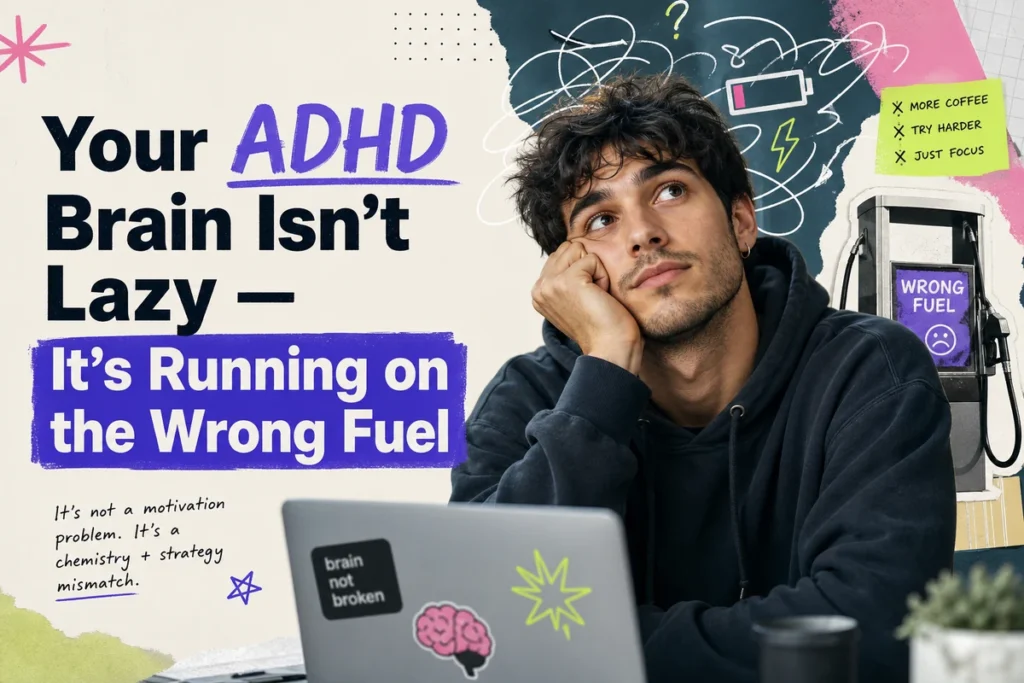
If you have ADHD, you have almost certainly been told some version of the same thing: try harder, care more, want it badly enough and the work will happen. You have probably also noticed that this advice does precisely nothing. Not because you lack effort or desire, but because the mechanism that converts desire into action is running on a fundamentally different fuel system than the advice assumes. This is not a reframe designed to make you feel better. It is what the neuroscience of ADHD motivation actually shows, and it is considerably more specific and more useful than any version of “you’re not lazy”, you have encountered before.
The “Lazy”, Label Is Wrong for a Very Precise Reason
Laziness, used accurately, describes a functioning motivation system that selects the low-effort option. It implies you have access to the ignition, you press it, and you choose not to. The whole moral charge of the label depends on that access being real. What the research shows about ADHD motivation is that the ignition itself is structurally impaired, not missing, but misfiring in ways that have nothing to do with how much you care about the outcome.
In 2011, Nora Volkow and colleagues used positron emission tomography (PET) scanning to directly measure the dopamine reward pathway in adults with ADHD compared to controls. They found significantly decreased D2/D3 dopamine receptor availability and reduced dopamine transporter density in the nucleus accumbens and midbrain, two regions central to motivation and reward processing. Critically, these reductions correlated directly with lower trait motivation scores in the ADHD group: the more depleted the dopamine pathway, the lower the measured motivation (Volkow et al., 2011, Molecular Psychiatry). This was not a questionnaire finding. It was a scan of living brains showing measurable neurochemical differences in the regions responsible for wanting to do things at all.
Laziness requires a working accelerator. ADHD involves a fuel system that does not reliably deliver the signal, not a driver who refuses to press the pedal.
The ADHD brain is not deficient in the desire to do things. It is deficient in the neurochemical infrastructure that converts desire into action. That is a fundamentally different problem, and it demands a fundamentally different solution.
Why Is ADHD Motivation So Dopamine-Dependent?
Dopamine does several things in the brain. One of its most important roles, and the one most relevant to ADHD, is encoding what matters. Not in the sense of intellectual understanding, but in the sense of neurological salience: the signal that tells your motor system to mobilize toward a goal. When dopamine signaling is efficient, a task you consciously care about gets flagged by the brain as worth acting on. The importance you feel cognitively gets translated into neurochemical signal that initiates movement.
In the ADHD brain, this translation process is disrupted. The catecholamine hypothesis of ADHD, which remains the most robust neurochemical model of the condition, identifies a state of hypodopaminergic functioning particularly in fronto-striatal pathways. The prefrontal cortex, which is responsible for bridging intention and action, is not receiving adequate dopamine signal to treat most tasks as neurologically urgent, even tasks the person knows are important and genuinely wants to complete.
This is why you can sit at your desk with a deadline you care about, feel real anxiety about not starting, and still find your brain completely unable to fire the start signal. The anxiety is cognitive. The initiation requires dopamine. And the dopamine does not show up just because the stakes are high. Building low-friction systems that do not require dopamine to appear on demand is one of the most practical structural responses to this reality.
What the PET data showed: Volkow et al. (2011, Molecular Psychiatry) found that ADHD adults scored significantly lower on trait motivation measures than controls, and that these scores correlated directly with D2/D3 receptor availability in the nucleus accumbens and midbrain. Motivation in ADHD is not a choice, it reflects the measurable state of a biological system.
The Tonic-Phasic Problem: Two Fuel Lines, Both Running Low
To understand why ADHD motivation fails in such a specific way, it helps to know that the dopamine system runs on two distinct modes. Tonic dopamine is the background baseline signal: the ambient level of dopamine that keeps the system ready to respond. Phasic dopamine is the burst signal: the sharp spike that fires when something rewarding or interesting happens, and which drives learning, motivation, and action.
The Dynamic Developmental Theory of ADHD, advanced by Sagvolden, Johansen, Aase, and Russell (2005), proposes that ADHD results from hypoactive tonic and phasic dopamine components. Blunted phasic bursts impair learning from positive outcomes, blunted phasic dips impair extinction processes. The practical result is that the reinforcing effect of completing a task is weaker and fades faster in the ADHD brain, and that environmental cues which ought to predict future rewards fail to generate sufficient anticipatory motivation (Cockburn and Holroyd, 2010, Brain Research).
A separate but complementary model, the Dopamine Transfer Deficit theory proposed by Tripp and Wickens (2008), argues that ADHD brains are specifically impaired in transferring the dopamine signal backward from the reward itself to the cues that predict it. In a neurotypical brain, when you know that starting a task leads to a good outcome, that knowledge generates some forward-looking dopamine signal that helps you begin. In the ADHD brain, this predictive signal is often weak. The reward feels abstract and remote, even when you know perfectly well it is coming. This is a neurological mechanism, not a failure of belief in yourself.
The ADHD brain can struggle to assign the correct motivational value to events that predict future rewards. The future reward is real. The brain’s ability to feel it in advance is impaired.
Why Distant Rewards Feel Fake (And Immediate Ones Feel Essential)
One of the most concrete expressions of disrupted tonic-phasic dopamine is temporal discounting. Research consistently shows that many people with ADHD discount the value of delayed rewards at a steeper rate than their neurotypical peers, meaning that a reward available in the future loses its motivational pull much more rapidly with each day that separates it from the present (Silvetti, Wiersema, Sonuga-Barke, and Verguts, Ghent University, peer-reviewed research on reinforcement learning deficits in ADHD).
This is not irrationality. It is a direct consequence of weak tonic dopamine. When the background dopamine signal is low, future rewards need to be very close and very certain to generate enough present-tense neurological urgency to compete with immediate, concrete alternatives. This is why “the deadline is in three weeks”, often produces no movement but “the deadline is in four hours”, suddenly unlocks a burst of productivity. The neurological urgency required to initiate action finally crosses the threshold when the reward is close enough for the impaired dopamine system to register it.
This same mechanism explains why ADHD brains respond so powerfully to genuine interest and novelty. When a topic captures attention involuntarily, it creates a phasic dopamine burst that can bypass the tonic deficit entirely. The brain does not need to borrow forward-looking motivation from a future reward when the task itself is generating dopamine in real time. This is not a personality preference. It is the one fuel source the ADHD reward system can reliably access without external scaffolding.
From the community: “I can be staring at something I genuinely *want* to do, something I chose, something I care about, and still sit frozen for 20 minutes because my brain won’t initiate the first step. It’s not laziness, and it’s not a lack of desire. It’s like my ‘start button’, is missing, and I’m constantly trying to find workarounds.”, r/ADHD thread
Why the “Just Try Harder”, Prescription Makes the Problem Worse
Telling someone with ADHD to try harder is like telling someone with a broken fuel pump to press the accelerator more firmly. The instruction is not meaningless, it reflects a genuine belief that effort is the missing variable. But it misidentifies what is broken. And when it fails, as it reliably does, the person concludes not that the advice was wrong but that they are. This is the direct path from a neurological fuel problem to a shame spiral that compounds the original difficulty.
The particular cruelty of the ADHD motivation deficit is that it is invisible from the outside and intermittent from the inside. When the conditions are right, when something is genuinely interesting, when a crisis creates artificial urgency, when a challenge activates competitive focus, the ADHD brain can produce extraordinary output. This inconsistency is often taken as evidence that the motivation deficit is selective and therefore chosen. “You can do it when you want to”, becomes the indictment. What that observation actually demonstrates is that the dopamine system is not uniformly impaired. It is conditionally responsive, firing reliably when the right inputs are present and misfiring when they are not.
Repeated failure under a “try harder”, framework also compounds the neurological problem itself. Each failed attempt at conventional motivation generates negative feedback that can further suppress the dopamine signal, making subsequent attempts even less likely to succeed. Research on reinforcement learning in ADHD shows that the brain’s error-correction signal, the anterior cingulate cortex’s response to failure, is also impaired in ADHD, making it harder to calibrate future effort based on past outcomes (Silvetti et al., Ghent University). The system that should learn from failure is itself running low on the fuel it needs to learn.
What “Refueling”, Actually Looks Like, and What It Doesn’t
If the problem is a mismatched fuel system, the solution is not willpower. It is engineering the conditions under which the actual fuel, interest, novelty, urgency, and challenge, becomes available. This is more specific than it sounds, and it is worth being precise about what this means in practice.
Environmental novelty is one of the most reliable phasic dopamine triggers available. Changing your physical location, switching to a different type of input, or introducing a time constraint you do not already have can generate the phasic spike that bypasses the tonic deficit. This is not a hack or a trick, it is using the one mode of the dopamine system that the ADHD brain reliably has access to. Research on reward variability in ADHD confirms that the brain can require higher and more varied reinforcement levels to sustain engagement, and that habituation to a consistent reward schedule tends to happen faster and more completely than in neurotypical brains.
Body-based activation also matters more than most motivation frameworks acknowledge. Physical movement, particularly aerobic exercise, directly increases dopamine and noradrenaline availability in the prefrontal cortex. A short bout of movement before a task you are avoiding is not procrastination dressed up as productivity. It is creating the neurochemical conditions under which initiation becomes physiologically more possible. The research on exercise as a dopamine regulation tool for ADHD supports this as a mechanism, not just a correlation.
Refueling is not about tricking yourself into motivation. It is about engineering the inputs your dopamine system actually responds to, rather than continuing to press an accelerator that is not connected to the engine.
Social presence is another frequently undervalued fuel source. The mechanism behind body doubling, working alongside another person even without interaction, likely involves the mild social pressure and novelty cue that generates just enough phasic dopamine to tip the system toward engagement. For many people with ADHD, the presence of another person is not a preference but a functional accommodation to a dopamine system that responds to social salience when it will not respond to abstract future consequences.
The Medication Question: What It’s Actually Doing to the Fuel System
Stimulant medications work on ADHD motivation not by supplying willpower but by addressing the tonic-phasic dopamine imbalance directly. Methylphenidate and amphetamine-based medications increase extracellular dopamine concentrations, particularly in the striatum, by blocking dopamine reuptake transporters or stimulating release. This raises the tonic baseline, which means the threshold for phasic activation becomes reachable with more types of tasks rather than only the highly stimulating ones.
PET imaging research shows that therapeutic doses of stimulant medication can significantly increase extracellular dopamine in the human brain, effectively narrowing the gap between the ADHD reward system’s baseline and the level needed to initiate action. This is why medication often allows people with ADHD to engage with tasks they genuinely care about but previously could not initiate, it does not manufacture desire, it allows existing desire to generate the neurochemical signal that was previously blocked. The fuel was always there. The delivery mechanism is what was impaired.
This also explains why medication effects are not uniform and why they do not eliminate the motivation challenge entirely. Medication raises the baseline but does not abolish the underlying architecture. Environmental design, behavioral strategies, and understanding of your own specific dopamine triggers remain essential alongside any pharmacological support.
The medication mechanism, simply: Stimulants do not create motivation. They raise the tonic dopamine baseline so that tasks you already care about can finally generate enough neurochemical signal to cross the initiation threshold. They are fuel delivery improvements, not artificial fuel sources.
Working With the Fuel System You Actually Have
The most practically useful shift that follows from understanding ADHD as a fuel problem rather than a laziness problem is this: you stop trying to generate conventional motivation and start designing for the specific inputs your dopamine system actually responds to. This is a different design brief entirely, and it produces different results.
It means accepting that importance-based motivation, the kind that gets neurotypical people through boring-but-necessary tasks, is genuinely harder for many ADHD brains to generate and genuinely requires external engineering to replicate. It means building systems that front-load reward rather than back-loading it, because the ADHD brain’s steep temporal discounting curve makes back-loaded rewards neurologically invisible until the deadline is almost on top of you. And it means taking seriously the conditions under which your brain does engage rather than treating them as indulgences or exceptions.
Hyperfocus is not a character inconsistency that undermines your account of struggling. It is the dopamine system operating in the one mode where it functions efficiently, where the interest or challenge input is strong enough to sustain phasic firing without needing the tonic baseline to carry the weight. The fact that you can hyperfocus is not evidence that you could have been doing this all along with everything. It is evidence that your fuel system has one very reliable ignition source, and your job is to learn how to route more tasks through it rather than blaming yourself for the tasks that cannot get there. Tracking your own ADHD energy patterns, when you are most likely to access that reliable ignition source versus when you are running on empty, is as practical as understanding the fuel system itself.
What This Reframe Actually Changes
Understanding the dopamine basis of ADHD motivation matters beyond the neurological explanation itself. It changes what you do when you are stuck. Instead of applying more effort to a broken ignition, you look for the fuel source that actually works. Instead of interpreting every failure to initiate as evidence of your character, you read it as information about what your dopamine system needs and does not have right now. And instead of waiting for motivation to arrive before you begin, you arrange the conditions that make motivation neurologically more possible and then use the window it opens.
It also changes what you ask of the people around you. When the problem is framed as laziness, the only proposed solution is trying harder, which produces no change and generates shame. When the problem is framed accurately as a fuel system misfiring, the conversation shifts to what structural accommodations, environmental designs, and neurological inputs actually help. That is a conversation worth having, at work, at home, and in the quiet of your own head where the laziness label has probably been doing its damage for years.
Your brain is not deficient in the desire to function well. It is running a reward system that requires different inputs, fires on a different schedule, and cannot be overridden by sheer force of will. The fuel is real. The tank is wired differently. And understanding exactly how it is wired is where any practical solution has to start.
Quick Dopamine Hits:
- Set a two-minute ignition rule: before any task you are avoiding, commit only to doing two minutes of it with no judgment on what follows. The micro-commitment often bypasses the dopamine gating problem that blocks initiation.
- Pair a boring task with a high-interest sensory input right now: put on a specific playlist, podcast, or ambient sound you only use for this task. You are not tricking yourself, you are engineering the environmental dopamine cue your brain needs to fire.
- If you have been stuck for more than 20 minutes, change your physical location before trying again. Novelty activates phasic dopamine even without changing the task itself, a different chair, room, or even facing a different direction can break the signal jam.
Rate this article
Was this a useful hit?