You’re Not Lazy. Both Your Nervous Systems Just Crashed at the Same Time.

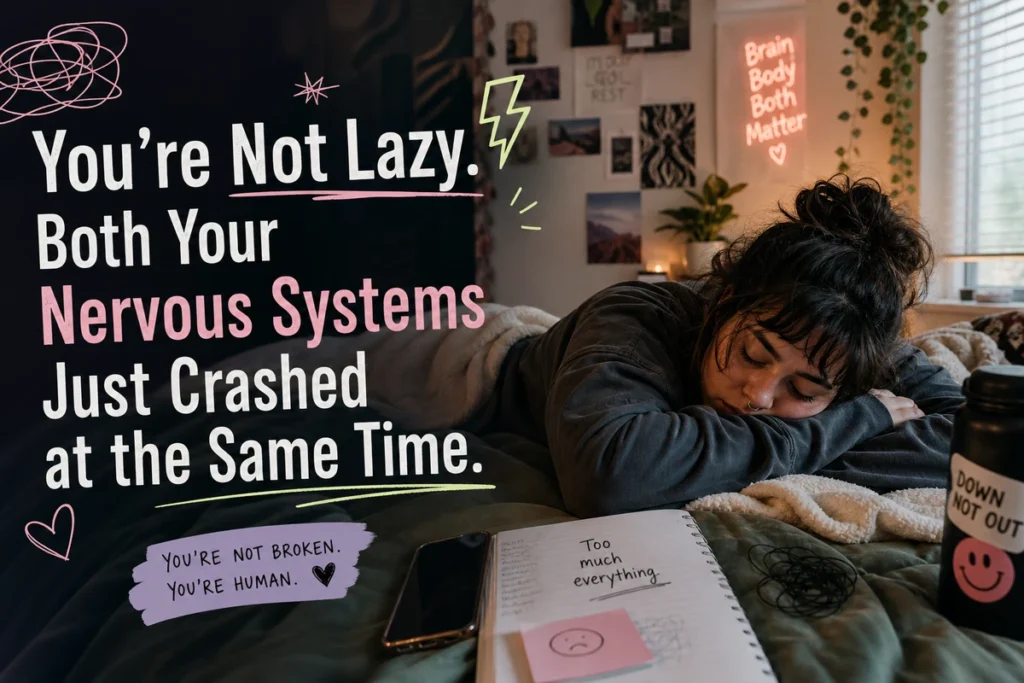
You have been sitting at your desk for two hours. There is something important you need to do. You know it is important. You can see it, right there, on the screen or on the page. And you cannot move toward it. Not because you have decided not to, not because you are choosing Netflix over responsibility, but because something in your nervous system has quietly locked the door, pocketed the key, and gone offline. If you are AuDHD, this is the freeze state nobody in the mainstream ADHD or autism spaces talks about clearly: not ADHD paralysis, not autistic shutdown, but both systems failing at once in a way that produces something uniquely brutal and uniquely misread as character failure.
What Competitors Get Wrong About This State
ADHD content talks about task paralysis. Autism content talks about shutdown. Both framings are accurate for the conditions they describe, but neither accounts for what happens when the two neurological profiles are running in the same brain simultaneously. For AuDHD individuals, the freeze state is not a symptom of one condition temporarily dominating the other. It is the result of two distinct failure modes compounding on top of each other, each making the other harder to exit.
ADHD paralysis, at its core, is a dopamine initiation problem. The prefrontal circuits that should generate the activation signal for a task often fail to fire reliably unless the task carries sufficient emotional salience, urgency, novelty, or perceived reward. Research on ADHD executive function consistently points to differences in the dorsolateral prefrontal cortex circuits, which govern working memory and goal maintenance, as central to why initiation fails even when the person urgently wants to start (Willcutt et al., 2005, Psychological Bulletin).
Autistic shutdown is a different mechanism. It is the nervous system’s protective response to overload: a form of conservation, where sensory and social processing costs have exceeded what the system can sustain, and the brain shifts into something resembling a low-power mode. The autistic nervous system does not experience shutdown as a choice. It is closer to a circuit breaker tripping. Phung et al. (2021, Frontiers in Psychology) found that autistic youth described shutdown as feeling physically immobilized, unable to speak, and cognitively offline, without any subjective sense of choosing to be that way.
Autistic burnout has been described as a powering down of the mind and body: exhausted, emptied of energy, and slowed to a halt, while at the same time experiencing heightened sensory sensitivity and, for many, an inability to identify internally what is happening. This dual quality of shutdown, collapse and hyperarousal coexisting, is part of what makes it so disorienting from the inside (Ali et al., 2026, Autism).
Now put both of those in the same brain. The ADHD system often cannot initiate because the dopamine signal is insufficient. The autistic system cannot stay online because the sensory or social load has crossed its threshold. From the outside, the person appears to be doing nothing. From the inside, it is more like sitting at the intersection of two broken engines, neither of which will start, while the world continues to ask why you are not moving.
Why This Specific State Gets Called Laziness
The freeze state is particularly vulnerable to the laziness misread for a precise reason: it produces no output and no visible distress. ADHD paralysis, when people observe it, is often accompanied by visible anxiety, pacing, last-minute scrambling. Autistic shutdown, when recognized, comes with visible withdrawal. But the AuDHD freeze state can look utterly calm. The person may be scrolling their phone, staring at a wall, or appearing to rest comfortably. Nothing in their external presentation signals to anyone else that two neurological systems have simultaneously failed to generate forward motion.
This surface calm is, in many cases, the result of masking running on autopilot even during shutdown. A lifetime of learning to look regulated while dysregulated means the face and body do not always broadcast what the nervous system is experiencing. For late-discovery AuDHD adults in particular, this is a deeply familiar pattern: the internal reality of being completely offline while maintaining the outward appearance of someone who is simply relaxing and choosing not to try.
From the community: “I’m ADHD/autism combo and call me dramatic all you want, but I can’t imagine a worse form of torture. The cubicles, hearing everyone around me talking on the desk phones, people having side conversations, coughing, the bright obnoxious lights, the constant buzzing of the printer, people’s space heat…”, r/ADHD thread
That description of sensory accumulation is exactly the kind of load that precedes a freeze state. It is not a single overwhelming event but a constant, compounding tax on a nervous system trying to manage dual neurological demands simultaneously. Each individual input may be manageable in isolation. The aggregate tips the system into shutdown before the person even registers what is happening.
The Push-Pull Loop That Makes the Freeze Worse
For people with only ADHD, the paralysis is usually a problem of insufficient activation. For people with only autism, shutdown is usually a problem of excessive input. AuDHD introduces a specific compounding dynamic that makes both states harder to exit: the push-pull between autistic inertia and ADHD understimulation.
A 2026 study analyzing the experience of inertia in AuDHD adults identified this loop directly. AuDHD participants described ADHD novelty-seeking and autistic need for predictability as directly clashing in their experience of being stuck. The ADHD system creates an urgent need for stimulation and something new to engage with. The autistic system, in shutdown or near-shutdown, cannot safely process novelty because novelty requires processing capacity it does not currently have. The result is a state where the brain is simultaneously craving input and unable to receive it: bored and overwhelmed at exactly the same time.
As one AuDHD writer and researcher described it: too little stimulation can be just as dysregulating as too much. Slowing down sounds lovely in theory, but in practice, not doing anything can feel like deprivation, like the brain is being underfed rather than soothed. This is the ADHD half of the equation pulling against the autistic half, inside the same person, during the same moment of freeze.
This internal opposition means that standard recovery advice lands badly. “Rest” does not resolve the freeze because the ADHD system interprets low stimulation as another form of dysregulation. “Just start with something small” does not work because the autistic system is protecting itself from exactly that kind of demand. Telling someone in AuDHD freeze to either rest properly or push through and start is, in effect, suggesting they choose which system to betray. Neither option resolves the underlying tension.
What Is Actually Happening Neurologically
Understanding the freeze state requires separating its components without losing sight of how they interact. The autistic component involves the nervous system shifting into a high-load protective state. When sensory input, social demands, and environmental unpredictability accumulate past a threshold, the autistic brain’s pattern-matching and predictive processing systems become overwhelmed. The system responds by pulling resources away from the parts of the brain responsible for social engagement, language processing, and motor initiation, and redirecting them toward basic threat monitoring. This is not a choice, it is an automatic protective response.
The ADHD component adds a failure of executive initiation on top of this. Even if the autistic protective state partially resolves, the dopamine signal required to generate goal-directed movement may still be absent. The dorsolateral prefrontal cortex circuits involved in task initiation require motivational salience to reliably activate, and during or after a protective shutdown, the entire system is running on depleted resources. Research on autism and ADHD comorbidity in adults consistently finds that impulsivity and attentional inconsistency characteristic of ADHD interact with the rigidity, sensory sensitivities, and social-cognitive differences associated with autism, amplifying executive, emotional, and social-communication difficulties across both conditions.
The compounding mechanism: Autistic inertia and ADHD dopamine dysregulation are not additive in their impact, they are multiplicative. Autistic shutdown reduces the cognitive resources needed to generate the novelty-seeking and activation behavior that ADHD relies on to get moving. ADHD’s chronic underactivation means the system never fully restores the baseline regulation that would allow the autistic nervous system to come back online safely.
There is also an alexithymia factor that rarely gets named here. Alexithymia, the difficulty identifying and describing one’s own emotional and physiological states, is significantly more common in autistic individuals and in many AuDHD adults. When alexithymia is part of the picture, the early warning signals of oncoming shutdown are invisible. The nervous system is heading toward overload, but the person has no internal read on it. By the time the freeze state is obvious, it has already been building for hours. The first conscious awareness of the problem is the full shutdown itself, which, by then, looks to everyone around them like a deliberate choice to do nothing.
How Chronic Masking Accelerates the Crash
The AuDHD freeze state does not appear out of nowhere. In most cases, it is the endpoint of a long arc of expenditure. Masking, the learned suppression of autistic traits in order to appear neurotypical, is energetically expensive in a way that is difficult to convey to someone who does not do it. It involves constant real-time monitoring of behavior, suppression of natural sensory or movement responses, active inference of social expectations, and performance of affect that does not match internal experience. It is cognitively and physiologically costly, and it runs on top of everything else the person is doing.
Research consistently frames autistic burnout as the downstream consequence of sustained masking beyond what the nervous system can sustain (Raymaker et al., 2020, Autism in Adulthood). The definition that has emerged from this research describes autistic burnout as having all internal resources exhausted beyond measure and being left with no clean-up crew: a state produced not by a single event but by chronic expenditure without adequate recovery time. For AuDHD adults who are also masking ADHD traits simultaneously, the impulsivity, the stimming, the need for repetition or clarification, the obvious difficulty sustaining focus, the masking load is doubled. They are suppressing two neurological profiles at once, neither of which is adequately resourced, both of which are generating warning signals the person may not be equipped to read.
The freeze state, in this context, is not failure. It is the system enforcing a limit that the person was not given cultural permission to enforce voluntarily. The shutdown would have happened earlier, and more gently, if there had been recovery time built into the days before it. Because there was not, the nervous system imposes it all at once.
What Recovery Actually Requires for AuDHD
If the AuDHD freeze state is a compounding failure of two neurological systems, recovery has to address both, and critically, it cannot address them with the same intervention at the same time. The autistic component needs sensory safety and predictability. The ADHD component needs just enough stimulation to avoid deepening dysregulation without triggering further overload.
Research on AuDHD burnout recovery is clear that rest alone is insufficient and can even deepen the stuck state. The autistic nervous system, given nothing but quiet and absence of demand, can begin to interpret low stimulation as a new kind of threat. The ADHD system, deprived of input, may start seeking novelty in ways that disrupt the rest the autistic system needs. The result is what many AuDHD adults frequently describe: lying down to recover and feeling worse, more agitated, more inert, more disconnected from any sense of forward motion.
Recovery from AuDHD burnout tends to look like small moments of engagement returning: a flicker of interest in something, the ability to take a shower without it feeling like a monumental task, laughing at something unexpected. It does not look like a decision to push through. It looks like the nervous system tentatively coming back online in small, unannounced ways.
What works instead of pure rest is a layered approach: sensory detox to reduce the incoming load that is keeping the autistic system in protection mode, combined with small doses of predictable, low-demand sensory input that give the ADHD nervous system just enough to organize around. A familiar texture, a warm drink, time with a special interest that requires no performance or output. Not stimulation for its own sake, but a specific, gentle, familiar signal that tells both systems simultaneously that the environment is safe enough to begin re-engaging.
Structure also matters during recovery, but structure of a specific kind. For autistic nervous systems, routine reduces the prediction cost of the environment: when the next thing is known and familiar, the system does not have to remain on alert. Even a minimal framework, morning, midday, and evening, with two or three anchoring activities, can prevent the freefall into deeper inertia that often follows a freeze episode. The ADHD component benefits from the same routine for a different reason: structure removes the need to generate task initiation from scratch, because the expectation is already set. The brain does not have to decide what comes next, the routine decides for it.
Recovery rhythm for AuDHD: Enough novelty to engage the ADHD brain, enough predictability to soothe the autistic nervous system. These are not contradictory goals. A familiar special interest, a known walk route, a predictable sensory ritual can satisfy both conditions at once. The goal is not stimulation or rest in isolation, but input that is both interesting and safe.
The Inertia Loop and Why Episodes Repeat
One of the most important things to understand about the AuDHD freeze state is that it is not a single isolated event. Research on autistic inertia describes it as cyclical: repeated episodes of being stuck feed into exhaustion, which lowers the threshold for the next episode, which produces more exhaustion, in a loop that can function as a precursor to full burnout. For AuDHD adults, the interaction between autism and ADHD has been specifically identified as an exacerbating factor in this cycle, with the two sets of neurological demands actively amplifying each other’s contribution to inertia and depletion.
This means that treating each freeze state as an isolated incident, rather than as part of a pattern, misses the most important intervention window: the recovery period between episodes, when the nervous system is partially online but not yet at full capacity. If that window is used to immediately resume the full demand load, the masking, the overcommitment, the under-resourced daily performance, the next episode arrives sooner and harder. The pattern is not random. It is the nervous system operating according to its actual capacity, which is usually significantly lower than the capacity the person has been performing.
Understanding this does not mean accepting indefinite freeze states as permanent. It means recognizing that capacity is real, that the current system is operating at a deficit, and that the goal of recovery is not to get back to the level of output that caused the problem in the first place. It is to build a baseline that is actually sustainable for the neurological profile you have, rather than the one you were expected to have. For late-discovery AuDHD adults who spent years being told their struggles were attitudinal, this reframing is not a minor semantic update. It is a fundamental shift in what self-understanding is even allowed to look like.
What You Can Actually Do Right Now
If you are in or near a freeze state while reading this, the principle to hold is: do not fight both systems simultaneously. The nervous system that is in shutdown cannot be reasoned, scheduled, or pushed out of it. What it can do is shift, slowly, when the conditions that are maintaining the shutdown change. That means changing one sensory condition before attempting any cognitive or task-based intervention. Dimming a light, silencing a sound source, moving to a physically different location. Not to solve the problem but to interrupt the input stream that is keeping the system locked.
Once the acute shutdown has slightly softened, the ADHD system needs a low-stakes signal that forward motion is possible. Not the original task. Something smaller and more physical: standing up, drinking water, touching a specific texture. This is not avoidance or distraction. It is using the ADHD brain’s responsiveness to physical novelty and immediate sensation to begin generating activation that the autistic system’s shutdown has suppressed.
Longer term, the most protective thing for AuDHD freeze states is building deliberate recovery time before the system demands it. If the pattern is freeze, partial recovery, full demand resumption, and then another freeze, the intervention point is the space between episodes, not the episodes themselves. Reducing masking load wherever it is safe to do so, identifying the sensory conditions that reliably precede shutdown, and building small predictable anchors into daily life are the structural changes that shift the cycle. They do not eliminate the AuDHD nervous system’s vulnerabilities. They reduce the frequency with which those vulnerabilities compound into a complete system collapse.
Understanding the AuDHD energy system more broadly is worth doing alongside this work. The ADHD Energy pillar covers burnout, nervous system regulation, and recovery from a neuroscience-grounded perspective that extends beyond what any single article can hold. And if the shame of freeze states and the internal narrative around laziness is a significant part of your experience, the existing framework on what AuDHD actually is at the neurological level provides useful grounding for why the contradiction is structural, not personal.
The freeze state looks like laziness because it produces no visible output. But output is not a reliable proxy for effort, and effort is not a reliable proxy for capacity. What the AuDHD freeze state actually is, from the inside and from the research, is a nervous system that has reached its limit from two directions at once and is doing the only thing available to it: enforcing a stop that the person was not culturally or diagnostically equipped to enforce voluntarily. That is not a character flaw. It is a neurological event with a mechanism, a pattern, and, once you understand it properly, a recovery pathway that does not require you to simply try harder.
Quick Dopamine Hits:
- When you feel the freeze coming on, remove one sensory demand immediately: dim one light, silence one notification, close one browser tab. You are not fixing the problem yet, you are stopping the input that is accelerating shutdown.
- Once the acute freeze has passed slightly, introduce one tiny physical sensation that feels safe: a warm drink, a specific texture, cold water on your wrists. This gives your nervous system a predictable input to organize around instead of threat.
- Do not try to restart with the original task. Start with the smallest physical action in the room: stand up, move to a different chair, drink something. Motion without demand can begin to shift the nervous system out of the freeze state before any cognitive work is possible.
Rate this article
Was this a useful hit?