ADHD Hyperfocus: Why Your Superpower Is Also the Thing Wrecking Your Day

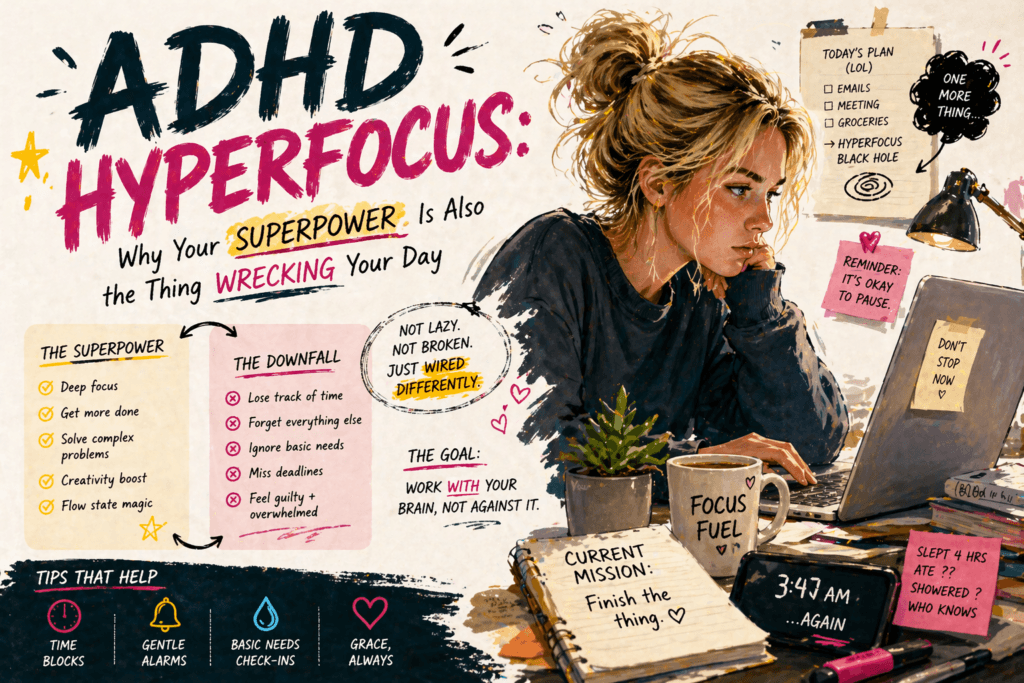
ADHD hyperfocus is the thing everyone wants to talk about at parties. You mention you have ADHD and suddenly someone's telling you about their cousin who can code for fourteen hours straight, or asking if you're one of those people who gets really into things. The implication is clear: sure, ADHD is hard, but at least you have this incredible ability to concentrate when you want to. The superpower. The gift that makes the rest of it worth it.
Here's what they don't see: the fourteen texts you missed because your phone was on silent and you forgot other humans existed. The dinner that burned on the stove. The deadline that passed three hours ago while you were optimizing a spreadsheet that didn't matter. The way you finally looked up from your screen at 2 AM, realizing you haven't eaten since breakfast and your back hurts and you were supposed to call your mom and now it's too late and you feel like garbage and somehow you're also exhausted despite having been completely absorbed in something for half the day.
That's hyperfocus for ADHD adults. Not a controllable superpower. Not a productivity hack. A neurological event that happens to you, often at the worst possible time, leaving wreckage in its wake that you'll spend the next week trying to clean up.
The Superpower Narrative Is Coping, Not Reality
Let's be honest about where the superpower framing comes from. When you have a brain that makes basic functioning harder than it should be, you need something. Some reason why this is okay, why you're not just broken, why maybe this thing that makes life difficult also gives you something special. The hyperfocus narrative fills that need perfectly. It transforms a symptom into a gift, reframes chaos as potential.
And look, there's value in not pathologizing every aspect of your neurology. The problem is when the reframe becomes denial. When we pretend hyperfocus is something we control, something we can aim like a weapon, something that reliably produces results rather than occasionally producing results while frequently producing disasters.
The hyperfocus state doesn't care about your priorities. It cares about dopamine salience, and your priorities rarely win that competition.
Research from Hupfeld and colleagues (2019, Neuropsychology Review) describes how ADHD involves dysregulation in the brain's salience network, the system that decides what deserves your attention right now. In neurotypical brains, this network weighs importance, urgency, and interest to allocate focus appropriately. In ADHD brains, the salience network over-weights immediate reward and interest while under-weighting future consequences and external importance. This isn't a choice. This is architecture.
What Hyperfocus Actually Is (Neurologically Speaking)
Hyperfocus isn't enhanced concentration. It's a failure of attention disengagement. Normal attention involves both engaging with a task and being able to pull away when needed. Your brain is supposed to maintain some awareness of time, bodily needs, and competing priorities even while focused. In hyperfocus, that monitoring system goes offline.
Ashinoff and Abu-Akel (2021, Psychological Research) proposed that hyperfocus represents a state of intense absorption where the filtering mechanisms that usually maintain peripheral awareness essentially shut down. You're not concentrating harder. You're concentrating exclusively, with no resources left over for anything else.
The attention budget metaphor: Neurotypical focus is like spending from a renewable budget with some kept in reserve. Hyperfocus is dumping your entire account into one thing while the bill collectors wait outside.
The dopamine system plays a central role here. Tasks that trigger hyperfocus tend to be high in novelty, immediate feedback, or personal interest because these factors drive dopamine release. Once you're locked in, the dopamine reward loop becomes self-sustaining. Each small hit of progress or discovery triggers more engagement, which triggers more dopamine, which makes disengaging feel almost physically painful.
The Real Cost Nobody Wants to Calculate
Every hour of hyperfocus has hidden costs that don't show up until later. Time cost: six hours disappeared into something that wasn't what you planned, and it often hijacks you when you have a work deadline or promised to meet someone. Physical cost: skipped meals, dehydration, cramped posture — during hyperfocus you literally cannot feel your body's signals properly. Relational cost: the texts that went unanswered, the commitments that were broken, the people who learned they can't rely on you when something interesting captures your attention.
Crash cost is what gets left out of the superpower narrative entirely. The intense engagement of hyperfocus is often followed by a drop in energy, mood, and motivation. You've depleted something, neurochemically and psychologically. The comedown can look like depression, exhaustion, or irritability — and it happens right when you need to deal with all the things you neglected.
Your body was sending signals the whole time. Hyperfocus just turned off the receiver.
Why You Can't Just Aim Hyperfocus
You cannot choose what triggers hyperfocus because hyperfocus is not a mode you activate. It's a mode you fall into. The salience network makes this decision below the level of conscious control, based on factors you can't fully predict or manipulate. Sometimes you desperately want to hyperfocus on something important and your brain simply refuses. Sometimes you desperately want to stop hyperfocusing on something pointless and you can't.
Research insight: Studies on flow states show that attempting to force flow often prevents it. Csikszentmihalyi's work (1990, Flow) emphasizes that these states emerge from conditions, not willpower. The more you try to control hyperfocus, the less likely productive hyperfocus becomes.
What Actually Helps
External interruption systems matter more than internal willpower. Physical timers across the room. Other people who will actually interrupt you. Scheduled commitments that create hard stops. Your willpower alone cannot reliably surface you from hyperfocus because the state itself suppresses the capacity to choose differently.
Environmental design: make hyperfocus traps harder to access. If certain apps, games, or activities reliably trigger multi-hour absorption, create friction. Delete apps from your phone. Use website blockers. Time awareness tools: analog clocks in your visual field, timers with physical alarms that require movement to stop.
Body need anchors: set recurring alarms specifically for bodily needs because you cannot trust yourself to notice them during hyperfocus. A hydration alarm. A food alarm. A movement alarm. These compensate for the way hyperfocus disconnects you from physical signals.
You are allowed to grieve the life you might have with reliable attention. That grief doesn't mean you hate yourself. It means you're being honest.
The real work isn't learning to aim your superpower. It's building a life that can survive the regular occurrence of an uncontrollable neurological event, minimizing the damage when it happens, and being honest with yourself and others about what you're actually dealing with.
Rate this article
Was this a useful hit?