ADHD Demand Avoidance: Why Productivity Advice Makes You Want to Do the Opposite

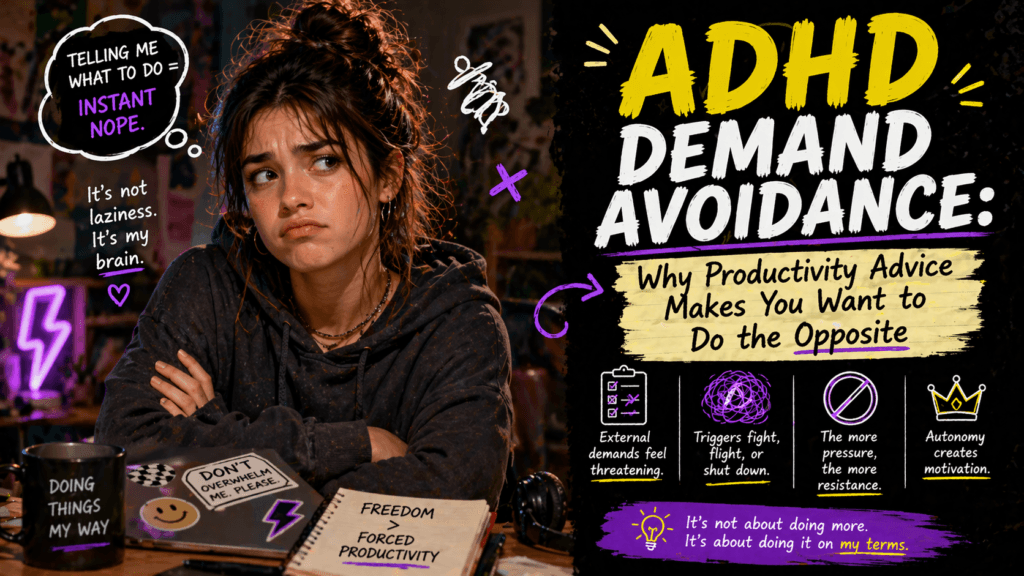
Someone gives you a tip: "Just break it into smaller steps." Immediately, something in you recoils. The tip is not wrong. You know it is not wrong. But knowing it is reasonable does not stop the reaction, which is something between contempt and paralysis and an inexplicable urge to do literally anything else.
This is demand avoidance. And it is not stubbornness, immaturity, or a failure of character. It is a documented pattern in neurodivergent brains that makes externally imposed demands, including the ones you impose on yourself, neurologically aversive in a way that has nothing to do with whether the demand is reasonable.
The Basic Pattern
Demand avoidance describes a pattern where the experience of obligation, whether external or self-generated, creates resistance that seems disproportionate to the demand itself. The task does not have to be unpleasant. You can genuinely want to do it. As soon as it becomes something you "have to" do, something shifts. The wanting does not change. But the willingness does.
This is why ADHD demand avoidance has such a specific texture. You were going to do the laundry anyway. You thought of it yourself. Then your partner asks if you have done it. Now you cannot do it. The external demand has triggered something that makes completion feel impossible, even though the underlying desire to have clean laundry has not changed and the ask was entirely reasonable.
The same pattern appears with self-generated demands. You schedule a writing session for 2pm on Tuesday. You block it in your calendar. By 1:45 on Tuesday, something in you is looking for any available exit. You did not change your mind about wanting to write. The scheduled obligation created its own resistance.
Where This Comes From: The Autonomy Connection
The leading psychological explanation for demand avoidance in neurodivergent people connects it to autonomy. Psychologists Edward Deci and Richard Ryan developed Self-Determination Theory in the 1980s, which identifies autonomy (feeling like you are the origin of your own behavior) as one of the three core psychological needs, alongside competence and relatedness.
When autonomy is threatened, people resist, even when the thing being demanded is something they would have chosen anyway. This is well-documented in neurotypical people too. But in some neurodivergent brains, the autonomy response appears to be significantly more sensitive. The threshold for what triggers a "demand" is lower, and the intensity of the resistance response is higher.
This has a specific implication: the framing of a task matters as much as the content of the task. "I have to write this report" and "I am going to write this report" describe the same action. Neurologically, they produce different activation patterns in a demand-avoidant brain. The second activates autonomy. The first activates resistance. The word "have to" is not neutral.
The Pathological Demand Avoidance (PDA) profile was first described by Elizabeth Newson in the 1980s as a pattern within autism. It is now recognized as a broader phenomenon that appears in ADHD populations as well. The word "pathological" is misleading; it reflects the clinical tradition of naming things after their most severe presentations. Demand avoidance exists on a spectrum.
Why Standard Productivity Advice Backfires
Most productivity frameworks are built on an implicit assumption: that the person using them wants structure and will respond positively to clear demands. Time-blocking, accountability partners, commitment devices, deadline-setting: all of these work by creating external demands to compensate for insufficient internal motivation.
For a demand-avoidant brain, these strategies often produce the opposite of the intended effect. Time-blocking creates a demand. Accountability partners create social pressure, which the demand-avoidant brain may experience as a threat to autonomy rather than as support. Commitment devices create obligations. The more structure you add, the more resistance accumulates.
This is genuinely frustrating, and it can create a secondary shame spiral. Everyone else seems to benefit from these tools. Why are they making things worse? The answer is not that you are broken. It is that these tools are calibrated for brains that respond to obligation with action rather than brains that respond to obligation with avoidance.
What makes this harder is that the resistance is not always conscious. You do not sit down and decide to resist the 2pm writing block. You sit down and discover that you cannot start, or you find yourself doing everything except the blocked task, or the block arrives and you have somehow agreed to three other things that now conflict with it. The avoidance is often automatic and post-hoc rationalized.
The Paradox of Self-Imposed Demands
Demand avoidance does not only respond to external demands. Self-generated demands, the ones you set for yourself in full autonomy, can trigger the same resistance. This is one of the more confusing and painful aspects of the pattern.
You decided to wake up at 7am and exercise. Nobody told you to. You made the plan freely. And then 7am arrives and some part of you treats the earlier self who made the plan as an external authority figure whose demands can be resisted.
This is sometimes described as a failure of self-continuity: the difficulty connecting the planning self with the executing self in a way that feels like genuine voluntary action rather than obligation. The plan, once made, stops feeling like your own choice and starts feeling like a demand from the past version of you. And demands can be resisted.
The practical implication is that planning, for demand-avoidant ADHD, needs to preserve optionality rather than create obligation. This is counterintuitive. Planning feels like the solution to demand avoidance; you are just not doing enough of it. But the wrong kind of planning makes demand avoidance worse.
What Actually Works
Strategies for demand avoidance do not look like standard productivity advice. They work by reducing the demand signature of tasks rather than by increasing compliance pressure.
Autonomy reframing. Changing the internal language from obligation to choice. "I have to" becomes "I am choosing to." "I need to" becomes "I want to, because..." This is not positive-thinking wishful thinking. It is a deliberate activation of the autonomy system rather than the compliance-resistance system. The task is the same. The framing changes the neurological context it enters.
Demand removal. Removing the structure that creates the demand, replacing obligation with intention. Instead of "I am working from 2pm to 4pm," try "I am going to see what I can do before 4pm." The shift from a fixed demand to an open exploration preserves the same time block but removes the compliance structure. For many demand-avoidant people, this is the difference between being able to start and not being able to start.
Interest-first entry. Finding the genuinely interesting part of the task and starting there, regardless of sequence. Demand avoidance often co-occurs with strong interest-based motivation. The task you "have to do" is often also a task that contains something genuinely engaging, and you can use that engagement as the activation mechanism rather than fighting it with obligation.
Reducing accountability pressure. If traditional accountability partners make demand avoidance worse, the alternative is not no accountability but accountability with a different texture. Someone who knows you are working on something and will celebrate progress, but who has not set a demand that you must reach a specific outcome by a specific point. The difference between "I'll check in with you at 3pm about how the report is going" and "let me know if you need anything while you work on the report" is significant for a demand-avoidant brain.
Body doubling without obligation. Working in the physical or virtual presence of another person, without that person tracking your output or setting expectations, can reduce demand avoidance because it provides the activation benefit of social context without the demand structure. Focus rooms, coworking spaces, and virtual body doubling communities work this way.
Working With Your Brain on This
The most important reframe for demand avoidance is this: it is not a character failure. It is a feature of an autonomy-sensitive brain that responds to obligation with resistance rather than compliance. That is a neurological profile, not a moral one.
The strategies that work with it do not try to force compliance. They try to preserve the felt sense of autonomy even while getting the task done. The output is identical. The internal experience of the task is fundamentally different, and for a demand-avoidant brain, that internal experience determines whether the task happens at all.
Learning to work with demand avoidance rather than against it is not about lowering standards or making excuses. It is about understanding the actual mechanism of your resistance and building an architecture that routes around it rather than colliding with it repeatedly and blaming yourself for the damage.
The productivity frameworks that work for most people do not work for you because they were built on a different brain model. That is a mismatch of tool and user, not evidence that you are not trying hard enough.
Rate this article
Was this a useful hit?