You’re Not Easygoing. You’re Overwhelmed and Your Brain Stopped Advocating For You.

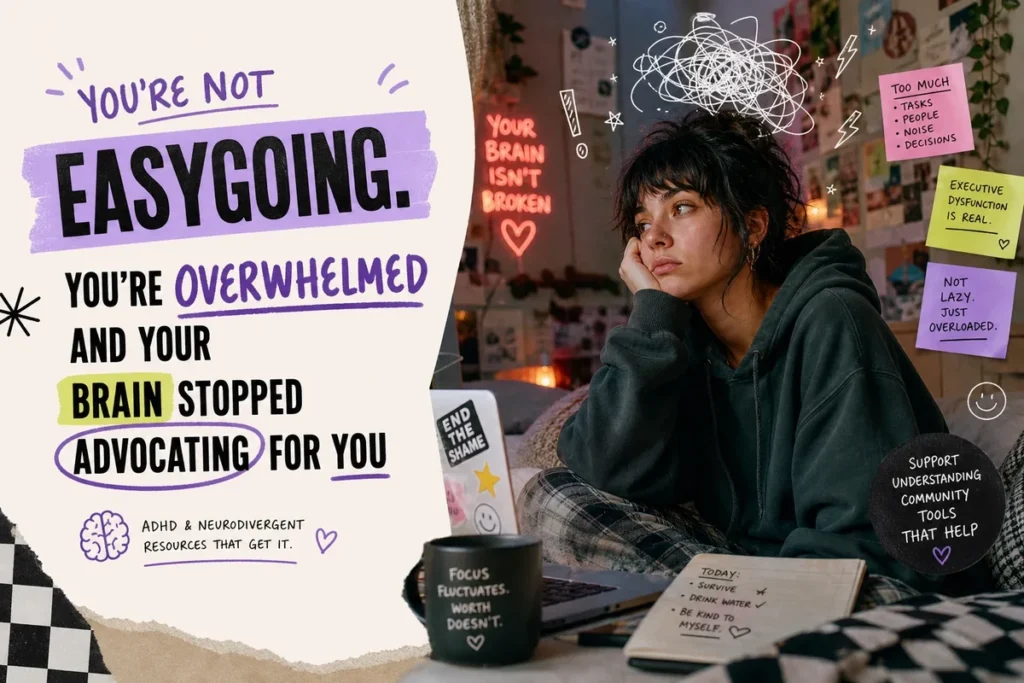
You are known as the person who never makes a fuss. You go with whatever the group decides, agree to the plans that get suggested, and smile through dinner at the place you do not like. People describe you as laid-back, easy to please, low-maintenance. You have collected these compliments your whole life and quietly suspected they were not compliments at all. The truth that nobody labels correctly is this: a significant portion of what looks like being easygoing in ADHD is actually selective shutdown, a state where your brain stops processing your own preferences because calculating them, communicating them, and defending them has become more cognitively expensive than simply agreeing. It is not a personality trait. It is a sophisticated form of self-suppression, and it has a measurable cost.
What Selective Shutdown Actually Is
Selective shutdown is not the same as being flexible or generous. Genuine flexibility involves evaluating two options, finding them roughly equivalent, and choosing freely. Selective shutdown skips the evaluation stage entirely. Your brain, already running above capacity from managing executive function demands, sensory input, social monitoring, and emotional regulation simultaneously, decides that forming and defending a preference is a resource expenditure it cannot authorize. So it does not. It routes you straight to agreement because agreement is the lowest-friction exit from a situation that has become overwhelming.
The result looks identical from the outside. Someone asks where you want to eat and you say “anywhere is fine.” To the observer, that is easygoing behaviour. Inside your nervous system, what actually happened is closer to a brief cognitive collapse: your working memory was already at capacity, the emotional labour of anticipating the other person’s reaction to your real answer felt unbearable, and the path of least resistance was taken not by choice but by exhaustion. The preference existed. The brain simply could not afford to surface it.
ADHD masking involves taking on less intuitive but more socially approved behaviors to reduce interpersonal friction. The personal cost of this substitution is significant and largely invisible to everyone except the person paying it.
Why ADHD Makes You Especially Vulnerable to This Pattern
Several features of ADHD converge to make selective shutdown disproportionately likely. The first is working memory load. When your brain is already juggling fragmented attention, incomplete plans, and environmental stimulation, adding the processing cost of “what do I actually want, how do I say it, how will they react, what if they are annoyed” tips the cognitive budget into deficit. Agreement is almost always the cheaper calculation.
The second factor is rejection sensitive dysphoria. Research by Rowney-Smith et al. (2026, PLoS ONE) found that in adults with ADHD, the expectation of rejection causes more distress than actual rejection itself. When your nervous system has learned that asserting a need sometimes leads to friction, disapproval, or being labelled “difficult,” the brain begins pre-empting that outcome by suppressing the assertion before it occurs. You do not avoid the conflict by processing it and choosing silence. You avoid it by shutting down the preference-generation system before it produces anything that needs silencing. This is a crucial distinction: it is not a decision, it is a reflex.
The third factor is the sustained effort of social performance. A 2026 study in Behavioral Sciences (Hall et al.) found a significant structural pathway from ADHD symptom severity to masking behaviours, and from masking to both identity distress and impostor phenomenon. Adults with ADHD who mask heavily report lower self-esteem and higher identity confusion precisely because the performance of being someone easier to be around erodes the clearer signal of who they actually are. Social camouflaging is not a neutral act. It consumes the same executive resources that ADHD already depletes, and those resources do not regenerate automatically when the social situation ends.
The masking math: Hall et al. (2026, Behavioral Sciences) found that ADHD symptom severity predicted higher masking, and masking predicted both impostor phenomenon and identity distress, independent of self-esteem. The person you present to the world when you are in shutdown mode is not a simplified version of you. It is a version that costs you your sense of self.
The Difference Between Agency and Fear-Driven Agreement
This is the point where some nuance is necessary. Not every instance of going along with the group represents shutdown. Some people with ADHD genuinely have a high tolerance for social variety, and choosing not to fight about a minor decision when you authentically do not care much is a valid, even efficient, energy conservation strategy. Low-friction choices become pathological not when you make them but when the choice is no longer really a choice, when you have no access to the alternative in that moment, not because the alternative does not exist but because the system that would surface it has gone offline.
Agency-driven easygoing leaves you feeling okay afterward. You chose it consciously, you could have spoken up if something had mattered enough, and you do not arrive home feeling like your body has been vibrating under a layer of glass all day. Fear-driven shutdown leaves a residue. You feel vaguely wrong, slightly hollowed out, aware that you are holding something in but unable to identify exactly what. Your behaviour agreed, but your nervous system did not.
Many people with ADHD describe a long lag between the social situation and the moment they realise they did not want what they agreed to. The preference surfaces hours later, or the next morning, or three days into an obligation they did not actually want. This is partly a working memory issue, since the information was never stable enough to retrieve in real time, and partly the delayed emotional processing that characterises ADHD. By the time the genuine response registers, the situation has already been decided.
What Shutdown Looks Like When You Are the One Going Through It
One of the reasons selective shutdown is so hard to identify in yourself is that it does not feel like a crisis. Crises have texture. They announce themselves. Shutdown feels neutral, almost calm. You say “sure” and “whatever works” and there is no internal alarm because your nervous system has already stopped generating the signal that would trigger the alarm. The absence of protest is not consent. It is the absence of capacity.
Common patterns that indicate shutdown rather than genuine flexibility include agreeing to social plans and dreading them the moment the other person walks away, finding that you cannot recall what you actually wanted when asked afterward, noticing that you only develop clear preferences in solitude, never in the moment a decision is being made, and consistently feeling like a guest in your own social life, present at events that feel as though they were planned for a version of you with slightly different needs.
You only develop strong preferences in solitude, never in the moment a decision is being made. That is not being laid-back. That is your brain reprocessing on a delay what it could not access in real time.
The recognition many people describe is this: they agreed to three plans they genuinely dislike because it was easier in the moment than explaining why their brain could not handle them. Not because they lacked an opinion. Because forming and communicating the opinion required more than the system had left to give.
From the community: “Do you ever get frustrated with never being able to fully articulate your issues to a psychiatrist?”, r/ADHD thread
The Burnout Waiting at the End of This Road
Chronic selective shutdown does not stay contained. The effort of performing easygoing-ness over months and years accumulates into a depletion of all available internal resources. Raymaker et al. (2020) defined autistic burnout as “having all of your internal resources exhausted beyond measure and being left with no clean-up crew.” While this definition emerged from autistic research specifically, the underlying mechanism maps onto what ADHD masking produces over time: a progressive drain on the energy budget that runs on no visible income while paying invisible expenses, until the account reaches zero.
ADHD burnout arrives looking like depression. The flatness, the difficulty initiating anything, the sense that you cannot locate enthusiasm for things you used to care about are all consistent with the aftermath of sustained self-suppression. Research on high-functioning adults with ADHD has found that people who appear outwardly composed often endure a significant internal burden, including emotional exhaustion, chronic stress, shame, and perfectionistic overcompensation. Their impairment is invisible, not absent. Selective shutdown is exactly this kind of invisible impairment: performing adequately at the social level while your nervous system depletes on a substrate nobody can see.
The relationship between masking and burnout matters for one specific reason: the burnout is not random. It is not a mystery why you crash after a period that looked, from the outside, like things were going well. You were paying a hidden tax on every interaction where you suppressed what you needed in order to maintain social harmony. The ADHD Energy pillar explores this dynamic in detail, but the simplified version is this: energy spent on being palatable is energy not spent on recovery, on the things that actually matter to you, or on the self-knowledge that makes the next set of decisions easier.
The Role of Not Wanting to Be “Too Much”
A significant driver of selective shutdown in ADHD is not simply cognitive overload. It is the internalized narrative that having needs makes you difficult. Research on women with ADHD and late discovery consistently shows that internalising negative messages about being “too sensitive” or “too demanding” leaves lasting marks on how people relate to their own needs (Holthe &, Langvik, 2017). The person who is reliably told they are exhausting when they ask for what they want learns, systematically, to stop asking. And then learns to stop surfacing the wanting in any space where someone else can see it.
Although research shows this pattern disproportionately shapes the presentations of women with ADHD, particularly those who go undiagnosed longest because visible need has been trained out of them, it is not an exclusively gendered experience. The lived experience of rejection sensitivity in ADHD (Rowney-Smith et al., 2026) documents that adults across presentations frequently adopt a “mask of toughness” to hide their sensitivity, appearing unaffected by the decisions of others. The mask requires energy. Sustained masking produces cumulative exhaustion that looks, in social contexts, like calmness and flexibility. It is neither.
ADDitude Magazine’s clinical coverage, drawing on the work of Dr. James Kustow, a UK psychiatrist specialising in ADHD, describes rejection sensitive dysphoria as triggering “identity-level pain” and notes that many people adapt by people-pleasing to the point of losing their identity entirely. Selective shutdown is what this looks like when it becomes automatic rather than deliberate: not a choice to suppress, but a brain that has learned to skip the suppression step by never generating the signal in the first place.
Is This the Same as Dissociation?
Selective shutdown overlaps with dissociation in some respects but is not identical to it. Clinical dissociation involves a detachment from thoughts, feelings, identity, or environment that is typically involuntary and can be significantly distressing. What happens in selective shutdown is more targeted: your brain is still largely online, still tracking the social situation, still performing adequately. What has detached is specifically your access to your own preferences and needs. You are present, you are functioning, but a layer of self-advocacy has gone offline.
This distinction matters because people who experience selective shutdown often do not recognise it as a protective response at all. They experience it as their true personality. The story they carry is “I really am just flexible” or “I genuinely do not have strong preferences about most things.” Research on ADHD burnout consistently shows that people who chronically underreport their own distress tend to be the most depleted, not the most resilient. The absence of visible need does not mean need is absent. It means the circuit that surfaces need has been trained into silence.
What Rebuilding Preference Looks Like in Practice
The goal is not to transform yourself into someone who makes every social situation about their own preferences. It is to restore access to what you actually want so that when something matters, you can reach it in real time rather than three days later. That is a much more modest and achievable aim, and it starts with noticing the gap between social performance and internal experience rather than immediately trying to close it.
Noticing the gap means paying attention to what happens in your body after you agree to something. If you feel a slight compression, a low-level dread, a vague wrongness, those are signals that shutdown has occurred and preference has been suppressed rather than genuinely absent. You do not need to change your answer immediately. You just need to register that something was there. Over time, registering it consistently makes it available earlier in the process, before the social situation has already been resolved around you.
The second step is the deliberate introduction of delays. Selective shutdown happens fastest under real-time social pressure. Giving yourself a buffer (“let me check my calendar and get back to you”) does two things: it removes the immediacy that triggers the shutdown reflex, and it creates a window where your actual preference can surface before the decision is locked. This is not about being difficult. It is about giving your prefrontal cortex time to participate in a decision that rejection sensitivity and executive overload would otherwise short-circuit entirely.
The third piece is practicing preference expression in low-stakes situations. Choose the restaurant when you are asked. Say “actually I would rather watch this.” Send the message that asks for what you actually need. Not because every preference matters equally, but because the neural pathway of self-advocacy requires regular use to stay functional. Hall et al. (2026) found that the erosion of self-expression through masking shapes the internal architecture of how you understand your own identity. Rebuilding it is a legitimate part of ADHD energy management, not a personality luxury.
The People Who Call You Easygoing Are Not Wrong About What They See
The people who describe you as laid-back and low-maintenance are not lying. They are describing a real and consistent pattern of behaviour. What they cannot see is the mechanism producing it, or what it costs. You have, across years of navigating social environments with a brain that processes everything at higher cost, built a very effective system for minimising friction. That system works. It keeps relationships smooth, avoids conflict, and produces the reliable outcome that people find you easy to be around.
The problem is not that the system is irrational. The problem is that it runs at your expense rather than theirs. Every time you shut down your preferences to maintain social harmony, the depletion registers in your nervous system even if nobody else notices. The shame that often follows ADHD burnout is partly this recognition: that you have been generous in ways that nobody asked for, that you cannot afford, for reasons that felt involuntary at the time and largely were.
You are not a naturally easygoing person who has occasionally learned to advocate for yourself. You may be a person with very clear preferences who has learned to keep them below the threshold where anyone, including yourself, can reliably detect them.
The recovery from selective shutdown is not dramatic. It does not require confrontational conversations or a personality overhaul. It requires the same thing most ADHD recovery requires: making the invisible visible, naming the mechanism, and giving yourself permission to acknowledge that the cost was real even when nobody saw you paying it. Your preferences are not an inconvenience to be managed. They are data about what your nervous system can actually sustain. Learning to listen to them again is not asking for special treatment. It is basic maintenance on the only system you have.
Quick Dopamine Hits:
- After any social event where you said ‘I don’t mind’ or ‘whatever you want’, sit alone for five minutes and write down what you actually wanted. No edits, no justifying, just the preference.
- Before agreeing to any plan that involves more than two hours of your time, introduce a 24-hour pause: ‘Let me check my calendar and get back to you.’ This is not rudeness, it is a delay buffer that lets your prefrontal cortex weigh in before your shutdown response commits.
- Once a week, make one tiny preference public. Tell someone what restaurant you actually want, what film you actually feel like watching. Practice the neural pathway of voicing a need before it atrophies completely.
Rate this article
Was this a useful hit?