ADHD Masking at Work: The Tax Your Brain Pays to Appear Fine

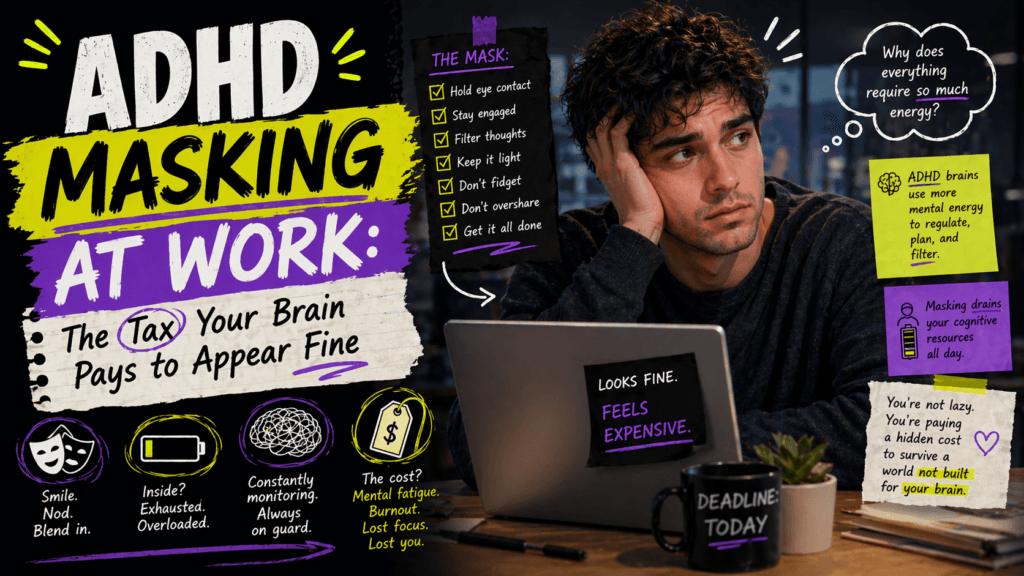
Here is a scenario that might sound familiar. You get to your desk and immediately start performing. You take careful notes in meetings because if you do not, you will float away and miss everything, but you do it in a way that looks organized rather than desperate. You laugh at the right moments. You ask two smart questions so nobody clocks that you lost the thread of the presentation twelve minutes in. You stay five minutes after everyone else leaves to reread the brief you should have understood in the room.
Then you go home and you are done. Not tired. Done. Like someone took a battery out.
That performance has a name: masking. And the crash that follows is not weakness. It is the metabolic bill for a full day of cognitive concealment.
What Masking Actually Is
Masking is the practice of hiding or compensating for neurological differences in order to appear neurotypical. It is most studied in autistic populations, but research has expanded significantly to include ADHD in recent years. A 2019 paper by Young and colleagues in the journal Autism Research documented masking behavior extensively in women with ADHD, finding that it was widespread, largely unconscious, and strongly correlated with mental health difficulties.
The behaviors that constitute masking are diverse. Some are obvious: sitting still when every cell wants to move. Forcing eye contact at intervals that feel socially appropriate even when it costs processing bandwidth you needed for the conversation. Suppressing the impulse to interrupt even when the thought will be gone in four seconds if you do not say it.
Others are subtler: over-preparing to compensate for anticipated working memory failures. Arriving early to buffer for the probability of losing track of time. Setting three alarms where one would do. Writing scripts for phone calls. All of these are strategies, but they are strategies built on concealment: hiding the need, not addressing it.
Why Masking Develops
Nobody decides to mask. It develops over time through feedback. You learn, through enough incidents, that your authentic ADHD behavior produces negative responses: teachers frustrated by interruptions, peers confused by topic switches, bosses worried about reliability. You learn that the behavior that comes naturally carries a social cost. So you learn to perform the behavior that does not.
The process is largely unconscious in children and becomes increasingly automatic in adults. By the time most people recognize they are masking, they have been doing it for so long that they cannot always distinguish what is mask and what is them. This identity confusion is one of the more disorienting aspects of late ADHD diagnosis: you spend years learning that a significant portion of your self-presentation was adaptive performance, not genuine preference.
Masking tends to be heavier in certain contexts: formal work environments, new relationships, situations where authority or social status feels precarious. It tends to be lower with close friends, in unstructured time, or in environments where ADHD traits are valued rather than penalized, a creative sprint, a brainstorming room, a conversation where interrupting is the norm.
The research on masking and burnout is direct. A 2021 study by Raymaker and colleagues found a strong association between high masking effort and autistic burnout. The parallel pattern is increasingly documented in ADHD. Sustained masking is not a sustainable strategy. It is a loan against future capacity.
The Specific Masks ADHD People Wear at Work
Masking at work tends to cluster around the specific executive function challenges ADHD creates. Understanding which masks you are wearing is useful because each one has a cost that can be estimated and, often, reduced.
The over-documentation mask. Taking exhaustive notes not because you prefer detailed records but because your working memory cannot hold the information and you have learned not to trust it. The mask works: you look organized. The cost: your note-taking takes bandwidth you could be using to actually engage with what is being said.
The enthusiasm performance mask. Injecting energy and engagement into interactions you are already struggling to track. Nodding more than necessary. Asking follow-up questions that buy you time to reorient. Looking engaged while your brain has been in another zip code for the last three minutes. The mask works: you look present. The cost: high effort, low information retention.
The early bird mask. Arriving before everyone else as a buffer against time blindness. Setting alarms that go off at intervals because you cannot trust your internal clock. Building in so much transition buffer that your schedule looks oddly rigid. The mask works: you are reliably on time. The cost: significant overhead and a constant undercurrent of anxiety about punctuality that neurotypical colleagues simply do not experience.
The perfectionism mask. Over-preparing and over-producing to compensate for the fear that if people saw how chaotic your process actually is, they would lose confidence in the output. Spending four hours on something that should take forty-five minutes because you cannot trust that the first draft is good enough. The mask works: your output is often high quality. The cost: unsustainable time investment that creates a secret life where work takes three times as long as anyone knows.
The humor mask. Being the funny one in the room because it makes task switches and interruptions look deliberate rather than impulsive. Deflecting with wit before anyone can clock the confusion. The mask works: you are charming and likable. The cost: it is exhausting to be "on" and it can prevent people from ever seeing you struggle, which means you never get actual support.
What the Crash Tells You
The post-work crash is not random. It is proportional to how much masking you did during the day. Days with high social performance, formal meetings, new environments, or difficult interpersonal dynamics tend to produce deeper crashes. Days where you could work alone, move freely, and operate without significant performance demands tend not to.
If you track this across two weeks, the pattern becomes visible. The information is useful: it tells you where your masking load is highest and where you have room to reduce it.
The crash is also sometimes misread as depression or laziness. "I got home and could not do anything." This is not a mood disorder episode, though mood disorders do frequently co-occur with ADHD. It is a neurological recovery period. The prefrontal cortex has been working overtime all day to maintain regulatory control over impulses, attention, and social behavior. When the external demands drop, the system does too.
Selective Unmasking: The Practical Middle Ground
Full unmasking at work is rarely feasible and often not strategically wise. Some masking behaviors are adaptations to real social contexts, and removing them entirely can create real consequences. The goal is not to stop masking. It is to mask strategically rather than automatically, and to reduce the load where possible without sacrificing what matters.
Selective unmasking means identifying the specific contexts, relationships, and environments where the masking cost is high and the masking benefit is low, and choosing to unmask there first. The late-afternoon meeting that you attend but barely contribute to, where the primary reason you are holding yourself together is habit rather than necessity. The colleague who has already indicated they understand how your brain works. The project phase where you are working independently and the performance pressure is low.
Unmasking in low-stakes contexts first has two benefits. It lowers the daily cognitive load modestly but meaningfully. And it builds evidence that unmasking does not always produce the negative consequences you have learned to expect. That evidence is important because the avoidance of unmasking is often driven by a fear that is no longer calibrated to current reality.
Talking to Managers About ADHD
The question of disclosure is genuinely complex and depends heavily on the work environment, the manager, and the legal context. What is often underestimated is how much relief comes from even partial disclosure to one trusted person. You do not need the whole organization to know. You need one person who will not raise an eyebrow when you ask for written follow-up after meetings, or who will not read your restlessness during a two-hour meeting as disrespect.
Research on ADHD disclosure at work is limited but growing. A 2020 report from the ADHD Foundation found that a majority of adults with ADHD who disclosed to their manager reported a positive or neutral outcome. The minority who reported negative outcomes were more likely to be in environments with low psychological safety generally, not specifically ADHD-hostile ones.
The framing matters significantly. "I have ADHD and it means I sometimes struggle" is a different conversation from "I have ADHD and I have learned I work better with written agendas, clear deadlines, and the flexibility to move around during focused work. Can we set those up?" The second is an accommodation request, not a confession.
Building Recovery Into the Schedule
If masking is a cost, then recovery is maintenance. Treating recovery time as optional is how ADHD burnout develops over months and years of sustained masking without adequate recharge.
What recovery looks like varies. For some people it is unstructured quiet. For others it is physical movement, something absorbing and low-stakes, or social time with people who do not require performance. The specifics matter less than the consistency: high-masking periods require scheduled recovery, not hoped-for recovery that gets eaten by other obligations.
Building this into the schedule looks like: if you have a day with back-to-back meetings, you schedule nothing consequential for the evening and you do not apologize for that. If you are in a high-stakes work period, you plan the recovery period on the other side before it starts. This is not self-indulgence. It is operational planning.
You Were Not Pretending, You Were Surviving
A lot of people, when they first understand masking, feel a complicated grief about it. Years of effort that looked like competence but was actually concealment. Energy spent performing rather than producing. A version of yourself that was always running a secondary process of "appear normal" alongside whatever the actual task was.
That grief is valid. And it is worth naming the other thing too: you did it because you had to, and you were very good at it. The same brain that made masking necessary also made masking possible. The adaptability, the social reading, the rapid pattern recognition that lets you know exactly when you have lost the room and what to do about it: these are real skills, even if they were deployed in service of concealment.
The goal going forward is not to erase them. It is to deploy them by choice, for real strategic purposes, rather than because you never learned another option. That shift, from automatic concealment to intentional presentation, is where the energy comes back.
Rate this article
Was this a useful hit?