Your Body Clock Is Not Broken. It Just Runs Three Hours Late.

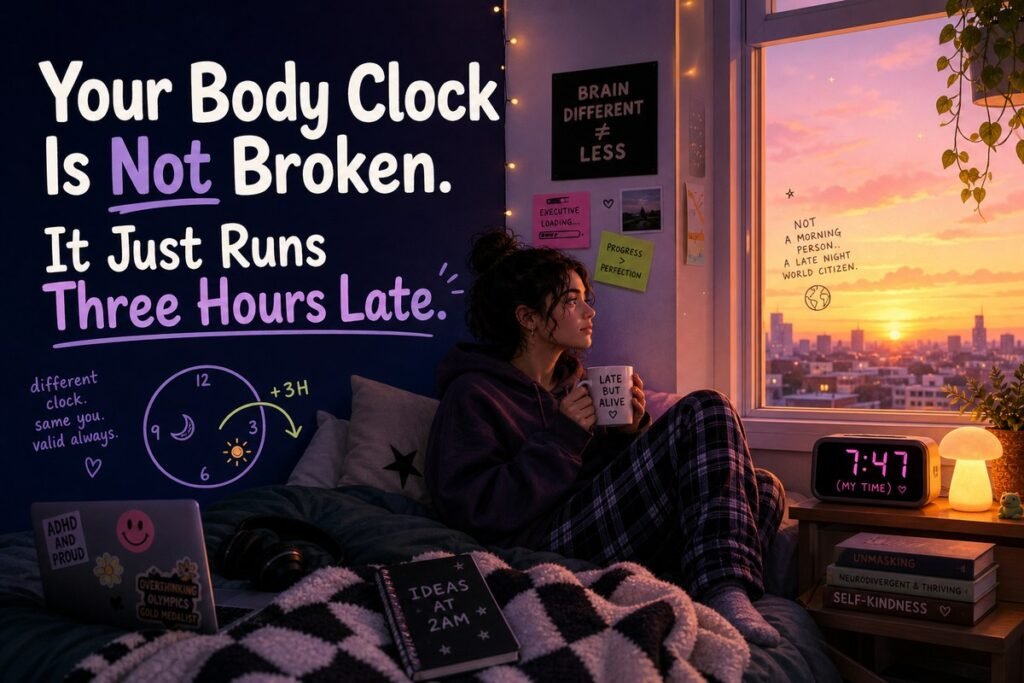
You already know the version of yourself at 11pm. Alert, ideas flowing, finally able to focus. You also know the version at 9am: fog, friction, a body that moves like it’s still underwater. You’ve probably been told that the second version is a character flaw. Too much screen time. No discipline. If you just went to bed earlier.
Here’s what nobody told you: these aren’t two different people. They’re the same brain running on a biological clock that is set, by neurology, to run late. Not broken. Not lazy. Just offset.
Professor J.J. Sandra Kooij, one of the world’s leading ADHD sleep researchers, published findings in World Psychiatry in 2025 confirming that melatonin onset in adults with ADHD is delayed by approximately 1.5 hours compared to people without ADHD. Melatonin is the chemical signal your brain releases to say “it’s time to sleep.” In a typical brain, it starts rising around 9pm. In an ADHD brain, it often doesn’t arrive until 10:30pm or later, and that small biological delay cascades into everything else: the 2am bedtime, the impossible 7am alarm, the daytime fog, the night-owl peak, all of it.
This is not a habit. It is a hardware difference. And understanding it changes everything about how you relate to your own sleep.
What Is Delayed Sleep Phase, and Why Does It Hit ADHD Brains So Hard?
Your body runs on an internal 24-hour timer. That timer controls when you feel sleepy, when your temperature dips, when your brain consolidates memory, and when your hormones shift. For most people, the timer is calibrated to something close to the standard social clock: sleepy by 10 or 11pm, awake by 6 or 7am, reasonably functional by mid-morning.
Delayed sleep phase is when that timer is set a few hours later than average. You’re not insomniac in the classic sense. You don’t struggle to stay asleep once you’re asleep. You struggle to fall asleep before midnight because, biologically, your night hasn’t started yet. And when an alarm drags you out of bed at 8am, you’re waking up in what your body still experiences as the middle of the night.
Multiple studies have documented that a substantial majority of people with ADHD show evidence of delayed circadian phase, based on the gold-standard measure: dim-light melatonin onset, or DLMO. That’s a blood or saliva test that measures exactly when your body starts releasing its sleep hormone. In ADHD, that moment keeps arriving late. One major review placed the figure at up to 75% of people with childhood-onset ADHD showing this pattern.
The link between ADHD and circadian disruption isn’t coincidental. The same dopamine pathways that regulate attention, motivation, and impulse control are also deeply involved in setting and maintaining your circadian clock. Dopamine, the chemical your brain uses to signal reward, urgency, and timing, plays a role in the brain’s master clock. When dopamine signalling runs differently, as it does in ADHD, the clock runs differently too.
Quick note: “Circadian rhythm” just means your body’s internal 24-hour schedule, the biological programme that decides when you’re alert, when you’re hungry, and when you’re ready to sleep. Everyone has one. In ADHD, it tends to run roughly 1.5 to 3 hours later than standard.
Why Does This Get Worse When You Leave Home?
If you’re 17 to 21 and reading this, there’s a good chance everything just got harder. First year of university. First flat. First time nobody is forcing you to be anywhere at a fixed time in the morning.
You probably expected freedom to help. Instead, your sleep schedule exploded.
This isn’t a failure of adulthood. It’s what delayed sleep phase looks like without external structure to hold it in place. When a parent was waking you up at 7am, the external pressure overrode your late-running clock, badly and exhaustingly, but it overrode it. The moment that structure disappeared, your body clock did exactly what it was always going to do: it drifted later and later.
A clinical review published in 2025 in the Canadian Medical Association Journal, by Dey, Do, Almagor, and Khullar at the University of Toronto, confirmed that at least half of adults with ADHD report significant sleep problems, with delayed sleep phase being among the most common. College students with ADHD show particularly severe sleep disruption. Hyperactivity traits specifically predict shorter sleep duration, while inattentive traits are linked to needing more sleep but getting worse quality sleep overall.
You didn’t ruin your sleep schedule when you got to university. You just finally stopped white-knuckling it against your own biology.
The cruel part is that this is also when the consequences hit hardest. Missed 9am lectures. Deadlines missed because the morning version of you barely functions. Feeling like everyone else is managing life fine while you’re somehow failing at sleeping, the most basic human thing.
Does Poor Sleep Actually Make ADHD Traits Worse?
Yes, and the relationship runs in both directions.
Kooij’s research is explicit on this point: sleep loss from circadian misalignment increases ADHD severity directly. Cognition and memory get worse. Mood becomes harder to regulate. Emotional reactions get bigger and faster. The parts of your brain responsible for pausing before you react, already running at lower capacity in ADHD, work even less well when they’re sleep-deprived.
Longer sleep latency (taking longer to fall asleep) has been directly linked to worse performance on selective attention tasks in adults with ADHD. Shorter total sleep time correlates with weaker impulse control. These aren’t vague associations. They show up in objective neuropsychological testing, documented in actimetry studies that track real sleep patterns over multiple nights rather than relying on self-report alone.
So if your ADHD feels dramatically worse in first-year university than it did in school, a significant part of that may be sleep debt. Not a sudden worsening of your condition. A circadian system that was already running late, now running completely untethered, draining the cognitive reserves your brain was already stretching to cover.
The 3am Brain and the 9am Brain Are the Same System
One thing that trips a lot of people up: the night-owl clarity doesn’t feel like a problem. It feels like the only time your brain actually works.
That’s because, for you, it often is. When your circadian clock finally reaches the point where your biology is alert and ready, dopamine is more available, your planning brain is more online, and hyperfocus can kick in. Of course things get done at midnight. Your brain has finally caught up to where it needed to be hours ago.
The problem isn’t the 3am brain. The problem is that the 9am brain is being asked to perform before your biological night is even finished. You’re not bad at mornings. You’re running a timezone mismatch against the rest of the world.
Being a “night person” with ADHD isn’t a personality quirk. It’s your dopamine system finally getting online after a late-scheduled biological sunrise.
This is also why standard sleep hygiene advice often feels useless. “Go to bed earlier.” Sure, but your body won’t release melatonin any earlier just because you’re lying in the dark. You can lie there for two hours, thoughts racing, feeling like you’re failing at the simple act of being unconscious. The executive function challenges that make it hard to stop tasks, switch activities, and transition between states also make it neurologically harder to wind down on schedule, which compounds the delay further.
Researchers tracking ADHD sleep patterns using wrist-worn activity monitors have found that ADHD brains tend to show more day-to-day instability in their sleep-wake patterns, not just a consistent late shift. The clock doesn’t just run late. It also runs irregularly. Some nights you crash at midnight, others you’re awake until 4am. This inconsistency makes the whole system harder to regulate, and makes social jet lag, the gap between your biological clock and the social clock, a near-permanent state.
Quick note: “Social jet lag” is the term researchers use for the mismatch between your biological sleep schedule and the one the world expects of you. For many people with ADHD, this isn’t a holiday inconvenience. It’s every single weekday.
What Can Actually Help
The goal here isn’t perfect sleep hygiene. It’s gently nudging your clock forward using the biology that controls it.
Light is your most powerful lever. Your body’s master clock sits in a region of the brain that receives direct input from your eyes. Bright light in the morning tells the clock: this is the start of the day. It shifts the whole schedule, including melatonin onset, a little earlier. Fifteen minutes of bright outdoor light within an hour of waking, even on a grey day, has a measurable effect on circadian timing. Morning light therapy using a bright light box has been explored clinically as an intervention for ADHD specifically, given the shared dopamine pathway between light exposure and the brain’s alertness system.
Darkness in the evening matters just as much. Your brain is waiting for a drop in light to trigger melatonin release. Bright artificial light, and especially the blue-spectrum light from screens, delays that signal even further. If your clock already fires late, you really can’t afford to add more delay. Dimming lights and reducing screen brightness from 9pm onward isn’t a wellness cliché. It’s removing a specific biological obstacle.
Low-dose melatonin, taken in the early evening rather than at bedtime, is supported by clinical evidence for circadian sleep timing issues in ADHD. The 2025 University of Toronto clinical guidance in the CMAJ recommends taking a small dose roughly three hours before your target sleep time, advancing gradually over several weeks. The goal isn’t sedation. It’s giving your clock an earlier signal so it can catch up. This is worth discussing with a GP or sleep specialist. It’s not the same as taking a large over-the-counter sleep dose, and timing matters far more than amount.
A Word on Stimulant Medication and Sleep
If you’re on medication for ADHD, you may already know that stimulants can make sleep harder. This is a real interaction worth taking seriously.
Stimulant medications work by increasing available dopamine and noradrenaline in the brain, the same chemicals involved in keeping you alert. If the dose lasts into the evening, it can delay sleep onset further on top of an already-late circadian clock. The 2025 CMAJ review noted that ADHD treatment should not be delayed because of sleep problems, but that medication timing and formulation are worth reviewing if sleep disruption is severe. A long-acting formulation taken too late in the morning, or a short-acting dose in the afternoon, can both push your already-late clock even further into the night.
This is a conversation for your prescriber. The point is that your sleep and your ADHD treatment don’t exist in separate boxes. They interact, and a clinician who understands both is worth finding. You can also read more about how time perception and ADHD are connected, since many of the same dopamine pathways that govern your clock also govern your sense of how time is passing.
You’re Not Failing. You’re Misaligned.
There’s a particular kind of shame that comes with sleep problems when you have ADHD. You already feel like you’re failing at the visible, measurable stuff: deadlines, attention, showing up on time. And then you can’t even manage to sleep at a normal hour. The one thing every human is supposed to do automatically.
Every system built for you, school, work, 9am lectures, was designed for a brain clock you don’t have.
But your body isn’t malfunctioning. It’s running on a different schedule, one that is neurobiologically driven and well-documented. The same dopamine differences that shape how your attention and motivation work are woven into how your clock works. You can’t separate them out, which is also why fixing sleep in ADHD often requires more than a bedtime routine.
Kooij has argued across multiple papers that sleep problems in ADHD are so prevalent, present in around 80% of adults with the condition according to her research, that they deserve to be considered a core feature, not just a side effect or a lifestyle problem. Sleep loss, in turn, makes every cognitive and emotional challenge of ADHD harder: attention, memory, impulse control, the speed at which you go from calm to overwhelmed.
Understanding that your clock runs late doesn’t fix the 9am world. But it does change how you talk to yourself at 2am when you can’t sleep, or at 8am when you can’t wake up. You’re not broken. You’re in the wrong timezone, and unlike an actual timezone, this one is adjustable with the right tools and a little patience.
Quick Dopamine Hits:
- Set a consistent wake time first, it anchors the whole system even if you slept late the night before.
- Get bright light in your eyes within 15 minutes of waking. Outdoors is best. This is the single fastest way to nudge your clock earlier over time.
- Keep your room genuinely dark from 9pm onward, screens included. Your brain is waiting for darkness to start a sleep signal it already sends late.
Rate this article
Was this a useful hit?