Your Brain Isn’t a Supplement Deficiency. What the Evidence Actually Says About ADHD and Food.

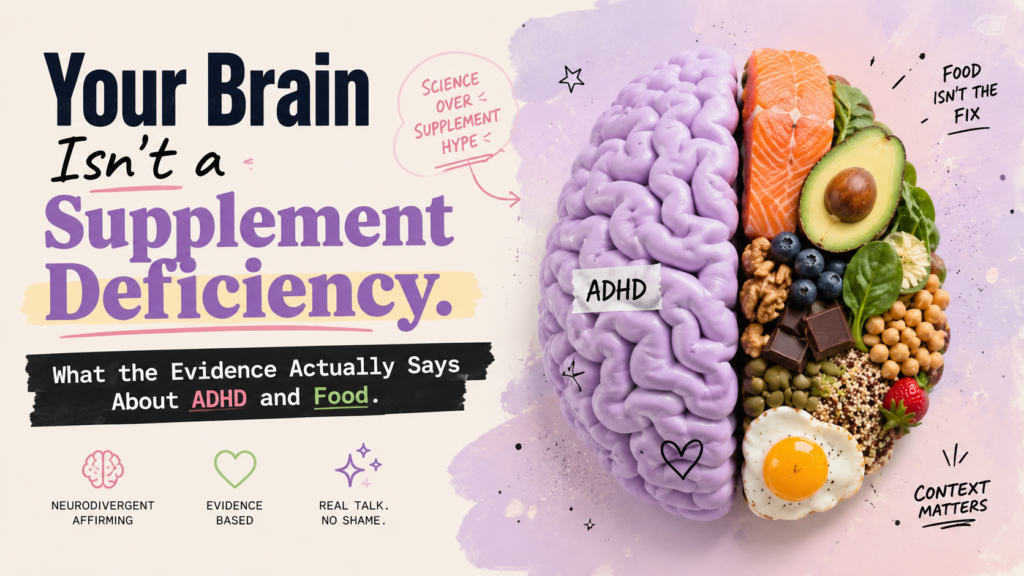
Every few months a new claim lands in ADHD spaces: cut gluten, go carnivore, load up on lion’s mane, time your carbs around dopamine cycles. The framing is always the same. Your ADHD is a deficiency. This food, this supplement, this protocol will fill the gap. The problem is that the dopamine hypothesis underpinning almost all of it is far less settled than the marketing assumes. And when you look at what peer-reviewed research on ADHD diet actually says, the picture is both more boring and more useful than the optimization content suggests.
This is not an article telling you food does not matter. It does, meaningfully. But the mechanisms are different from what most nutrition influencers describe, the effect sizes are more modest, and the practical implications are narrower. Understanding the difference between what is solid and what is noise is the only way to build a food strategy that actually holds up across a real adult life with ADHD.
The Dopamine Hypothesis Is Messier Than Your Supplement Bottle Suggests
Almost every diet claim aimed at people with ADHD rests on a single premise: ADHD is a dopamine deficiency, and therefore anything that raises dopamine will reduce symptoms. It sounds airtight. It is not.
MacDonald et al. (2024, Frontiers in Psychiatry) conducted a comprehensive review of over 40 years of evidence on dopamine dysfunction in ADHD, spanning genetic, neuroimaging, and neurometabolic research. Their findings are worth sitting with. In modern large-scale genome-wide association studies, the core dopamine-related genes that early candidate gene research focused on, including DRD4 and DAT1, do not appear among the top-ranked risk genes for ADHD. The genetic story is not pointing where we thought it pointed.
The neuroimaging picture is equally unsettled. PET and SPECT studies examining dopamine availability in ADHD brains have produced contradictory results: some report increased [18F]DOPA uptake, others document decreased uptake, and multiple studies show no significant differences from neurotypical controls at all. MacDonald et al. (2024) also note that patients with documented brain dopamine insufficiency, such as those with Parkinson’s disease, do not exhibit canonical ADHD presentations. The hyperactivity and impulsivity seen in ADHD appear unrelated to nigrostriatal dopamine loss, the kind of dysfunction that produces Parkinson’s motor symptoms.
ADHD likely involves multiple neurobiological mechanisms rather than a singular dopamine deficit. The “low dopamine” framing is a shortcut that has outlived its explanatory usefulness.
This does not mean dopamine is irrelevant to ADHD. Volkow et al.’s PET research linked decreased dopamine reward pathway function to motivation deficits in adults with ADHD, and that research is real and important. But decreased function in the reward pathway is not the same as a whole-brain dopamine deficiency that a supplement can fix. ADHD involves dopamine, norepinephrine, serotonin, glutamate, and GABA in overlapping and context-dependent ways. The “take this to boost dopamine” model is a dramatic oversimplification of a system that researchers are still mapping.
Why does this matter for diet? Because if you believe ADHD is simply low dopamine, every food or supplement that claims to raise dopamine looks promising. When you understand that the neurobiology is far more distributed and context-sensitive, the question changes from “what boosts dopamine?” to “what conditions allow my brain to function more reliably?” Those are very different questions with very different answers.
What Solid Research Says About Protein and Medication Timing
Here is one area where the physiological mechanism is real and the practical implication is concrete. If you take stimulant medication, whether methylphenidate or an amphetamine formulation, what you eat around that window genuinely affects what the drug does.
The mechanism involves large neutral amino acids, the building blocks of dietary protein. These amino acids compete with amphetamine and methylphenidate for active transport across the blood-brain barrier using the same transporter systems. When you have a large, inconsistent amino acid load in circulation, it can create variability in how much of your medication actually crosses into the central nervous system. Consistent protein intake, particularly with some separation from your medication window or as a stable morning foundation, reduces that variability. This is basic pharmacokinetics. It is not dramatic, but it is real.
The practical implication for ADHD nutrition in adults is straightforward. Eating a consistent amount of protein at consistent times matters more than eating any particular protein. Erratic eating, skipping breakfast entirely and then consuming a large protein-dense meal at noon, introduces more variability into your medication’s absorption pattern than eating the same modest amount of protein every morning. If you experience significant afternoon wear-off or an unpredictable medication curve, your eating pattern is worth examining before adjusting your dose.
On protein and stimulant medication: Large neutral amino acids compete with methylphenidate and amphetamine for blood-brain barrier transport. Consistent protein intake, not a specific superfood, reduces absorption variability and can improve medication predictability across the day.
This is not permission to obsess over protein macros. Adults who are already eating reasonably consistently and still experience wear-off likely have a dosing or formulation issue rather than a nutrition issue. But adults who skip meals regularly, which is extremely common with ADHD, are introducing a physiological variable that complicates their medication response unnecessarily.
Omega-3s: The One Supplement With Real but Modest Evidence
Of everything sold as a cognitive supplement for ADHD, omega-3 fatty acids, specifically EPA (eicosapentaenoic acid) and DHA (docosahexaenoic acid), have the most replicable and mechanistically coherent evidence base. That evidence is genuinely worth taking seriously. It is also worth calibrating correctly.
The mechanism is relevant to neurological function broadly. EPA and DHA support neuronal membrane fluidity and synaptic plasticity, both of which are important for cognitive control and attention regulation (as reviewed in adult ADHD clinical literature, including the overview in Cortese et al.). More fluid neuronal membranes allow neurotransmitter receptors to operate more efficiently. Synaptic plasticity supports the kind of learning and adaptive signaling that executive function depends on.
Omega-3 supplementation has a legitimate mechanistic rationale and a modest replicable effect. “Modest” is not dismissive, for a supplement with no significant side effects and additional cardiovascular benefits, modest is enough to be worth trying.
The effect sizes in omega-3 and ADHD research are consistently smaller than those seen with stimulant medication, substantially smaller. But they appear to be independent of stimulant effects, meaning omega-3s and stimulants are not competing for the same mechanism. For adults who are on medication and looking for a low-risk addition, or for adults who cannot or choose not to use stimulants, the evidence genuinely supports trying a quality EPA/DHA supplement.
What matters for dosing is the EPA to DHA ratio and total EPA content. Research suggests higher EPA ratios are associated with stronger effects, particularly on mood-adjacent symptoms. A combined daily dose with at least 1g of EPA is the range most study protocols use. Brand prestige is irrelevant. Third-party testing for purity matters more than marketing.
What does not have evidence support: omega-3s in combination products that split the dose across twenty other ingredients, algae-based supplements at very low doses, and omega-3s treated as a replacement for a consistent dietary foundation. They are an addition, not a system.
Why Elimination Diets Fail for Most Adults
The elimination diet conversation in ADHD circles almost always traces back to pediatric research. The specific evidence here is narrower than its reputation suggests, and it applies even less to adults than most people realize.
The most frequently cited line of research involves artificial food dyes, particularly the “Southampton Six” additives studied in children by McCann et al. (2007, The Lancet). That research found an association between certain artificial colorings and hyperactivity in children, but importantly, it was in children with and without ADHD diagnoses, the effect was not specific to ADHD neurobiology, and the effect size was small. Subsequent regulatory decisions in the EU and UK to require warning labels on products containing those additives were precautionary rather than definitive.
For adult ADHD, the evidence base for elimination diets is even thinner. There are no robust randomized controlled trials demonstrating that removing artificial additives, gluten, dairy, or any other common elimination target produces meaningful symptom improvement in adults with ADHD. The clinical overview in adult ADHD literature notes that restrictive elimination diets involving artificial food additive removal have a narrow evidence base that has not translated reliably to adult populations.
This does not mean adults should eat artificial dyes with abandon. But the psychological risk of elimination diets in adults with ADHD is real and underacknowledged. Elimination protocols are cognitively expensive: they require constant planning, label reading, social navigation, and restriction management. For a population where executive function is already taxed and perfectionism can trigger shame spirals, a restrictive protocol that produces no measurable effect is not neutral. It consumes cognitive bandwidth, can create disordered eating patterns, and often generates false attribution, the belief that when symptoms improve during an elimination period, the food was the cause, when in fact the structured eating schedule, increased self-attention, and placebo response are more likely explanations.
The elimination diet trap: When adults with ADHD feel better during an elimination protocol, the structure and self-focus often explain the improvement, not the removed food. Elimination diets are cognitively expensive and have no robust evidence base for adult ADHD symptom reduction.
Consistent Eating Patterns as Nervous System Scaffolding
This is probably the most under-discussed mechanism in ADHD nutrition, and it is also the one with the most pragmatic traction. Regular mealtimes do not boost dopamine. What they do is stabilize the physiological baseline on which dopamine signaling operates, and that is not a small thing.
Irregular eating, particularly skipping meals, produces fluctuations in blood glucose, cortisol, and sympathetic nervous system activation. Each of those fluctuations narrows the effective window of stimulant medication and increases emotional reactivity. The stress neurobiology literature on ADHD is instructive here. Research synthesized in recent clinical reviews of stimulants under stress conditions shows that glucocorticoids alter neuronal excitability and synaptic plasticity in the prefrontal cortex, while stress increases glutamatergic drive and modulates dopamine transmission in cortico-mesolimbic pathways. Within the nucleus accumbens, chronic stress shifts synaptic signaling in ways that reduce reward-anticipatory dopamine activity.
Put simply: when your cortisol baseline is elevated by irregular eating and skipped meals, your ADHD medication has to do more work against a less stable substrate. The medication’s effective window may shorten. Emotional dysregulation may increase. This is not about food being medicine. It is about food consistency being a form of nervous system hygiene that allows your actual treatment to function closer to its potential.
Meal timing is not a direct dopamine intervention. It is a stability intervention. The distinction matters because it changes what you are trying to achieve: not optimization, but a reliable baseline.
For most adults with ADHD, the meaningful target is not perfect nutrition. It is reducing the frequency and severity of the physiological disruptions that make everything harder. Two or three consistent mealtimes per day, anchored by protein and not skipped under deadline pressure, accomplish more than any supplement protocol built on an unstable foundation.
Zinc, Iron, and B Vitamins: Deficiency Matters, Supplementation Without Testing Doesn’t
Micronutrient deficiencies are genuinely relevant to ADHD symptoms. Zinc is a cofactor in neurotransmitter metabolism and is frequently reported at lower levels in individuals with ADHD, though the direct impact of supplementation in adults remains under investigation. Iron deficiency, specifically low ferritin, is associated with restless legs syndrome, sleep disruption, and fatigue patterns that significantly overlap with ADHD symptom presentation. B12 and folate deficiencies affect neurological function across populations and are particularly relevant for adults on certain medications or with gut absorption issues.
Here is the critical distinction that gets lost in supplement marketing: the evidence for deficiency correction is not the same as evidence for supplementation in people without deficiency. Testing for actual deficiency and then correcting it is evidence-based medicine. Buying a broad-spectrum micronutrient stack without knowing your levels and hoping it moves the needle is not supported by the adult ADHD research base, despite the mechanistic plausibility.
The practical step is a standard blood panel through your GP or a direct lab service: ferritin (not just hemoglobin), serum zinc, B12, folate, and vitamin D if you are in a low-sunlight environment. If a deficiency is identified, correcting it has a legitimate evidence basis and is often inexpensive. Supplementing nutrients you already have adequate levels of has no demonstrated benefit for adult ADHD symptoms and adds cost, pill burden, and complexity to an already complicated daily management structure.
The Stress-Nutrient Interaction: Why the Same Diet Works Differently Under Load
One of the most practically important and least discussed aspects of ADHD nutrition is that the same dietary pattern produces different outcomes depending on your stress load, sleep quality, and external circumstances. This is not a vague wellness claim. It has a mechanistic basis in stress neurobiology.
Clinical evidence synthesis on stimulants under sustained stress shows that periods of high psychosocial demand, including financial strain, academic deadlines, or chronic workplace pressure, are associated with greater functional difficulty for adults with ADHD, narrowed therapeutic windows for stimulants, and increased likelihood of emotional and sleep-related adverse outcomes. The mechanism involves stress hormones remodeling prefrontal and striatal networks that support attention and motivation, while simultaneously increasing glutamatergic drive and disrupting dopamine transmission patterns in cortico-mesolimbic pathways.
What this means practically for food and ADHD adults: during high-stress periods, your nutritional strategy needs to be simpler and more robust, not more elaborate. The cognitive load of complex meal planning compounds the cognitive load of the stressor. The disrupted sleep degrades appetite regulation and decision-making around food simultaneously. The financial pressure that often accompanies high-demand periods may limit food access. Expecting your diet to perform at its best precisely when everything else is hardest is a setup for failure and self-blame.
The realistic goal during high-load periods is maintaining enough consistency to avoid actively destabilizing your baseline. Enough protein to support medication transport. Regular enough mealtimes to avoid cortisol spikes. Omega-3s if they are already in your routine and easy to maintain. Nothing more elaborate than that is evidence-supported as necessary.
Building a Food Strategy That Is Evidence-First, Not Optimization-First
The supplement and wellness industry serves ADHD audiences a version of nutrition that is fundamentally about optimization, the idea that if you just find the right stack, the right ratio, the right protocol, you will unlock a version of your brain that works the way you want it to. That framing is not only unsupported by the evidence, it is actively counterproductive for a population that already struggles with perfectionism, all-or-nothing thinking, and shame cycles around failed systems.
A more honest and more useful framing is this: food strategy for ADHD adults is about reducing instability, not engineering performance. The decision sequence looks something like this: first, get a micronutrient panel and address any confirmed deficiencies. Second, establish consistent mealtimes as a non-negotiable, at least two anchors per day, with enough protein to support your medication’s pharmacokinetics. Third, add an omega-3 supplement with a meaningful EPA dose if you tolerate it and can sustain it. Stop there unless you have a specific, testable reason to do something else.
How do you know if this is working? Not by tracking mood hour by hour in a spreadsheet. Watch for these specific signals over two to four weeks: Does afternoon medication wear-off seem more or less predictable? Are you experiencing fewer mid-afternoon emotional crashes that seem disconnected from events? Is your sleep quality stable enough to assess medication effects clearly? These are proxies for the nervous system stability that consistent eating supports. If they improve, your foundation is working. If they do not, the issue is more likely dosing, formulation, sleep, or a comorbid condition, not an insufficiently optimized food protocol.
The question is not “what can I add to make my brain work better?” The question is “what instabilities am I introducing that are making everything harder?” Those are different problems with different solutions.
Thread, the follow-through tool on this platform, is built specifically for the kind of low-drama consistency work that evidence-based nutrition requires: not a dramatic protocol overhaul, but the steady maintenance of a small number of high-leverage habits across weeks and months. If the gap between knowing what to do and actually doing it is where this breaks down for you, that is the lever worth pulling.
The noise in the ADHD diet space is loud because it promises what ADHD adults desperately want: a clean, controllable explanation and a concrete fix. The actual evidence is quieter and less exciting. Consistent meals, adequate protein, tested micronutrients, and modest omega-3 supplementation. That is most of what holds up under scrutiny. Everything else deserves skepticism until it earns otherwise.
Quick Dopamine Hits:
- Set a phone alarm labeled ‘protein first’ for 20 minutes before your medication window. Eat 15, 20g of protein before the dose. Do this for two weeks and note whether afternoon wear-off shifts.
- Order a full micronutrient panel from your GP or a lab: ferritin, serum zinc, B12, and folate. Do not buy supplements until you have the numbers. Deficiency replacement works, prophylactic supplementation does not.
- Pick one consistent mealtime as your anchor, the same time every day regardless of hunger. Treat it like a medication dose. Skipping it is not neutral, it degrades your cortisol baseline and narrows your medication’s effective window.
Rate this article
Was this a useful hit?