Your Apartment Isn’t Messy Because You’re Failing — It’s Messy Because It’s Fighting Your Brain

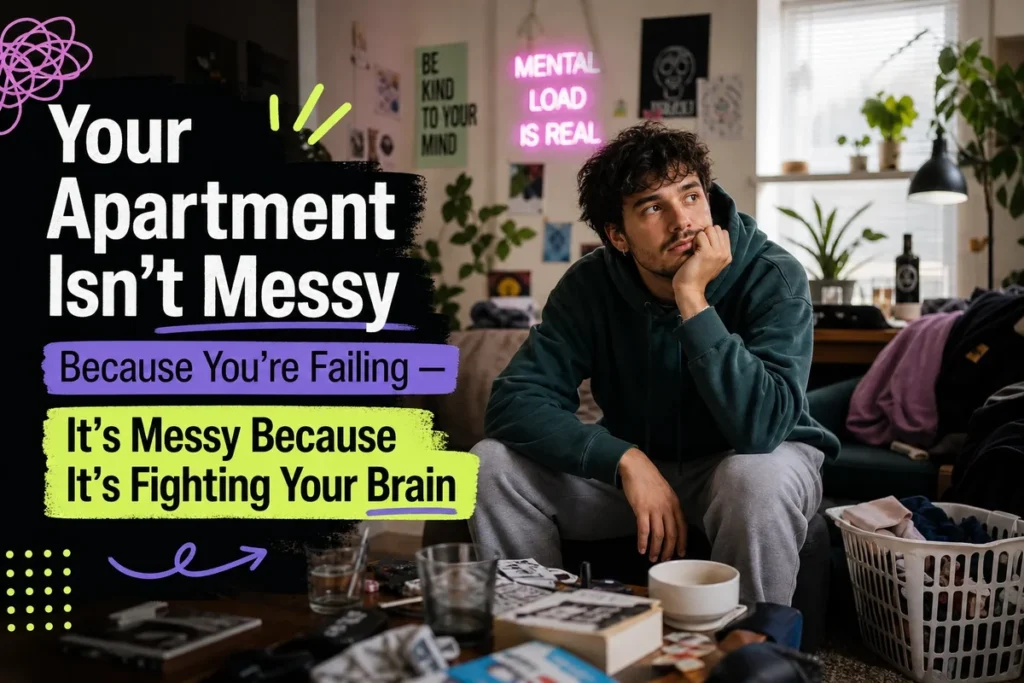
Every surface in your apartment holds a small tax. Unopened mail, a mug that migrated from the kitchen three days ago, a pile of clothes on the chair that is technically a chair but functionally a wardrobe: each of these is a micro-demand on your attention, a low-level alarm the ADHD brain often cannot fully mute. The research on working memory in ADHD is unambiguous: this is a system that is already stretched thin. When your physical environment adds constant background noise to that system, it does not just feel harder to get things done. Cognitively, it genuinely is harder. Your apartment is not a reflection of your character. It is an obstacle course that was never engineered for your neurology.
Why Visual Clutter Hits the ADHD Brain Differently
Working memory deficits are among the most replicated findings in ADHD research, with effect sizes across meta-analyses landing around d=0.69 to 0.74, placing them firmly in the substantial range. What working memory actually does is act as the brain’s active workspace: the mental scratch pad that holds current context while you figure out what to do next. When you walk into a cluttered room, your visual system begins cataloguing everything it sees. A neurotypical brain can suppress most of that input relatively easily and focus on the one relevant thing. The ADHD brain is significantly worse at this selective filtering.
Research on selective attention in adults with ADHD consistently shows that visual attention problems are among the most pronounced features of the condition (Selective Attention Dynamics in Adults With ADHD, Frontiers in Neuroscience, 2022). Where auditory distraction creates moderate interference for ADHD adults, visual distraction tends to be worse, particularly in inattentive presentations. The implication for your living space is not trivial. A cluttered counter is not a benign backdrop. It is an active competitor for the neural resources your brain needs to initiate the next task. Every object your eye lands on that is not what you intend to do costs something from a system that has less to spend.
Low working memory capacity may give rise to short attention spans and distractible behavior due to a failure to maintain task goals, and to the intermediate products of ongoing mental activity, causing attentional focus to shift away from the task at hand toward other salient events in the environment. (Holmes et al., 2014, Frontiers in Human Neuroscience)
This is the mechanism behind the experience most ADHD adults recognize immediately: you walk into the kitchen to wash the dishes, notice the recycling that needs to go out, remember a call you forgot to make, see the sticky note you cannot decode, and leave having done none of it. The environment hijacked the working memory buffer before the task had a chance to get started. That is not distraction in the colloquial sense. That is a cognitive load problem built into the physical space.
What Friction Actually Costs an ADHD Brain
Friction, in the behavioral science sense, is anything that adds steps between an intention and an action. For a neurotypical brain, moderate friction is manageable. For the ADHD brain, friction carries a disproportionate cost because of how the dopamine reward pathway functions. Research using PET imaging found significantly decreased dopamine receptor and transporter availability in the reward pathways of adults with ADHD, specifically in the midbrain and nucleus accumbens, the brain regions responsible for translating intention into motivated action (Volkow et al., Motivation Deficit in ADHD is Associated with Dysfunction of the Dopamine Reward Pathway). What this means in practice is that the ADHD brain requires a stronger reward signal to initiate a task than a neurotypical brain does. When friction adds steps, the perceived reward-to-effort ratio drops. The task feels not just harder but genuinely less worth starting at all.
Apply this to something as ordinary as laundry. If the hamper is in a closet behind a door you have to pull open, and the laundry room is two floors down, and you need coins, and you have to remember to go back: every one of those steps is a friction point that chips away at the dopamine-driven activation budget. Taken individually, each step is minor. Taken together, they form a chain that the ADHD brain finds genuinely difficult to initiate, not because you cannot be bothered, but because the reward pathway cannot generate enough forward momentum against that chain of friction. This is the architecture of the problem. The solution is not to develop more willpower. It is to redesign the chain.
The friction math: Research on dopamine-related motivation deficits in ADHD shows that the reward signal required to initiate tasks is structurally higher than in neurotypical brains. Adding even one extra step between intention and action can be the difference between starting and not starting, not because of laziness, but because of neurology.
Why “Out of Sight” Really Does Mean “Out of Brain”
ADHD object permanence is not a quirky metaphor. It describes a real functional consequence of working memory deficits: when something leaves your immediate sensory environment, your brain often stops actively representing it as relevant. Arnsten et al. (2009, Neuron) established that dopamine and norepinephrine modulate the signal-to-noise ratio in prefrontal networks. Without adequate modulation, the network responsible for holding background representations, such as “the thing I need to do tonight” or “the bill that arrived Tuesday,” gets overwhelmed by whatever is most salient in the present moment. The present tends to win, not because you choose it, but because your brain’s architecture gives it a structural advantage over things you cannot currently see.
This is why the standard advice to “put things away” is actively counterproductive for many ADHD adults. A beautiful cabinet with neatly labelled drawers is also a system that makes important objects functionally invisible. The vitamins in the bathroom cabinet often will not get taken. The library books in the tote bag in the closet will not get returned. The letter that needs a reply will live in the drawer indefinitely. Hiding things solves the visual clutter problem but creates an object permanence problem, and for ADHD brains the object permanence problem is often more costly. The question is not “where is the tidiest place for this?” but “where will I actually see this when it is relevant?”
From the community: “Things that make sense in your ADHD friendly apartment?”, a thread that generated hundreds of responses, with the recurring theme that environmental friction is a neurological problem, not a personal failing., r/ADHD thread
The Visibility Principle: Open Storage and Why It Works
The single most evidence-consistent change you can make to an ADHD-friendly home is to shift from concealed storage to open storage for things you need to use regularly. Open shelving, hooks instead of drawers, clear containers instead of opaque boxes, bowls on counters instead of cupboards. This is not primarily an aesthetic choice. It is a direct response to the object permanence problem. If you can see the thing, your working memory does not need to actively maintain a representation of it. The environment is doing the cognitive work instead of your brain.
Barkley’s framework for ADHD management places heavy emphasis on what he calls point-of-performance interventions: getting the cue, the tool, and the reminder present at the exact moment and location the behavior needs to happen. The principle applies directly to home design. Your medication goes where you make coffee, not in a medicine cabinet. Your keys go on a hook immediately inside the door, not “somewhere logical.” Your gym bag goes where you will physically have to step over it, not in a wardrobe where it has ceased to exist. The environment becomes the external working memory your internal working memory cannot reliably provide. This is also the underlying logic behind the popular ADHD strategy of keeping things in plain sight: what feels like messiness to a neurotypical observer is often a functional organizational system for an ADHD brain.
The assistive technology design framework for ADHD identifies minimizing distractions and establishing visible routines as core design strategies, noting that ADHD challenges with organization of materials represent a distinct executive function domain, not a general failure of effort. (Sonne et al., An Assistive Technology Design Framework for ADHD)
Designing Zones That Reduce Decision Fatigue
Decision fatigue is a well-documented phenomenon: each decision depletes a finite cognitive resource. The ADHD brain tends to start with a smaller effective allocation of that resource and can spend it faster under conditions of uncertainty or complexity. A home that requires constant small decisions, such as where to put this, where does this go, or which drawer something was in, is a home that will exhaust an ADHD brain before it has done anything meaningful. The antidote is zones.
Zoning means assigning a physical location a single, consistent purpose and then defending that purpose from creep. The counter near the door is the “things that need to leave the apartment” zone. Nothing else goes there. The basket on the coffee table is the “currently active projects” zone. One project, one basket. The kitchen table has one designated working surface and nothing else gets placed there. The power of zones is not that they create perfect order. It is that they eliminate micro-decisions. When everything has a zone, the cost of putting something away drops significantly, and the cost of finding something drops with it. Both of those are friction points that the ADHD brain has been paying silently, every day.
The same logic applies to what designers sometimes call commitment devices for ADHD home setup. A charging station that is the only place your phone charges means you always know where your phone is. A single tray for mail means you make one decision about mail, not sixteen. These are not organizational hacks in the superficial sense. They are friction-reducing environment designs that work because they reduce the number of decisions the prefrontal cortex has to make, freeing up that limited resource for tasks that actually matter. This connects directly to the broader ADHD systems framework: sustainable home organization is not about doing more but about designing environments that demand less.
The Sensory Environment Matters Beyond Tidiness
Visual clutter is the most discussed sensory issue in ADHD home design, but it is not the only one. Research on sensory processing in adults with ADHD consistently finds that ADHD-related attention problems are context-dependent rather than global: the same person who struggles to filter visual distractions may actually perform better with ambient auditory noise than in silence. The Moderate Brain Arousal model, explored by Söderlund et al. in research comparing white noise effects in children with ADHD and control groups, proposes that the ADHD brain, with its characteristically lower baseline dopamine tone, can benefit from background noise that raises overall neural arousal toward a more optimal level. This is a significant part of why many ADHD adults report focusing better in cafes, with music playing, or with background television: environments that feel chaotic to others are, counterintuitively, providing a calibrated level of stimulation that helps the ADHD brain filter and engage.
Practically, this means the ADHD-friendly home environment is not necessarily a silent minimalist space. It means being intentional about which sensory inputs serve you and which ones compete for your attention. A consistent background music playlist or ambient sound may genuinely help. Alternating visual noise, meaning visual information that keeps changing and drawing the eye, tends to be harmful. The difference is between noise that fills an arousal baseline and noise that keeps pulling your attention away from what you are trying to do. Designing your sensory environment with that distinction in mind gives you a tool that most home organization advice completely ignores.
What an ADHD-Designed Space Actually Looks Like
An ADHD-designed space does not look like a magazine spread. It looks like a place where the friction between intention and action has been systematically reduced. Hooks on the wall by the door, because hooks beat coat closets for ADHD brains in most cases. A whiteboard on the fridge, or sticky notes at eye level, because the information needs to be where you will be when it is relevant. Laundry hampers that are open-topped and in the room where clothes come off, not in a separate space. Dishes that fit in a drying rack rather than requiring immediate cabinet storage, because the cabinet step adds friction. A designated charging spot that is also where you land when you come home, so the phone charges without a separate decision.
The overarching principle is cognitive offloading: moving as much organizational work as possible out of your brain and into the physical environment. This is not a concession to dysfunction. It is a design response to a real neurological constraint. Research consistently shows that compensatory strategies, including external structuring devices, environmental scaffolding, and point-of-performance reminders, are the mechanism behind adaptive functioning in many adults with ADHD, not willpower or internalized systems (Barkley, 1997). An environment that does cognitive work for you is not a crutch. It is infrastructure.
Individuals who perform well in highly structured or well-adapted contexts while struggling silently in less supportive environments demonstrate that the issue is often not capacity but context. Change the environment and the performance can change with it. (Adapted from: High Functioning Yet High Suffering, a clinical commentary on adult ADHD diagnostic criteria)
Starting the Redesign Without Entering ADHD Paralysis
The paradox of redesigning your space is that the task requires sustained effort in precisely the environment that is currently most hostile to sustained effort. Starting a whole-apartment overhaul is exactly the kind of large, ambiguous, multi-step project that the ADHD brain tends to struggle most to initiate. Bodalski, Canu, and Hartung (2023) found that emotional dysregulation, including the sense that a task is too big or the frustration of not knowing where to start, is one of the strongest drivers of procrastination in ADHD. The answer is not to find more motivation. It is to reduce the scale of the task until it is small enough that the initiation cost falls within your available activation budget.
One surface. One zone. One category of objects. Not the whole apartment, not a weekend project, not a system overhaul. The question to ask is: what is the single physical friction point costing me the most this week? The answer might be that your keys are never where you expect them, so that is where you start: a hook goes up beside the door, today, before anything else. Or it might be that every morning you cannot find your medication, so the medication moves to beside the kettle right now. The principle of starting with the highest-cost friction point means you get the largest cognitive payoff for the smallest amount of effort. Once that one thing is working reliably, the system earns enough trust to expand.
The redesign rule: Identify the one friction point costing you the most cognitive load this week: the thing you lose most often, forget most reliably, or avoid most consistently. Fix that one thing before touching anything else. Small environmental wins compound into sustainable infrastructure.
Your Space as ADHD Infrastructure
The shame that accumulates around a messy apartment deserves to be named directly, because it is often heavier than the mess itself. It carries the weight of every self-help article that implied your home reflected your character, every comment from someone who simply cannot function in chaos, every morning you walked past the pile and felt a fresh stab of self-judgment. That shame is misattributed. What you have been living with is not a character flaw made physical. It is an environment designed for a different kind of brain, combined with organizational strategies built on the same assumption.
The ADHD brain is not broken. It is running a working memory and dopamine reward system with different specifications than the default organizational advice assumes. When the advice fails, the failure belongs to the advice, not to you. Environment design for ADHD is not about achieving the tidiness standard someone else set. It is about building a space where your brain can spend its limited cognitive resources on things that actually matter, rather than burning them on a constant low-level war with friction, visual noise, and objects that have become functionally invisible. That is a systems problem. And systems problems have systems solutions.
If the organizational layer, the habits, routines, and follow-through that sit on top of environment design, is the part that keeps collapsing, that is a separate and equally structural issue worth investigating. Why ADHD organization systems keep breaking down goes into the cognitive architecture behind that pattern, and the design features that actually survive contact with an ADHD brain over time.
Quick Dopamine Hits:
- Pick one surface, the kitchen counter, the bathroom sink ledge, or your desk, and remove everything that doesn’t belong there right now. One surface, five minutes. That’s the whole task.
- Put one frequently avoided item (vitamins, charger, keys, medication) somewhere you will literally walk into it, on your pillow, in front of the kettle, directly on top of your phone. Make it impossible to miss.
- Choose one opaque container and one open tray or bowl. Move the things you hide (and then forget) into the open tray. Move the things you never need to see but keep accessible into the opaque container. Start with one category.
Rate this article
Was this a useful hit?