Your Autistic Brain Wants a Schedule. Your ADHD Brain Just Burned It Down. Here’s What Actually Works.

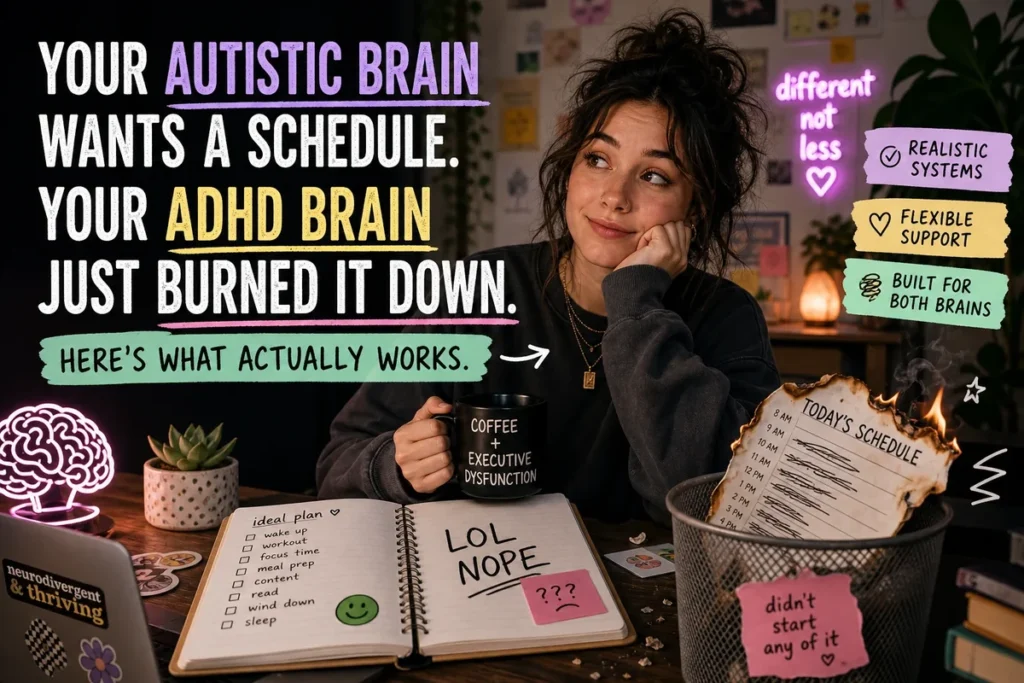
If you have both autism and ADHD, you have probably built the same routine at least a dozen times. You design it carefully, maybe even colour-code it. For a few days it works, and something in you relaxes at the predictability of it. Then the ADHD gets bored, the whole thing collapses, and you are left with the specific guilt of someone who knows exactly what they need and cannot make themselves do it. This is not a discipline problem. It is the central structural problem of AuDHD daily life: your autistic nervous system requires predictable routine to feel safe, while your ADHD nervous system dismantles routine the moment it stops being novel. Both drives are neurological. Neither one is optional. And almost no advice about building structure addresses what happens when you need both at the same time.
Why Standard Routine Advice Fails AuDHD People Completely
Most productivity advice is written for one of two audiences: people who need more structure, or people who need more flexibility. Autistic-focused resources generally tell you to add more routine. ADHD-focused resources generally tell you to make things more stimulating and varied. Applied to an AuDHD brain, both types of advice solve half the problem and create the other half. More rigid routine produces the sameness your autistic nervous system craves, and within days your ADHD is in active revolt. More novelty and flexibility satisfies the dopamine-seeking ADHD brain and plunges your autistic nervous system into the disorientation that comes from not knowing what is coming next.
Research published in Health (Craddock, 2026) documented this exact dynamic through interviews with women diagnosed with both conditions in adulthood. One participant described it precisely: “My autism creates a need for order, formality, structure, routines, repetition, solitude, and intense interests, all of which are disrupted by my ADHD’s chaotic impulse towards newness, variety, inconsistency, and inattention. So I am forever starting routines and habits (autism) but I can never stick to them because I lose motivation and get bored (ADHD).” What is striking is that this person does not describe confusion about what they need. They understand it completely. The problem is structural: the two needs are genuinely incompatible when addressed with standard, single-condition advice.
From the community: “My autism creates a need for order, formality, structure, routines, repetition, solitude, and intense interests, all of which are disrupted by my ADHD’s chaotic impulse towards newness, variety, inconsistency, and inattention. So I am forever starting routines and habits (autism) but I can never stick to them because I lose motivation and get bored (ADHD).”, r/ADHD thread
This tension is not incidental to the AuDHD experience. It sits at the centre of it. And it is invisible to clinicians and productivity writers who treat autism and ADHD as separate categories rather than as a single interactive neurological profile. As Craddock (2026) noted, the clinical history of treating these conditions as mutually exclusive meant that people living with both had no framework for understanding why standard strategies reliably failed them. They were left concluding that they were uniquely broken, when in fact they had a problem that required a genuinely different kind of solution.
What Each Nervous System Is Actually Asking For
Before you can build a structure that works, it helps to understand what each part of your neurology is requesting, and why those requests seem irreconcilable at first glance.
The autistic nervous system uses predictability as a regulatory tool. When the environment is known and sequenced, the cognitive and sensory processing load drops significantly. Research consistently identifies craving familiarity, finding comfort in routines and repetitive behaviours, strict adherence to routines, and a need for contextual clarity as core autistic traits (as documented in late-discovery literature reviewed by Neff, 2023, and the National Autistic Society, 2024). This is not about preference in a casual sense. Predictability reduces what the autistic nervous system has to monitor and compute at any given moment. Unpredictability is not just uncomfortable, it is genuinely more cognitively expensive.
The ADHD nervous system operates from almost the opposite direction. Dopamine pathways in ADHD brains show what researchers describe as deficient reinforcement learning signals, meaning the brain does not reliably generate the neurochemical engagement it needs from predictable, lower-novelty tasks. Research on ADHD dopamine modelling finds that ADHD brains tend to switch between options more frequently than non-ADHD brains and struggle to sustain engagement with choices that have lost their reward signal (Frank et al., 2007, Luman et al., 2009, as reviewed in reinforcement learning literature). The ADHD system is not simply bored by routine. At a neurochemical level, routine can stop providing the activation signal the brain needs to engage at all.
The autistic brain uses predictability to lower its processing load. The ADHD brain needs novelty to generate the dopamine required for engagement. In AuDHD, these are not competing preferences. They are competing survival mechanisms.
Both of these drives are adaptive. Both reflect functional responses to the specific neurological architecture each condition involves. The problem is that in AuDHD, they are running simultaneously in the same person, which means any structure you build will partially satisfy one system while frustrating the other. The solution is not to pick one neurology to serve. It is to build a structure with two distinct layers, one for each.
The Anchor-and-Novelty Model: A Hybrid Frame for AuDHD Brains
The most practical approach to AuDHD routine building is what community members and some clinicians have started calling an anchor-and-novelty framework. The principle is straightforward: the skeleton of your day stays fixed (the anchor layer), while the content within that skeleton is deliberately variable (the novelty layer). Your autistic nervous system gets the predictability of a reliable sequence. Your ADHD nervous system gets enough variation within that sequence to maintain dopamine engagement.
Anchors are not full routines. They are a small number of fixed, non-negotiable transition points in the day, each associated with a sensory or contextual cue that signals the shift. Think of them as doorframes rather than hallways: they define where you are moving from and to, without dictating every step between. For many people, three to five anchors spread through the day is a workable number. A morning anchor, a midday reset, and a wind-down sequence at the end of the day are the most common starting points. The power of anchors is that they do not require working memory to activate. They are cued by something external: a particular playlist, a specific scent, a change in lighting, a cup of a particular tea. Research on ADHD assistive design notes that structure is most effective when it occurs in a predictable pattern and is cued externally rather than relying on internal recall (Firmin and Phillips, 2009, as reviewed by Sonne et al.). This applies directly to AuDHD: the anchor point works because it is environmental, not because you remembered to start it.
The anchor point rule: Anchors should require zero decision-making to begin. They start because a sensory or environmental cue fired, not because you thought “it’s time to start.” If your anchor requires you to remember to initiate it, it is not yet an anchor. It is a task.
Novelty slots are the designated spaces inside and between your anchors where variation is not just permitted but planned. Instead of letting your ADHD brain blow up the whole structure when it gets bored, you build in sanctioned flexibility. A novelty slot might be the specific activity you do between your morning anchor and starting work: it rotates daily, could be a different podcast, a walk on a different route, or a short hyperfocus on something currently interesting. It might be which order you complete your work blocks, or which environment you work in during the afternoon. The key design principle is that the novelty is contained within the anchored structure rather than replacing it. Your autistic brain knows the frame is intact. Your ADHD brain gets the variation it needs to stay activated.
Why Your Routines Keep Collapsing
If you are AuDHD and your routines have always fallen apart after a week or two, this is not because you are bad at routines. It is because you were building one-system routines for a two-system brain. A 2026 study by Ruel et al., published in Frontiers in Child and Adolescent Psychiatry, compared routine execution across neurotypical children, children with ADHD, and children with autism spectrum condition. The researchers found that children with ADHD showed significantly more difficulty with morning routines and homework tasks than both other groups, and experienced significantly more frustration during routine execution. Critically, the nature of routine difficulties differed across the ADHD and autism groups: challenges showed up differently in behavioural self-regulation and planning and time management. The AuDHD combination compounds both profiles at once.
Routine collapse in AuDHD also tends to follow a recognisable pattern. The autistic part of the brain builds the structure with genuine care and detail, which is itself a form of interest-driven systematising. The ADHD part of the brain, initially engaged by the novelty of a new system, finds that novelty exhausted within days. The dopamine signal drops. The ADHD brain begins seeking stimulation elsewhere, and the routine loses its grip. What looks like giving up is actually a neurochemical signal running out of fuel. This is the precise failure point that an anchor-and-novelty design targets: keeping the framework intact while rotating the fuel source often enough that the ADHD system stays engaged.
Routine collapse is not a character flaw. It is a design flaw. The routine was built for one set of neurological requirements when two sets are operating simultaneously.
The role of time blindness in AuDHD routine failures is also worth naming directly. ADHD time blindness means the gap between “I should start the routine now” and actually starting it can expand invisibly, without any subjective sense that time has passed. The autistic brain may then become distressed by the violation of the expected sequence, which triggers dysregulation, which makes it even harder to re-enter the routine. External time anchors, whether visible clocks, timers, or alarms cued to anchor points, are not optional extras for AuDHD people. They are structural requirements. Without them, the internal time signal is too unreliable to sustain even a routine the autistic brain genuinely wants to maintain.
The Sensory Design Layer Most Advice Skips
Standard productivity advice treats environment as background. For AuDHD people, environment is foreground. The sensory conditions of a space can make the difference between a routine that starts automatically and one that stalls before it begins, because the autistic nervous system continuously processes sensory input as a regulatory signal. If the environment feels wrong, the nervous system does not settle into the routine’s next step. It stays on alert.
Designing sensory consistency into anchor points is one of the highest-leverage moves available. This means assigning a specific and reliable sensory profile to each anchor. The morning anchor might always begin with the same lighting (warm, not overhead), the same scent from a diffuser, and a drink prepared the same way each time. These are not rituals for their own sake. They are sensory signals that tell the autistic nervous system “this is a known, safe transition” before any cognitive task has to be initiated. They also reduce working memory demand: because the sensory cue fires first, you do not have to remember what comes next. The environment prompts the sequence.
The ADHD dimension of sensory design works differently. ADHD brains often benefit from moderate ambient stimulation during cognitive work, particularly background sound that is complex enough to reduce distractibility but not so demanding as to compete with the primary task. What the autistic dimension requires is more control over sensory input: the ability to choose and manage the sensory environment rather than being subjected to unpredictable sensory events. For AuDHD people, the practical implication is that you need both: a consistent sensory baseline you have chosen (autistic need) with the option to add selected stimulation within that baseline (ADHD need). Noise-cancelling headphones with your own playlist, rather than an open-plan space with unpredictable sound, is not merely a preference. It is a structural requirement for many AuDHD people.
Sensory scaffolding works both ways: Autistic nervous systems need sensory conditions to be predictable and self-chosen. ADHD nervous systems often need moderate stimulation within those conditions to stay engaged. Design your environment for both: a controlled sensory baseline with selected variable input like music or movement inside it.
Externalise Everything: The Working Memory Problem in AuDHD
Working memory is affected in both autism and ADHD, though through somewhat different mechanisms. Research on executive function in both conditions consistently identifies working memory as a shared area of difficulty, even as the profiles differ across other domains (Townes et al., 2023, Journal of Attention Disorders; Liu et al., 2024, Review Journal of Autism and Developmental Disorders). For AuDHD people, this means that even routines your autistic brain has memorised and your ADHD brain finds temporarily engaging can be disrupted simply because working memory dropped a step mid-execution.
The structural implication is clear: your routine cannot live in your head. It needs to be externalised into the environment in a form that is visible, consistent, and low-friction to consult. A written sequence on a whiteboard by your desk, a laminated card in your bathroom, a pinned note on your phone’s lock screen: the medium matters less than the visibility. If you have to open an app, navigate a menu, or remember where you put the list, that friction point will become a failure point on days when executive function is already taxed.
The specific format of externalised routines matters too. AuDHD brains tend to respond well to sequences that are ordered but short, and that include the sensory or contextual cue alongside the step itself. Not just “shower” but “shower (towel already on hook, warm lighting, playlist on).” The additional detail pre-loads the context so your brain is not generating the setup from scratch each time. This is particularly relevant during periods when the autistic part of the brain is in sensory overload or the ADHD part is in low-dopamine inertia: the detailed external prompt can substitute for the internal initiation signal when both are compromised.
This connects to the broader ADHD life systems principle of designing around your brain’s actual architecture rather than against it. Externalising the routine is not a sign of failure to internalise good habits. It is an evidence-backed accommodation of how AuDHD working memory actually operates.
Protecting the Routine Without Making It a Cage
One of the subtler AuDHD complications is that autistic rigidity and ADHD demand avoidance can combine to make any routine feel like a threat. The autistic part of the brain may become attached to the routine’s exact form to the point where a minor deviation triggers disproportionate distress. The ADHD part of the brain, particularly where demand avoidance features are present, may experience even a self-designed routine as an external imposition and resist it. The result is that the routine you built to reduce anxiety becomes a source of it.
Building in explicit and sanctioned flexibility is one way to address this. Certain parameters stay fixed: the anchors, the sensory cues, the sequence of transitions. Certain parameters are openly variable: which novelty slot activity you choose, which order you tackle work blocks within a session, how long you spend on each element within a defined window. The autistic nervous system can tolerate variation more easily when the variation itself is predicted and bounded. “This slot always changes” is itself a form of predictability. The ADHD nervous system gets its autonomy signal because nothing is over-specified.
Recovery design matters equally. AuDHD routines need built-in re-entry points after disruption. Life will disrupt the structure, whether through illness, sensory overload, hyperfocus running past a transition, or a low executive function day. If the routine is designed so that missing one element invalidates the whole thing, it will be abandoned after the first disruption. If it is designed with explicit return points, “if morning collapsed, the midday anchor is still available, if both collapsed, the wind-down is still worth doing,” the structure survives imperfection. This is not lowering standards. It is designing for a nervous system that will have irregular days and needs a structure that remains accessible even then.
The goal is not a routine you can execute perfectly every day. It is a structure you can re-enter on the bad days without having to rebuild it from nothing.
The energy costs of maintaining a structure that fights both your neurology simultaneously are real. As explored in the piece on the AuDHD double bind, every strategy one condition relies on becomes material for the other condition to dismantle. A hybrid structure that holds at 70 percent of days is worth far more than a perfect structure that holds for four days and then fails entirely.
What a Workable AuDHD Day Actually Looks Like
Rather than prescribing a specific schedule, which would immediately collide with the ADHD resistance to anything imposed from outside, it helps to describe the architecture and let you build the content into it.
The structure has a fixed morning anchor, cued by a sensory signal rather than willpower, and containing a short, predictable sequence of steps that move you from sleep to functional without requiring decisions. After the anchor, there is a novelty slot: whatever currently-interesting thing you want to do for a defined period. This is not a reward for completing the anchor. It is part of the anchor’s design, because the ADHD brain often needs a dopamine hook to make the whole sequence worth beginning. The morning novelty slot is one of the most important features of an AuDHD morning routine, and almost every neurotypical productivity framework leaves it out entirely.
The midday reset anchor is a shorter version of the same principle: a sensory-cued transition point that marks the shift from whatever you were doing to a rest or nourishment phase. It does not need to be elaborate. Eating the same thing, in the same place, with consistent background noise for a defined period is often enough. The consistency is the point. The novelty need in this window can be met by listening to something different each day, or by doing a brief unstructured activity before returning to work.
The wind-down anchor tends to matter more than most people expect, because AuDHD brains often have significant difficulty with the transition from active-mode to rest-mode. Hyperfocus can extend well past the point where the body needs rest, and the autistic nervous system may find the shift to lower stimulation difficult if it is not signalled clearly. A consistent wind-down sequence, cued by sensory or environmental signals, gives the nervous system advance notice that the transition is coming rather than requiring it to switch modes abruptly.
The specific activities between your anchors can vary substantially day to day. Your autistic brain knows the frame is intact. Your ADHD brain gets to choose what fills it. This is not a compromise between two competing needs. It is a structure that actually serves both of them at once.
Summer Is When AuDHD Structure Needs the Most Intentional Design
If you are reading this in June or July, there is a particular context worth naming. Summer is one of the hardest structure environments for AuDHD adults. The external scaffolding that comes from school schedules, work rhythms, and seasonal routines disappears, replaced by long unstructured days that neurotypical advice frames as freedom. For AuDHD people, the removal of external structure is not freedom. It is the removal of the regulatory architecture your autistic nervous system depended on, combined with the removal of the novelty signal your ADHD brain was getting from a varied weekly schedule.
The collapse of external scaffolding during summer is not a personal failing. It is what happens when the structure disappears. Building your own anchor-and-novelty framework during unstructured periods is not optional self-improvement. It is maintenance of the regulatory system your nervous system needs to function. If your summer feels like it is dissolving faster than you can hold it together, this is precisely the problem the hybrid structure model is designed to address. The scaffolding fell, and you need to build one that belongs to you rather than waiting for external structure to return in September.
For more on building daily systems that survive schedule disruption, the ADHD Systems pillar covers low-friction approaches designed around executive function variability rather than assuming a consistent baseline.
Starting Without Starting Over
The trap many AuDHD people fall into is designing a complete overhaul and then experiencing its collapse as catastrophic. The hybrid structure approach works better when introduced one anchor at a time rather than as a full daily framework. Choose the transition that currently causes the most dysregulation, usually the morning or the switch from work to rest, and build one anchor there first. One sensory cue, one short sequence, one novelty slot. Let it run for a week before adding anything else.
The autistic desire to design the whole system perfectly before beginning is real, and it often produces elaborate frameworks that collapse on day three because they were too comprehensive to sustain. The ADHD desire to design a completely different system each week is also real, and it produces novelty but no lasting structure. The anchor-and-novelty model works precisely because it gives the systematising autistic brain a framework to design, while giving the ADHD brain a built-in rotation mechanism that keeps the content fresh without requiring the structure to be dismantled and rebuilt each time the novelty wears off.
You have probably known for a long time that you need both stability and novelty, and you have probably felt the conflict between those needs as a personal failure rather than as a design problem. It is a design problem. One that has a design solution. The routine you actually keep will be the one built for both of your nervous systems, not just whichever one was louder last week.
Quick Dopamine Hits:
- Pick three fixed ‘anchor points’ today: wake-up, a midday reset, and wind-down. Assign each a single sensory cue, a specific scent, song, or lighting change, to signal the transition without relying on willpower.
- Inside each anchor block, leave one open ‘novelty slot’ where you can do anything currently interesting. Rotate it freely each day so your ADHD brain gets its dopamine hit without blowing up the whole structure.
- Write your routine on a whiteboard or sticky note visible from your desk, not buried in a digital app. AuDHD working memory leaks fast, externalising the structure removes the recall cost entirely.
Rate this article
Was this a useful hit?