Your ADHD Brain Has a Point of No Return in Arguments. You Can Learn to Exit Before You Hit It.

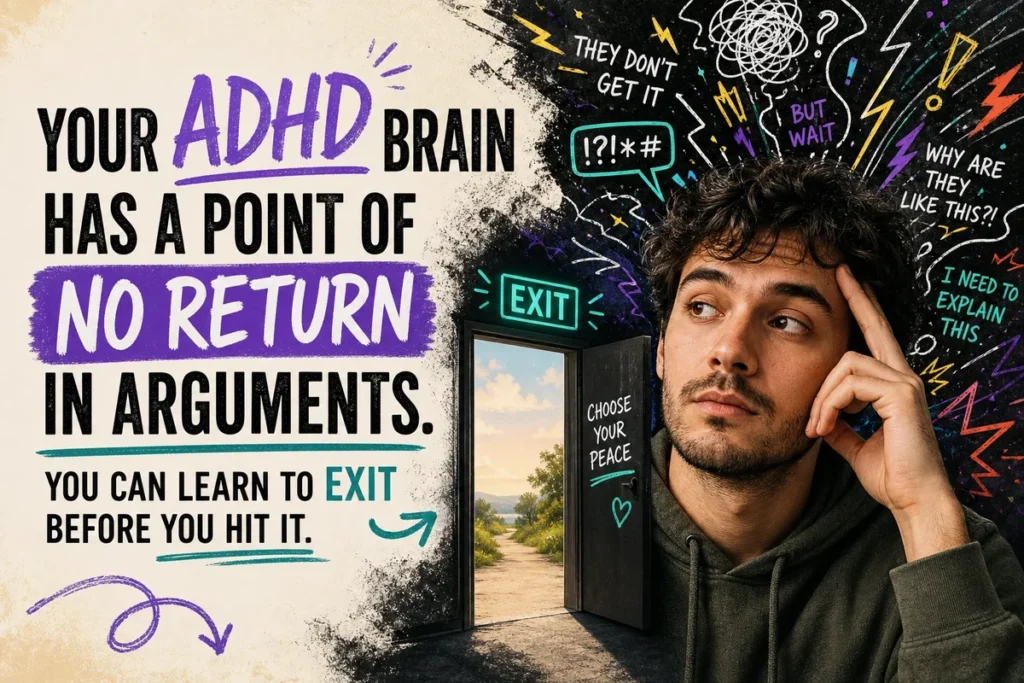
ADHD conflict escalation does not announce itself. One moment you are having a difficult but manageable conversation. The next, something has flipped: your heart is running fast, you are hearing words that weren’t said, you cannot remember what the argument was even about, and you are saying things you will spend the next three hours regretting. The interval between those two states can be less than thirty seconds. And the critical thing to understand is that this is not about your personality. It is about a specific neurological threshold that your brain crosses faster than a neurotypical brain does, and often before your conscious awareness can catch up.
Most ADHD advice about conflict focuses on the aftermath: the apology, the repair, the explanation. This article is about the 60 seconds before the explosion. Because that window exists, even when it feels like it doesn’t. Learning to read it, and learning to exit it, is one of the most structurally important things a person with ADHD can do for their relationships.
Why the Point of No Return Arrives So Much Faster in ADHD
Emotional flooding in conflict is not unique to ADHD. Relationship researcher John Gottman identified the phenomenon decades ago: once physiological arousal climbs steeply and stress hormones flood the bloodstream, collaborative reasoning effectively shuts down. At that point, the brain is no longer problem-solving. It is threat-responding. Gottman’s research established that productive conversation becomes nearly impossible while the body is in that state.
The ADHD-specific problem is not the threshold itself. It is how fast the brain reaches it, and how little runway exists before it does. In a neurotypical argument, the process from “raised concern” to “full flood” typically involves a sequence of cognitive checkpoints where the prefrontal cortex has an opportunity to intervene: noticing the emotional signal, contextualizing it, weighing a response proportionate to the situation. That sequence takes time. In ADHD neurology, it is compressed to almost nothing.
The mechanism is well-documented. Neuroimaging research has found abnormal functional connectivity between the dorsolateral prefrontal cortex (DLPFC) and the orbitofrontal cortex in ADHD with emotional dysregulation, meaning the regions responsible for integrating emotional signals with goal-directed judgment are communicating poorly with each other (Hulvershorn et al., Journal of the American Academy of Child and Adolescent Psychiatry, 2013). The prefrontal cortex, which ordinarily acts as a modulating brake between the emotional brain and behavioral output, does not hold the same inhibitory grip. The emotion arrives at full volume before the volume control has even been located.
According to Barkley (2010), adults with ADHD are demonstrably less likely to inhibit emotions pertaining to frustration, impatience, and anger as a result of deficient cortical regulation. The emotion does not necessarily arrive bigger. It arrives faster, and the mechanism that would normally slow its translation into behavior is underperforming.
What this means practically is that the gap between “calm conversation” and “full dysregulation” may be two or three cues rather than ten or fifteen. Your partner changes their tone. You register a flicker of perceived criticism. Your amygdala fires a threat signal. And if your prefrontal cortex cannot catch that signal and modulate it in time, you are already through the point of no return before you consciously registered that anything was happening.
What the Threshold Actually Feels Like From the Inside
The problem with the “point of no return” as a concept is that it is easy to describe in retrospect and almost impossible to identify in real time. People with ADHD often report that an argument “just happened,” that they went from zero to flooded without any meaningful middle phase. Neurologically, this account is approximately accurate. But it is not quite complete.
There is a pre-threshold phase. It is brief, and it is easy to miss, but it exists. The body typically signals it before the mind registers it. Research on interoceptive awareness suggests that people with ADHD are often less able to detect and act on internal bodily signals, which is one reason the escalation can feel so sudden: the warning signs were present, but the brain’s ability to read them was impaired.
Common pre-threshold signals vary by person, but tend to cluster around a few themes. Physical tension appears early: a tightening in the chest, jaw clenching, shoulders pulling up, hands that start moving. Cognitive narrowing follows: the conversation feels like it is closing in, you start losing the thread of what was just said, you find yourself focused only on the one phrase that landed wrong. A strong urge to interrupt arrives, not because you have something important to add but because holding the sentence inside feels physically intolerable. And then there is the heat, a spreading warmth or pressure in the face or chest that is not quite emotion yet but is the biological precursor to it.
None of these signals feel like warnings. They feel like the argument. This is the cognitive trap: because ADHD dysregulation arrives so fast, the pre-threshold state is experienced as already-flooded. But it is not. It is a brief window, and for most people it is navigable if they have learned to recognize it.
The compressed window: Neuroimaging research confirms that ADHD involves altered connectivity between the prefrontal cortex and the orbitofrontal cortex, the regions that integrate emotional signals with rational judgment. This structural difference compresses the window before full dysregulation. But the window still exists. The goal is not to eliminate the response. It is to extend the window by a few seconds, consistently, until the exit becomes habitual.
The Role of RSD in Turning Conversations Into Crises
Conflict escalation in ADHD is rarely just about the argument’s content. Underneath many ADHD arguments is a neurological hair trigger that gets pulled by perceived rejection, not by the topic on the table.
Rejection sensitive dysphoria (RSD) is an intense, rapid emotional and physiological reaction to real or perceived criticism, disappointment, or disapproval. Dr. James Kustow, a UK psychiatrist specializing in adult ADHD, described it in a 2026 ADDitude webinar as “real, embodied, and deeply impairing,” a body-brain response that can arrive within milliseconds of a trigger and can persist for hours or days. What it does to conflict is specific: it transforms a factual disagreement into an identity-level attack before the other person has finished their sentence.
Your partner says: “You forgot to call the insurance company again.” What your RSD-wired nervous system hears: “You are fundamentally unreliable, and I have lost confidence in you.” These two messages are not the same. But in the moment of flooding, the brain can process them identically. The shame response fires, the prefrontal cortex goes offline, and what looks from the outside like a disproportionate reaction is, from the inside, a completely proportionate response to what the brain genuinely registered as an attack on the self.
Qualitative research on the lived experience of rejection sensitivity in ADHD found that participants described the response as involving unpleasant bodily sensations alongside intense anxiety and a feeling of misery that could be triggered by subtle cues others would not even notice (PLOS ONE, 2026). The overlap between RSD and conflict escalation is not incidental: RSD is often what pushes a difficult conversation past the threshold into territory from which repair becomes difficult.
Why “Just Calm Down” Is Neurologically Incoherent Advice
Partners, friends, and well-meaning therapists often suggest that the solution to ADHD conflict escalation is simply to take a breath and calm down. This advice is not wrong exactly. It is just instructions for a skill that tends to go offline at the precise moment it is needed.
Cognitive reappraisal, the ability to reframe a situation so that it generates less emotional charge, is one of the most well-supported emotion regulation strategies in psychological research. The problem is that it requires prefrontal cortex involvement. It requires working memory to hold the situation in mind while evaluating it. It requires inhibitory control to prevent the immediate reactive response while the reappraisal runs. All of these are areas where ADHD creates genuine difficulty, and all of them are further impaired under emotional stress.
A review by Corbisiero et al. (European Archives of Psychiatry and Clinical Neuroscience, 2013) found that emotional dysregulation in ADHD is driven precisely by deficits in inhibitory control and self-regulatory function, the same executive functions that reappraisal and “calming down” depend on. Asking someone flooded by ADHD dysregulation to simply choose a calmer response is equivalent to instructing someone to use a tool that is currently unavailable to them. The mechanism that would execute the instruction is the mechanism currently offline.
This is why de-escalation for ADHD requires a fundamentally different approach: one that works at a physiological level before the prefrontal cortex is needed, rather than after it is already gone.
The goal is not willpower during the flood. The goal is structure before the flood. An exit protocol that is already agreed upon, already practiced, and already automatic can execute even when the prefrontal cortex is not available to authorize it.
The Exit Protocol: What Actually Works for ADHD Neurology
Exit protocols for ADHD conflict are not time-outs in the traditional sense. A classic time-out instruction asks for sustained self-reflection and meta-cognitive awareness, both of which are compromised under flooding. What tends to work for ADHD is a more mechanical interruption: a pre-agreed signal, a physical transition, and a physiologically grounded recovery activity, in that order.
The pre-agreed signal is non-negotiable. If one partner calls a pause and the other experiences that as withdrawal or defeat, the protocol fails immediately. This is particularly important in relationships where one partner has ADHD and the other does not: the non-ADHD partner may interpret the exit as avoidance, stonewalling, or emotional unavailability. Research on ADHD relationships consistently finds that this asymmetry of perception creates secondary conflict on top of the original one (Rudden et al., “I Felt Like a Burden,” Irish Journal of Psychological Medicine, 2025). Negotiating the signal in advance, when both people are calm, and agreeing explicitly on what it means and what it does not mean, removes that layer.
The physical transition matters because the body needs to experience a genuine state change, not just a cognitive one. Moving to a different room, stepping outside, or even changing posture significantly can begin to interrupt the physiological arousal cycle. This works because arousal follows physical cues as well as cognitive ones. You cannot think your way out of a flooded nervous system, but you can sometimes move your way out of it.
The recovery activity needs to be absorbing without being stimulating. Scrolling through social media during a conflict pause is counterproductive: it delivers intermittent stimulation that keeps arousal elevated without providing genuine nervous system regulation. Activities that work tend to be repetitive, mildly engaging, and physically grounded: a short walk, cold water on the face, slow rhythmic breathing, or a task that occupies the hands without demanding complex thought.
The minimum recovery window: Gottman’s research on physiological flooding suggests the body needs a meaningful period of time, often 20 minutes or more, to return to a sub-threshold arousal level after full flooding. For ADHD brains, where arousal regulation itself is impaired, this window may be longer. Returning to the conversation before that recovery is complete will often re-trigger the escalation. The exit protocol is only half the work. The other half is actually waiting.
Building the Pre-Threshold Vocabulary
One of the least-discussed but most powerful interventions for ADHD conflict is developing a shared vocabulary for pre-threshold states. This means training both yourself and your partner to name the approach of flooding before it arrives, not after.
The practical version of this is simple: instead of waiting until you are fully dysregulated to announce that something is wrong, you identify and name the earlier state. “I can feel something starting” works. “I’m getting hot” works. “I need thirty seconds before I can answer that” works. None of these are withdrawals from the conversation. They are the opposite: they are data that help both people navigate toward a usable outcome instead of an unusable one.
This approach requires something ADHD brains often find difficult: real-time interoceptive awareness, the ability to notice internal states accurately as they are happening. Research indicates that people with ADHD tend to have reduced interoceptive processing, meaning the signals are there but the brain’s ability to read and act on them can be impaired. Building this awareness is a skill, not a fixed trait, and it can be practiced outside of conflict situations. The three-sentence writing exercise in the protocols section is one accessible method: over time, reviewing what you noticed in your body during escalation builds a personal map of your own warning signals.
Naming the pre-threshold state also de-escalates the other person. When your partner sees you move from zero to flooded with no visible middle phase, it is frightening and disorienting. It reads as unpredictable. When they start to observe you catching the early signals and calling them out, the entire dynamic shifts: the conflict is no longer something that happens to both of you. It becomes something you are both navigating together.
What Partners Need to Understand
The most corrosive pattern in ADHD-affected relationships is not the conflict itself. It is the accumulation of conflicts that resolved nothing because both people were flooded for most of them. A qualitative study by Rudden et al. (2025) found that adults with ADHD described relationships where their emotional reactivity had fundamentally altered their partner’s willingness to raise issues. The partner had learned that certain topics would trigger a flood and began to avoid them, creating a slow-building silence where unresolved resentments accumulated below the surface.
Partners of people with ADHD benefit from understanding two things specifically. First, the emotional reactivity they witness is not a measure of how much the person cares about the relationship or how willing they are to engage. It is a neurological event. The person who says “I can’t do this” and leaves the room genuinely cannot do it in that moment: the prefrontal cortex that would allow them to stay present and regulated is not available. Framing it as deliberate withdrawal or emotional manipulation, even internally, tends to escalate the damage.
Second, partners can actively support the exit protocol instead of contesting it. Phrases like “do you need to take a minute?” offered without resentment, and genuine willingness to pause and return rather than pushing to resolve everything in a single flooded session, are not concessions. They are interventions that make resolution more likely, not less. The conversation paused and returned to from a regulated state is dramatically more likely to produce understanding than the same conversation pushed through while both nervous systems are in crisis mode.
For a broader look at what ADHD does to the patterns and dynamics that partners observe over months and years, the ADHD Relationships pillar covers the full landscape, including the credibility gap, the asymmetry of perception, and how both people can begin to see the same relationship more accurately.
The goal of an exit protocol is not to end difficult conversations. It is to make difficult conversations survivable, so that the relationship does not gradually train itself to avoid them entirely.
The Shame Cycle That Keeps the Pattern Locked In
Every ADHD argument that escalates past the point of no return tends to leave a residue: shame. The specific flavor of shame that follows ADHD dysregulation is not just regret about what was said. It is a recursive indictment: I should be able to control this. Other people control this. The fact that I cannot means something fundamental and terrible about who I am.
This shame cycle actively interferes with the acquisition of better conflict skills. People who believe their dysregulation reflects a character defect are less likely to invest in the careful, structured work of building exit protocols, because the implicit logic is that if they were different enough, they would not need these scaffolds. The scaffolds feel like an admission of something damning.
The more accurate framing is structural: ADHD involves documented differences in prefrontal-limbic connectivity that compress the emotional runway available in conflict situations. This is not a character flaw any more than poor distance vision is a character flaw. Wearing glasses is not an admission of failure. It is the correct response to a real structural difference. Exit protocols, pre-agreed signals, and deliberate physiological reset practices are the equivalent: tools for a nervous system that cannot self-regulate quickly enough in high-stakes moments without external support.
Understanding RSD as a neurological pain response rather than a personality failing is part of the same reframe. The article on RSD and anger on this site covers that distinction in depth, and for anyone whose conflict escalation consistently runs through perceived criticism rather than through the argument’s content, that piece is worth reading alongside this one.
The Longer Game: Building Arguments That Don’t Need Exits
Exit protocols are the immediate intervention. But the longer game is reducing the baseline arousal that makes the point of no return so accessible in the first place.
Emotional dysregulation in ADHD is load-sensitive. When the nervous system is already carrying a high cognitive, sensory, or emotional load, the threshold for flooding drops. An argument that could be navigated on a rested, regulated day can become unsurvivable on a day of accumulated overwhelm. This is why many people with ADHD find that certain arguments seem to “always go the same way.” The content is different but the pattern is identical, because the underlying arousal state going into them is consistently elevated.
Dialectical Behavior Therapy (DBT), which has strong evidence for emotional dysregulation across multiple presentations, approaches this through distress tolerance and physiological regulation skills. These include practices such as cold water on the face to interrupt acute arousal, paced breathing, and progressive muscle relaxation. These are not techniques for use during an argument. They are maintenance practices that lower the arousal baseline so that the threshold is further away to begin with. Research supports their relevance for ADHD-related emotional dysregulation specifically, given that the same underlying inhibitory deficits that drive ADHD also drive the emotional flooding in conflict (Corbisiero et al., 2013).
Writing in ADDitude (Thomas, 2026), a licensed professional counselor specializing in ADHD framed this usefully: building intentional decompression time, tracking emotional triggers, and developing shared language with a partner are not crisis interventions. They are maintenance work that shifts the baseline far enough that the point of no return is no longer the default outcome of every difficult conversation.
ADHD conflict is not inevitable. The speed is real. The neurological compression is real. But neither is fixed. The brain that escalates in thirty seconds can, with the right structure, learn to catch the signal earlier, and then earlier still. That difference, built out over months of practice, is what separates a relationship that survives its difficult conversations from one that learns to avoid them entirely. And a relationship that avoids all its difficult conversations is not, in the end, a relationship that feels safe to either person in it.
Quick Dopamine Hits:
- The next time tension starts rising, place both feet flat on the floor and count three full, slow exhales before saying anything. This is not a pause, it is a neurological interrupt that buys your prefrontal cortex enough time to come back online.
- Agree with your partner in advance on a one-word or one-phrase exit signal, something neutral like ‘yellow flag’, that either of you can say without it meaning surrender or rejection. Practise saying it when you’re calm so your brain can access it when you’re not.
- After any argument that escalated, write three sentences about what you noticed in your body in the 60 seconds before it went bad. Over time, this builds a personal early-warning map that is specific to your own nervous system.
Rate this article
Was this a useful hit?