Your ADHD Argument Is Already Over Before You Know It Started

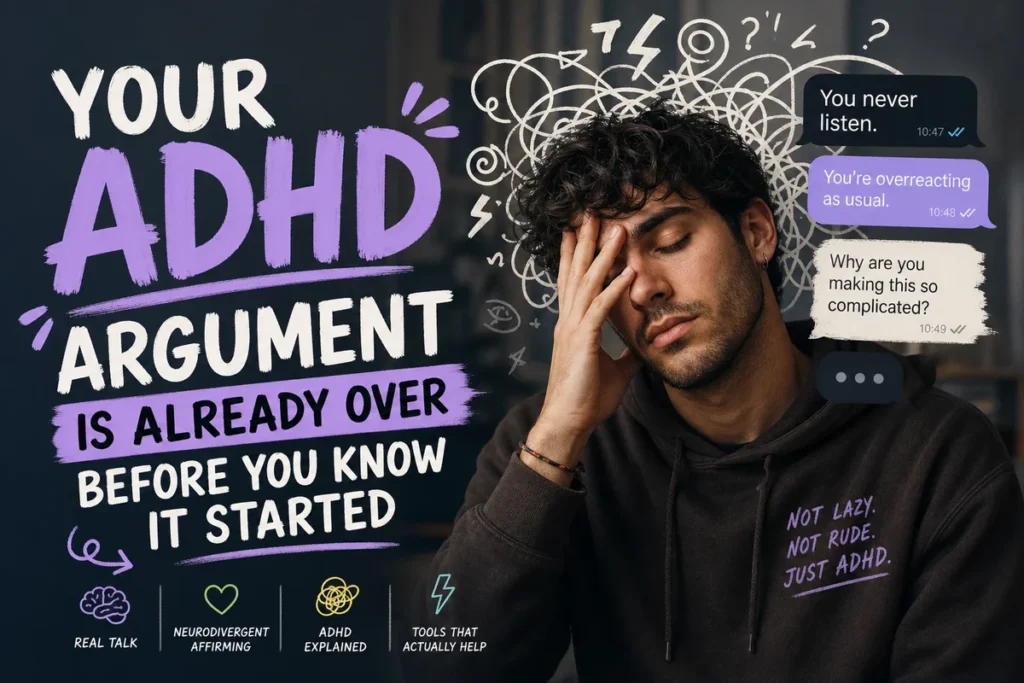
You know the version of yourself that appears in arguments. The one who says things faster than you think them. The one who cannot remember the original point because three other points arrived before you could finish the first sentence. The one who, twenty minutes after it is over, replays the whole thing with perfect clarity and realizes exactly what you should have said, what they were actually saying, and how it could have gone differently. If you have ADHD, this is not a communication style. It is a neurological event. And the most important thing to understand about ADHD conflict escalation is that it moves at a different speed from neurotypical arguments. Not slightly different. Categorically different.
Why ADHD Arguments Escalate Faster Than You Can Intervene
Emotional flooding in conflict is not unique to ADHD. Relationship researcher John Gottman identified physiological flooding decades ago: heart rate climbs steeply, stress hormones flood the bloodstream, and the capacity for collaborative listening effectively shuts down. At this point, most people are no longer arguing about the issue at hand. They are defending themselves against a perceived threat. What Gottman’s research found is that productive conversation becomes nearly impossible when the body is in this physiological state.
The ADHD-specific problem is the timeline. Neurotypical adults typically have more runway before they hit that wall. The process from “raised concern” to “full flood” involves a series of cognitive steps where the prefrontal cortex has an opportunity to intervene: noticing the emotional signal, contextualizing it, weighing an appropriate response. In ADHD, this runway is structurally compressed. The prefrontal cortex, which in healthy functioning acts as a moderating signal between the emotional brain and behavioral output, does not have the same inhibitory grip in ADHD neurology.
Emotional dysregulation in ADHD is not about feeling things too much. It is about the braking system being genuinely impaired. The emotion arrives at full volume before the volume control is even located.
Research by Barkley (2010) established that adults with ADHD are demonstrably less likely to inhibit emotions pertaining specifically to frustration, impatience, and anger, as a result of deficient cortical regulation. The emotion does not necessarily arrive bigger. It arrives faster, and the mechanism that would normally slow its translation into behavior is underperforming. Neuroimaging studies have found that ADHD with emotional dysregulation involves altered functional connectivity between the dorsolateral prefrontal cortex and the orbitofrontal cortex, meaning the regions responsible for integrating emotional signals with goal-directed judgment are communicating poorly with each other (Hulvershorn et al., Journal of the American Academy of Child and Adolescent Psychiatry, 2013).
What the Amygdala Is Actually Doing in a Fight
The amygdala is commonly described as the brain’s threat-detection center, and that framing is approximately right. It is the structure responsible for registering fear, perceived danger, and social threat, and for triggering the behavioral responses associated with those states. In ADHD, the amygdala shows structural and functional differences that researchers associate directly with the emotional lability and rapid anger responses characteristic of the condition. Neuroimaging research has found abnormal amygdala activation and connectivity patterns in adolescents with ADHD, with the amygdala responding more strongly to emotionally charged stimuli than in controls (Posner et al., Journal of the American Academy of Child and Adolescent Psychiatry, 2013).
What this means in a real argument is specific. Your partner makes a comment. Perhaps it is mildly critical. Perhaps the tone is slightly sharp. Perhaps it lands on top of a stressful day when your nervous system is already running thin. Your amygdala registers threat. In a neurotypical brain, the prefrontal cortex receives that signal, evaluates it, and returns a moderating message: this is an argument with someone you trust, not a physical danger, we have had versions of this before, here is how to respond. In an ADHD brain, that moderation loop is slower, less reliable, and under conditions of stress, substantially weaker. The amygdala’s threat signal tends to proceed with far less moderation into behavioral output. You are defending before you have consciously decided to defend.
The collapsing window: Research on emotional impulsivity in ADHD (Barkley and Fischer, 2010, Journal of the American Academy of Child and Adolescent Psychiatry) found that emotional impulsiveness contributed uniquely to functional impairment in adults with ADHD, above and beyond attention traits alone. In conflict, this manifests as the window between trigger and escalation collapsing from minutes to seconds. The problem is not the emotion. It is the speed at which behavior follows it.
Rejection Sensitivity Makes the Fuse Even Shorter
Layered on top of the standard ADHD emotional regulation deficit is a feature that turns ordinary disagreements into something that feels, neurologically, like an emergency. Rejection sensitive dysphoria means that perceived criticism from a close partner does not register as an uncomfortable conversation. It registers as a threat to the relationship itself, or to your fundamental worthiness as a partner and person.
Research exploring the lived experience of rejection sensitivity in ADHD found that participants described an expectation of rejection that caused more distress than actual rejection. They reported pre-emptive withdrawal, hypervigilance to tone of voice, and an inability to separate “my partner is frustrated right now” from “my partner has decided I am a failure” (Rowney-Smith et al., PLOS One, 2026). When rejection sensitivity operates in real time during an argument, the emotional threat level is not calculated based on what was actually said. It is calculated based on the worst plausible interpretation of what was said, because that interpretation feels equally probable to the ADHD brain in that moment.
A qualitative study of romantic relationships in adults with ADHD captured what this looks like from both sides. Participants described feeling “too intense” for their partners, going in “full steam,” and finding that what felt like demonstrating care read to their partners as overwhelming pressure (“I Felt Like a Burden,” Irish Journal of Psychological Medicine, 2025). The asymmetry is painful in both directions: the ADHD partner is often genuinely trying harder than they appear to be, and the intensity of their response in conflict is not evidence of caring less. It is evidence of their nervous system being far less insulated from perceived threat.
What Flooding Actually Looks Like From the Inside
Before looking at how to exit, it is worth naming what the flood state actually feels like, because people with ADHD frequently report not recognizing it until they are already in it. The signs are physical as much as emotional. Your chest gets tight or hot. Your thoughts start to compete with each other rather than sequence. You interrupt, not because you do not care about what your partner is saying, but because working memory is genuinely struggling to hold one point while also tracking incoming speech. Your voice rises without you deciding to raise it. You hear yourself say something and feel almost simultaneously that it was the wrong thing to say, but the edit did not arrive in time.
Researchers studying emotion dysregulation in ADHD describe the construct as multidimensional: it encompasses both the failure to inhibit behavior associated with strong emotion and the subsequent failure to engage in self-regulatory actions, including self-soothing, refocusing attention, and moderating the initial response (Barkley, 2010, cited in Shaw et al., 2014). That second part matters. It is not just that escalation happens faster. It is that the usual tools for self-soothing and calming down tend to go offline at roughly the same moment. The emotional brake and the emotional clutch both fail at once.
From the community: “Why do we have feelings we can’t turn off? Why does this happen ALOT!? Why do moods and actions change around those people?”, r/ADHD thread
The Point of No Return Is Earlier Than You Think
Most people assume the point of no return in an argument is the moment something damaging gets said. In reality, for an ADHD brain, it often arrives earlier than that. It is the moment the physiological flood state makes self-monitoring impossible. Once past that point, the argument is no longer being navigated with the prefrontal cortex online. It is being driven by the amygdala, which has no access to nuance, context, history, or the distinction between a partner who is temporarily frustrated and a partner who has decided to leave.
Recognizing this point is counterintuitive, because from the inside it does not feel like a wall. It feels like finally making a point clearly. The emotional intensity that accompanies flooding frequently reads as urgency and clarity, not as loss of regulation. Your partner, from the outside, is watching escalation. You, from the inside, are experiencing what feels like finally being heard correctly. This mismatch is one of the most consistently documented patterns in the relationship research on ADHD: a partner raising a concern is registered as an attack, and the ADHD partner’s defensive response feels like communication while functioning as further escalation.
The most dangerous moment in an ADHD argument is the one that feels like breakthrough. The emotional intensity of flooding is indistinguishable, from the inside, from the intensity of finally being understood.
This is why de-escalation tactics that work for neurotypical conflict, primarily techniques that require reasoning your way through the emotion, tend to fail when applied directly to ADHD flooding. Trying to use logic while the prefrontal cortex is offline is like trying to open a safe while wearing oven mitts. The tool does not fit the hand you currently have. De-escalation in ADHD conflict has to work at the physiological level first, and the cognitive level second.
Why Standard Conflict Advice Fails ADHD Brains
Couples therapy has generated a substantial body of useful conflict-management techniques. Most of them assume a certain minimum of prefrontal cortex availability. “Use I-statements.” “Avoid generalizations.” “Reflect back what your partner said before responding.” These are genuinely useful for arguments where the inhibitory control system is still broadly online. In moderate emotional arousal, they can work.
In ADHD flooding, they require exactly the cognitive resources that are no longer accessible. Using an I-statement demands working memory to construct the sentence while managing emotional input. Reflecting back what your partner said requires holding their words in working memory while your own threat response is active. ADHD working memory tends to be stretched thin even at baseline. Under emotional stress, research shows that emotional interference effects are significantly amplified in ADHD: performance on working memory tasks degrades faster and more severely when emotionally charged stimuli are present, compared to non-ADHD controls (Posner et al., 2011).
The practical implication is that the intervention has to happen earlier in the sequence than standard advice assumes, and it has to be more direct. Not better language. Not more skillful framing. A physical interruption of the flood state before the conversation continues.
How to Exit Before the Point of No Return
What actually works for ADHD emotional flooding in conflict requires three components: a pre-agreed exit mechanism, a physiologically effective cool-down period, and a deferred return to the conversation. None of these are complicated. All three require setup outside the argument, because they cannot be reliably constructed in the moment flooding begins.
The exit mechanism is the most critical element. It needs to be a single word or phrase agreed upon in advance, during a calm period, with the explicit shared understanding that when either person uses it, the conversation stops for a minimum of twenty minutes without any follow-up, summary statement, or parting shot. The word needs to be neutral. Not “stop,” which sounds commanding. Not “calm down,” which is one of the most reliably escalating phrases in any argument. Something arbitrary, low-charge, and associated with the prior agreement rather than with the content of any particular fight.
The minimum gap matters because it reflects something real about physiology. Cortisol and adrenaline released during a stress response do not clear from the bloodstream in two or five minutes. Research on physiological recovery from emotional flooding generally supports allowing substantially more time before attempting to resume a charged conversation, with many clinicians recommending at least twenty minutes as a floor. Returning before the nervous system has had meaningful recovery time tends not to resolve the flood. It tends to resume it. For ADHD brains, where return to baseline may be further delayed by emotional lability, erring toward thirty minutes is frequently more practical.
What to do during the break: The goal is physiological regulation, not cognitive processing. Walking at a moderate pace, slow paced breathing (four seconds in, six seconds out), or any physical activity that shifts the nervous system out of high alert are all effective approaches. Replaying the argument in your head during the break, which ADHD brains are strongly inclined to do, actually prolongs the flood state by keeping the threat response active. The break is for your body, not for building your case.
What the Research Recommends for ADHD Specifically
Research on emotional lability in ADHD offers some useful framing for understanding what is actually changeable here. A review by Posner, Kass, and Hulvershorn, published in a peer-reviewed psychiatry journal, examined clinical and neuroimaging findings on stimulant treatment for ADHD-related emotional lability. The review found promising evidence that stimulants, particularly methylphenidate and lisdexamfetamine, showed measurable reductions in emotional dysregulation above and beyond their effects on core attention traits. Multiple trials found meaningful effect sizes specifically for emotional regulation measures, with some studies finding a trend for those with prominent emotional dysregulation to show the greatest improvement on psychostimulant treatment (Posner et al., Current Psychiatry Reports, 2014).
This is not an argument for medication as the primary strategy. It is an argument against treating emotional flooding in ADHD purely as a behavioral or communication problem. If escalation in conflict is partly driven by impaired inhibitory control at a neurological level, then behavioral strategies applied exclusively at the communication layer will always be working against the current. Treating the underlying neurology where possible, and building behavioral strategies on top of that rather than instead of it, gives those strategies a meaningfully better chance of holding under pressure.
Clinical guidance on rejection sensitivity management also recommends what ADHD specialist Dr. William Dodson describes as creating a pause between the trigger and the response, specifically by naming the emotional state before acting on it. Labeling an emotion activates prefrontal processing of it, which is precisely the shift ADHD brains need to buy a few seconds of self-monitoring. It will not reverse a full flood already in progress. But catching the feeling just before the point of no return, when the flood is building rather than peaked, makes the difference between a rough conversation and one that leaves lasting damage.
Building the Conversation You Can Actually Have
The goal is not to suppress the emotion. The emotion is often accurate. Frustration may reflect a legitimate frustration worth expressing. A sense of being dismissed may reflect something real in the dynamic. The problem is not the feeling itself. The problem is that the ADHD nervous system delivers it at a speed and intensity that makes it difficult for the relationship to process productively in real time.
What couples navigating ADHD conflict tend to find useful is structuring the conditions around hard conversations rather than trying to manage the conversation itself in the moment. This means having the conversation when the ADHD partner is not sleep-deprived, hungry, or already dysregulated from an earlier part of the day, all states that functionally reduce the prefrontal cortex’s available capacity before the discussion even begins. It means scheduling rather than ambushing. Research on rejection sensitivity management recommends that partners approach sensitive conversations with curiosity rather than judgment and provide advance notice of the topic, so the person with rejection sensitivity can prepare the internal scaffolding needed rather than having it collapse under a sudden trigger (Dodson, ADDitude Magazine).
Couples where one partner has ADHD do not need to have fewer hard conversations. They need to build different architecture around how those conversations happen.
The ADHD partner’s job in this framework is to do the physiological preparation work that creates the best possible conditions for the prefrontal cortex to stay online: treat sleep as a regulatory tool, not a luxury, eat before emotionally demanding conversations, and if rejection sensitive dysphoria is a consistent driver of escalation, work with a therapist or prescriber specifically on that feature, since it is responsive to both behavioral and pharmacological approaches. The non-ADHD partner’s job is to understand that emotional flooding is not a choice, and that the exit request is not avoidance of the issue. It is the prerequisite for the issue to actually get addressed.
For more on how ADHD shapes the broader relational landscape, including the accumulating pattern gaps that generate conflict pressure over time, the guide to ADHD in relationships covers the wider system in depth. And if rejection sensitive dysphoria is driving much of the speed of escalation you recognize in yourself, the deeper article on how RSD operates as a neurological pain response breaks down that specific mechanism in detail. Understanding both the conflict trigger and the relational pattern it sits inside is what makes the difference between one better argument and a genuinely different way of navigating them.
The Argument You Have Tomorrow
Knowing this does not stop the flood. What it does is change the window. If you understand that your prefrontal cortex can go offline faster than most people’s, and that the moment it does your ability to recognize that fact tends to disappear along with it, then the only real leverage point is before the flood hits. Not during. Before. The agreements you make with your partner about how both of you handle escalation are the only tools that will be available when you need them, because in that moment you will not be capable of inventing new ones.
This is not a failure of character. It is a predictable function of an ADHD nervous system under pressure. The frustrating thing about it is that the moments when you most need self-regulation tools are exactly the moments those tools become hardest to reach. That is the design problem. The solution is not willpower applied at the moment of flooding. It is infrastructure built well in advance, agreed on by both people, and specific enough to actually use in the seconds before everything goes sideways.
That infrastructure is buildable. It just has to be built before the argument, not during it.
Quick Dopamine Hits:
- Before any hard conversation, agree on a ‘pause word’ with your partner, one neutral word (not ‘stop’ or ‘calm down’) that signals a 20-minute minimum break, no follow-up allowed until both people return.
- When you feel the flood starting, chest tightening, voice rising, thoughts narrowing, name it out loud: ‘I’m flooding.’ That single act of labeling shifts processing toward the prefrontal cortex and buys you seconds to act before the point of no return.
- After a flooded argument, wait at least 20 minutes before attempting repair. Use the time to walk, do slow exhales (4 seconds in, 6 seconds out), or change your physical environment entirely. Do not replay the argument in your head during this period.
Rate this article
Was this a useful hit?