Is It an ADHD Thing That You Are Doing Multiple Things at Once but Not Actually Enjoying Any of Them?

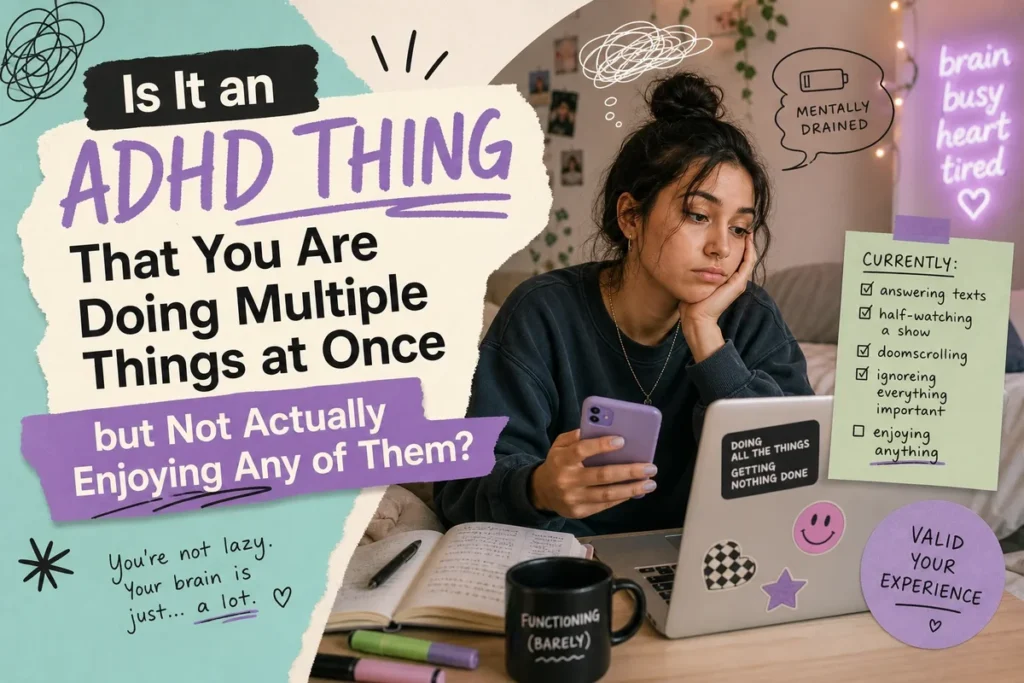
You sat down to watch the show you have been looking forward to all week. The episode starts, and within about ninety seconds your hand is already on your phone. You tell yourself it is just for a second. Then you are twelve posts deep, a snack bag is open on your lap, and the characters on screen are having an important conversation you did not hear. You rewind. You try again. Same thing. Forty-five minutes later the credits are rolling, you could not tell anyone what happened, and your thumb is tired. You did not rest, you did not enjoy the show, and you did not enjoy the scrolling either. You just spent the evening in a strange limbo of doing everything and feeling nothing.
Yes, this is an ADHD thing. It is what we can call the ADHD multitasking enjoyment gap: a stimulation-seeking brain splitting its attention across so many inputs that no single one gets enough of you to register as pleasure.
What the ADHD multitasking enjoyment gap actually looks like
It rarely looks like a dramatic productivity failure. It looks like a normal evening. TV on, phone in hand, something to eat, maybe a second tab open on a laptop. Each input is small and each one feels harmless.
The giveaway is the aftermath. You do not feel satisfied, you feel vaguely smeared. You were busy the whole time, but nothing was completed and nothing was savoured. A lot of people describe it as being stuck: you are not truly relaxing and you are not truly engaged, and the guilt arrives on top because you spent hours "doing something" with nothing to show for it.
That guilt is worth looking at, because it points at the real problem. You did not choose this. If you had chosen it, you would have had a reason. This was your attention being pulled apart while you watched it happen.
The ADHD multitasking enjoyment gap is not laziness and it is not a lack of interest in the show. It is a brain that cannot get enough stimulation from one source, so it grabs three, and then cannot fully receive any of them.
Why one input is never enough for an ADHD brain
ADHD is a neurodevelopmental condition that affects the brain systems responsible for executive function: the abilities that let you direct attention, manage impulses and carry out what you intend to do.1 Underneath those systems sits dopamine, a chemical involved in motivation, reward and how much a given activity feels worth staying with.
Research on ADHD has linked it to disrupted dopamine-related reward processing, including how the medial frontal cortex learns which activities are worth continuing.2 In plain terms, the signal that says "this is rewarding, stay here" arrives weaker or less reliably. A show that would hold a typical viewer can feel, to your brain, like it is running a little under budget.
So your brain does what a brain under-stimulated by one source does. It goes shopping. The phone is an instant hit of novelty. The snack is sensory input. Each addition tops up the stimulation level, and for a moment the evening feels more bearable.
The trap is that the top-up is also the thing that breaks the original experience.
The attention split: why more input means less enjoyment
Here is the part that feels unfair. Adding stimulation does lift your arousal level, but it does it by dividing attention, and enjoyment needs attention. You cannot be moved by a scene you did not fully take in.
Every time your focus jumps to the phone and back, you pay a switching cost. You lose a few seconds rebuilding where you were in the plot, who said what, why the music changed. After enough of those, the story stops cohering. It turns into background noise, which is exactly what it was never supposed to be.
This is the ADHD attention split in action. Your brain gets the stimulation it was hunting for, and loses the thing the stimulation was supposed to serve. Many people describe it as having an attention span that is not broken, just constantly dragged in opposite directions. That is a fair description. The capacity is there. It is being spent on switching instead of staying.
The core loop: low stimulation from one source, so you add a second, which splits attention, which lowers enjoyment of both, which leaves you under-stimulated again. Then you add a third.
How this differs from intentional multitasking
Plenty of people without ADHD have a podcast on while they cook, or music while they clean. That is not what this is. The difference is in who is steering.
Intentional multitasking pairs a low-demand task with a background one. One input is the main event and the other is support. You chose the pairing, you know why, and you are fine with the result.
The ADHD version is parallel inputs that all want to be the main event. A show you actually wanted to watch, a scrolling feed, a snack you are not hungry for and a half-open book. None is the support act. They compete, and you are not deciding which one wins. Your attention is deciding, and it keeps changing its mind.
A useful test is agency. Ask yourself whether you chose this mix, and whether you could stop right now and settle on one thing. Writing about related experiences of absorption, one clinician-writer notes that agency, meaning your ability to regulate your relationship to the thing, is the useful litmus test for when an experience has stopped serving you.3 If the answer is that it just happened and you could not easily stop, you are likely looking at the enjoyment gap and not a preference.
Stimulation versus presence: what this says about what you need
It is tempting to read this behaviour as a failure to appreciate your own life. A more accurate reading is that your brain is confusing two different needs.
One is stimulation: enough input to keep your nervous system engaged. The other is presence: the experience of actually being inside one thing and feeling it. Typical brains often get both from the same source. An ADHD brain frequently gets plenty of the first and almost none of the second, because chasing stimulation is the very thing that blocks presence.
This is why the evening feels so empty. You supplied the stimulation again and again, and you never arrived at presence. The need underneath, to feel something, to be absorbed, to rest, went unmet while you were busy meeting a different one.
Seeing it this way changes the question. Instead of asking why you cannot focus on things you like, you can ask what your brain needs in order to stay with one thing. That is a solvable problem.
Why "just put the phone down" does not work
The standard advice is willpower with a nicer name. Leave the phone in the other room. Be mindful. Enjoy the moment.
The problem is that this treats the phone as the cause. The phone is the solution your brain reached for. If you remove it and change nothing else, you have removed the top-up and left the original problem in place: a single input that is not stimulating enough. So you feel restless, you reach for something else, and you decide you have no self-control.
This is also a pattern that gets harder with the load of everyday life. People with ADHD often describe being able to hold only a few things at a time, with everything else a gamble. When you are already stretched across a lot, your evening brain is not going to produce discipline on demand. It is going to look for relief.
Advice that works has to give the stimulation-seeking part of your brain something to do, rather than asking it to sit quietly.
What actually helps you be present
The most reliable approach is to feed the second stream deliberately. Give your hands or a small corner of your attention a task that is low-demand and does not compete with the main event. Folding laundry, drawing, a fidget, a puzzle, a crochet row, even playing with a piece of clay. The show gets your eyes and ears, and the restless part of you gets something physical. You chose the pairing, so it supports the experience rather than swallowing it.
Raise the cost of the phone reach. A phone on the couch cushion is a one-second decision. A phone in another room is a thirty-second one, and that gap is often enough for the impulse to pass. You are not relying on willpower, you are adding friction.
Slow the thoughts down before you start. One approach people find useful is to stop when you notice the spiral, take a breath, name what is happening, and write down whatever is crowding your head, by hand, with no plan to read it again. Getting the noise out of your head and onto paper can lower the pace enough that one input becomes enough.
Finally, choose inputs that match your stimulation level. If a slow drama cannot hold you, that is information, not a flaw. Faster shows, audiobooks while walking, or a story you can fully lose yourself in may work better than whatever you think you should be watching. Some people find that a gripping book read in one long sitting gives them the presence that a half-watched series never does.
Reframe: if you cannot enjoy one thing, the question is not "why am I like this?" It is "what does this input need next to it so my brain can stay?"
The takeaway on the ADHD multitasking enjoyment gap
The ADHD multitasking enjoyment gap is a stimulation problem wearing the costume of a focus problem. Your brain is not refusing to enjoy things. It is under-fed by single sources, so it adds more, and the adding is what costs you the experience. Next time you catch yourself three inputs deep, skip the lecture and change the setup: one main thing, one deliberate low-demand activity for your hands, and the phone somewhere that takes effort to reach. Then see what lands.
Rate this article
Was this a useful hit?