Your ADHD Medication Didn’t Stop Working. Your Estrogen Did.

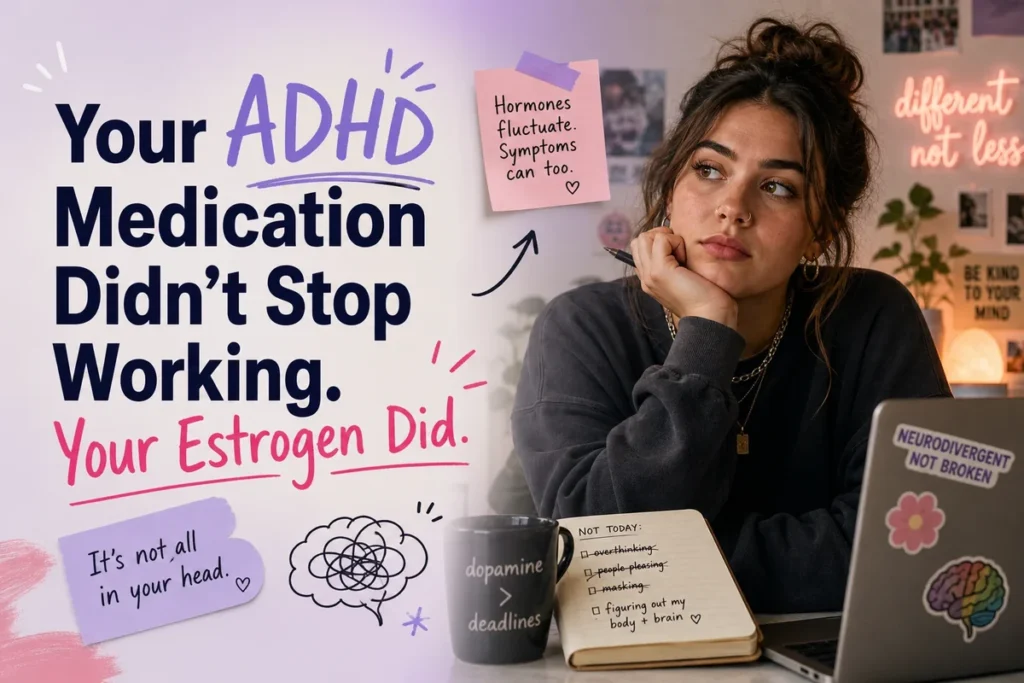
You had a system. It wasn’t elegant, but it worked. The right medication dose, the right routines, the right amount of structure layered carefully over the parts of your brain that couldn’t regulate themselves. You had spent years, possibly decades, building the invisible scaffolding that kept your ADHD brain functioning at something close to its potential. And then, somewhere in your late thirties or your forties, the scaffolding started shaking. Your stimulant felt weaker. Your brain fog thickened in ways that had nothing to do with sleep. You couldn’t finish sentences. The working memory that was already thin became almost non-existent. Your GP offered antidepressants. Maybe blood pressure medication. Nobody mentioned the one thing that was actually happening: your estrogen was declining, and it was taking the neurochemical architecture of your executive function with it.
This is the perimenopause cliff. For women with ADHD, it is not a gradual descent. It is a sudden loss of floor. And the research is unambiguous about why.
Why Perimenopause Hits ADHD Brains Harder Than Any Other Life Stage
Perimenopause is, according to the clinical literature, the most impairing phase of life for women with ADHD. That is not a soft claim. It is a conclusion drawn from survey data, cohort studies, and neurobiological research, and it has been reproduced consistently enough that researchers studying female ADHD have started calling it the definitive danger window. In an ADDitude survey, 94% of women reported that their ADHD symptoms grew significantly more severe during perimenopause and menopause. In a separate 2022 survey of 4,000 women with ADHD, 70% described the impact in their 40s and 50s as “life-altering,” with half calling their ADHD during this period “extremely severe” (Kooij et al., 2025, Frontiers in Global Women’s Health). The most commonly reported impairments were procrastination and time management, working memory failures, feelings of overwhelm, and disorganisation: the exact symptoms that ADHD management had, for many women, brought under some degree of control.
To understand why perimenopause strikes with such force, you need to understand a relationship that is still largely missing from primary care training. Estrogen is not only a reproductive hormone. It functions as a direct neuromodulator of the dopamine system, particularly in the prefrontal cortex. Research by Jacobs and D’Esposito, published in the Journal of Neuroscience in 2011, established that estrogen actively shapes dopamine-dependent cognitive processes, with direct implications for working memory and executive function. Shanmugan and Epperson, writing in Human Brain Mapping in 2014, extended this finding to show that declining estrogen specifically compromises prefrontal cortex activity, the region that governs almost everything the ADHD framework describes as impaired.
When oestrogen is low or declining in an individual in whom important neurotransmitters such as dopamine are already compromised, these shortages reinforce each other, explaining mood and cognitive deterioration during hormonal fluctuation periods. (Kooij et al., 2025, Frontiers in Global Women’s Health)
ADHD brains typically run on a chronically under-functioning dopamine system. Estrogen has been quietly amplifying whatever signal was available. During perimenopause, that amplification is progressively withdrawn. The impairment is not additive. It is compounding, and it compounds against a baseline that was already tight.
What Makes Perimenopause Different From Every Other Hormonal Drop
If you have noticed that your ADHD gets worse in the days before your period, or that postpartum felt like cognitive freefall, you already have some intuition about what estrogen withdrawal does to your brain. But perimenopause operates by a different set of rules, and the distinction matters.
The monthly luteal phase drop is predictable. It follows a cycle. You can track it, anticipate it, and adapt around it. The postpartum drop is catastrophic but, broadly speaking, temporary: as estrogen recovers over weeks and months, the cognitive function typically recovers too. Perimenopause is neither cyclical nor temporary. It is a sustained, progressive, and ultimately permanent withdrawal from the hormonal environment your brain has been operating in for thirty years. The estrogen is not coming back to where it was. And the transition does not announce itself clearly. It arrives as unpredictability: months where the drop is severe, followed by months where levels partially recover, followed by another plunge. For a brain that learned to compensate against a relatively stable neurochemical background, that erratic shifting is often more destabilising than the eventual plateau of full menopause.
The timing is earlier than you think: Research shows that perimenopause begins up to 10 years earlier for women with ADHD. Women with ADHD report their most severe perimenopausal symptoms between the ages of 35 and 39, compared to typical onset from the mid-to-late 40s. If your cognition started deteriorating in your late thirties and your doctor kept telling you it was stress, this may be why.
A population-based cohort study comparing women with and without ADHD found that women with ADHD had significantly higher total perimenopausal symptom scores across psychological, somatic, and urogenital domains, and were substantially more likely to experience severe symptoms. This is not a mild difference in degree. Women with ADHD are experiencing a categorically more severe perimenopausal transition than their neurotypical peers, and the neurobiological reason is the same as it has always been: two systems that depend on each other are declining at the same time.
The Medication Cliff: Why Your Stimulant Suddenly Stopped Working
The moment many women with ADHD describe as the most frightening part of perimenopause is not the hot flashes or the irregular cycles. It is the morning their medication stopped doing anything.
Stimulant medications work partly by increasing dopamine availability in the prefrontal cortex. Estrogen enhances dopamine receptor sensitivity and increases the functional impact of that dopamine signal. During perimenopause, as estrogen declines, the same dose of stimulant that was effective for years produces a diminished response. Not because the medication has changed, but because the hormonal environment that made it effective is no longer there. Wynchank, de Jong, and Kooij, writing in European Psychiatry in 2025, documented this directly: reduced psychostimulant efficacy is a reported feature of the perimenopausal transition in women with ADHD, and it is a predictable consequence of the estrogen-dopamine relationship, not a clinical mystery requiring years of failed medication trials to eventually solve.
What typically happens instead is this. A woman notices her symptoms worsening dramatically. She reports this to her prescribing doctor. The dose is adjusted upward, sometimes effectively, often temporarily. The underlying hormonal variable is never assessed. Eventually, the dose creep reaches a point where side effects accumulate or the clinical picture becomes genuinely confusing to everyone involved. Practitioners who are unaware of the hormonal dimension may attribute the change to tolerance, to mood disorder, to burnout, or to a completely unrelated diagnosis. The woman’s lived knowledge of her own neurochemistry, the precision with which she knows something specific has shifted, is rarely treated as the diagnostic evidence it actually is.
“My general practitioner only offered antidepressants and medication to bring down my blood pressure, no investigation into why a previously capable, energetic, high-functioning woman had suddenly begun to fall apart.”, First-person account, ADDitude Magazine
This is not a rare anecdotal outlier. It reflects a systemic gap in how perimenopause presents in women with ADHD and in how poorly prepared most primary care providers are to recognise the interaction. A narrative review on the pharmacological management of ADHD across perimenopause and menopause confirmed that current clinical practice relies almost entirely on expert consensus, with no randomised controlled trials specific to perimenopausal women with ADHD. The absence of research is not evidence that the problem does not exist. It is evidence of how long this population has been overlooked.
The Scaffolding Collapse: Why Everything Fails at Once
For women who received their ADHD diagnosis late in life, or who masked their ADHD for decades before any formal recognition, perimenopause arrives with a particular kind of cruelty. The compensatory strategies they built, the rigid routines, the carefully constructed external systems, the intelligence deployed as a daily workaround, were never a cure. They were always load-bearing structures in a precarious architecture. Estrogen was part of the foundation, and nobody said so.
When estrogen declines, it does not just reduce dopamine availability in the abstract. It degrades the specific cognitive resources that masking and compensation require most: working memory, processing speed, emotional regulation, and the capacity to hold multiple competing demands in mind simultaneously. These are precisely the tools that women who went undiagnosed for years learned to deploy in place of the executive function support they never received. When they degrade together, it is not one system failing. It is the entire internal structure coming down at once.
The story the brain tells during this collapse is brutal. You are failing. You were always going to fail. The capability you had was never real. This narrative is not an accurate account of what is happening. It is an ADHD shame spiral being powered by estrogen withdrawal, and it is lying. The scaffolding held for years precisely because you built it carefully. It is falling now because the hormonal substrate it was built on has shifted beneath it, not because the scaffolding was ever illusory.
Understanding the broader context of ADHD identity and the cost of decades of masking matters here. The perimenopause experience lands differently when you understand how much of your apparent high-functioning was compensatory architecture all along. More on that dimension of the ADHD lifespan is at the ADHD identity pillar, because the grief of this transition is inseparable from the grief of late discovery.
The most reported impairments during perimenopause in women with ADHD: In a 2022 ADDitude survey of 4,000 women, the most debilitating perimenopausal symptoms were procrastination and time management (79%), working memory problems (74%), feelings of being overwhelmed (72%), and greater disorganisation (70%). These are not new symptoms. They are the same symptoms that ADHD management had, until now, been containing.
The Misdiagnosis Trap: Why Doctors Keep Getting This Wrong
The symptom overlap between ADHD and perimenopause is extensive enough to create genuine confusion even for clinicians who know both conditions. Brain fog, concentration failures, emotional dysregulation, irritability, sleep disruption, and memory problems appear on both diagnostic checklists. For a woman who has not yet received an ADHD diagnosis, perimenopause can trigger a first presentation that looks, on the surface, like a mental health crisis. For a woman who already carries an ADHD diagnosis, perimenopause can make existing symptoms so severe that they are misread as a new psychiatric comorbidity.
The most common clinical errors fall into three patterns. The first is attributing cognitive symptoms purely to depression and prescribing antidepressants as a first response, without assessing the hormonal dimension. The second is treating elevated blood pressure or heightened anxiety as the primary problem, without investigating the dysregulation driving those physical symptoms. The third is managing the estrogen decline and the ADHD as entirely separate issues, handled by separate clinicians who do not communicate about the interaction between them. The practical result in all three cases is treatments targeting symptoms rather than causes, with the ADHD-hormonal interaction remaining invisible and unaddressed, sometimes for years.
The research community is increasingly explicit about what the correct clinical response looks like. A 2025 review by Wynchank, de Jong, and Kooij in European Psychiatry recommended that for perimenopausal exacerbation of ADHD, low mood, and sleep disturbance, a combination of hormone therapy and ADHD medication is clinically warranted. Not either/or. The two systems are interacting, and treating only one is not a solution.
What Is Actually Worth Raising With Your Doctor
The conversation about perimenopause and ADHD that you need to have with a clinician is different from the standard ADHD medication review, and it is different from the standard perimenopause consultation. It requires a clinician who understands that these conditions interact, or who is willing to engage with the evidence that they do.
On the hormonal side, hormone replacement therapy, or what some researchers describe as “hormone stabilisation therapy,” is a legitimate clinical consideration for women with ADHD whose symptoms have worsened significantly during the transition. Dr. Patricia O. Quinn, a physician specialising in ADHD in women, has described estrogen stabilisation as potentially restoring some of the neurochemical conditions that made ADHD management effective in the first place. Using estrogen, or estrogen combined with progesterone, to steady declining levels may improve the conditions under which stimulant medication can function. The specific form, dose, and timing of hormone therapy is a clinical decision requiring individualised assessment, but the question is worth raising explicitly, rather than waiting for a prescriber to volunteer it.
On the ADHD medication side, dose adjustment is a recognised and often necessary clinical response to perimenopausal symptom worsening. The critical nuance is that adjusting the stimulant without addressing the hormonal variable may provide partial and temporary relief at best. An ADDitude webinar poll of 777 respondents found that approximately 24% of women rated their medical provider as very receptive to discussing HRT in the context of ADHD, while 15% rated their provider as not at all receptive. The gap in clinical awareness is real and documented. Entering appointments with specific, named questions, whether stimulant efficacy might be affected by hormonal decline, whether hormone stabilisation is worth discussing, whether a referral to a specialist in female ADHD is available, gives the conversation a better chance of going somewhere clinically useful.
“Perimenopause is when you need the most help, the most support. You need to take care of yourself during this time.”, Patricia O. Quinn, M.D., ADDitude Webinar on Perimenopause and ADHD
When “It’s Just Aging” Is the Wrong Frame
Some practitioners position cognitive changes during perimenopause as a universal feature of aging, not a condition requiring specialised neurological attention, and argue that standard menopause care is appropriate for all women. This position is not irrational in the abstract. Cognitive shifts during the perimenopausal transition do affect neurotypical women, and many practitioners are managing those changes appropriately for that population. The question is whether the experience is comparable in scale and mechanism for women with ADHD.
The data says it is not. The population-based cohort study referenced above found that women with ADHD had significantly higher perimenopausal symptom scores and far higher rates of severe symptoms than women without ADHD. The Kooij et al. 2025 position paper in Frontiers in Global Women’s Health identifies the interaction between declining estrogen and already-dysregulated dopamine as a distinct biological phenomenon producing categorically different impairment from the standard perimenopausal experience. Treating a double-deficit as though it were a single standard aging process means systematically under-treating the women most severely affected.
Ignoring the neurological interplay between estrogen and dopamine regulation does not make it disappear. It simply means the women experiencing it keep being offered antidepressants they may not need and blood pressure medications that do not address the underlying mechanism, while the years of the transition pass without adequate support.
You Are Not Losing Your Mind. You Are Losing Estrogen.
The narrative many women construct around this experience is that something has fundamentally broken. That the person they were is gone. That the capability they had was never real. The research tells a different story. What is happening is a documented, neurobiologically explainable event: the progressive withdrawal of a hormone that was actively supporting the dopamine system your ADHD depends on. Your symptoms are not a measure of your character, your intelligence, or the durability of who you are. They are a measure of what estrogen was doing quietly, behind the scenes, for thirty years.
The practical frame that helps most during this transition is reduction rather than reconstruction. The goal is not to build a more elaborate ADHD management system while executive function is at its most compromised. It is to reduce the cognitive demands placed on a system under siege and to protect the structures that matter most. The work of nervous system regulation and the pattern of ADHD burnout and energy recovery is directly relevant here, because the depletion perimenopause produces in ADHD brains maps closely onto the burnout pattern: a cognitive reserve drawn down to near zero that is no longer recovering between demands.
Sleep disruption deserves particular attention during this period, since it is both a core ADHD vulnerability and a primary perimenopausal symptom. Its effects on executive function are multiplicative when ADHD is already in the picture. Addressing sleep directly, whether through hormone treatment, sleep hygiene adjustments, or medication review, can shift the functional baseline in ways that matter during a period when that baseline feels unreachable.
The perimenopause cliff is not the end point. It is a transition with a neurobiological explanation, a documented clinical pathway, and treatment options that most women are never told exist. The broader picture of how hormones, the body, and ADHD interact across the lifespan is worth understanding in full, because perimenopause does not arrive in isolation. It is the final and most intense chapter in a hormonal story that has been shaping your ADHD since puberty. The women arriving at specialist clinics in their forties, insisting that something specific and neurological is happening and demanding to be taken seriously, are correct. The research, increasingly and urgently, agrees with them.
Quick Dopamine Hits:
- Track the date your symptoms shifted: note the month when your ADHD medication felt like it stopped working. Bring that timeline to your next appointment, it is clinical evidence, not a complaint.
- Before your GP visit, write down two separate symptom lists: one for ADHD symptoms and one for physical changes (sleep, heat, mood swings). Presenting them side-by-side makes the hormonal-neurological connection visible to clinicians who may not connect them.
- Ask your prescribing doctor specifically: ‘Could my stimulant dose need adjustment because of hormonal changes?’ If they don’t know the connection, that’s information too, consider seeking a referral to a specialist who does.
Rate this article
Was this a useful hit?