You Think Best at 11 PM Because Your Brain Clock Runs Late. Your Job Was Built for Someone Else’s.

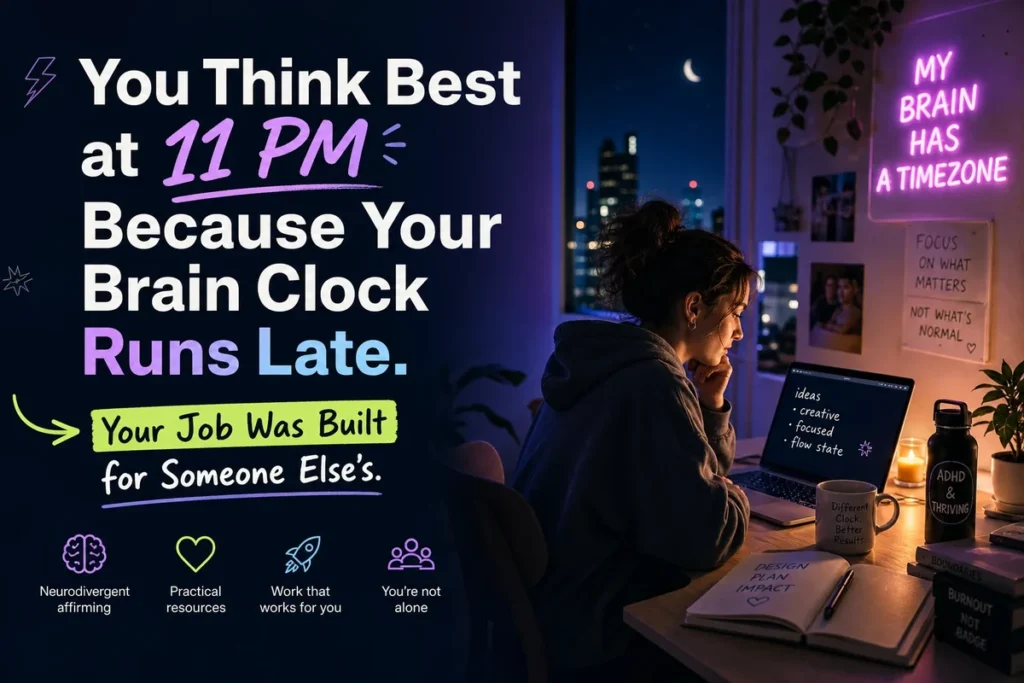
ADHD and an evening body clock go together far more often than chance would predict. In adults with ADHD, dim-light melatonin onset, the lab marker of when your biological night begins, runs about 90 minutes late, and delayed sleep-wake timing shows up in up to 78% of people, according to a 2025 Frontiers perspective on ADHD as a circadian rhythm disorder. Put that clock behind a 9 AM start and you get social jet lag: a standing, mild time-zone mismatch between your biology and your calendar. If you think best at 11 PM and have lost that argument with every job you have ever had, the evidence points to a scheduling design problem, not a discipline problem.
You know the pattern already. The alarm goes at 7. You spend the morning moving like you are wading through wet cement, the fog lifts around noon, and somewhere after 10 PM your head finally clears and the work you could not touch all day starts to flow. Monday arrives and someone mentions your “energy” in a review. That story has a biological explanation, and the fix has nothing to do with another morning routine.
Is ADHD Linked to Being a Night Owl?
Yes. Research consistently links ADHD with evening chronotype, meaning a preference for later sleeping and waking, and with a measurably delayed circadian phase. The same 2025 Frontiers perspective describes circadian dysfunction as a clinically significant phenotype in a substantial subgroup of people with ADHD. It does not claim every ADHD brain runs late, and not every night owl has ADHD.
The numbers are hard to wave away. Insomnia and sleep disturbance affect up to 80% of adults with ADHD, and delayed sleep-wake timing occurs in up to 78%. Melatonin onset is delayed by roughly 45 minutes in children and 90 minutes in adults, and a separate review puts delayed circadian phase at up to 75% of people with childhood-onset ADHD. Those delays travel with blunted and delayed cortisol rhythms, reduced pineal volume, and weaker peripheral clock-gene rhythms in BMAL1 and PER2. Genetic studies also link ADHD with variants in clock genes such as PER and CLOCK.
Objective measurement agrees with the questionnaires. A recent actigraphy study of adults with ADHD, which tracked rest and activity with a wrist sensor, found a more unstable and delayed rhythm than in neurotypical controls, along with a more pronounced evening chronotype on self-report. Light influences dopamine release, and forebrain dopamine is reduced in ADHD, which is one reason researchers are exploring light-based treatment. The mechanisms are still under investigation, but the pattern suggests that the circuitry behind attention and motivation and the circuitry behind the clock overlap. If you want the melatonin timeline in more detail, our piece on why your body clock runs three hours late goes deeper.
What Is Social Jet Lag, and Why Does It Hit ADHD Brains Harder?
Social jet lag is the gap between the sleep timing your body prefers and the timing your schedule imposes, usually measured by comparing sleep on workdays with sleep on free days (Roenneberg et al., 2019, Biology). For an ADHD evening type, that gap opens every weekday morning and only partly closes on weekends, which is why Sunday night can feel like the end of a long-haul flight.
The time-zone comparison is an analogy, but the physiology under it is real. Evening types forced onto early schedules show disrupted secretion timing for cortisol, ghrelin, leptin, and melatonin (Fischer et al., 2016, Chaput et al., 2023), and their late-night preferences collide with early obligations to produce chronic sleep loss (Roenneberg et al., 2019). In ADHD, that lands on top of cortisol rhythms that are already blunted and delayed. Your body releases its alertness signal at the wrong moment relative to the day it is being asked to perform.
The cognitive bill is harder to pin down, so precision matters here. In the actigraphy study above, shorter total sleep time was linked to weaker inhibitory control, and longer sleep latency to poorer selective attention. Those associations did not survive correction for multiple comparisons and need replication. What is better established is that time of day and circadian preference interact. In a study of 113 healthy young women tested at 08:00 and 13:00, circadian typology and time of day together shaped performance on semantic and visuospatial tasks. How well you perform depends partly on how well your clock matches the hour you are being asked to perform at, and most workplaces choose that hour for the average clock.
A 7 AM alarm is not a neutral fact about the day. It is a decision about whose biology the day was built for.
Mood takes a hit too. In a 2025 cross-sectional study of 428 adults aged 18 to 70, Axelsson and Balter (Translational Psychiatry) found that morningness was generally linked to lower psychiatric symptom levels, and that emotional instability and emotion dysregulation were most pronounced in younger adults with eveningness. Cross-sectional data cannot prove the schedule causes that. It does fit what many late-clock adults describe: emotional regulation that already runs thin with ADHD thins further on borrowed sleep. We looked at that mechanism in how ADHD sleep debt dismantles your ability to handle conflict.
What the numbers say: As of November 2026, published estimates put delayed sleep-wake timing at up to 78% of people with ADHD, melatonin onset about 90 minutes late in adults, and significant sleep problems in at least 50% of children and adults with ADHD (Dey et al., 2025, CMAJ). These are group figures, so your own offset may be smaller or larger.
Why Does 11 PM Feel Like the Only Time Your Brain Works?
Part of the answer is clock and part is context, and it helps to separate them. A delayed circadian phase means alertness arrives later in the day, so by 11 PM you may be sitting at a biological peak that a morning person reaches at 8 AM. The context part is the one nobody advertises: after 10 PM the email slows, the messages stop, nobody needs anything from you, and an interest-driven ADHD nervous system finally gets to pick a target without competing demands.
Both effects stack, which is why flow at 11:47 PM can feel impossible to leave. Our piece on getting into flow at midnight and being unable to stop covers the mechanics. The catch is that late hyperfocus, bright screens, and time blindness can push the clock later still, since artificial light exposure may worsen circadian delay in ADHD. The night you reclaimed gets paid back as a worse morning. The night shift your brain keeps volunteering for is not rebellion or procrastination. It is the part of the day where your biology and your environment finally agree.
Why Do Willpower and Sleep Hygiene Fail Against a Late Clock?
Standard sleep advice assumes the clock is fine and the behaviour is the problem: dim the lights, skip the caffeine, be in bed by 10. For someone whose melatonin has not started rising by then, lying down at 10 PM is an instruction to fall asleep before the body has begun its night. The result is an hour of staring at the ceiling and the shame of failing at something that is supposed to be easy. We unpacked that gap in what happens when you follow every sleep hygiene rule and your brain ignores them.
The morning compounds the problem. Waking at 6:30 AM means surfacing in what your body may still treat as the small hours, with a cortisol rhythm that is delayed and blunted to begin with. The heavy, underwater stretch after waking is the predictable outcome, and it is the subject of our piece on the first two hours after waking up. No amount of character gets a late clock to behave like an early one on command.
One caution keeps you from a wrong turn. Not every late, broken sleep pattern is a delayed clock. Adults with ADHD show elevated rates of restless leg syndrome (about 30%) and obstructive sleep apnea (20% to 30%), according to the CMAJ review by Dey and colleagues (2025), which also lists screening tools for both. If you sleep a full night on a late schedule when nothing forces an alarm and wake reasonably refreshed, that pattern points toward the clock. If you sleep long and still wake wrecked, or someone has heard you stop breathing, ask for a sleep assessment rather than assuming it is your chronotype.
Chronotype Is an Accommodation Issue, Not a Productivity Tip
Most advice on this topic arrives dressed as optimisation: win the morning, stack your habits, hack your light. That framing quietly assumes the 9 AM start is the neutral baseline and your biology is the thing needing correction. Flip it. If a neurodevelopmental condition produces a measurable timing difference in the body, a rigid start time works like a building with only stairs. Everyone is technically free to come in. Some people pay a cost every single day to do it.
That cost is easy to miss because it looks like personal failings: the lateness, the mid-afternoon crash, the half-present Monday meetings. It also feeds masking. Performing alertness at 8:45 AM when your body thinks it is the small hours is effort that never appears on a task list, and it accumulates into the exhaustion we describe in the ADHD masking tax. It belongs to the wider territory of burnout and recovery in our ADHD energy guides.
The legal footing is firmer than many people assume. As of November 2026, ADHD can qualify as a disability under the Americans with Disabilities Act in the US and under the Equality Act 2010 in the UK, and adjusted working hours are a widely recognised type of reasonable adjustment. Whether a request succeeds depends on your role, your documentation, and your employer, and this is not legal advice. “I work better later” is a preference that is easy to refuse. “My diagnosed condition shifts my biological clock, and a fixed 9 AM start causes measurable impairment” is an accommodation request, and it belongs in a different conversation. Our ADHD career section and our guide to the accommodations nobody hands you at enrolment cover how those conversations tend to go.
A schedule that only one biology can meet comfortably is not neutral. It is a barrier with a policy attached.
The business case is not exotic either. Research on neurodivergent employees working remotely found that people valued relief from the fatigue of managing self-presentation, while cautioning that remote work alone is not enough and that individualised, adaptive design is what makes the difference. Hours that fit the person are part of that design, and so is knowing whether to disclose, which we weigh in whether to tell your boss you have ADHD.
What Can Actually Shift the Clock, and What Cannot?
The clock can be moved, at least temporarily, and that is worth knowing. Intervention studies show that circadian phase can be advanced in people with ADHD using melatonin and bright light, and the Frontiers perspective notes emerging data linking phase advancement with improvement in ADHD traits. In the PhASE randomized trial, 37 adults with ADHD and delayed sleep phase syndrome received three weeks of 0.5 mg daily melatonin, melatonin plus 30 minutes of bright light therapy, or placebo, and an exploratory secondary analysis looked at appetite and glucose hormones in that sample.
The caveats are real. In adults with ADHD and delayed sleep phase syndrome, low-dose melatonin advanced circadian phase and eased self-reported ADHD traits, but the benefits were not sustained after treatment stopped. In children, melatonin improved sleep timing without significantly changing behaviour or cognition. Clinical guidance in CMAJ describes low-dose immediate-release melatonin taken hours before the target sleep time and shifted earlier gradually over several weeks, which is exactly why timing and dose belong in a conversation with a clinician rather than a pharmacy aisle. If you take stimulant medication, its timing interacts with sleep, and any change should go through the person who prescribes it.
Non-drug levers are modest but cheap: bright light soon after waking, a consistent wake time that includes weekends, and dimmer evenings. Research reported in 2026 suggested that regular timing of waking, eating, and sleeping is linked to less pain and depression and softens the effects of social jet lag, although that work centred on older adults with insomnia, so treat it as suggestive for ADHD rather than proven. Shifting your clock is a treatment option for people who want one. It is not a moral requirement for deserving a job, and plenty of people will keep a late clock that the schedule has to flex around.
How Do You Ask for Work Hours That Match Your Biology?
Frame the request around function rather than preference, propose a specific alternative schedule, and offer to measure the result. A clinician’s letter and two weeks of your own sleep data make the request much harder to dismiss.
Start with the data. Note the time you fall asleep and wake on days with no alarm, plus the hours when your focus genuinely peaks. Researchers often estimate chronotype from the midpoint of sleep on free days, so your own log mirrors how the science works. A letter from your clinician confirming your diagnosis and describing the sleep pattern gives the request weight.
A request that tends to land: “Because of my ADHD, my sleep timing runs late. I would like a 10 AM start with core hours of 10 to 4, meetings kept out of the morning where possible, and a three-month trial judged on agreed outputs.”
Ask for something concrete. A later start, protected core hours, or a quiet late-afternoon deep-work window each beats a vague plea for flexibility, and a trial period with agreed outputs speaks the language managers actually care about. If the answer is no, you still have levers. Schedule the most demanding task after your inertia clears, protect an anchor wake time, and stop treating your 8:30 AM performance as a measure of your ability.
This article draws on published findings I read through directly, including the 2025 CMAJ clinical review, the 2025 Frontiers perspective, the PhASE trial analysis, and the 2025 Translational Psychiatry lifespan study, and it reflects the evidence as of November 2026. You were never failing at mornings. You were running a late clock inside a schedule that never asked what time it was for you.
Frequently asked questions
Is delayed sleep phase common in ADHD? Yes. Delayed sleep-wake timing is reported in up to 78% of people with ADHD, and melatonin onset is delayed by about 90 minutes in adults. Research describes this as a substantial subgroup rather than everyone with ADHD.
What is social jet lag? It is the gap between the sleep timing your body prefers and the timing your schedule forces on you, often measured as the difference between workday and free-day sleep. For evening types with ADHD, it recurs every weekday.
Can you change an ADHD night owl schedule? Sometimes, in part. Melatonin and bright light have advanced circadian phase in studies of people with ADHD, but in adults the benefit faded after treatment stopped, so timing and dose should be guided by a clinician.
Can being a night owl with ADHD qualify for workplace accommodations? As of November 2026, ADHD can qualify as a disability under the ADA and the UK Equality Act 2010, and adjusted hours are a recognised reasonable adjustment. Chronotype alone is not a diagnosis, and outcomes depend on your role, documentation, and employer.
Quick Dopamine Hits:
- For the next two weeks, write down when you fall asleep and wake on days with no alarm, plus the hour your focus peaks. Use that sheet as the evidence for any conversation about your schedule.
- Get bright light, ideally outdoors, within 30 minutes of waking, and keep your wake time within an hour of the same every day, including weekends.
- Put your hardest task after your morning fog clears, not before. Move any meeting you control to the part of the day when your brain is actually online.
Rate this article
Was this a useful hit?