Female Friendships Feel Like a Full-Time Job When You Have ADHD. Here’s the Neuroscience of Why.

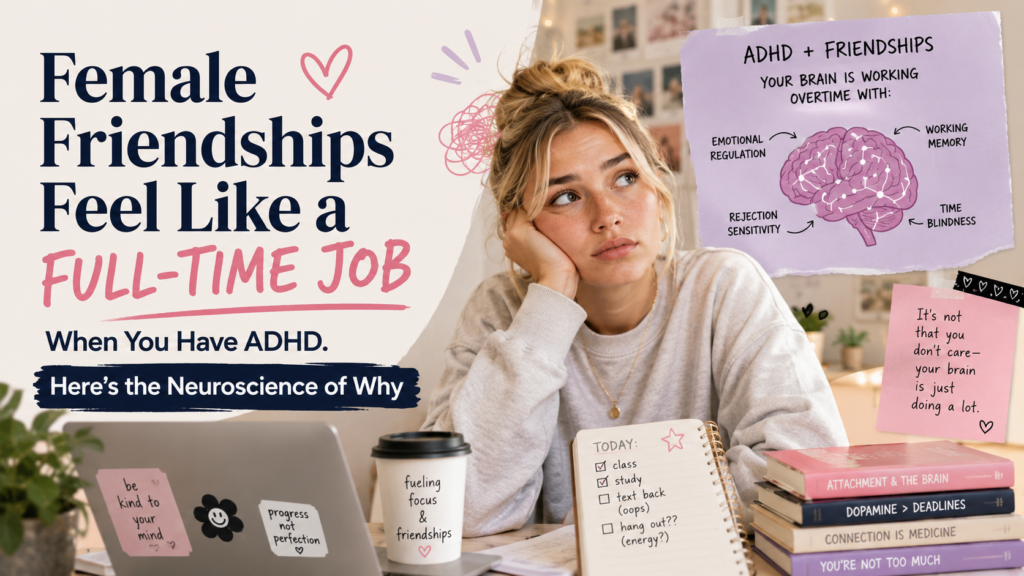
You care about your friends. You think about them constantly, their job stress, their relationship drama, that thing they said three months ago that you’re still turning over. But when it comes to actually maintaining the friendship in the way female social culture expects, you fall apart. The group chat sits unread for a week. The birthday slips by. The “let’s catch up soon”, texts go unreplied. And what you’re left with is not laziness or indifference but a specific kind of grinding guilt: the sense that you are failing at something other people seem to do effortlessly. If you have ADHD, that failure is not a character flaw. It is a structural mismatch between how your brain works and what ADHD female friendships demand from you.
What Female Friendship Actually Asks of You
Before getting into the neuroscience, it is worth naming what the cultural infrastructure of women’s friendships actually requires. Unlike male friendship norms, which research suggests tend to center on shared activities, female friendship maintenance is largely built around verbal and emotional reciprocity: regular check-ins, remembering personal details, acknowledging milestones, group coordination, and sustained availability across multiple communication channels simultaneously. This is not a stereotype. It is a documented social pattern. The invisible architecture of women’s friendships is high-frequency and detail-dense.
Think about what a “good friend”, looks like by these standards. She remembers that your job interview is tomorrow and texts to ask how it went. She notices you have been quiet in the group chat and sends a private message to check in. She replies to the birthday plan thread with her availability, coordinates the restaurant, and remembers who has a dietary restriction. She responds to voice notes within a reasonable window so the other person does not spiral. She does not go quiet for weeks without a word. None of these tasks are enormous in isolation. Together, they constitute a continuous, low-level operational load that runs in the background of a friendship at all times.
For a brain with intact working memory, prospective memory, and executive function, this background load is manageable. For an ADHD brain, it is essentially a second job with no salary, no schedule, and a boss who never explains the performance review criteria.
Why Your Brain Keeps Dropping the Friendship Ball
There are at least four neurological systems that friendship maintenance depends on, and ADHD can disrupt all of them. Understanding this is not an excuse. It is a map. You cannot navigate terrain you cannot see.
The first is prospective memory: the ability to remember to do something at a future point in time without an external prompt. Remembering to text your friend after her difficult doctor’s appointment is a prospective memory task. So is sending a birthday message. So is following up on the conversation from two weeks ago. Research on time perception in ADHD (Weissenberger et al., 2021, Medical Science Monitor) confirms that adults with ADHD demonstrate significant difficulties in prospective time estimation, including the subjective sense of when future events will arrive. Events that are not happening right now often do not register with the same urgency as events in the present. A birthday that is two days away does not feel imminent. And then it is gone, and with it goes a small piece of how the friendship is perceived.
The second is working memory: holding and manipulating information in real time. Female friendship conversations are layered and nonlinear. They jump between topics, reference past conversations, and carry emotional subtext. Research by Slobodin et al. (2025, PLOS One) found that working memory deficits were a significant mediator between ADHD traits and emotional dysregulation in adult women. When a group chat fires twelve messages in three minutes, each containing a different social thread, the ADHD brain can struggle to hold all of it simultaneously, sequence a coherent response, and send it before the moment has passed. By the time a response feels manageable, the conversation has moved on. This is not rudeness. It is a processing bottleneck.
The third is task initiation: the ability to start doing something even when the motivation to do it is genuinely present. Many women with ADHD describe knowing they want to reply, wanting to reach out, intending to check in, and then not doing it. This is the kind of ADHD paralysis that looks like laziness from outside but feels, from inside, like being frozen. The intent is real. The execution is stuck. And the longer it sits, the heavier it becomes.
The fourth is object permanence. The ADHD brain often struggles to hold things in mind when they are not immediately visible or present. Friends who are not in front of you, physically or digitally, can fade from your working awareness in ways that feel inexplicable to you and hurtful to them. This is not because you do not care. It is because ADHD can genuinely impair the ambient “thinking of you”, signal that other brains send to the people they love. Out of sight can genuinely mean out of mental priority, not out of heart.
The Group Chat: A Specifically Terrible Invention for ADHD Brains
Group chats deserve their own section because they represent such a precise collision of everything that is difficult for an ADHD brain in a social context.
A group chat is asynchronous, meaning it requires you to hold the thread of a conversation across time gaps without losing context. It is multi-participant, meaning every reply potentially shifts the social dynamic and requires you to re-read backwards. It generates notifications that function as intermittent stimuli, activating your threat detection system as each unread message carries micro-uncertainty about what it contains. And the longer you leave it unread, the worse the cognitive load of catching up becomes, until the chat represents such a mountain of context that entering it feels genuinely overwhelming.
From the community: “That early sense of not quite fitting in, of watching the other girls from a distance…, Girls in circles chatting and bonding effortlessly while someone lingers nearby, never quite part of it…, That sense of being too intense, too sensitive, too much or not enough all at once leaves a lasting mark.”, r/ADHDwomen thread
Research on ADHD and mobile phone use (Panagiotidi and Overton, 2020) found that ADHD traits positively predict engagement in managing multiple overlapping conversations simultaneously, while also predicting more distress around that communication load. The ADHD brain is often pulled toward novelty in digital communication but not consistently equipped to sustain the organizational and emotional demands that come with it. Group chats are novelty delivery systems that quickly become obligation machines.
For women specifically, the stakes of group chat participation tend to be high. Going quiet in a women’s group chat is rarely interpreted as neutral. It can read as disengagement, upset, or social withdrawal. Women with ADHD often describe muting group chats to protect their attention, then feeling crushing guilt about their absence, then finding re-entry so socially loaded that they avoid it further. It becomes a cycle with no clean exit.
The Masking Tax Nobody Mentions
One dimension of ADHD female friendships that rarely gets named directly is the cost of social masking. Research by Hall et al. (2026, Behavioral Sciences) found that ADHD symptom severity was significantly associated with higher masking tendencies in adults, and that masking itself mediated greater identity distress and imposter phenomenon. Women with ADHD tend to report masking at higher rates than men, in part because social expectations for women include a level of social fluency, attentiveness, and emotional responsiveness that requires sustained performance.
When you are with friends and you are masking, you are using cognitive resources to perform social engagement while simultaneously managing your actual attention, monitoring the conversation for cues you might have missed, suppressing the impulse to say the wrong thing or zone out visibly, and tracking the meta-level of how you are coming across. By the end of a social event, even one you genuinely enjoyed, you may feel emptied in a way your friends simply do not. This is sometimes called the “social hangover,”, but it is really the aftermath of sustained executive performance under conditions that were never built for your neurology.
A 2025 qualitative study on the lived experience of ADHD in girls and young adults described participants who had spent years trying to “fake my way through”, social situations: unable to focus on what people were saying, finding extended social situations genuinely draining, and describing themselves as “a hard friend to have.”
That framing, “a hard friend to have,”, carries enormous weight for women who have internalized it as a verdict rather than recognizing it as a description of an unsupported neurological difference.
The masking cost is documented: Research by Slobodin et al. (2025, PLOS One) confirmed that in adult women with ADHD, executive function deficits, specifically working memory and task-shifting difficulties, directly predict emotional dysregulation above and beyond ADHD traits alone. Every social interaction that demands sustained performance is borrowing from a limited executive resource pool.
Why Birthdays Feel Like Traps
Birthdays are a microcosm of everything difficult about friendship maintenance with ADHD. They are fixed-date obligations that require prospective memory (remembering in advance), planning (finding or writing a message, selecting a gift if relevant), and timely execution. They occur across a distributed calendar, meaning there is no single annual event to prepare for. There are twelve months of individually scattered deadlines with no external scaffolding unless you build it yourself.
The social cost of missing a birthday is often disproportionately high relative to the task complexity. A forgotten birthday reads as “you do not care enough to remember,”, even when the truth is that you think about this person constantly and would have done anything for them if the date had registered. The mismatch between your internal reality and the external signal you send is one of the most painful features of ADHD in relationships: you feel more than you demonstrate, and the gap gets interpreted as evidence that you feel less.
This is distinct from the fear-of-rejection dynamic covered in our deep dive on rejection sensitive dysphoria. That article addresses the terror of being rejected. This one addresses the logistical failure mode that can trigger the rupture in the first place, and the shame that quietly accumulates around it over time.
How This Gets Gendered: The Expectations Women Face
It would be incomplete to write about ADHD female friendships without acknowledging that the burden is not simply neurological. It is also cultural. Women are socialized into a model of friendship that is maintenance-heavy by design. The expectation that women will be the social schedulers, the emotional holders, the memory-keepers of relationships, the ones who notice when someone goes quiet and reach out, is not biologically determined. It is a learned and enforced script.
A narrative review of outcomes in adolescent and adult women with ADHD documents that girls and women with ADHD show consistently elevated rates of problematic peer functioning, including peer victimization, social rejection, and difficulty fitting in, particularly in the context of the complex social dynamics of female peer groups (Kok et al., as cited in the narrative review of outcomes in female ADHD). Boys with ADHD may struggle to follow the rules of a game. Girls with ADHD often struggle to follow the unwritten rules of a social ecosystem, which are more numerous, more implicit, and more socially punishing to violate.
A 2025 qualitative study on ADHD manifestation in girls found that female ADHD presentations are often “socially oriented and internalised.”, Girls with ADHD spend enormous energy trying to read the room, track social hierarchies, and perform friendship correctly, precisely because the cost of getting it wrong in female social spaces tends to be exclusion rather than confrontation. The result is a pattern that can look like anxiety or introversion from outside, but is actually a high-effort adaptive response to a system that never accommodated the way their brains actually work.
The research on social camouflaging in ADHD (van der Putten et al., 2024, as cited in Müller et al., 2024, Frontiers in Psychiatry) shows that adults with ADHD make efforts to assimilate socially in ways that closely parallel masking in autistic adults. The energy cost is real, measurable, and often invisible to the people around them.
The Shame Loop That Makes Everything Worse
Here is the cycle that many women with ADHD know intimately, even if they have never named it. You miss a birthday, or you go silent in the group chat for too long, or you cancel the plan at the last minute. You feel immediate shame. The shame makes reaching out feel impossible. What do you even say? So you delay. The delay compounds the shame. Now it has been two weeks and you feel like you owe a full explanation that you cannot organize. So you delay more. Now it has been a month and the friendship feels irretrievable, even though the other person may have barely registered the gap.
Executive dysfunction makes this loop particularly vicious because the very cognitive resources you need to break out of it, planning, initiating, regulating the emotion so you can act despite it, are exactly the resources that ADHD tends to deplete. The shame freezes you. The freeze makes things worse. The worsening intensifies the shame. This is not weakness. It is a neurological trap with a clear mechanism, and naming that mechanism is the first step toward interrupting it.
The interpersonal cost is documented: A comprehensive clinical review of ADHD in adulthood confirms that interpersonal functioning is often profoundly affected across romantic partnerships, family dynamics, and social networks, and that greater ADHD symptom severity is consistently associated with more significant social relationship difficulties. This is not an individual failing. It is a measurable outcome of unaddressed ADHD in a demanding social world.
What Actually Helps (Without Pretending It Is Easy)
There is no system that completely eliminates the friction. What follows are approaches that reduce it: not fixes, but structural changes that make the neurological realities more workable.
The most effective shift is moving friendship maintenance from memory-dependent to system-dependent. Neurotypical friendship maintenance runs largely on ambient social memory, the background awareness of people’s lives that prompts timely check-ins. Friendship maintenance for ADHD brains often needs to be externalized. This means building reminders that do not rely on your brain’s spontaneous recall: birthday calendars with pre-written message drafts, recurring weekly “reach out to one person”, alarms, or designated friendship check-in slots in your schedule treated with the same seriousness as a work meeting.
The second shift is quality over frequency, and being honest with your friends about this. Many women with ADHD are far better at deep, present, one-on-one connection than they are at sustained low-level maintenance. Leaning into that, and having an honest conversation with your closest friends about how your brain works, can reframe the relationship away from “she never texts back”, toward “when she is here, she is really here.”, This requires vulnerability, but it tends to produce more durable friendships than performing a maintenance pattern you cannot sustain.
The third shift addresses group chats specifically: giving yourself permission to participate asynchronously without guilt. Muting a group chat is not abandoning the friendship. It may be the thing that makes it possible for you to actually engage when you do show up, because you are not spending your limited attention managing notification anxiety all day. Sending a personal message to the person in the group you most care about is not a consolation prize. That direct connection is often more meaningful than a presence in the group thread anyway.
Finally, if you recognize the shame loop described above, the interrupt is not willpower. It is lowering the re-entry bar as far as it will go. A voice note that says “I have been in my own head and I miss you”, is not a failure. It is the thing that breaks the cycle. The executive function barrier to sending a voice note is lower than crafting a text explanation. Use the format that costs you least, not the one that meets some imaginary standard of social adequacy.
None of this is about becoming a different kind of friend. It is about designing the conditions in which you can actually be the friend you already are, because the care is there. It has always been there. The infrastructure just needs to be built around a brain that works differently, not against it.
Quick Dopamine Hits:
- Set a single ‘friendship anchor’, alarm every Sunday at noon. When it fires, send one voice note to one friend, no typing, no planning, just talk for 60 seconds. Done.
- Create a ‘birthday shortcut’: on January 1st each year, schedule birthday texts in your calendar for every person you care about. Include a draft of what you want to say so future-you doesn’t freeze.
- Mute group chats that feel like obligation rather than joy. Then send one personal message to the person you actually miss. One thread, one person, that’s a real friendship.
Rate this article
Was this a useful hit?