Is It an ADHD Thing That Starting a New TV Show or Movie Feels Like an Insurmountable Commitment?

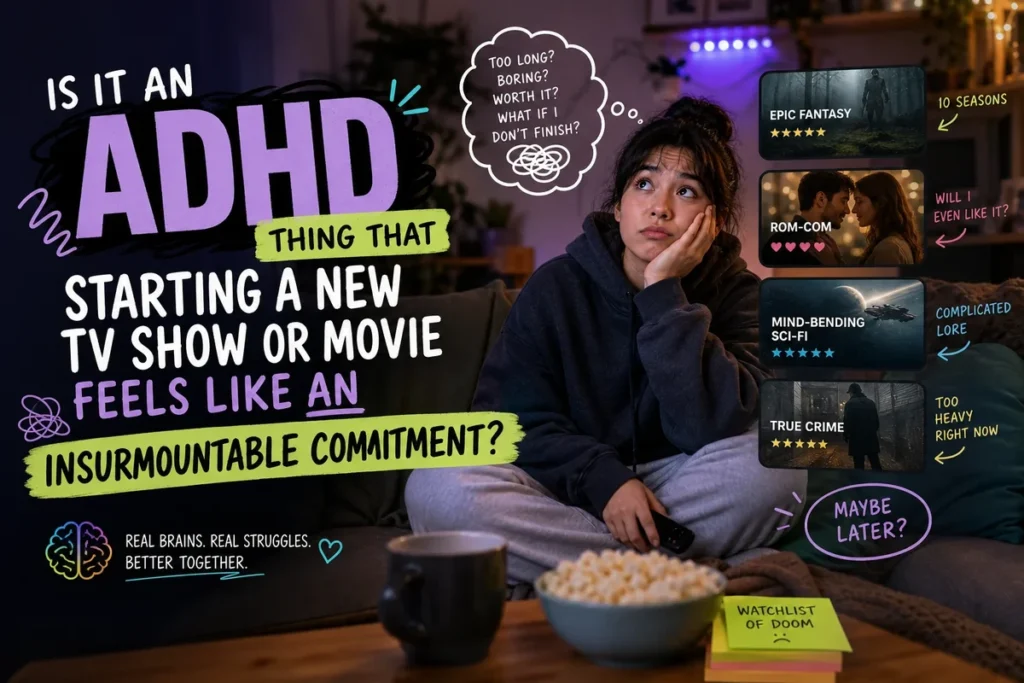
You have been scrolling through Netflix for forty-five minutes. Your dinner is getting cold. You have opened and closed three different show descriptions, read the premise of a movie that sounds interesting, hovered over the play button, and then backed out to keep scrolling. You are exhausted from a long day and all you want is to watch something, anything, but the thought of starting something new feels like agreeing to run a marathon. So you navigate back to The Office for the ninth time, or you pull up YouTube and watch clips from shows you have already seen, or you give up entirely and stare at your phone instead. The streaming service has ten thousand options. You cannot commit to a single one.
Yes, this is an ADHD thing. It is called ADHD media decision paralysis, and it sits at the intersection of two core ADHD challenges: task initiation deficit and choice overload. Your brain is not being lazy or indecisive. It is running a cost-benefit analysis it cannot complete, trying to guarantee that the next two hours will be worth the attentional investment before it has any data to work with.
Why ADHD Media Decision Paralysis Freezes You in Place
The ADHD brain has a fundamentally different relationship with uncertainty than neurotypical brains do. When you face a choice with an unknown outcome, your prefrontal cortex is supposed to make a reasonable prediction, tolerate some ambiguity, and move forward. But ADHD involves underactivity in the prefrontal cortex and dysregulation of dopamine, the neurotransmitter that helps you feel motivated to pursue uncertain rewards.
Starting a new show is pure uncertainty. You do not know if the pacing will work for your brain. You do not know if the characters will be interesting enough to hold your attention. You do not know if the plot will deliver on its premise or fizzle out by episode three. For a neurotypical brain, this uncertainty registers as mild, tolerable, part of the experience. For an ADHD brain, this uncertainty registers as risk. The dopamine system that should help you feel excited about a potential reward instead hesitates, because it has been burned before.
You have started shows and abandoned them. You have invested three episodes into something only to realize it was not for you. You have recommended something you loved to a friend and then felt the creeping dread that they might not like it. Your brain remembers all of this, and it applies that memory to every new decision. The result is paralysis.
The Paradox of Wanting Entertainment but Resisting It
Here is the part that feels genuinely absurd: you want to watch something. This is supposed to be a pleasurable activity. You are not procrastinating on taxes or avoiding a difficult conversation. You are trying to relax, and your brain is treating relaxation like a high-stakes commitment.
This is because ADHD task initiation problems do not discriminate between tasks you want to do and tasks you have to do. The executive function required to start something, to transition from scrolling to watching, to commit to a single choice, is the same executive function you struggle with everywhere else. Your brain does not care that this is fun. It cares that this requires a decision, and decisions are expensive.
The ADHD brain often experiences starting a new show the same way it experiences starting a work project: as a commitment that might not pay off, requiring mental resources it is not sure it has.
This is why rewatching familiar shows feels so different. When you put on Frasier for the hundredth time, there is no decision happening. You already know you like it. You already know the pacing works for your brain. You already know which episodes to skip and which ones to savor. The cognitive load drops to nearly zero, and your exhausted executive function gets a break.
The Search Spiral That Makes Everything Worse
There is a specific hell that ADHD brains know intimately: the search spiral. You finish a show you loved, and you want something similar. Not just any show, but something with that exact tone, that exact pacing, that exact feeling. So you start searching. You read reviews. You watch trailers. You compare ratings. You open twelve browser tabs and cross-reference recommendations.
Two hours later, you have not watched anything. You have researched entertainment so thoroughly that you are now too tired to be entertained. The search itself became the activity, consuming all the time and energy you had allocated for actually watching something.
This happens because the ADHD brain often finds the hunt more stimulating than the catch. Searching feels productive. It feels like you are making progress toward a decision. But the decision never arrives, because no amount of research can guarantee that a new show will hit the same way the last one did. You are looking for certainty in a fundamentally uncertain domain.
The research trap: If you have spent more than fifteen minutes searching for something to watch, you have likely passed the point of diminishing returns. The search is now the problem, not the solution.
Why the Anxiety Shows Hit Different
Some ADHD brains have an additional layer to this problem: they cannot watch shows where characters are hiding something and might get discovered. Breaking Bad. You. Dead to Me. Any show where the tension comes from secrets being slowly revealed and the constant threat of exposure.
This is not a quirk. It is a predictable response to how ADHD affects emotional regulation. The ADHD nervous system often struggles to maintain appropriate distance from fictional stakes. When a character is in danger of being caught, your body responds as if you are in danger of being caught. The anxiety is not metaphorical. It is physiological.
This further narrows the already overwhelming field of options. You cannot just find something good. You have to find something good that will not dysregulate you. The cognitive load of predicting which shows will trigger anxiety, combined with the existing paralysis around starting anything new, creates a perfect storm of avoidance.
What Standard Advice Gets Wrong About ADHD Starting New Show Difficulty
The standard advice for decision paralysis is to just pick something. Stop overthinking. Make a choice and commit. This advice assumes that the barrier is psychological, that you are simply being too precious about your entertainment choices and need to lower your standards.
But ADHD choice overload entertainment struggles are neurological, not psychological. Your brain is not overthinking because it wants to. It is overthinking because the executive function required to stop thinking and start doing is impaired. Telling an ADHD brain to "just pick something" is like telling someone with a broken leg to just walk it off.
The other common advice is to make a list of shows you want to watch and work through it methodically. This sounds logical, but it often backfires for ADHD brains. The list becomes another source of obligation. Now you are not just failing to start a new show, you are failing to complete your list. The shame compounds.
What Actually Helps With ADHD Commitment Resistance Media
The goal is not to eliminate the paralysis. It is to reduce the cognitive load of starting until your impaired executive function can actually handle it. Here is what that looks like in practice.
First, externalize the decision entirely. Ask someone you trust to pick something for you, with no options and no discussion. Not "give me some recommendations." Literally "tell me one show to watch tonight and I will watch it." This removes the decision from your plate completely. You are not choosing. You are following instructions. The cognitive load drops dramatically.
Second, commit to the smallest possible unit. Do not decide to watch a show. Decide to watch ten minutes of a show. Give yourself explicit permission to stop after ten minutes with no guilt and no obligation to continue. This reframes the commitment from "I might be investing sixty hours into this series" to "I am spending ten minutes on an experiment." The stakes lower, and starting becomes possible.
You do not have to finish what you start. Treating every show as an experiment rather than a commitment changes everything about how your brain approaches the decision.
Third, recognize that rewatching is valid. The cultural pressure to consume new content constantly is not calibrated for ADHD brains. If rewatching familiar shows is what your nervous system needs to actually relax, that is not a failure. It is an accommodation. Stop judging yourself for choosing the option that works.
Fourth, use external tools to break the scroll cycle. Set a timer before you open Netflix. When the timer goes off, you watch whatever your cursor is currently on, no matter what. This creates an arbitrary deadline that your ADHD brain might actually respond to, turning an infinite decision space into a finite one.
The ten-minute rule: Commit only to watching the first ten minutes. If your brain is engaged, you will naturally continue. If not, you have lost ten minutes instead of an entire evening to the scroll spiral.
The Deeper Pattern Worth Noticing
ADHD media decision paralysis is a symptom of something larger: the way ADHD makes every commitment feel heavier than it should. Your brain treats starting a TV show the same way it treats starting a job, a relationship, or a project. It runs the full cost-benefit analysis, factors in every previous failure, and often concludes that the safest option is to not start at all.
This pattern shows up everywhere. It is why you have books you bought and never read, games you downloaded and never played, hobbies you researched extensively and never tried. The enthusiasm is real. The interest is genuine. But the executive function required to translate interest into action is inconsistently available.
Understanding this pattern does not make it disappear. But it does change how you interpret your own behavior. You are not flaky, lazy, or impossible to please. You have a neurological difference that makes initiation genuinely harder, even for things you want to do. The path forward is not willpower. It is accommodation: reducing the cognitive load of starting until it falls within the range your executive function can actually handle.
Tonight, instead of opening Netflix and scrolling, try texting someone and asking them to pick for you. Or set a five-minute timer and watch whatever is on screen when it goes off. Or put on that show you have already seen a dozen times and let yourself enjoy it without guilt. The goal is not perfect media consumption. The goal is actually resting, in whatever form that takes for your particular brain.
Rate this article
Was this a useful hit?