Is It an ADHD Thing That You Restart the Game Every Time the Creative Building Part Is Over and the Grinding Begins?

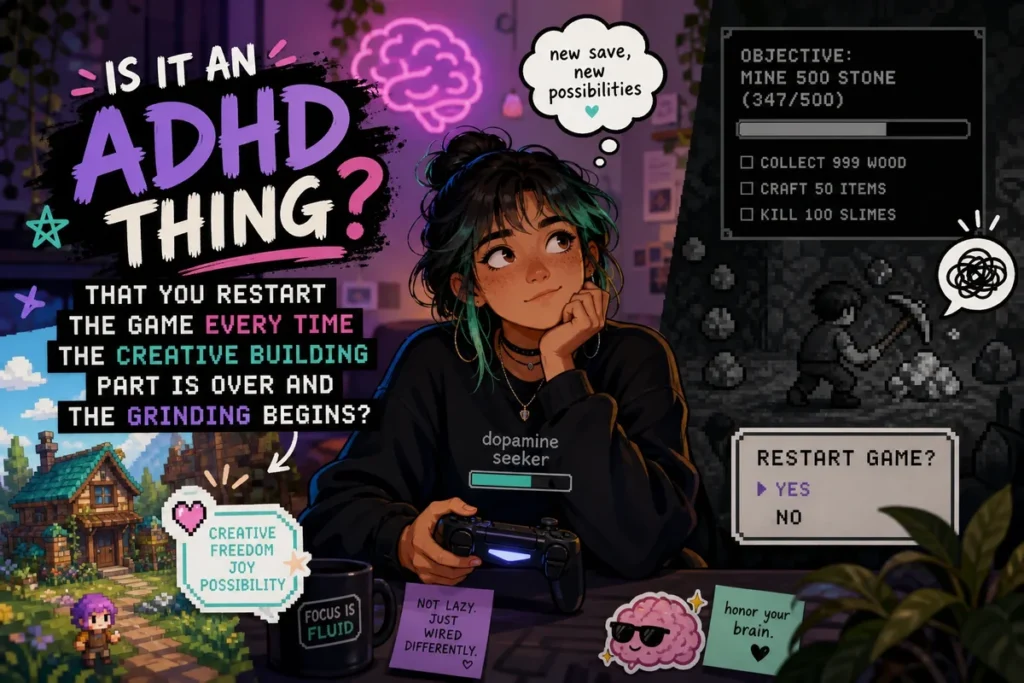
You spend three hours on the house. The roofline is exactly right, the garden has a little path that curves around the pond, and the family you made has a backstory you invented while placing the furniture. Then the game asks you to do the next thing. Go to work. Balance the budget. Feed the animals for the four hundredth time. Manage the queue of tasks that keeps refilling. You open the menu, look at your save file, and feel something go flat. Two minutes later you are in character creation again, telling yourself this time will be different. This time you will stick with it. You have forty saves, and thirty-nine of them look like a beautiful first chapter.
Yes, this is an ADHD thing. It is a form of novelty-driven dopamine regulation, and the ADHD video game restart cycle is one of the clearest everyday windows into how an interest-based brain actually works.
What the ADHD video game restart cycle actually looks like
The pattern is remarkably consistent across games. Sims, Planet Zoo, Prison Architect, Minecraft, Cities Skylines, farming sims. The details change but the arc does not. Setup is electric. You research the best traits, plan the layout, watch a tutorial, and maybe read a guide for an hour before you place a single object. The building phase is absorbing. Time disappears.
Then the game shifts from making to maintaining. The creative decisions get replaced with routines. Earn money, keep needs bars full, repeat. Some people describe an almost physical drop, like a light turning off. You still like the game. You just cannot make yourself continue this particular save.
Then comes the part that makes it feel like a personal flaw. You start a new game and promise yourself it will be a better one. Sometimes you even research for an hour to pick the perfect setup, play ten minutes, decide a different setup would have been better, and start over again. The restart begins to feel like the main activity.
It is. That is the uncomfortable and useful truth about this pattern.
Why your brain pays out at the start, not the finish
Dopamine is not the pleasure chemical. It is closer to an anticipation and prediction signal. It fires when something is new, uncertain, or promising, and it tapers off as an outcome becomes predictable. Every brain does this to some degree. ADHD brains do it with a lower baseline and a steeper drop.
Research on ADHD consistently points to differences in the brain's reward pathways, including reduced dopamine signalling. That means ordinary, predictable rewards do not register with as much force. Novelty, challenge, and urgency do. The early game is all three. You do not know what the house will look like. You are solving spatial problems. Every placement is a small decision with a visible result.
Once the layout is finished, the uncertainty is gone. What remains is known, repeatable, and slow to pay off. To a neurotypical player that can feel calming. To an ADHD player it can feel like a signal being cut.
The ADHD video game restart cycle is not a failure to finish. It is a brain following the only reliable reward it has: the moment before you know how it ends.
The building phase is where your strengths live
There is a reason the creative phase feels so good. Research on ADHD has linked it to stronger divergent thinking, the kind of thinking that generates many ideas, sees unusual connections, and asks what could fit here. Studies, including work by Hoogman and colleagues in 2020, describe this pattern alongside weaker convergent thinking, which is the step-by-step narrowing toward one correct outcome.
Sandbox building is divergent thinking in its purest form. There is no wrong answer. Every choice opens more options. It rewards exactly the mode your brain is good at.
Grinding is the opposite. It asks for sequence, repetition, and delayed payoff. Do step one, then step two, then step three, and wait. That is the mode where ADHD brains tend to burn fuel fastest and get the least back.
So when your interest drops at the transition, it is not random. You have moved from the part of the game that matches your wiring to the part that fights it.
Hyperfocus in the game building phase, and why it ends so abruptly
The ADHD hyperfocus game building phase can be intense enough that people lose whole afternoons and forget to eat. Hyperfocus is not really focus you control. It is attention that locks on when interest, novelty, and challenge line up. You do not choose it, and you cannot summon it on demand.
The flip side is that hyperfocus is fuelled by the same things that vanish when the build is done. When uncertainty falls and the tasks become predictable, the conditions that created the lock disappear. Attention does not gradually fade. It drops off a ledge.
That is why the change feels so sudden. Ten minutes ago you were absorbed. Now the game feels like homework, and you cannot explain what changed. What changed is that your brain stopped getting paid.
Spot the drop: The moment you first think “I should start a new one” is usually the moment novelty ran out, not the moment the game got bad. Notice what just changed in the game right before that thought. It is almost always the shift from creating to maintaining.
Why the next save always feels like it will be different
The hope in that restart is real. You believe the next attempt will be the one you stick with, and that belief is not a lie. It is a prediction your reward system makes because starting is exciting, and excitement feels like evidence.
There is also a quieter piece. Starting fresh gives you a clean slate with no accumulated mess, no half-finished systems, and no evidence that you drifted last time. A new save file is a new story where you get to be the person who follows through. It is the same reason people restart planners in January or buy a fresh notebook.
The research pattern on ADHD interest novelty gaming shows up here too. Choosing the perfect setup, comparing classes, tweaking starting conditions: all of that is still novelty. You are getting dopamine from the decision, which is why the research phase can feel as good as the play itself and why the setup sometimes never turns into a game.
And if the new save does not match the imagined version exactly, the letdown feels sharp. So you restart again, chasing a game that only exists in your head.
Why “just commit to one save” does not work
The standard advice is some version of discipline. Pick one, stick with it, push through the boring part. It sounds reasonable and it ignores the mechanism. If your brain is not registering the reward, willpower has to cover the entire gap. That is expensive, and it is the executive function system that ADHD already makes unreliable.
Pushing through also carries an emotional cost. Every abandoned save can feel like proof of a character flaw, and that shame makes the next attempt heavier. Over time, some people stop buying games they know they love, because they are tired of the pattern.
It helps to name what the pattern is. It is not laziness, because you are putting real effort into the early game. It is not a lack of commitment, because you do come back with genuine enthusiasm. It is a mismatch between where the reward is and where the game asks you to stay.
What actually helps: work with your dopamine, not against it
You do not have to fix this. You can adjust how you play so the reward lasts longer, or decide the build is the point and stop feeling guilty about it.
Add novelty to the maintenance phase. Give the old save a new problem. Introduce a disaster, a self-imposed challenge, a rule you have never tried, or a new district that changes the shape of the game. Anything that brings uncertainty back can restart the signal without restarting the file.
Choose games that keep generating new decisions. Some games change constantly, with events, seasons, expansions, and shifting goals. Others settle into a loop. Notice which ones hold you longest, and pick more of those.
Make the build the finished product. If you love designing, treat each save as a completed creative project. Take screenshots, name it, and close it with a sense of done rather than dropped. That small reframe changes the emotional ending from failure to finish.
Use cheats and mods without guilt. If the grind is the part that drains you, removing it is a valid way to play. You are shaping the game so your brain stays engaged, which is the same thing a good designer would do.
Track the pattern: Keep a short note of where each save lost your interest. After a few games you will see the exact transition point that triggers it, which tells you what to change.
The restart cycle beyond games
Once you see this in gaming, it is hard to miss elsewhere. The hobby you researched for weeks and dropped when the beginner phase ended. The project that thrilled you until it became routine. The job that was perfect until you learned it. The same mechanism runs underneath all of them.
That is useful information, not a verdict on your character. It tells you where your motivation actually comes from, which lets you design your work, hobbies, and routines around it. Build in novelty checkpoints. Break long projects into stages that each have their own beginning. Hand off the maintenance when you can, or pair it with something stimulating.
People who arrive at this through Late Discovery often say the same thing: the pattern made far more sense once it had a name. The forty save files were never proof that you cannot commit. They were a record of what your brain rewards.
The next time you feel the drop and reach for New Game, pause for a minute. Ask what changed, and whether you can bring that back into the save you already have. If you cannot, and you want the fresh start, take it without shame. The ADHD video game restart cycle is not something to defeat. It is a signal that tells you exactly where your interest lives, and the more precisely you can read it, the more you can build around it.
Rate this article
Was this a useful hit?