Is It an ADHD Thing That You Responded to a Stranger’s Message Instantly but Your Close Friend’s Text Has Been Sitting There Three Days?

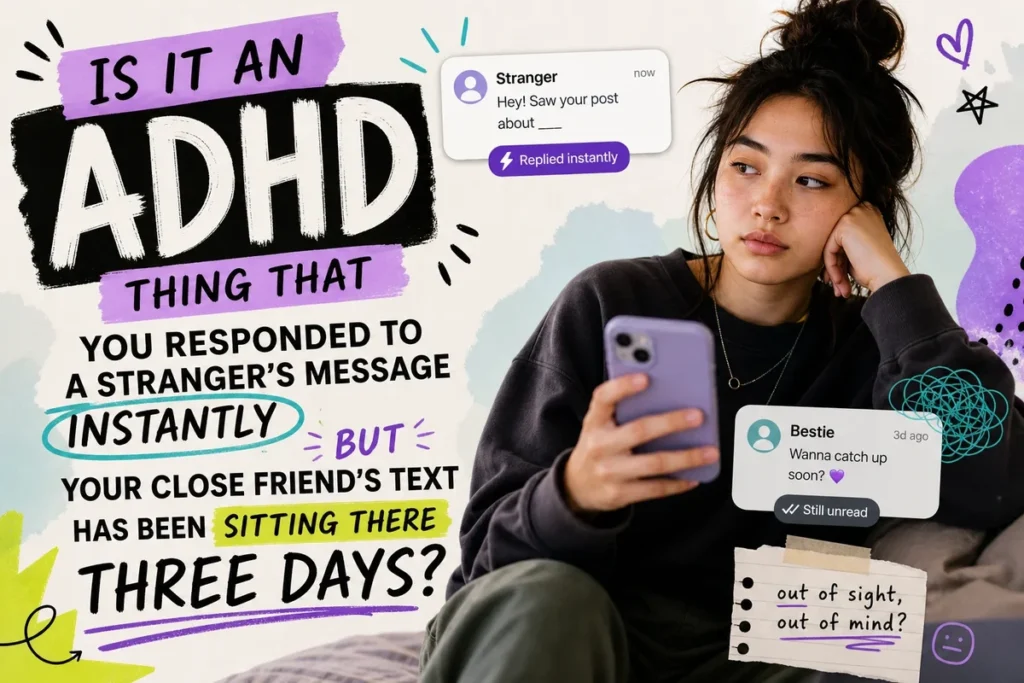
The notification from someone you’ve never met pops up, and your thumb moves before you’ve consciously decided to reply. Thirty seconds later, the stranger has a thoughtful response. Meanwhile, your best friend’s text from three days ago sits there, marked unread, a small number badge you’ve trained yourself to stop seeing. Your partner asked a simple question on Tuesday. It’s Friday. You’ve thought about that message approximately forty times. You’ve composed responses in your head while showering. You’ve felt genuine guilt about it at 2am. But you still haven’t opened it. And somehow, when a coworker you barely know sends a random meme, you reply within minutes with a full commentary.
Yes, this is an ADHD thing. It’s called novelty-driven dopamine response, and it explains why ADHD texting inconsistency has nothing to do with who you care about and everything to do with how your brain processes familiar versus unfamiliar stimuli.
Why ADHD Texting Inconsistency Happens in the First Place
The ADHD brain produces and regulates dopamine differently than neurotypical brains. Dopamine isn’t just a “reward chemical.” It’s what creates the feeling that something is worth doing right now. It provides the activation energy to move from thinking about a task to actually doing it. And here’s what matters for your unread messages: novel stimuli trigger significantly more dopamine release than familiar ones.
A stranger’s message is new. It’s unpredictable. Your brain doesn’t know what it contains, what tone it will have, or what it will require. That uncertainty creates a small dopamine spike that makes opening and responding feel almost automatic. The action completes itself.
Your close friend’s message? Your brain has already categorised it. It knows approximately what kind of message it is, what kind of response it will need, and that the relationship is secure enough to handle a delay. There’s no novelty. There’s no urgency signal. The dopamine system doesn’t activate. And without that activation, initiating the response becomes surprisingly hard, even when you want to do it, even when you love the person, even when the message requires nothing more than “haha, same.”
The Safety Paradox: Why We Neglect the People We Love Most
There’s a brutal irony in ADHD communication patterns: the safer someone feels, the harder it becomes to respond to them. This isn’t about taking people for granted in some moral sense. It’s about how safety registers in a brain that needs urgency signals to initiate action.
A stranger might think poorly of you if you don’t respond. A new contact might lose interest. A professional connection might judge your reliability. These possibilities create just enough activation to push the response across the threshold.
Your best friend of fifteen years? Your brain knows, accurately, that they’ll still love you whether you respond today or next week. That knowledge, which should make responding easier, actually removes the urgency signal your ADHD brain requires to act. The relationship’s security becomes the very thing that makes responding feel impossible.
The people who will forgive you for not texting back are exactly the people your brain deprioritises, because forgiveness means no consequence, and no consequence means no activation signal.
This is why ADHD texting inconsistency often looks like you value acquaintances over loved ones. The pattern is real, even though the underlying preference absolutely isn’t.
The Cognitive Load of “Easy” Messages
From the outside, replying to “how are you?” looks simple. From inside an ADHD brain, that open-ended question requires constructing a response that accounts for how you actually are (complicated), how much detail is appropriate (unclear), what tone to strike (depends), and whether you have the bandwidth for the follow-up conversation your response might initiate (probably not). The message sits there, radiating low-grade demand, while you scroll past it another twelve times.
Meanwhile, the stranger asking a specific question gets an answer immediately. The task is bounded. The social stakes are lower. The processing demand is manageable.
This isn’t laziness: Executive function research consistently shows that task initiation difficulty increases when tasks feel emotionally loaded or open-ended, regardless of how objectively simple they appear. A message from someone you love often carries more emotional weight, more potential conversation branches, and more perceived consequences for getting the tone wrong.
The cognitive load isn’t visible in the message itself. It lives in everything the message implies about what happens next.
Why Standard Advice Makes ADHD Communication Patterns Worse
“Just reply when you see it.” This assumes the problem is decision-making speed. It isn’t. The problem is that seeing the message and being able to respond to it are completely disconnected experiences in the ADHD brain. You see the message constantly. You think about responding constantly. The initiation pathway just doesn’t fire.
“Set aside time each day to respond to messages.” This requires the same task initiation that the individual messages require, except now applied to an entire category of tasks. You’ll set the reminder, see the reminder, and feel the same paralysis, except now it covers everyone at once.
“Just be honest and tell people you’re bad at texting.” This helps with expectation management but does nothing about the actual ADHD texting inconsistency pattern. You’ll still respond to strangers instantly. You’ll still leave close friends unread. The honesty doesn’t change the brain chemistry.
The advice fails because it treats the symptom as a habits problem. It’s not. It’s a dopamine regulation problem. And habits-based solutions can’t override neurotransmitter dysfunction through willpower.
What Actually Helps: Working With the Novelty System
Since your brain responds to novelty, the question becomes: how do you inject novelty into familiar relationships?
Voice notes instead of text. The physical act is different. The processing feels different. Many people with ADHD find they can respond instantly with voice when text feels impossible, because speaking requires less executive function than writing.
Reactions and emojis as complete responses. A heart reaction isn’t a failure to communicate. It’s a successful acknowledgment that you’ve seen the message, you care, and you’ll engage more fully when you can. Many close friends will understand that a quick emoji is actually a win, not a dismissal.
Changing the medium entirely. If you’ve been text-silent with someone for weeks, calling them often feels more achievable than crafting the “sorry I’ve been quiet” text that requires explaining yourself. The phone call is novel. The explanation text is loaded.
ADHD respond strangers not friends patterns can shift when you make familiar communication feel slightly unfamiliar again.
Physical context switching helps too. If you always ignore texts from your couch, try opening messages only when you’re in a specific location, like a coffee shop or even just a different room. The environmental change can provide enough novelty to lower the initiation barrier.
The Guilt Spiral and Why It Makes Everything Worse
Three days become five. Five become ten. Now the message requires an apology. The apology requires explaining why you didn’t respond. Explaining requires admitting something about yourself you might not want to articulate. The task has grown. The barrier has grown. The guilt has grown. You’re now less likely to respond than you were on day one.
ADHD communication patterns include this escalation cycle. The longer you wait, the harder initiating becomes, not because the person is angrier with you, but because the task in your mind has accumulated additional requirements that the original message never had.
Breaking the cycle means responding before the response feels “ready.” It means sending “been meaning to reply, brain wouldn’t let me, love you” without waiting until you can compose the fuller response you feel you owe. The incomplete response actually arrives. The complete response often doesn’t.
ADHD Novelty Social Response and Identity Questions
When you notice yourself replying to strangers while ignoring loved ones, it’s easy to construct a story about who you are. You might conclude you’re selfish, unreliable, bad at relationships, or that you don’t actually care as much as you think you do. People with ADHD frequently report lower self-esteem related to exactly these kinds of behavioural patterns that seem to contradict their internal values.
The story isn’t accurate. ADHD novelty social response is a feature of how dopamine systems interact with familiarity and safety, not a reflection of your character or attachment capacity. You can simultaneously love someone deeply and struggle to respond to their messages. Both things are true. The second doesn’t disprove the first.
Reframe worth holding: The fact that you feel guilty about not responding is evidence that you care, not evidence that you don’t. Indifference doesn’t produce guilt spirals. Love does.
If you’re in the process of late discovery, recognising ADHD texting inconsistency as a brain pattern rather than a character flaw can shift how you understand years of relationship friction. You weren’t careless with the people you loved. You were fighting a neurological system that deprioritised them precisely because they mattered enough to feel safe.
Communicating About the Pattern to People You Care About
Explaining this to close friends and family can help, but the explanation itself needs to avoid sounding like an excuse. One approach: describe the pattern as a brain thing rather than a feelings thing. “My brain treats your messages as safe enough to answer later, which means I end up answering strangers first because they feel more urgent. It’s the opposite of how much I care about you.”
Some people will understand immediately. Others won’t, and their feelings are valid even if the pattern has a neurological explanation. The explanation doesn’t erase the impact. It contextualises it.
For romantic partners especially, ADHD communication patterns can feel like rejection even when you understand the mechanism. Regular conversations about how both people are experiencing the pattern help more than a one-time explanation that’s supposed to fix everything. The pattern will continue. The communication about the pattern also needs to continue.
Practical Shifts That Work With ADHD Brains
Make your most-neglected contacts easier to reach than your most-responsive ones. Pin your close friend’s thread at the top of your messages. Put their contact on your home screen. The accessibility creates a small reduction in initiation friction.
Batch-respond during already-activated moments. If you just replied to something and feel a small momentum, immediately open the next message and reply before the activation fades. Borrow the dopamine from the first task for the second.
Use artificial urgency when necessary. Set a timer for three minutes. Tell yourself you have to send something, anything, before it goes off. The imposed deadline can create enough activation to override the natural deprioritisation.
Stop treating long replies as the goal. The message your friend actually receives beats the perfect message that stays in draft form forever. Lower the bar radically: a reply exists, or it doesn’t. Quality is a secondary concern when the primary problem is initiation.
The pattern won’t disappear entirely. ADHD texting inconsistency is baked into how the novelty-driven dopamine system interacts with safety and familiarity. But understanding why it happens, and building systems around it, means the pattern can coexist with close relationships that feel valued and maintained. Your best friend’s three-day-old text might still sit there sometimes. But you’ll know it’s not about caring less. And more importantly, they will too.
Rate this article
Was this a useful hit?