Is It an ADHD Thing That You Buy a Planner, Use It for Four Days, and Never Open It Again?

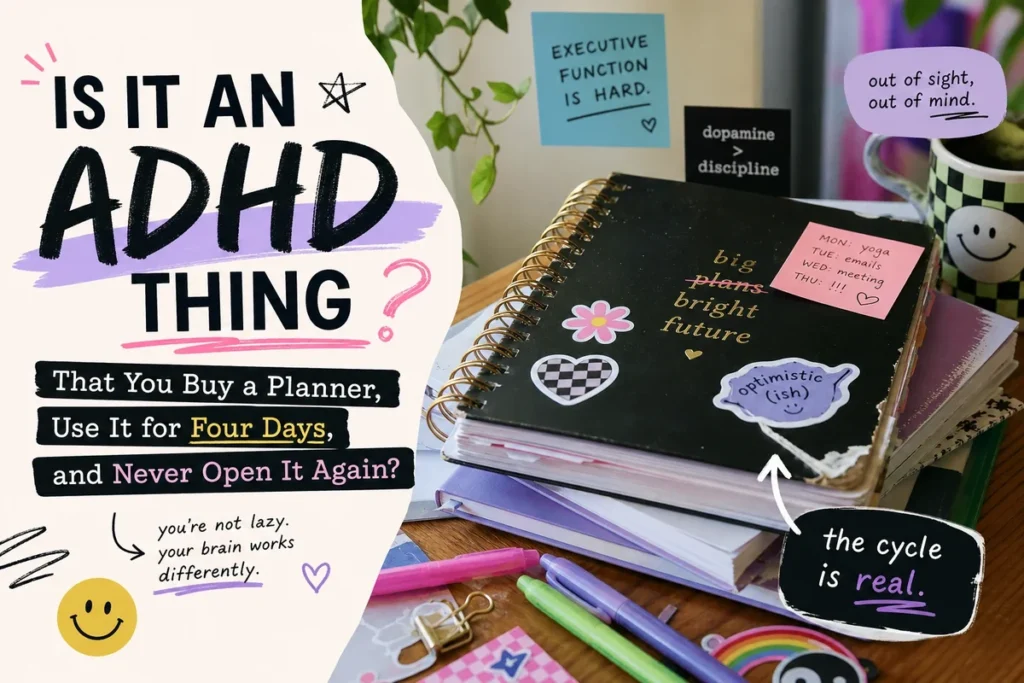
You bought it on a Tuesday. Maybe it was the specific layout that promised to finally work for your brain. Maybe it was the satisfying weight of the paper or the color of the cover or the influencer who swore it changed her life. You sat down that first evening with fresh pens and wrote out your goals, your habits, your weekly spread. You felt organized. You felt capable. You felt like this was the beginning of a new chapter.
By Saturday, you had not opened it once. It sits on your desk now, or in a drawer, or on a shelf next to the three other planners you bought this year. Each one represents a version of yourself that lasted approximately four days.
Yes, this is an ADHD thing. The technical name is novelty-dependent dopamine activation, and it explains why the ADHD planner doesn’t work the way you desperately need it to.
Why the ADHD Planner Doesn’t Work After the First Week
Your brain runs on dopamine. Everyone’s does. But the ADHD brain has a specific relationship with this neurotransmitter: it does not produce or regulate dopamine the way neurotypical brains do. This means you are constantly, unconsciously seeking experiences that will generate dopamine because your baseline levels are lower than average.
Novelty is one of the most reliable dopamine triggers that exists. A new planner, a new app, a new organizational system: these are not just tools. To your brain, they are dopamine delivery devices. The act of setting up a new system, of imagining the organized future self who will use it, of writing in fresh pages with fresh pens: this generates genuine neurochemical reward.
The problem is that novelty, by definition, fades. Within three to seven days, the new system becomes a familiar system. Your brain no longer registers it as interesting. The dopamine reward disappears. And without that reward, the executive function required to actually use the planner becomes monumentally harder to access.
You did not fail the planner. The planner stopped providing what your brain needed to engage with it.
The Graveyard of Productivity Systems
If you have ADHD, you probably own more organizational tools than anyone you know. Planners. Apps. Whiteboards. Bullet journal supplies. Color-coded folders. Habit trackers. Each one felt like the answer when you bought it. Each one now sits unused, a monument to a motivation that evaporated.
This pattern is so common in ADHD communities that it has become a running joke. But underneath the humor is genuine frustration and shame. Every abandoned system feels like evidence of personal failure. You bought the tool. You set it up. You had the intention. Why can you not simply follow through?
The answer is that follow-through requires sustained executive function, and executive function in ADHD is state-dependent. When novelty provides dopamine, you have access to the focus, motivation, and working memory needed to use the system. When novelty fades, those cognitive resources become much harder to summon. The system itself has not changed. Your neurological access to it has.
Why ADHD Productivity Systems Fail Where Neurotypical Ones Succeed
Most productivity advice is designed for brains that can generate motivation internally. Write down your goals. Break them into steps. Check them off. The assumption is that the satisfaction of progress will sustain engagement over time.
For ADHD brains, this assumption is flawed. The satisfaction of checking a box fades quickly. The steps written yesterday feel like they were written by a stranger. The goals that felt urgent last week now feel distant and abstract. Without the novelty hit, the system requires effortful engagement that your brain actively resists.
The core mismatch: Neurotypical systems assume consistent access to executive function. ADHD means your access fluctuates based on interest, novelty, urgency, and dozens of other variables outside your conscious control.
This is why you can hyperfocus on setting up a complex productivity system for six hours and then never touch it again. The setup was novel. The maintenance is not. Your brain literally does not provide the same resources for both activities.
The Four-Day Pattern Is Predictable
Research on ADHD and novelty-seeking confirms what you have experienced: the window of engagement with new systems is remarkably consistent. Studies on information processing in ADHD show that sustained attention and consistent performance are the specific areas where the ADHD brain struggles most. What looks like inconsistency is actually a predictable neurological pattern.
Day one: maximum novelty, maximum dopamine, maximum engagement. You are organized, motivated, and certain this will work.
Day two to three: novelty begins to fade but has not disappeared entirely. You still open the planner, though perhaps not as enthusiastically.
Day four to five: the system feels familiar. Opening it requires effort that no longer feels rewarded. You skip a day.
Day six onward: the skipped day creates a gap. The gap creates mild shame. The shame makes the planner aversive. You stop opening it entirely.
This is not a character flaw. This is your dopamine system functioning exactly as it does. The pattern will repeat with the next planner because the next planner will provide the same temporary novelty hit and the same inevitable fade.
What Actually Helps When Your ADHD Planner Doesn’t Work
The solution is not to find the perfect planner. There is no planner designed well enough to override your neurology. Instead, the solution is to work with your need for novelty rather than against it.
First: accept rotation as a valid strategy. If your brain needs novelty to engage, build novelty into your system intentionally. Use one planner for a month, then switch to another. Alternate between paper and digital. Change the format seasonally. This is not failing at organization. This is accommodating how your brain actually works.
Second: externalize the cue. Your brain will not spontaneously remember to open the planner once novelty fades. You need an external reminder: a phone alarm, a visual cue in your environment, a habit stacked onto something you already do automatically. The cue should not rely on your motivation because motivation is the resource that disappears when novelty fades.
The goal is not to become someone who loves using a planner. The goal is to create conditions where using a planner does not require love.
Third: reduce the scope dramatically. A planner full of elaborate spreads, habit trackers, and monthly goals is a planner designed for novelty, not maintenance. When novelty fades, all that complexity becomes overwhelming. A simpler system: one page, one day, one or two tasks: reduces the executive function load enough that you might actually sustain it.
The Role of Working Memory in System Abandonment
ADHD is fundamentally a working memory problem, not an attention problem. Your working memory is where you hold information while using it: the thing you were about to do, the step you are on, the plan you made this morning.
When working memory is compromised, information falls off. You know you wrote something in the planner. You cannot remember what it was. You know you had a system. You cannot remember how it worked. The planner sitting on your desk becomes a reminder of a plan you can no longer fully access, which makes it feel useless even if the information is still in there.
This is why external capture matters so much. A planner works best when it functions as external working memory: a place where information lives outside your head so you do not have to hold it internally. But this only works if you actually check the planner. And checking the planner requires either novelty or an external cue. Without one of those, the information trapped in the planner might as well not exist.
Cognitive offloading: Research confirms that people with ADHD compensate through planners, reminders, and external systems. The challenge is not using these tools once. It is maintaining engagement with them over time.
Reframing the Stack of Abandoned Planners
Every planner you have abandoned represents an attempt to accommodate your brain. You identified a need for external structure. You sought out a tool to meet that need. You engaged with that tool as long as your neurology allowed.
The fact that engagement faded is not evidence that you are broken or lazy or incapable of organization. It is evidence that your brain requires conditions that most tools do not provide. You were not wrong to try. You were not wrong to hope. You were working with incomplete information about why the pattern kept repeating.
Now you have that information. The ADHD planner doesn’t work because planners are designed for brains that maintain consistent access to motivation and working memory. Your brain does not work that way. This is not a flaw to fix. It is a difference to accommodate.
What This Means for Your Next Attempt
You will probably buy another planner. Or download another app. Or try another system. This is fine. The novelty will still provide value, even if the value is temporary. What changes now is your expectation.
Do not expect the system to sustain itself. Expect the novelty to fade in four to seven days. Plan for that fade by building in external cues and reduced scope from the beginning. Consider rotation not as failure but as intentional refresh.
The goal is not to become someone who maintains the same system forever. The goal is to have external structure available when you need it, in whatever form your brain can actually access. Sometimes that means the same planner for six months. Sometimes that means a new app every three weeks. Both can work. Both are valid. The only version that does not work is the one that requires sustained internal motivation your brain cannot reliably provide.
That stack of abandoned planners on your shelf is not a monument to failure. It is evidence of repeated attempts to solve a real problem. Now you understand the problem better. Your next attempt can be designed around what your brain actually does, not what you wish it would do. That is not settling. That is working with the brain you have.
Rate this article
Was this a useful hit?