Is It an ADHD Thing That You Were a Perfect Employee for Three Weeks and Then Completely Lost Interest?

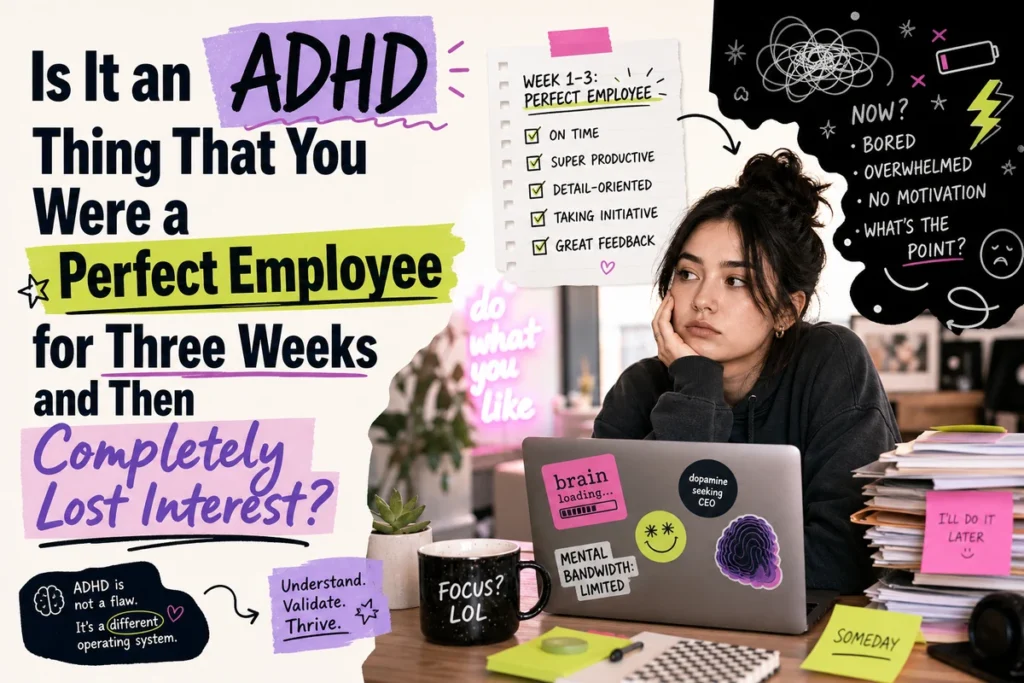
The first week, you arrived early. You took notes in meetings and actually reviewed them afterwards. You asked questions, remembered names, volunteered for projects. Your manager mentioned you were “a great fit” and you believed it. By week two, you’d built a system for tracking your tasks. You felt competent, engaged, genuinely interested in the work. You thought: maybe this is the job where it finally sticks.
Then week three hit. The alarm felt heavier. Your carefully organised task system went untouched. You sat at your desk with your laptop open, toggling between tabs, unable to start anything. The work hadn’t changed. You had. And the worst part: you could see it happening, watch yourself becoming the unreliable person you promised yourself you wouldn’t be again, and you couldn’t stop it.
Yes, this is an ADHD thing. It’s called novelty-dependent dopamine response, and it’s one of the most misunderstood features of how the ADHD brain engages with work. Your enthusiasm wasn’t fake. Your crash isn’t laziness. Both are predictable outcomes of a reward system that runs on different fuel than the neurotypical brain expects.
Why ADHD Job Performance Looks Inconsistent From the Outside
The ADHD brain has a documented deficit in baseline dopamine availability and dopamine receptor sensitivity.1 This isn’t about feeling happy or sad. Dopamine is the neurochemical that makes effort feel possible. It’s what bridges the gap between “I should do this” and “I am doing this.” Without adequate dopamine signalling, starting a task feels like pushing a car uphill with the parking brake on.
Novelty is one of the few things that reliably triggers dopamine release in the ADHD brain. A new job is a dopamine goldmine: unfamiliar systems, new faces, fresh problems, the uncertainty of not knowing what comes next. Your brain responds to all of this by flooding you with engagement chemicals. You feel sharp, motivated, capable. This isn’t performance. It’s chemistry.
The problem is that novelty has a half-life. Usually around two to four weeks. Once the systems become familiar, the faces become routine, the problems become repetitive, the dopamine tap turns off. The work is the same. Your neurochemistry is not. And suddenly ADHD job performance inconsistent patterns emerge, visible to everyone, explainable to no one.
The Three-Week Cliff Is Predictable, Not Personal
If you’ve cycled through jobs, hobbies, relationships, or projects with the same arc, you might have internalised a story about yourself: that you’re flaky, unreliable, incapable of commitment. That you self-sabotage. That you don’t really want the things you pursue.
Here’s what’s actually happening. The ADHD brain has a narrower window of interest-based engagement. Neurotypical motivation runs on a combination of importance, rewards, and consequences. ADHD motivation runs almost entirely on interest, urgency, and novelty. When those three disappear, so does access to effort. Not desire. Not intention. Effort itself.
You didn’t lose interest because you’re uncommitted. You lost access to the neurochemical that makes commitment feel like something you can act on.
Research on ADHD and occupational functioning consistently finds that people with ADHD show high initial engagement followed by declining performance over time, particularly in roles that become routine.2 This isn’t a finding about character. It’s a finding about how brains work. The pattern you’ve been ashamed of is documented in the literature.
Why “Just Push Through” Makes It Worse
The standard advice for motivation dips is discipline. Show up anyway. Build habits. Push through the resistance. This advice assumes that effort is always available and you’re choosing not to use it. For the ADHD brain, that assumption is wrong.
When novelty-driven dopamine depletes, forcing yourself to work doesn’t build discipline. It builds associations between the task and suffering. Your brain learns: this work equals pain. The next time you try to start, the resistance is even stronger. You’re not building a habit. You’re building an aversion.
This is why people with ADHD often perform better in crisis mode. Deadlines, consequences, and urgency artificially generate the dopamine that novelty used to provide. It works, but it’s unsustainable. You end up cycling between paralysis and panic, wondering why you can’t just work steadily like everyone else seems to.
The cruel irony: the harder you try to force engagement when dopamine is depleted, the more your brain codes the work as something to avoid. Willpower without neurochemistry backfires.
ADHD Novelty Burnout Is Not the Same as Actual Burnout
There’s a difference between being exhausted from overwork and being unable to engage because the novelty wore off. Standard burnout responds to rest. Novelty depletion doesn’t. You can take a week off, feel physically recovered, and still sit down at your desk with nothing. Because the problem wasn’t fatigue. The problem was fuel.
This is why vacations often don’t help. You come back refreshed but the work is still familiar. The dopamine tap doesn’t turn back on just because you slept well. ADHD novelty burnout work patterns look like laziness to managers and like moral failure to you, but they’re neither. They’re the predictable outcome of a brain that needed novelty to function and ran out.
Understanding this distinction matters. If you treat novelty depletion like burnout, you’ll rest and wonder why you’re still stuck. If you treat it like what it is, you can start building systems that generate novelty artificially, create urgency without crisis, and work with your neurochemistry instead of against it.
What Actually Helps When the Interest Fades
The goal isn’t to recreate the first week. That level of engagement was chemically unsustainable. The goal is to build a floor: a baseline of function that doesn’t depend on novelty but also doesn’t drain you through pure willpower.
First, accept that ADHD interest fade is not a problem to solve but a pattern to manage. You will lose engagement with routine tasks. Planning for that, rather than being surprised by it every time, changes everything. If you know the cliff is coming at week three, you can build scaffolding before you fall off it.
Second, manufacture novelty. Change where you work. Change when you work. Change the order of your tasks. Change the music, the lighting, the tools. None of these changes are productive in the traditional sense, but they generate just enough dopamine to get you started. And starting is the hardest part.
Your brain doesn’t care if the novelty is meaningful. It just needs something to be different. Use that.
Third, shrink the task until it’s almost embarrassing. Not “work on the project” but “open the document.” Not “write the report” but “write one sentence.” ADHD brains resist large, vague tasks because they can’t see a clear path to completion. Tiny tasks bypass that resistance. Once you’re moving, momentum takes over.
Fourth, build accountability that isn’t shame-based. Body doubling, coworking sessions, or simply telling someone “I’ll have this done by 3pm” creates external structure that substitutes for the internal engagement you’ve lost. This isn’t weakness. It’s prosthetic motivation.
ADHD Dopamine Novelty Patterns Show Up Everywhere
Once you see this pattern in work, you’ll see it everywhere. The hobby you were obsessed with for a month and then abandoned. The friendship that felt electric until it became familiar. The home organisation system that worked perfectly until it didn’t. The fitness routine that lasted exactly long enough for the novelty to wear off.
This isn’t about jobs specifically. It’s about how the ADHD brain interacts with anything that becomes routine. The pattern is consistent because the underlying neurology is consistent. You’re not uniquely flawed across dozens of life domains. You have one brain that works the same way in all of them.
Understanding ADHD dopamine novelty patterns as a feature of your neurology rather than a series of unrelated personal failures changes your relationship with yourself. You stop asking “why can’t I just be consistent?” and start asking “what does my brain need to stay functional when the novelty runs out?”
Late discovery note: if you’re only now learning that this pattern has a name and a mechanism, you may be grieving every job you left, every hobby you abandoned, every commitment you couldn’t keep. That grief is valid. So is the relief of finally understanding.
Reframing the Pattern as Information, Not Judgment
The three-week cliff isn’t evidence that you’re unreliable. It’s data about how your brain allocates engagement. You can use that data. You can choose jobs with more variety. You can negotiate role changes before boredom calcifies into paralysis. You can build rotation into your work so no single task becomes too familiar. You can stop promising yourself that “this time will be different” and start planning for what you know will happen.
ADHD job performance inconsistent patterns are not a verdict on your value as an employee or a person. They’re a description of how your neurology interacts with routine. The description is accurate. The judgment attached to it is optional.
Your competence didn’t disappear when the novelty wore off. You still know everything you learned in those first three weeks. The skills are still there. What changed was your access to them. And access can be rebuilt through systems, environment design, and external accountability, without requiring you to become a different person.
The job where you were perfect for three weeks wasn’t a trick. It was real. So is what came after. Both are you. Both are your brain. The work now is learning to function in both states, not just waiting for the next novelty hit to carry you again.
Start small. Change one thing about how you work today. Not because discipline demands it, but because your brain needs variety to function and you’re finally allowed to give it that.
Rate this article
Was this a useful hit?