Is It an ADHD Thing That Your Brain Completely Drops Its Filter Around Certain People and You Become a Different Version of Yourself?

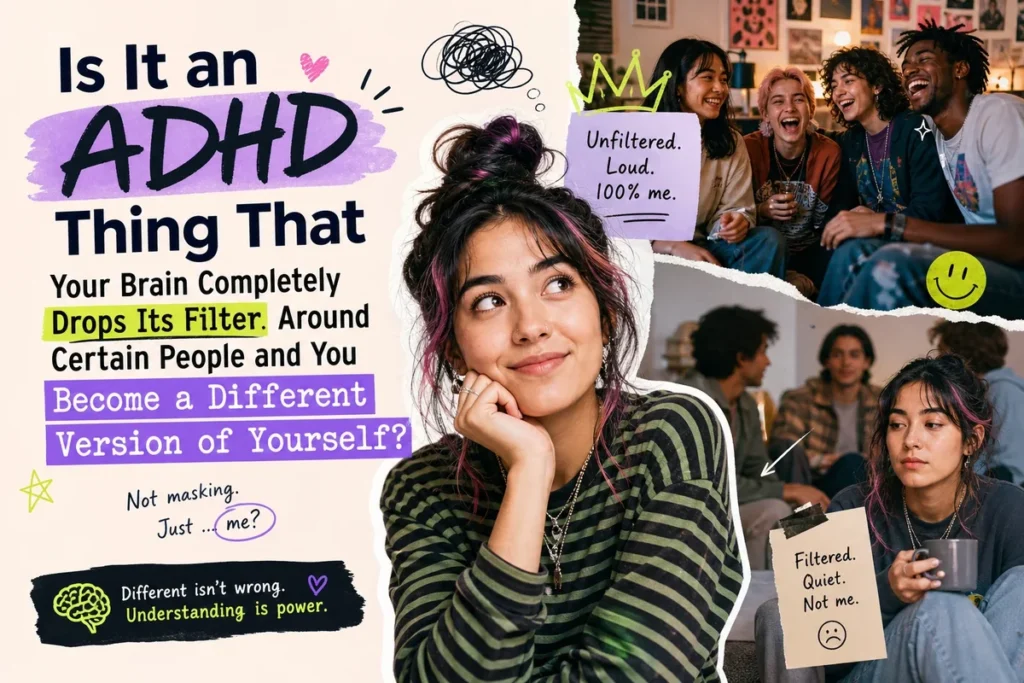
You walk into work and you are measured, calm, professional. You choose your words carefully. You edit your responses before they leave your mouth. You hold back the random comment, the impulsive joke, the thing that popped into your head that has nothing to do with anything. You are the version of yourself that people expect. And then you meet up with one specific friend, or you are around your partner, or somehow you end up spending time with a coworker you barely know, and something in your brain just switches off. The filter vanishes. Suddenly you are saying everything that comes to mind. You are making weird noises. You are doing bits. You are being, for lack of a better word, kind of childish. Not immature exactly, but unguarded in a way that feels like you have dropped twenty years off your social presentation. And you cannot explain why this person activates it. There is no obvious pattern. It just happens.
Yes, this is an ADHD thing. It is called context-dependent unmasking, and it happens because your brain has finally encountered someone with whom it no longer perceives a risk of rejection. The childlike, unfiltered self that emerges is not a regression or a character flaw. It is closer to the real you, the version that exists when your brain is not spending enormous energy running its social protection software.
The Social Filter Is a Protection System, Not Your Personality
Most people with ADHD run a constant background process that neurotypical people do not even know exists. It is a real-time social filter: scanning the environment for potential rejection signals, editing responses before they leave your mouth, suppressing impulses, matching your energy to what seems acceptable. This filter is not optional. It runs automatically because your brain learned, probably very early, that the unfiltered version of you gets you into trouble. You interrupted too much. You said the wrong thing. You were too loud, too much, too weird. The social consequences taught your nervous system that filtering equals safety.
This is ADHD masking. It is the performance of a more acceptable version of yourself, and it is exhausting in a way that is hard to explain to people who do not do it. The filter requires executive function resources your brain already struggles to allocate. Every filtered response costs something. Every suppressed impulse takes energy. By the end of a high-masking day, you are not just tired. You are depleted in a specific way that rest does not immediately fix.
Why the Filter Drops With Certain People
Your brain is constantly calculating rejection risk. With most people, the risk feels present, so the filter stays on. But occasionally, your nervous system encounters someone and makes a rapid calculation: this person is safe. This can happen with people you have known for years, but it can also happen with near-strangers. The calculation is not logical. It is not based on time spent together. It is your nervous system reading cues you are not consciously aware of: tone of voice, microexpressions, how they responded to something you said, whether they made space for your weirdness without flinching.
When the brain decides someone is safe, it does something remarkable. It powers down the filter. Not partially. Completely. The constant editing stops. The impulse suppression shuts off. Whatever thought enters your head leaves your mouth. And because your natural ADHD brain is impulsive, energetic, and often playful in ways that social conditioning has taught you to hide, the version of you that emerges can feel shockingly childlike. You might find yourself making random sounds, saying absurd things, being physically more animated. You might feel like you have regressed to a younger version of yourself.
You are not regressing. You are unmasking. The childlike self is not a lesser version of you. It is the version that was there before the world taught you to filter it out.
ADHD Masking Dropping Around Safe People Is Neurologically Expensive
Here is what makes this confusing: the unmasking feels good. Being around people who let you drop the filter is one of the most relieving experiences an ADHD brain can have. The problem is not the unmasking itself. The problem is the whiplash between your two selves and the energy cost of maintaining the filtered version everywhere else.
Research into ADHD and emotional regulation shows that the brain regions responsible for impulse control and social monitoring are already working harder in ADHD just to achieve baseline function.1 When you add constant social masking to that load, you are essentially running your prefrontal cortex at maximum capacity for hours at a time. The filter does not turn off when it gets tired. It just gets worse at filtering, which is why late in the day you might blurt something you would have caught in the morning. Or why after sustained masking, you crash hard when you finally get alone.
The relief of being with a safe person is not just emotional. It is neurological. Your brain is finally getting a break from one of its most demanding tasks.
The Childlike Self Is Not Immaturity
One of the most disorienting parts of this experience is the language we use for it. Childlike. Childish. Goofy. Immature. These words carry judgment, and that judgment often comes from the same social conditioning that taught you to filter in the first place. But what actually emerges when the filter drops is not a lack of maturity. It is unmediated enthusiasm. It is genuine curiosity. It is the kind of spontaneous playfulness that gets trained out of most adults.
The unfiltered you is not the problem. The problem is that you have been taught to believe the filtered version is the real one, when in fact the filter is a protective adaptation that costs you energy and connection.
Many people with late discovery ADHD spend years believing something is fundamentally wrong with their unfiltered self. They develop shame around the version of them that emerges with safe people, as if it is a character flaw they need to manage. This shame can make them pull back from the very relationships that let them be themselves, or feel guilty after spending time unmasked. Understanding that this is neurological, not moral, can shift how you relate to both versions of yourself.
Why Standard Social Advice Does Not Apply
Neurotypical people often give advice about authenticity that does not account for ADHD masking. Be yourself. Just relax. Do not overthink it. This advice assumes that the filter is optional, that you could just choose to turn it off if you were confident enough. But for ADHD brains, the filter is not a choice. It is a protective response built on years of rejection data. You cannot just decide to be authentic everywhere. Your nervous system will not let you, because it has learned that authenticity is sometimes punished.
The people who tell you to just be yourself everywhere are often people who have never experienced the specific kind of social rejection that ADHD impulsivity can trigger. They have not had the experience of saying the wrong thing, reading the room incorrectly, being too much for a situation, and then watching relationships cool as a result. Rejection sensitive dysphoria, a common ADHD experience, makes perceived rejection feel catastrophic rather than mildly uncomfortable.2 The filter exists because your brain is trying to protect you from that pain.
The Exhaustion of Living as Two Selves
One of the hardest parts of ADHD unmasking is the dissonance between your two presentations. The filtered self and the unfiltered self can feel like completely different people. You might wonder which one is real. You might feel like a fraud in professional settings, or feel embarrassed about your unfiltered behavior even with people who clearly enjoyed it. You might leave a hangout where you were wildly yourself and then spend hours analyzing whether you were too much.
This is not personality fragmentation. This is the cost of running two operating modes and not having enough context where the unfiltered mode is safe. Most people have some version of work self and home self. But for ADHD brains, the gap between these selves is often much wider, and the energy required to maintain the filtered version is much higher. The exhaustion is not about which self is real. Both are real. The exhaustion comes from having to perform one version while the other is trying to exist.
You are not fake for filtering. You are not immature for unmasking. You are an ADHD brain doing what it needs to survive a social world that was not designed for your wiring.
What Actually Helps With ADHD Masking Fatigue
The goal is not to eliminate masking entirely. Some social contexts genuinely require more filtering, and your brain knows that. The goal is to reduce the ratio of filtered to unfiltered time, and to release the shame around the unfiltered self so it takes less recovery time.
First, recognize that your nervous system is doing the calculation automatically. You do not choose who triggers unmasking. Your brain decides based on subtle safety cues. But you can intentionally spend more time with people where the filter drops. Notice who lets you be weird. Notice who does not flinch when you say the random thing. Those people are neurological resources, not just friends.
Second, build recovery time into high-masking days. If you know you are going to spend eight hours filtering at work, schedule time afterward where you do not have to perform at all. This might mean time alone. It might mean time with a safe person. It does not mean scrolling social media, which often feels restful but is actually another form of social input.
Name the filter when it activates. When you feel yourself editing, suppressing, or performing, notice it. Say to yourself: protection mode. This is not me becoming a different person. This is me protecting myself from perceived rejection risk.
Third, stop apologizing for the unfiltered self after the fact. The post-hangout shame spiral, where you replay everything you said and cringe, is often rejection sensitivity misreading neutral data. If someone spent time with you, laughed, and said they wanted to hang out again, believe that. Your unfiltered self did not ruin it. Your unfiltered self is probably why they enjoyed it.
The Version That Emerges Is Closer to You
When your brain drops the filter around certain people and you become that unguarded, impulsive, childlike version, you are not reverting to something lesser. You are experiencing what it feels like when your brain is not running constant protection software. The filtered self is an adaptation. It is necessary and it serves a function. But the unfiltered self is not the problem you were taught it was. The unfiltered self is closer to who you actually are when the fear of rejection is not driving the conversation.
Find the people where the filter turns off. Spend time with them. Stop analyzing whether you were too much afterward. The version of you that emerges when you feel safe is not a regression. It is relief. And you deserve more of it.
Rate this article
Was this a useful hit?