Is It an ADHD Thing That You Feel About Ten Years Younger Than You Actually Are?

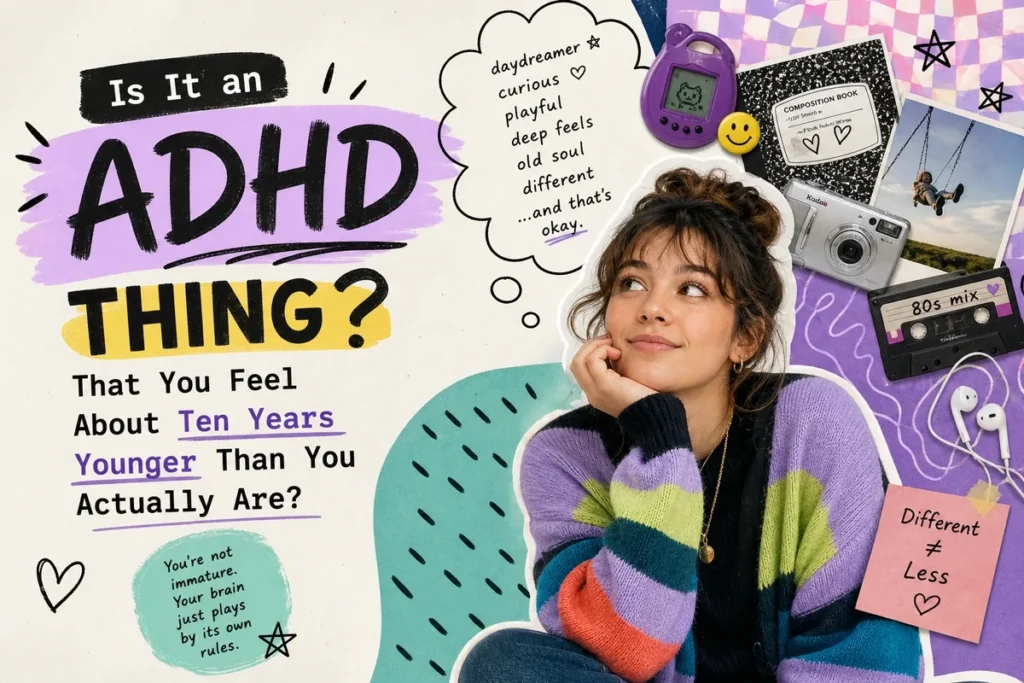
You are 32, but when someone asks your age, you feel a jolt of surprise before you answer. Thirty-two? That cannot be right. Inside, you feel maybe 22. Maybe younger. You watch your peers buying houses, getting married, having children, building careers with a sense of purpose and direction, and you feel like you are watching a movie about adults while still sitting in the teenagers' section. You kept your childhood toys longer than your friends did. You still get excited about things in ways that feel "too enthusiastic" for your age. When you try to imagine yourself as the age you actually are, the image does not match the person you see in the mirror. It is not that you are trying to stay young. It is that something inside you genuinely has not caught up.
Yes, this is an ADHD thing. It is called developmental maturity delay, and it is one of the most consistent findings in ADHD research. Your brain's prefrontal cortex, the region responsible for executive function, emotional regulation, and what we broadly call "maturity," develops on a different timeline than neurotypical brains. The result is a persistent gap between your chronological age and your felt sense of where you are in life.
The ADHD Emotional Maturity Age Gap Is Neurological, Not a Choice
When people talk about "maturity," they are usually describing a collection of skills: emotional regulation, impulse control, long-term planning, self-awareness, and the ability to delay gratification. Every single one of these skills lives in the prefrontal cortex. And in ADHD brains, the prefrontal cortex reaches full development approximately two to three years later than in neurotypical brains.
Russell Barkley, one of the most cited ADHD researchers, has described this as a 30% delay in developmental readiness. A 30-year-old with ADHD may have the executive function capacity of a 21-year-old. This is not about intelligence, personality, or effort. It is about the biological timeline of brain development.
This delay affects everything: when you feel ready to commit to a career, when relationships feel manageable, when "adult" responsibilities stop feeling like an impossible weight. Your internal sense of your own age is not wrong. It is an accurate reflection of where your brain actually is in its developmental journey.
"I always felt childish or immature and felt that my friends and classmates were more mature than me. It took a long time for me to let go of my childhood toys and habits. Even now as an adult I still feel like a teenager, and whenever I remember and tell someone my age, I am as surprised as the person who asked me."
Why You Felt "Behind" Even as a Child
This did not start in adulthood. If you think back, you probably noticed it as early as middle school. Your classmates seemed to care about different things than you did. They were interested in dating, in social hierarchies, in "mature" topics, while you were still deeply invested in things that suddenly became "childish" overnight. You might have been the last one to give up playing, the last one to stop being openly enthusiastic, the last one to understand why certain behaviours were now embarrassing.
Teachers and parents may have called you immature, and you internalised that as a character flaw. But what was actually happening was a developmental mismatch. You were not immature for your brain. You were immature relative to an arbitrary chronological standard that your neurology was never going to meet on schedule.
The cruelty of this is that you knew you were different. You could see the gap. You just could not close it, no matter how hard you tried. And trying harder to "act your age" only highlighted how unnatural it felt, like wearing a costume that did not fit.
The ADHD Emotional Maturity Age Gap Affects Major Life Milestones
Society has a rough timeline for when things are supposed to happen. Graduate by 22. Establish a career by 25. Settle down by 30. Buy a house. Have children. Build wealth. These milestones assume a neurotypical developmental trajectory. For ADHDers, who are working with a delayed executive function timeline, these deadlines are often impossible to meet.
This is not because you are lazy or unfocused or unwilling to grow up. It is because the brain systems required to execute these milestones are still developing. You cannot plan a wedding when your working memory makes it impossible to hold all the details. You cannot commit to a mortgage when your prefrontal cortex cannot reliably project you into a stable future. You cannot "settle down" when your dopamine system is still demanding novelty and stimulation.
The 30% Rule: If you are 30, your executive function readiness may be closer to 21. At 40, you may feel like you are just hitting 28. This is not arrested development. This is a different developmental timeline.
The result is a life that looks "behind" by neurotypical standards but is actually right on time for your brain. You are not failing to grow up. You are growing up on a different schedule.
Why People Online Mistake You for Younger
This gap is not just internal. It shows up in how others perceive you. Your communication style, your interests, your energy level, your emotional expressiveness: all of these can read as "younger" to people who are calibrated to neurotypical norms. When you are openly enthusiastic, playfully silly, or emotionally transparent, you are displaying traits that neurotypical adults have often learned to suppress or moderate. You have not learned to suppress them because your brain is not yet at the developmental stage where that suppression feels natural.
This can be frustrating when you want to be taken seriously. It can also be isolating. You may find yourself connecting more easily with people younger than you, simply because they are closer to your developmental stage. Meanwhile, friendships with age-peers can feel exhausting, like you are constantly performing a version of adulthood you have not actually arrived at yet.
The good news is that this authenticity is not a flaw. The ability to remain enthusiastic, curious, and emotionally open is something many neurotypical adults lose as they "mature." You did not lose it. That is not a deficit. That is a different way of moving through the world.
Why Standard "Just Grow Up" Advice Fails Completely
The advice you have probably received your entire life goes something like this: be more responsible, act your age, stop being so childish, just figure it out like everyone else did. This advice assumes you have access to the same neurological tools as everyone else. You do not.
Telling someone with ADHD to "just be more mature" is like telling someone with poor vision to "just see better." The infrastructure required for the behaviour you are being asked to produce is not fully operational yet. No amount of willpower changes the timeline of prefrontal cortex development.
The shame this advice creates is worse than useless. It makes you feel broken for not being able to do something that is literally neurologically unavailable to you. It encourages masking: pretending to be at a developmental stage you have not reached. And masking is exhausting. It drains the cognitive resources you need to actually function, leaving you with even less capacity to handle adult responsibilities.
The felt experience of being "behind" is not evidence that you are failing. It is evidence that your brain is on a different schedule and society has not adjusted its expectations accordingly.
The ADHD Feel Younger Experience Is Not Permanent Arrested Development
Here is the part that matters most: this is not a life sentence. The research shows that ADHD brains do eventually reach full prefrontal cortex development. The timeline is delayed, not cancelled. Many ADHDers report that their 30s or 40s bring a sense of finally "catching up," of feeling more capable of the things that seemed impossible a decade earlier.
This does not mean you should just wait around for your brain to finish developing. It means you can stop treating the gap as a personal failure. Your developmental timeline is different. It is not inferior. And the skills you are building now, even if they are arriving "late" by neurotypical standards, will eventually be yours to keep.
The trajectory is not "never grow up." The trajectory is "grow up on your own schedule." And people who reach milestones later often reach them with more self-awareness, more intentionality, and more clarity about what they actually want, rather than what they were supposed to want by a certain age.
What Actually Helps When You Feel Younger Than Your Peers
The first thing that helps is radical acceptance of your timeline. Not resigned acceptance, not "I guess I am broken" acceptance, but genuine recognition that your developmental trajectory is valid even though it is different. You are not behind. You are on a different path.
The second thing is finding your people. You may connect more easily with others who are developmentally similar, regardless of their chronological age. ADHD communities, neurodivergent spaces, and friendships with people who share your communication style can reduce the constant friction of trying to perform a neurotypical version of adulthood.
Reframe the Gap: Instead of "I am behind my peers," try "I am right on time for my brain." The felt age gap is not a problem to solve. It is information about where you actually are.
The third thing is building external structure to compensate for the executive function gaps that create the maturity delay. Routines, reminders, body-doubling, and accountability systems are not crutches. They are tools that bridge the gap between your chronological age and your developmental readiness. Medication, for those who use it, can also increase the sense of being capable of "adulting" by addressing the dopamine deficits that underlie executive dysfunction.
The fourth thing is protecting your authenticity. The parts of you that feel "too young" are often the parts that are most genuinely you: the enthusiasm, the openness, the capacity for joy. You do not have to trade those in to be a functional adult. You can be both.
Living with the ADHD Emotional Maturity Age Gap
The gap between how old you are and how old you feel is not going to disappear overnight. It may narrow as your brain continues to develop. It may remain as a permanent feature of how you experience the world. Either way, it does not make you broken, childish, or incapable of adult life.
What it makes you is someone working with a different set of neurological tools than the people around you. The milestones will come. The capability will come. The sense of being a "real adult" will come. Just not on the schedule that society wrote for a brain you do not have.
The next time someone asks your age and you feel that familiar jolt of surprise, let it be information rather than judgment. Your felt age is real. Your developmental timeline is valid. And the ADHD emotional maturity age gap is not a character flaw to overcome. It is a neurological reality to understand and work with.
Rate this article
Was this a useful hit?