Is It an ADHD Thing That It Is 3 AM and You Are Still Scrolling Even Though You Are Exhausted?

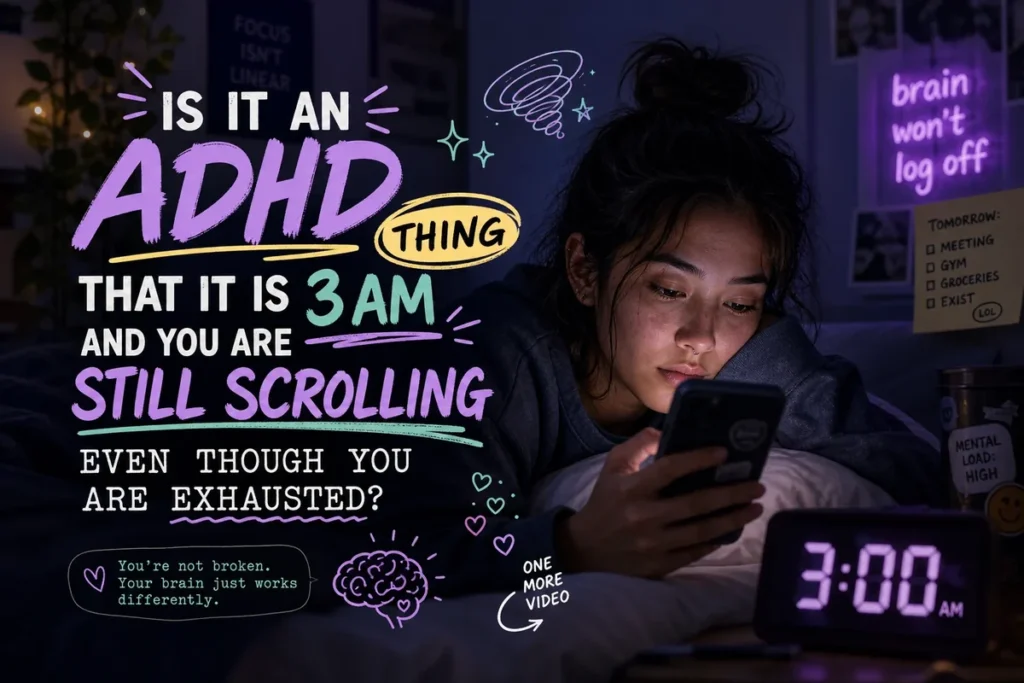
Your eyes are burning. Your body is heavy and begging for sleep. You have to be awake in four hours. And yet: you are still here, thumb moving automatically, watching content you will not remember in the morning. You are not even enjoying it anymore. Each video or post gives you almost nothing, just enough to swipe again. You have told yourself “one more” seventeen times. The clock says 3:14 AM. You feel trapped by your own hand.
Yes, this is an ADHD thing. It is called dopamine-seeking bedtime resistance, and it often combines with what researchers call “revenge bedtime procrastination.” Your ADHD brain has not received a stop signal because the micro-rewards from scrolling are outpacing your physical exhaustion signals. Your body is registering tiredness, but the message is not making it through to the command center. This is not a willpower failure. This is neurology.
Why ADHD Doomscrolling Night Feels Impossible to Stop
ADHD doomscrolling night is not regular insomnia. It is not even regular phone addiction. It is a specific collision of ADHD traits: dopamine deficiency, impaired interoceptive awareness, and a desperate need to reclaim personal time after a day of performing for a neurotypical world.
The ADHD brain operates with lower baseline dopamine levels. Throughout the day, you are running on a deficit. By nighttime, when demands finally stop, your nervous system is starving for something, anything, that feels like reward. The phone delivers microdoses of novelty: a new post, a notification, a funny video, an outrage, a comment section. Each swipe is a tiny hit. None of them satisfy, but each one promises that the next one might.
Meanwhile, your body is sending exhaustion signals. But ADHD affects interoceptive awareness, which is your ability to notice and respond to internal cues like hunger, thirst, temperature, and tiredness. You register the tiredness somewhere in the background, like a notification you have swiped away. It is there. You know it. But the signal does not translate into action because the dopamine loop has hijacked the priority queue.
The Revenge Component: Why Nighttime Feels Like Your Only Free Time
Revenge bedtime procrastination is not an official clinical term, but it describes something real. It is the phenomenon of refusing to go to sleep in order to reclaim personal time that you did not have during the day.
For people with ADHD, this hits differently. Your days are often spent masking, compensating, and burning enormous cognitive resources just to meet baseline expectations. By the time everyone else is asleep and no one needs anything from you, it finally feels like your time. The quiet house, the dark room, the absence of demands: this is the first moment all day that belongs only to you.
Going to sleep feels like giving that up. Worse, it feels like fast-forwarding directly to tomorrow morning, which is another day of demands, alarms, and performance. So you stay awake, scrolling, even though what you are doing is not actually restful or enjoyable. It is a protest. A small rebellion. And the phone is always willing to participate.
They spend hours scrolling online, even when they say they do not want to. They do not sleep at a consistent time. This one baffles me because they then say how tired they are the next day.
That observation, from someone living with ADHD roommates, captures the confusion from the outside. It looks irrational. It looks like a choice. From the inside, it feels like being trapped by a loop you cannot exit, even though you built the loop yourself.
Why Your Exhaustion Is Not Translating to Action
Here is what most people do not understand about ADHD and tiredness: knowing you are tired is not the same as being able to act on it.
ADHD is a neurodevelopmental disorder that affects executive function, which is the ability to plan, prioritize, and carry out tasks. Going to bed sounds simple, but it requires a series of executive function steps: recognizing the tiredness signal, deciding it is time to stop, transitioning away from the current activity, physically moving to the bed, managing any pre-sleep tasks, and then actually letting go of wakefulness.
Each of those steps is a small executive function demand. When your executive function is already depleted from a full day, even one more transition feels impossible. The phone requires nothing. Staying on the couch requires nothing. You are stuck in place because moving requires resources you have already spent.
The stop signal problem: Neurotypical brains receive a clear internal signal when an activity should end. ADHD brains often do not generate that stop signal, especially when the activity provides even minimal dopamine. The scroll never tells you to stop. So you do not.
ADHD Sleep Problems Phone: The Algorithm Knows Your Brain
Social media algorithms are designed to exploit exactly the vulnerabilities that ADHD creates. They deliver variable reward schedules, which are the same pattern that makes slot machines addictive. You never know when the next good post is coming, so you keep pulling the lever.
For a dopamine-deficient brain, this is especially hard to resist. The ADHD brain is not lazy or undisciplined. It is chronically under-stimulated, and it will chase stimulation wherever it can find it. The phone is an infinite supply of low-effort stimulation. It asks nothing of you. It never runs out. And it is always available at 3 AM when nothing else is.
ADHD sleep problems with phones are not about screen addiction in the typical sense. They are about a brain that cannot generate its own stop signals being given access to an experience specifically designed to never end.
Why Standard Sleep Advice Fails for ADHD
You have probably heard the standard advice. No screens an hour before bed. Put the phone in another room. Have a wind-down routine. Read a book instead. These suggestions assume that your brain can smoothly transition between activities and that removing the phone will naturally lead to sleep.
For ADHD, this often backfires. Take away the phone, and you are left alone with a brain that is still seeking stimulation. You might lie in bed with racing thoughts for hours. You might get up and find the phone anyway because the discomfort of understimulation is unbearable. The advice assumes a brain that can self-regulate. ADHD is, at its core, a disorder of self-regulation.
The advice also misses the revenge component. Telling someone with ADHD to go to bed earlier does not address why they are resisting bedtime in the first place. If the day feels like it was stolen from you, you will steal it back at night. That is not a discipline problem. That is a needs problem.
Their energy levels are all over the place. Sometimes they will have a day when they seem to be able to do anything.
This inconsistency is part of the ADHD experience. Some nights, you might fall asleep easily. Other nights, the same routine produces nothing. The variability makes it harder to trust any strategy because nothing works reliably.
ADHD Dopamine Seeking Bedtime: What Is Actually Happening
When you are scrolling at 3 AM despite exhaustion, multiple ADHD systems are colliding at once.
First, your dopamine system is seeking novelty because it did not get enough satisfaction during the day. Second, your interoceptive system is failing to translate tiredness signals into action. Third, your executive function is too depleted to initiate a transition. Fourth, your emotional regulation system is craving the alone time that nighttime provides. Fifth, your time perception is distorted: 3 AM does not feel as late as it is because ADHD often comes with time blindness.
All of these factors combine into the experience of being stuck. You are not choosing to stay awake. You are unable to stop staying awake. There is a difference.
Bone-tired exhaustion: Many ADHDers describe a specific kind of tiredness that is always present, like running on a deficit. Managing life without adequate executive function support is exhausting. The phone becomes a way to rest without actually resting, because it asks nothing of you while still providing something.
What Actually Helps: Working With the ADHD Brain
The goal is not to eliminate scrolling or to develop ironclad discipline. The goal is to give your brain what it actually needs so that it stops seeking substitutes.
First, address the revenge component. If you are stealing time at night because your days feel like they belong to everyone else, the solution is to reclaim time during the day. Even fifteen minutes of genuine personal time, not productive time, not errand time, but time for you, can reduce the pressure to stay awake. The nighttime rebellion is often a symptom of daytime deprivation.
Second, make the transition easier. Instead of “put down the phone and go to bed,” which requires executive function, try creating a bridge activity. Something that is lower stimulation than scrolling but does not require action. An audiobook. A boring podcast. A sleep story. Something that gently reduces the stimulation level without demanding that you generate the stop signal yourself.
Third, address the dopamine need directly. If your brain is seeking stimulation, it will not stop seeking until it gets something. A few minutes of a specific, finite activity, like a short video you chose in advance or a game with a clear endpoint, may satisfy the craving better than infinite scrolling, which never actually satisfies anything.
Fourth, externalize the stop signal. Set a timer or an alarm that represents the end of scrolling time. When it goes off, the external cue provides the signal your brain cannot generate internally. You may still ignore it sometimes. But having an external signal is more effective than relying on internal awareness that is not working.
The Deeper Pattern: What the 3 AM Scroll Is Trying to Tell You
The late-night scroll is not a character flaw. It is information. It is telling you that something is missing from your days. Rest, reward, personal time, stimulation: something is in deficit, and the phone is the easiest, most available way to address that deficit.
The solution is not to fight the scroll harder. It is to investigate what the scroll is substituting for and find ways to meet that need more directly. When the underlying need is addressed, the compulsive quality of the scrolling often decreases on its own.
This does not mean you will never scroll at night again. It means the scroll becomes a choice rather than a trap. You might still choose it sometimes. But you will also be able to choose sleep when sleep is what you actually need.
The next time you find yourself at 3 AM, thumb still moving, eyes burning, ask yourself: what am I actually looking for right now? The answer might not be anything on the screen. And knowing that is the first step toward finally putting it down.
Rate this article
Was this a useful hit?