Is It an ADHD Thing That You Cannot Figure Out What to Do With Free Time Even Though You Have Dozens of Interests?

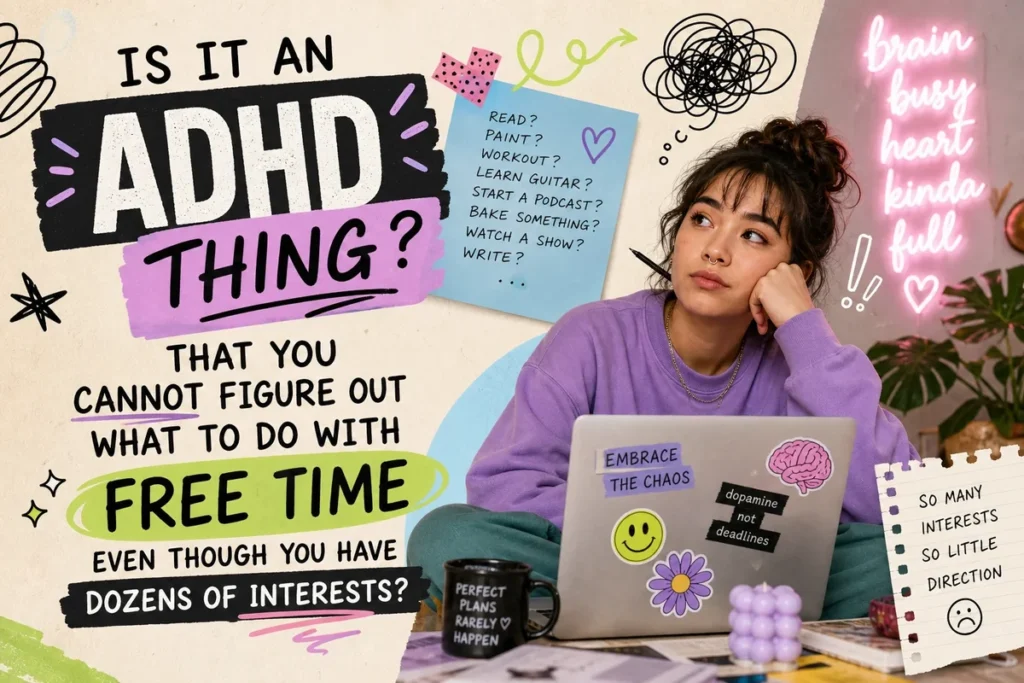
It is Saturday afternoon. You have been looking forward to this all week. No obligations, no deadlines, no one needs anything from you. You could finally read that book you bought three months ago. You could start the art project you pinned to your board. You could watch that show everyone keeps recommending. You could play that game you have been meaning to finish for two years. You could go for a walk. You could learn guitar. You could reorganise your closet. You could do any one of the dozens of things you genuinely, sincerely want to do. And you do none of them. You stand in the middle of your living room, or sit on the edge of your bed, or hover over your phone, and you scroll. You scroll for an hour. Two hours. The entire afternoon disappears. You end the day having done nothing you actually wanted to do, and you cannot explain why. It is not that nothing sounded good. Everything sounded good. That was the problem.
Yes, this is an ADHD thing. It is called ADHD free time paralysis, and it happens when two core deficits collide: impaired decision-making under multiple options, and a broken task initiation system that cannot generate starting energy without external pressure.
Why ADHD Free Time Paralysis Feels Different From Regular Indecision
Regular indecision looks like weighing two restaurant options and eventually picking one. ADHD free time paralysis looks like having thirty-seven things you actively want to do and being physically incapable of beginning any of them. The distinction matters because the advice for regular indecision does not work here. "Just pick something" assumes your brain can execute the picking part. Yours cannot, at least not without a workaround.
What makes this so disorienting is that you are not bored. Boredom would be simpler. Boredom is when nothing sounds appealing. This is the opposite: everything sounds appealing. You have hobbies. You have interests. You have lists of things you want to do. You have been waiting all week for this time. And the moment it arrives, your brain locks up.
The paralysis is not laziness. You spent forty hours at work this week and you desperately want to enjoy your time. It is not apathy. You care deeply about your interests, sometimes too deeply, which is part of the problem. It is a neurological traffic jam, and understanding the mechanism is the first step to finding a way around it.
The Neuroscience Behind the Freeze
ADHD affects the prefrontal cortex, the part of your brain responsible for executive function. Executive function includes the ability to plan, organise, evaluate options, and initiate tasks. When you face a decision between thirty possible activities, your prefrontal cortex is supposed to weigh them, assign priorities, select one, and then generate the activation energy to begin. In ADHD brains, every step of that process is compromised.
The first breakdown happens at evaluation. Your brain struggles to compare options when they all feel equally valid. Without a clear "winner," the decision stage stalls. You keep cycling through the list, unable to rank or eliminate anything, because ranking requires a kind of cognitive focus that ADHD directly impairs.
The second breakdown happens at initiation. Even if you did manage to pick something, the ADHD brain has a deficit in generating the neurological activation needed to start. This is not about willpower. It is about dopamine and norepinephrine signalling. The circuits that translate intention into action do not fire reliably. At work, deadlines and bosses and consequences provide the external pressure that forces the start. Free time has no such pressure. The starting mechanism simply does not engage.
The fear of missing out on something by choosing something else is not irrational. Your brain is accurately perceiving that every choice closes off other possibilities. The problem is that it cannot tolerate that closure long enough to act.
Why Standard Advice Makes It Worse
The advice people give for ADHD free time paralysis tends to fall into two categories: productivity advice ("make a list!") and mindset advice ("just be present!"). Neither addresses the actual problem.
Making a list does not help because you already have a list. You have dozens of lists. The list is not the issue. The issue is that your brain cannot select from the list and cannot initiate once you select. Adding more items to the list, or reorganising the list, or making a prettier list, does not solve the underlying deficit.
Being present does not help because presence assumes you have arrived somewhere. You have not started anything. There is nothing to be present with. Mindfulness for ADHD free time paralysis feels like being mindfully aware of your own stuckness, which just makes the stuckness more painful.
The advice that actually helps has to address both the decision paralysis and the initiation deficit separately. They are two distinct problems wearing a trench coat.
ADHD Free Time Paralysis and the Paradox of Wanting
One of the most confusing aspects of this experience is that you genuinely want to do these things. You fantasise about reading that book. You daydream about playing that game. You feel excitement when you think about your hobbies during the week. And then the free time arrives and the wanting evaporates, replaced by a kind of foggy numbness.
This is not your interests failing you. It is the translation layer between wanting and doing being offline. The desire is real. The executive function to act on the desire is impaired. This distinction matters because a lot of self-blame comes from confusing the two. "If I really wanted to do it, I would do it." That logic does not apply to ADHD brains. You can want something desperately and still be neurologically blocked from starting it.
The wanting is not fake: Your interests are real. The problem is not that you do not care about your hobbies. The problem is that the bridge between caring and starting is broken, and you need to build a different route.
The other layer is the FOMO spiral. When you have too many interests, choosing one means not choosing the others. Your brain perceives this as loss. And ADHD brains are particularly sensitive to perceived loss. The result is that choosing anything feels like losing everything else. So you choose nothing, and lose everything anyway, but at least you did not have to feel the moment of closing a door.
The Scroll Trap: Why You End Up on Your Phone
Here is what actually happens when you cannot choose: you default to the path of least resistance. Scrolling requires no decision. You do not have to pick a show, because the algorithm picks for you. You do not have to initiate anything, because the content just appears. The dopamine trickle is low-quality but it is immediate and it asks nothing of you.
This is not a failure of discipline. It is your brain routing around a broken system. When the decision-making apparatus is overloaded and the initiation system is offline, the phone becomes the only action your brain can take. It is the lowest-activation-energy option in your environment, and your brain will always default to the lowest barrier when the executive function is depleted.
The scrolling itself then creates a secondary trap. The low-grade dopamine from social media just barely satisfies the brain's craving for stimulation, which means the drive to do something more meaningful gets muted. You are not satisfied, but you are not desperate enough to override the paralysis either. You end up in a grey zone, not enjoying yourself but not uncomfortable enough to force a change.
What Actually Helps: External Decision Systems
The solution to ADHD free time paralysis is not trying harder to choose. It is removing the choice entirely, or making the choice before the moment arrives.
Pre-decision is one of the most effective strategies. Before your free time begins, while you still have some structure and pressure in your day, decide what you will do with the unstructured time. Write it down. Treat it like an appointment. When the free time arrives, do not re-evaluate. Follow the instruction your past self left you. This works because you are not making a decision in the moment. You are executing a pre-made decision, which is a different cognitive task that does not trigger the same paralysis.
Randomisation is another strategy that sounds counterintuitive but works. Write your options on slips of paper. Pull one from a jar. Roll a die. Use a random choice app. The key insight is that the quality of the choice does not matter nearly as much as making a choice. A coin flip that gets you started on a mediocre activity is better than perfect deliberation that leads to nothing.
The goal is not optimal. The goal is started. Optimal does not exist when every option is appealing. Started does.
Environmental design helps with the initiation half of the problem. If you want to read, put the book on your couch with a blanket next to it before you need it. If you want to draw, leave the sketchbook open on your desk with a pencil on top. Reduce the number of steps between deciding and doing to as close to zero as possible. Every additional step is an opportunity for the initiation system to fail.
The Permission to Do Less Than All of It
Part of what fuels ADHD free time paralysis is the sense that you need to do something significant with your free time. You only have a few hours. You should make them count. You should do something meaningful, enriching, productive. This pressure makes the stakes of the decision feel enormous, which makes the decision harder, which makes the paralysis worse.
Five minutes counts: Reading for five minutes is reading. Sketching for five minutes is sketching. Your brain wants to believe that if you cannot do the whole thing, you should not start at all. That belief is the enemy. Start for five minutes. What happens next is not your problem.
Giving yourself permission to do something imperfectly, incompletely, or briefly is one of the most effective interventions for this pattern. The paralysis often comes from imagining the full version of the activity, getting overwhelmed by the scope, and then shutting down. But you do not have to do the full version. You can read one chapter. You can watch half an episode. You can work on a hobby for fifteen minutes and then stop. That still counts. That is still better than scrolling for three hours and feeling empty afterward.
Why This Keeps Happening Even When You Know Better
You have probably noticed this pattern before. You have probably told yourself you would handle it differently next time. And next time came, and you froze again. This is not a knowledge problem. Knowing what is happening does not automatically give you the capacity to do something different.
ADHD free time paralysis recurs because the conditions that cause it recur. Every time you face unstructured time with too many options and no external pressure, the same neurological bottleneck appears. The solution is not remembering the lesson. The solution is building systems that do not rely on your in-the-moment executive function, because your in-the-moment executive function is exactly what is impaired.
This is why strategies like pre-decision and environmental design work better than insight. They move the cognitive load to a different time, when your brain has more capacity, or they eliminate the load entirely by outsourcing the decision to randomness. You are not fixing the underlying deficit. You are routing around it.
One Small Shift to Try This Week
Before your next chunk of free time, pick one activity. Just one. Write it on a sticky note. When the free time arrives, do not revisit the decision. Look at the note. Start that thing, even if only for five minutes. The goal is not to solve the paralysis forever. The goal is to prove to your nervous system that starting is possible, that a choice was made and survived, that one door closed and you did not lose everything. That experience, repeated, begins to loosen the grip. You cannot think your way out of ADHD free time paralysis, but you can act your way through it, one pre-made decision at a time.
Rate this article
Was this a useful hit?