Is It an ADHD Thing That Certain Background Noise Helps You Focus While Other Sounds Make You Want to Scream?

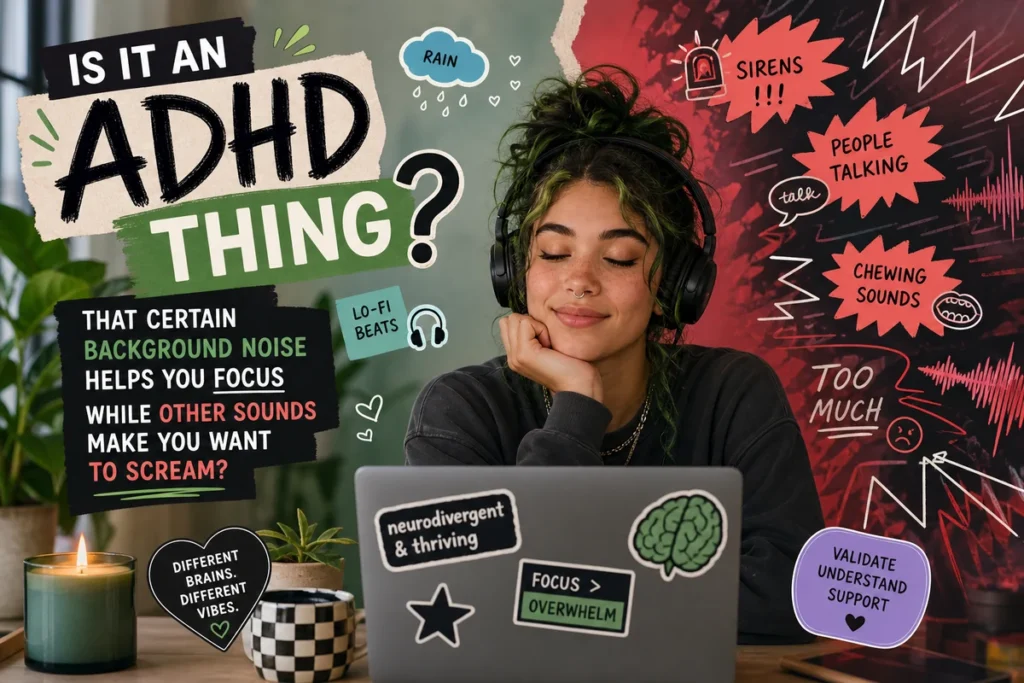
You’re working in a coffee shop and the ambient chatter, the espresso machine, the door chiming: it all fades into a comfortable hum. You’re in the zone. Three hours pass and you’ve written more than you have in weeks. Then someone at the next table starts a phone call. Not loud. Just one side of a conversation, rising and falling unpredictably. Within thirty seconds your focus is shattered. You read the same sentence four times. Your jaw tightens. You want to throw your laptop at them, which seems disproportionate, but the rage is real.
Yes, this is an ADHD thing. It’s called an auditory filtering deficit, sometimes described as reduced sensory gating. Your brain cannot automatically deprioritise irrelevant sounds the way neurotypical brains do, which means some sounds become an unexpected tool for ADHD background noise focus while others become an unbearable intrusion.
Why ADHD Brains Process Sound Differently
In a neurotypical brain, a system called sensory gating acts like a bouncer at a club. It scans incoming sounds, decides which ones are worth attending to, and blocks the rest from reaching conscious awareness. You’re writing an email and the air conditioning hums: gated out. Someone coughs three desks over: gated out. Your name gets called: allowed through. This happens automatically, below the level of conscious thought.
ADHD brains have weaker sensory gating.1 The bouncer is understaffed and inconsistent. More sounds get through, more often, and you have to use conscious attention to decide what matters. This takes cognitive effort that neurotypical people don’t have to spend. Every irrelevant sound that slips past the gate competes for your already-limited working memory bandwidth.
But here’s where it gets counterintuitive. If your brain is constantly scanning for novel input, and if silence feels like a vacuum your attention will rush to fill, then certain background noise can actually occupy that scanning system just enough to stop it from seeking distractions. The right noise becomes a buffer. The wrong noise becomes another distraction.
The Predictability Principle: Why Coffee Shop Ambience Works
The key variable is predictability. When ADHD background noise focus works, it’s almost always because the sound is consistent and non-semantic. White noise. Brown noise. Rain sounds. Lo-fi beats. The drone of a coffee shop where no single voice is distinct. These sounds share a crucial feature: they don’t demand parsing.
Your brain recognises there’s nothing new to process. The pattern stays the same. So the auditory system can relax its vigilance slightly. Instead of scanning for the next unexpected input, it settles into a steady state. That freed-up bandwidth goes back to your task.
Think of it like this: your attention is a dog that wants to chase every squirrel. Predictable noise is a fence. It doesn’t remove the squirrels, but it removes the chase.
Research supports this. A 2007 study found that children with ADHD performed better on memory tasks when exposed to white noise, while neurotypical children performed worse.2 The explanation: ADHD brains are understimulated at baseline. Background noise raises the stimulation floor just enough to reach optimal arousal for focus. Neurotypical brains, already at optimal arousal, get pushed past it.
Why Certain Sounds Make You Want to Scream
If predictability is the key, unpredictability is the lock. Sounds that vary, that carry semantic content, or that have an irregular rhythm are the ones that hijack your attention.
Someone’s phone conversation is unpredictable in two ways. First, the rhythm is irregular: silence, then words, then silence, then words. Your brain cannot stop waiting for the next phrase. Second, the content is semantic: it’s language, which your brain is hardwired to process for meaning. You don’t choose to listen. The words just enter.
This is why ADHD auditory sensitivity often looks selective. You can work through a thunderstorm but not through a conversation. The storm is consistent and meaningless. The conversation is erratic and meaningful. One occupies the bouncer; the other slips past and demands the whole club’s attention.
Common focus-destroying sounds: One-sided phone calls. Intermittent tapping or clicking. People eating crunchy food. Music with lyrics in your native language. Televisions at a volume just low enough that you can almost hear what’s being said.
The “almost” is important. Sounds at the edge of comprehension are worst because your brain keeps trying to complete the pattern. Full clarity would be distracting but at least resolvable. Partial clarity creates a loop of effortful listening that drains you.
The Overlap with Misophonia and Sensory Processing
If certain sounds don’t just distract you but actively enrage you, you may be experiencing misophonia, a condition where specific sounds trigger intense emotional reactions, often anger or disgust. Misophonia is significantly more common in people with ADHD than in the general population.3
The triggers are often sounds other people don’t even notice: chewing, breathing, pen clicking, keyboard tapping. The response feels involuntary and disproportionate. You know it’s just someone eating an apple, but your nervous system acts like you’re under attack.
ADHD sensory processing noise issues and misophonia share a root: reduced ability to deprioritise sensory input. When the gating system is weak, sounds that should be filtered out reach the emotional centres of the brain and trigger a threat response. You’re not being dramatic. Your neurology is doing this without your permission.
This is also why ADHD white noise works for some people: it masks the specific frequencies that trigger misophonic responses. If chewing sounds drive you to distraction, broadband noise can cover them while remaining non-semantic enough to avoid creating new distractions.
Why Standard Advice Fails
The standard advice for noise distraction is “just tune it out” or “use earplugs.” Neither addresses what’s actually happening.
“Just tune it out” assumes the filtering happens automatically. For you, it doesn’t. Telling someone with ADHD to tune out noise is like telling someone with a broken thermostat to just be the right temperature. The mechanism that allows neurotypical people to do this is the mechanism that doesn’t work.
Earplugs or complete silence create a different problem. In total quiet, the ADHD brain often becomes more distractible, not less. Without any auditory input, the attention system starts scanning harder for something to latch onto. You might notice your own heartbeat, your breathing, the faint ring of tinnitus. Silence becomes another thing to be distracted by.
The goal isn’t eliminating sound. It’s finding the sound that tells your brain “nothing interesting is happening here.”
This is why noise-cancelling headphones plus the right audio is so much more effective than noise-cancelling headphones alone. You need to replace the unpredictable with the predictable, not replace sound with silence.
Finding Your Personal Focus Sound
There’s no universal “best” background noise for ADHD. The right sound depends on your specific arousal needs, your misophonic triggers, and the task you’re doing. But there are patterns worth testing.
Brown noise and pink noise tend to work better than white noise for many people. White noise has equal energy at all frequencies, which some find harsh. Brown noise emphasises lower frequencies, creating a warmer, rumbling quality that feels less fatiguing over long periods.
Nature sounds work when they’re continuous: rain, river, wind. They fail when they include sudden variations: birdsong, thunderclaps, waves with irregular rhythm. The moment your brain detects a pattern variation, it will orient toward it.
Music is complicated. Instrumental music without vocals often works. Music with lyrics in a language you understand rarely works: the semantic content pulls your attention. Music you know extremely well sometimes works: the prediction is so complete that your brain doesn’t need to process it. Music that’s new almost never works: novelty is the enemy of focus.
Experiment systematically: Spend one work session with brown noise, one with lo-fi beats, one with coffee shop ambience, one with rain sounds. Note not just whether you focused, but how you felt at the end. Fatigue matters. The right ADHD background noise focus solution sustains you, not just your output.
Practical Strategies That Actually Work
Once you understand that this is a gating problem, solutions become clearer. You’re not trying to develop willpower. You’re trying to manage input.
Noise-cancelling headphones are worth the investment. Good ones remove unpredictable ambient sound and let you replace it with chosen sound. This gives you control over your auditory environment even in spaces you can’t control physically. If cost is a barrier, even basic over-ear headphones create a meaningful buffer.
Have your focus sound ready before you need it. Create a playlist, bookmark a website, or download an app so you can activate it in seconds. The moment you notice distraction creeping in, you need the solution immediately available. If finding the sound requires effort, you’ll skip it.
Communicate your needs directly. “I focus better with headphones” is a reasonable workplace accommodation. You don’t owe anyone a neuroscience lecture, but you do owe yourself the conditions that let you work. If open-plan offices are unavoidable, ask about quiet rooms or work-from-home arrangements on focus-intensive days.
Monitor for fatigue. Even helpful background noise takes a toll if used for too long. Silence during breaks can help. The point isn’t to live in a constant soundscape but to use sound strategically when you need to concentrate.
The Deeper Pattern: Control and Predictability
ADHD background noise focus is really about one thing: your brain needs predictability to allocate attention effectively. When the environment is predictable, the scanning system can rest. When the environment is unpredictable, the scanning system activates, and you’re working against your own neurology.
This extends beyond sound. Visual clutter, notification dings, temperature fluctuations, hunger signals: they all compete for the same limited bandwidth. The principle is the same. Reduce unpredictability wherever you can. Create environments where the background stays background.
You’re not broken for needing environmental control. Your brain just allocates attention differently. Working with that allocation, instead of against it, is how you get things done.
The coffee shop works because you chose it. The predictable hum is yours. When the phone call intrudes, it’s not just noise: it’s loss of control over your auditory environment. The rage makes sense. It’s your brain recognising that the conditions for focus just got taken from you.
Finding the sounds that work, building the environments that support you, and communicating your needs are not accommodations for a deficit. They’re practical responses to a brain that processes sound differently. When you stop fighting the paradox, you can use the predictable to buffer against the unpredictable. Your ability to focus with ADHD background noise focus strategies isn’t a workaround. It’s a feature you’ve already discovered. Now you understand why it works.
1 Micoulaud-Franchi, J. A., et al. (2015). Sensory gating in adult ADHD: A systematic review. Attention Deficit and Hyperactivity Disorders, 7(2), 57-67.
2 Söderlund, G., Sikström, S., & Smart, A. (2007). Listen to the noise: Noise is beneficial for cognitive performance in ADHD. Journal of Child Psychology and Psychiatry, 48(8), 840-847.
3 Rinaldi, L. J., et al. (2023). Misophonia is associated with ADHD: Evidence from an online self-report study. Journal of Clinical Psychology, 79(4), 1012-1024.
Rate this article
Was this a useful hit?