You Are the Last Person to Leave Every Social Event Because Your Brain Cannot Find the Exit

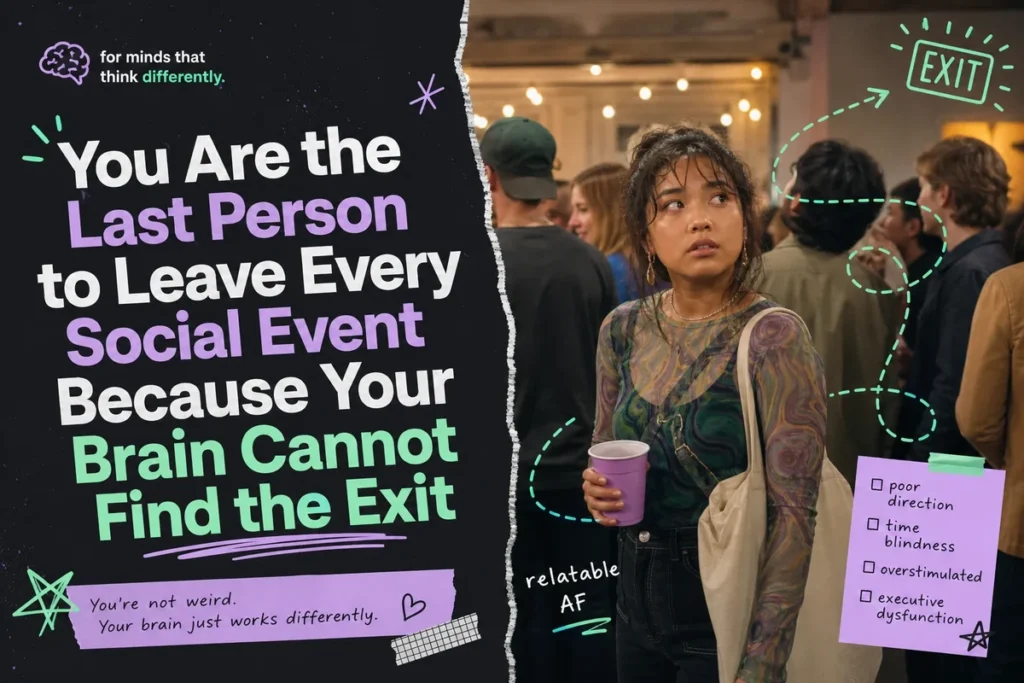
You told yourself you would leave at 10. It is 12:40. You are standing in a kitchen with your jacket on, holding your keys, mid-conversation about a documentary you have not even seen. Your body has been "leaving" for forty minutes. Your brain keeps finding one more reason to stay. You are tired in a way that feels physical, and you are also somehow still here. If this is you, the ADHD social exit is a real thing, and it is not a character flaw.
Most people think leaving a party is simple. You stop, you say bye, you go. For a lot of ADHD brains, it is closer to trying to land a plane with no runway lights. This article is about why that happens and what actually helps.
The ADHD social exit is a transition problem wearing a social costume
Here is the thing nobody tells you: leaving is a task switch. You are moving from one state (being in the room, engaged, stimulated) to a completely different one (getting up, finding your stuff, navigating goodbyes, traveling home). Task switching is one of the places ADHD brains tend to struggle most, and it is part of what researchers call executive function.
Russell Barkley, who has spent decades researching ADHD, describes the core difficulty as a gap between knowing what to do and doing it at the right moment.1 You know it is time to go. The knowing is not the problem. The trigger that converts "I should leave" into "I am leaving" is what misfires.
That is why you can sit in a perfectly clear mental decision for an hour and still not move. Transition difficulty is not about wanting. It is about the activation cost of stopping one thing and starting another, and parties are packed with reasons to keep that cost high.
Why you cannot tell when the event is "over"
Neurotypical people seem to have a built-in radar for the end of a night. The energy dips, the group thins out, someone yawns, and everyone just knows. You do not get that signal, or you get it late, or you get it and talk yourself out of it.
Part of this is time perception. ADHD is closely tied to difficulty sensing how much time has passed, sometimes called time blindness. Two hours can feel like forty minutes. If you cannot feel the night moving, you cannot feel it ending either.
The other part is that social events do not have clear edges. A work meeting has an agenda and a calendar block. A movie has credits. A hangout has... vibes. No one announces the final round. So your brain waits for a clean signal that never arrives, and in the meantime you keep saying "yeah, I'll stay a bit longer."
The ADHD social exit is hard partly because the ending is invisible. Nothing in the room tells your brain the event is over, so you keep waiting for permission that never comes.
The one-more-thing loop
This is the part that feels the most like betrayal. You are actually ready to go. You have said "okay, I'm heading out." And then someone starts a story. Or the host mentions a snack. Or a person you like walks in. Or you remember the thing you wanted to ask your friend about. So you stay for one more thing.
Then there is another one more thing. And another.
For an ADHD brain, novelty and interest are fuel. The conversation in front of you is giving you dopamine, and the couch at home is not. Your brain is doing a quick, unconscious math problem: stay and get stimulation now, or leave and get a gap with nothing in it. It almost always picks now.
The one-more-thing loop also gets worse when you are tired. Exhaustion lowers your capacity to regulate, so the part of you that would normally say "I am done, I am going" has less authority. You are depleted and still glued to the room.
Why goodbyes themselves are a minefield
Even when you decide to go, ADHD goodbyes can turn into a whole second event. You have to find the host. You have to say bye to five people. You hit a conversation you cannot cleanly exit. Someone says "wait, before you go," and you are back in it.
If you have any rejection sensitivity in the mix, it gets heavier. You do not want to seem rude. You do not want anyone to think you are bored or that you do not like them. You do not want to interrupt. So you wait for the perfect moment, which means you wait forever.
Some people with ADHD respond to this by doing the opposite: the Irish exit, where you vanish without telling anyone. That works sometimes, but it can leave you spiraling later about whether you offended someone. Neither extreme is great. What you want is a middle path that is short, predictable, and does not need you to read the room perfectly.
Reality check: Staying too long is not proof you are bad at socializing. It is often proof your brain is bad at transitions and endings. Those are different problems, and they have different fixes.
The hidden cost: social exhaustion ADHD brains do not see coming
Staying past your limit has a price, and you usually pay it the next day. Social exhaustion with ADHD is not just being tired. It is the flat, foggy, slightly irritable crash that comes from hours of tracking conversations, masking, filtering impulses, and managing how you come across.
Masking is a big piece. Research on camouflaging in neurodivergent people has linked it to higher fatigue and worse mental health outcomes.2 If you spent the night performing "normal and fine," your battery drained faster than it looked from the outside.
The problem is that your internal gauge does not read well in the moment. You feel okay, then you feel fine, then you feel fine, then you are suddenly wrecked. By the time you notice, you are three hours past the point you should have left. This is why many people end up spending the entire following day recovering from one good night.
How to build an exit that does not rely on willpower
Willpower is the wrong tool here. You do not need to try harder to leave. You need to move the decision earlier, when your brain is still working, and make the exit physical instead of mental.
Start with a leave time you set before you arrive. Not "I'll go when I'm tired," because you will not feel it. Pick a number: 10:30. Put it in your phone with an alarm labeled with the action, not the time. "Say bye to host, call ride." Your future self cannot negotiate with a clear instruction as easily as with a vague feeling.
Next, use external structure. Tell one trusted person your plan. Ask a friend to give you a nudge. Come with a ride that has its own deadline, like the last train or a friend who has to leave. A hard edge from the outside does what your internal radar cannot.
Then shrink the goodbye. A simple script helps: "I am heading out, this was great, talk soon." Say it once, to the host or the people closest to you, and start moving. Do not wait for a gap in the conversation. Walking is part of the message. A lot of the dread around goodbyes comes from thinking you have to do them perfectly. You do not. People forget the exact words within a minute.
Make the first ten minutes after leaving easier
One thing that makes leaving feel worse is that what comes after is blank. You are leaving something stimulating for something empty, and your brain pushes back. So give the exit a landing.
Decide what happens when you get home before you leave. Water, pajamas, phone on the charger, one comfort show. Make it small and specific. When your brain sees a clear next step, the transition costs less. This is the same logic that helps with starting any task: a vague gap is hard, a concrete first move is easier.
If the next day is going to be rough, protect it too. Leave a recovery block in your calendar after big events. Knowing you have space after can make it easier to go home at a reasonable hour rather than squeezing out every last minute.
Leaving on time is not leaving people behind
A lot of ADHD people stay because they are scared of missing something. The best story. The inside joke. The moment everyone bonds. That fear is real, and it makes sense, especially if you have spent years feeling like an outsider.
But the people who like you will still like you at 11 instead of 2. Leaving earlier often makes you better company, because you stop running on fumes and start showing up with more of yourself the next time. If you have been wondering about the ADHD social exit as a pattern, this is the reframe worth holding: a clean exit is a way of protecting the connection, not abandoning it.
You will still get it wrong sometimes. You will still stand by a door for twenty minutes now and then. That is fine. The goal is not a perfect exit. It is an exit you chose, with a plan your brain can actually follow.
1 Barkley, R. A. (2012). Executive Functions: What They Are, How They Work, and Why They Evolved. Guilford Press.
2 Hull, L., et al. (2017). "Putting on My Best Normal": Social Camouflaging in Adults with Autism Spectrum Conditions. Journal of Autism and Developmental Disorders, 47(8), 2519-2534.
Rate this article
Was this a useful hit?