Not Enough People Talk About How Severely ADHD Can Affect a Life When Left Untreated

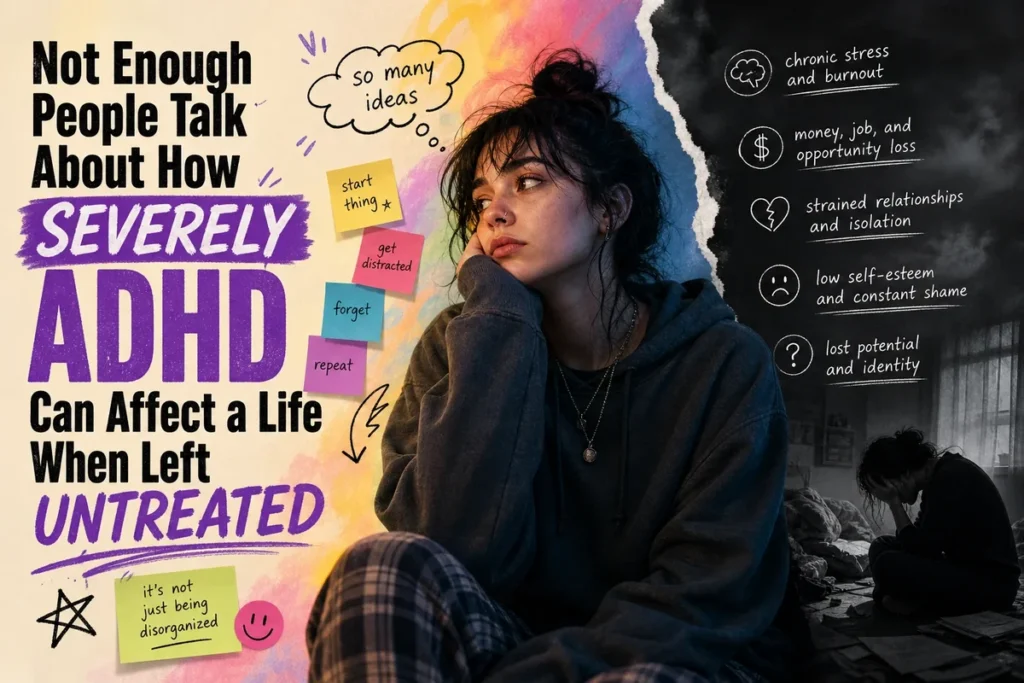
You know the internal math. The calculation you run every single day: how much energy it takes to do something that should be simple, versus how much energy you actually have, versus how much you'll hate yourself later for not doing it anyway. You know the way your brain just shuts down when something is too boring, how it will literally force you to sleep rather than complete a task that lacks stimulation. You know the years of calling yourself lazy, stupid, incompetent. You know the look on people's faces when they compare you to their other friend with ADHD who seems to be doing fine. And you know the quiet, exhausting truth that ADHD severity is constantly underestimated by everyone who has never lived inside your head.
This article is about that truth. Not the TikTok version of ADHD where you're a little scattered and like shiny things. The version where the research shows untreated ADHD is associated with shortened lifespans, higher rates of addiction, job loss, relationship failure, and financial ruin. The version that nobody wants to talk about because it makes people uncomfortable.
The ADHD Severity Problem: Why Your Struggle Gets Dismissed
Here's what happened to ADHD in the public conversation: it got absorbed into internet culture. It became content. It became "me when I forget to text back" and "anyone else hyperfixate on a random hobby for two weeks?" And look, some of that content is genuinely relatable, made by people who actually have ADHD. But something got lost in the translation.
ADHD severity underestimated consequences show up in the research as dramatically different life outcomes. This isn't a single condition where everyone has the same experience. It's a spectrum, like autism, where some people are mildly affected and medication makes their lives manageable, while others are severely affected and medication helps but doesn't fix the fundamental problems with executive function, emotional regulation, and daily living.
The problem is that the meme version of ADHD became the default understanding. So when you can't hold down a job, when you've destroyed relationships, when you've spent years in a cycle of self-hatred because you can't do things that seem easy for everyone else, people don't see a disability. They see someone who isn't trying hard enough. They see the mess you made, the deadline you missed, the text you forgot to respond to. They see the physical consequences of your disorder but they can't see how much it affects you mentally.
What the Research Actually Shows About Untreated ADHD
Let's talk about ADHD serious consequences untreated, because the data is stark and it deserves to be taken seriously.
Dr. Russell Barkley, one of the most cited ADHD researchers in the world, has spent decades documenting what happens when ADHD goes unrecognized or untreated. His longitudinal studies show that adults with ADHD have significantly higher rates of unemployment, job termination, and underemployment relative to their education levels.1 They're more likely to have been fired from jobs. They're more likely to have impulsively quit jobs. They're more likely to be struggling financially despite being capable and intelligent.
The relationship data is equally concerning. Adults with ADHD have higher rates of divorce and separation. They report more conflict in their relationships. Their partners report more frustration and exhaustion. This isn't because people with ADHD are bad partners. It's because the executive function deficits that define ADHD make it harder to follow through on commitments, remember important dates, manage household tasks, and regulate emotional reactions during conflict.
They can't see the years of self-flagellation I inflicted on myself because I felt stupid, incompetent, and worthless. They can't see how my brain shuts itself down if it lacks something to keep it stimulated. They only see how someone else with ADHD is better than me and ask me why I can't just be like them.
Perhaps most sobering: ADHD is associated with reduced life expectancy. A Danish study of over 1.9 million individuals found that people with ADHD had a significantly elevated mortality rate, with accidents being a leading cause.2 The impulsivity and attention deficits that define ADHD translate directly into real-world risk: car accidents, injuries, dangerous decision-making.
ADHD Disability: Why the Language Matters
ADHD disability serious life impact is not a phrase designed to make you feel broken. It's a phrase designed to make other people take this condition seriously.
There's a reason ADHD qualifies as a disability under the Americans with Disabilities Act. There's a reason it qualifies for workplace accommodations. There's a reason clinical guidelines emphasize early identification and treatment. This is not a personality quirk. This is a neurodevelopmental condition that affects the fundamental architecture of how your brain manages attention, impulse control, working memory, and emotional regulation.
The disability framing isn't about pathologizing your brain. It's about legitimizing your struggle. When someone with a physical disability needs accommodations, we don't tell them to try harder. We recognize that their body works differently and we adjust expectations and environments accordingly. ADHD deserves the same recognition.
But that recognition only happens when we're honest about ADHD severity underestimated consequences. When we admit that this condition, left untreated, does real damage to real lives. When we stop letting the meme version of ADHD define public understanding.
The Comparison Trap: When someone says "my friend has ADHD and they're fine," they're comparing your internal struggle to someone else's external presentation. They have no idea what that person's internal experience is, what support systems they have, what medication protocol works for them, or how hard they're working just to appear "fine."
The Invisible Weight: What People Don't See
The cruelest part of ADHD is that the hardest work you do is invisible. The effort it takes to start a task. The mental energy required to switch between activities. The constant background noise of forgotten obligations and missed opportunities. The shame spiral that kicks in every time you fail at something you know you should be able to do.
People see the outcome. They don't see the process. They see that you're late, not the forty-five minutes you spent trying to leave the house, getting distracted, forgetting things, starting over. They see that you didn't respond to their text, not the genuine intention you had to respond, the mental note that immediately evaporated, the guilt you felt when you finally remembered three days later.
ADHD severity research outcomes data consistently shows that the internal experience of ADHD is far more burdensome than the external presentation suggests. People with ADHD report higher levels of anxiety, depression, and chronic stress. They report lower life satisfaction despite often achieving at similar levels to their neurotypical peers. The effort required to achieve is just so much higher.
And then there's the shutdown. The way your brain will literally force you to sleep if it finds something too boring. This isn't laziness. This is a documented phenomenon where the ADHD brain, starved of stimulation, essentially goes into a protective state rather than engaging with low-dopamine tasks. It's your neurology overriding your intentions. And it's incredibly frustrating to explain to people who have never experienced it.
Why "Just Take Your Meds" Isn't the Full Answer
Medication helps. For many people with ADHD, medication is genuinely life-changing. But medication is not a cure, and the narrative that ADHD is "solved" by stimulants is part of why ADHD severity gets underestimated.
Even with optimal medication, most people with moderate to severe ADHD still struggle with executive function deficits. The medication might help you focus, but it doesn't automatically give you organizational systems, emotional regulation skills, or the ability to accurately estimate how long tasks will take. Those are skills that neurotypical people develop naturally through childhood and that people with ADHD often have to consciously learn as adults.
For people with severe ADHD, medication is often necessary but not sufficient. You might be able to focus on a task, but still struggle to initiate it. You might be able to maintain attention, but still have trouble switching between tasks. You might have better impulse control, but still experience intense emotional reactions that feel disproportionate to the situation.
This is why ADHD serious consequences untreated is such an important concept. Because "untreated" doesn't just mean "unmedicated." It means lacking the comprehensive support that ADHD actually requires: skills training, environmental modifications, therapeutic support for the emotional toll, and genuine understanding from the people in your life.
Momentum is huge. If I start the day slow, I'm not going to accomplish much. Maintaining the momentum or regaining it after losing it is so challenging.
The Self-Flagellation Years: Acknowledging the Damage
If you were late-discovered, meaning you weren't identified as having ADHD until adolescence or adulthood, you probably spent years believing there was something fundamentally wrong with you as a person. Not your brain. You. Your character. Your work ethic. Your worthiness.
This is one of the most damaging ADHD severity underestimated consequences: the psychological toll of living with an unrecognized disability. You internalized every failure as a moral failing. You developed elaborate coping mechanisms that exhausted you. You learned to mask, to compensate, to push through. And every time you couldn't push through, you added another entry to your mental catalogue of personal failures.
The years of self-flagellation don't disappear when you get a diagnosis. That damage is real. The neural pathways of shame and self-criticism are well-worn. Unlearning them takes time and intentional work, often with a therapist who understands how ADHD affects self-concept.
Recognition is not enough: Getting diagnosed is just the first step. The real work is rebuilding your self-concept, developing systems that work for your brain, and processing years of internalized shame. That work deserves support and resources, not minimization.
Why This Matters for How We Talk About ADHD
The reason ADHD severity research outcomes data matters is not to make you feel hopeless. It's to give you language and evidence for something you already know: this is serious.
When your employer doesn't take your accommodation request seriously, you can point to the research. When your family thinks you just need to try harder, you can explain the neurological basis. When you're struggling to get appropriate treatment, you can advocate for yourself with data.
But more than that: this matters because you deserve to stop gaslighting yourself. You deserve to understand that your struggle is real, documented, and shared by millions of other people. You deserve to know that when ADHD feels like it's ruining your life, that's not an overreaction. That's an accurate assessment of a serious condition that too often gets minimized.
The research on ADHD disability serious life impact isn't meant to scare you. It's meant to validate what you've been experiencing. And it's meant to make the case, to yourself and others, that this condition deserves real resources, real support, and real understanding.
Moving Forward With Accurate Information
ADHD severity underestimated consequences will continue to be a problem as long as the public conversation stays dominated by meme culture and minimization. But you don't have to participate in that minimization of your own experience.
You can acknowledge that your ADHD is severe if it's severe. You can stop comparing yourself to people whose internal experience you know nothing about. You can advocate for the accommodations and support you actually need, rather than the bare minimum that your dismissive environment seems to think you deserve.
You can also seek out information and tools designed for the actual reality of ADHD, not the sanitized version. Resources that acknowledge the emotional toll, the relationship challenges, the career impacts. Resources that treat ADHD as the serious condition the research shows it to be.
The goal isn't to define yourself entirely by your disorder. The goal is to understand what you're actually dealing with so you can build a life that works for your actual brain. And that starts with taking ADHD severity seriously, even when the world around you refuses to.
The research is clear. The personal experiences of millions of people are consistent. ADHD, especially when severe, especially when untreated or under-supported, has profound impacts on every domain of life. That's not an exaggeration. That's not catastrophizing. That's the documented reality of living with a neurodevelopmental condition that affects executive function. And you deserve to have that reality acknowledged, by yourself and by everyone in your life who matters.
1 Barkley, R. A. (2015). Attention-Deficit Hyperactivity Disorder: A Handbook for Diagnosis and Treatment. Guilford Press.
2 Dalsgaard, S., et al. (2015). Mortality in children, adolescents, and adults with attention deficit hyperactivity disorder: a nationwide cohort study. The Lancet, 385(9983), 2190-2196.
Rate this article
Was this a useful hit?