You Do Not Say No Because Somewhere Along the Way Your Brain Decided Yes Was Safer

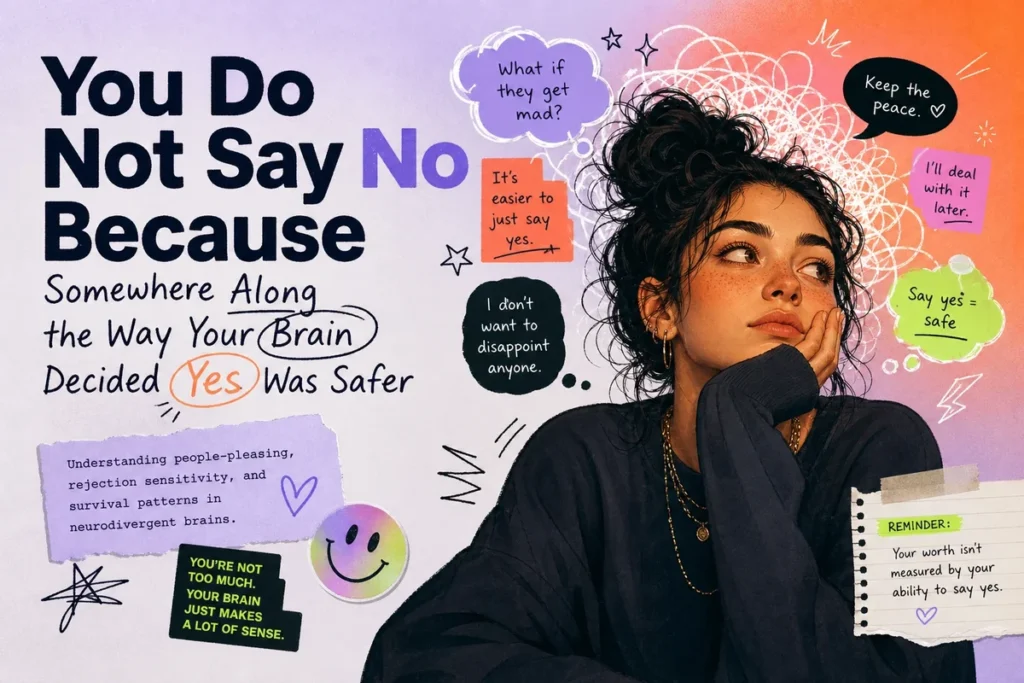
Someone asks you for a favor and your mouth says yes before your brain even registers what they asked. You are already calculating how to make it happen, already rearranging your week, already feeling the slight panic of another commitment you cannot actually hold. The word no exists in your vocabulary. You have seen other people use it. You understand conceptually that it is an option. But when you try to reach for it, something inside you flinches so hard that yes comes out instead, every single time.
This is ADHD people pleasing. And it is not about being nice.
The Fawn Response Your Brain Built Without Asking You
When researchers talk about trauma responses, they usually mention fight, flight, and freeze. But there is a fourth one that does not get as much attention: fawn. Fawning means automatically prioritizing other people's needs and emotions to keep yourself safe. It means becoming so attuned to what everyone around you wants that you lose track of what you want. It means making yourself small, agreeable, and useful because somewhere along the way, your nervous system decided that was the best strategy for survival.
For people with ADHD, fawning often develops as a direct response to rejection sensitive dysphoria. Your brain already experiences perceived rejection as physical pain. It already catastrophizes social missteps into evidence that you are fundamentally unlovable. So when you were growing up, your nervous system started running calculations: how do I make sure no one ever has a reason to reject me?
The answer it landed on was simple. Never give them a reason to be disappointed. Never say no. Never have needs that inconvenience anyone. Never be difficult.
ADHD people pleasing is the behavioral pattern that emerged from that calculation. It is not a personality trait. It is not evidence that you are a good person. It is a survival adaptation that made sense when you were a kid getting constant feedback that you were too much, not enough, or fundamentally wrong in ways you could not identify or fix.
Why Your Brain Thinks Yes Is the Safe Answer
Here is what happens neurologically when someone with ADHD and rejection sensitivity faces a request they do not want to fulfill. First, the request lands. Then, almost instantaneously, your brain runs a threat assessment. What happens if I say no? The answer it generates is not rational. It is not proportional. It is a cascade of worst-case scenarios that feel absolutely real: they will be upset, they will think less of me, they will tell other people I am selfish, I will lose this relationship, I will end up alone.
All of that happens in the fraction of a second before you open your mouth. Your brain has already decided that saying no will cause more pain than whatever sacrifice you have to make by saying yes. So yes comes out. Automatically. Reflexively. Before you even have time to consider whether you actually want to do the thing.
Research on ADHD and emotional dysregulation supports this pattern. A 2019 study in the Journal of Attention Disorders found that adults with ADHD show heightened emotional reactivity to social feedback, particularly negative feedback.1 Your brain is not overreacting for no reason. It is responding to a lifetime of data that taught it rejection is coming, and the only way to prevent it is to make yourself indispensable.
You are not weak for struggling to say no. You are carrying a nervous system that learned early that your safety depended on other people's approval.
The ADHD People Pleasing Burnout Cycle
Here is where it gets brutal. The ADHD people pleasing burnout cycle is self-perpetuating, and it will run until you intervene consciously.
It works like this: you say yes to something you do not have capacity for. Now you are overcommitted. Your executive function, already compromised, has to stretch across more tasks than it can handle. You start dropping balls. You miss deadlines, forget details, show up late or not at all. And then the thing you were trying to prevent happens anyway: someone is disappointed in you.
Except now it is worse, because you promised something you could not deliver. The rejection you were trying to avoid arrives anyway, but now it comes with evidence that you failed. Your brain stores that data and updates its model: you need to try harder next time. Say yes to more things. Be more accommodating. Make sure no one has any reason to be upset.
So you say yes to more things. And the cycle repeats.
This is why ADHD people pleasing is not sustainable. It is not a strategy that protects you. It is a pattern that guarantees eventual burnout, because you are making commitments based on your fear of rejection rather than your actual capacity. You are building a life designed to keep other people comfortable while you slowly collapse under the weight of obligations you never actually wanted.
The Specific Ways This Shows Up
ADHD people pleasing does not always look like saying yes to favors. Sometimes it is more subtle. See if you recognize any of these patterns.
You over-explain everything. When you do have to say no, you provide a dissertation's worth of justification because you need the other person to understand that you are not being selfish, that there is a real reason, that you would definitely say yes if you could. The explanation is not for them. It is for your own nervous system, trying to prove that you are still a good person.
You apologize constantly. For things that are not your fault. For taking up space. For having opinions. For existing in ways that might inconvenience someone. The apologies are preemptive. You are trying to acknowledge fault before anyone can accuse you of it.
You abandon your own plans the moment someone else has a preference. You wanted to eat at the Thai place, but they want pizza, and suddenly you are saying pizza sounds great even though you have been craving pad thai all week. Your preferences feel less valid than other people's preferences. Their disappointment would hurt you more than your own.
You cannot accept compliments or help. When someone tries to do something nice for you, you deflect, minimize, or immediately try to reciprocate. Receiving without giving feels dangerous. It creates an imbalance where someone might feel like you owe them something, and you cannot tolerate that debt.
You mask your emotions to match the room. If everyone else seems fine, you seem fine. If someone is upset, you are immediately focused on their feelings rather than your own. Your emotional state becomes a reflection of whoever you are with, because having your own feelings might be inconvenient or burdensome.
Reality check: These patterns are not evidence that you are a considerate person. They are evidence that your nervous system does not feel safe having needs.
Where the Fawn Response Comes From
If you grew up with undiagnosed ADHD, you probably spent years receiving feedback that something was wrong with you. Teachers told you to try harder. Parents were frustrated by your inconsistency. Friends got tired of you forgetting plans or interrupting them. The message was consistent: the way you naturally are is not okay. You need to be different.
But here is the thing about ADHD: you could not actually be different. You could not just try harder and become neurotypical. You could not will yourself into remembering things or managing time or controlling your impulses. So you developed the only strategy available to you: if I cannot fix the thing that is wrong with me, I can at least make sure people like me enough to tolerate it.
This is where ADHD fawn response RSD becomes a package deal. The rejection sensitivity makes social disapproval unbearable. The fawning develops as a way to prevent that disapproval from ever happening. You learn to read people, anticipate their needs, make yourself useful, stay agreeable, and never, ever ask for anything that might make you a burden.
It works, kind of. People do like you. You get praised for being so helpful, so understanding, so easy to get along with. And your nervous system records that data: this is working. Keep doing this. This is how you stay safe.
Except you are not actually safe. You are exhausted. You are resentful. You are so disconnected from your own wants and needs that you do not even know what they are anymore. But the pattern is so deeply embedded that stopping feels impossible.
Why "Just Say No" Does Not Work
If you have tried to set boundaries and failed, it is not because you lack willpower. It is because your nervous system genuinely perceives saying no as dangerous. Telling someone with an ADHD fawn response to "just say no" is like telling someone with a phobia to just stop being afraid. The fear is not rational. It is not something you can think your way out of. It is encoded in your body, and it will override your conscious intentions every time unless you work with it instead of against it.
This is why scripts and boundary-setting techniques often fail. You can memorize the perfect way to decline a request. You can practice it in the mirror. But the moment you are face-to-face with someone and the stakes feel real, your nervous system floods you with threat signals and your mouth says yes anyway.
The solution is not more discipline. It is building a felt sense of safety that allows your nervous system to tolerate the discomfort of potentially disappointing someone. That takes time. It takes practice. And it requires understanding that the fawn response is not a character flaw you need to punish yourself for. It is a protective mechanism that your brain built to keep you safe, and it is not going to let go easily.
Your nervous system is not broken. It is doing exactly what it learned to do. The work is teaching it that you can survive disapproval now.
Working With Your Fawn Response Instead of Against It
The goal is not to eliminate people pleasing entirely. Some consideration for other people is healthy. The goal is to make it a choice rather than a compulsion. You want to be able to say yes when you genuinely want to, and no when you genuinely need to, without your nervous system hijacking the decision.
Start by noticing. Before you can change the pattern, you have to see it clearly. For the next week, pay attention every time you agree to something. Ask yourself: did I actually want to do this, or did I say yes automatically? No judgment. Just data collection. You cannot interrupt a pattern you cannot see.
Build in a pause. The fawn response is fast. It kicks in before you have time to think. One of the most effective interventions is simply slowing down the process. When someone asks you for something, practice saying "Let me think about it" or "I need to check my schedule" before answering. This gives your prefrontal cortex time to come online before your nervous system makes the decision for you.
Start with low-stakes nos. You do not have to begin by setting boundaries with your most important relationships. Start with situations where the consequences of saying no are minimal. The barista asks if you want a receipt. Say no. Someone asks if they can cut in line. Say no. The goal is giving your nervous system evidence that saying no does not result in catastrophe.
Notice what does not happen. After you say no to something, pay attention. Did the relationship end? Did the person hate you forever? In most cases, nothing bad happens. The person moves on. They find someone else to help them, or they do without. Your nervous system needs this evidence: no does not equal rejection. Build the data set.
Key insight: Every time you say no and nothing terrible happens, you are retraining your nervous system. You are proving that you can survive disapproval.
The Relationship Between People Pleasing and Self-Knowledge
Here is something no one tells you about ADHD people pleasing: if you have been doing it long enough, you might not actually know what you want. You have spent so much energy tracking other people's needs and preferences that your own have atrophied from disuse.
This is disorienting when you start trying to set boundaries. Someone asks what restaurant you want to go to and you genuinely do not know. Not because you are being accommodating, but because you have lost access to your own preferences. The signal has been suppressed for so long that you cannot hear it anymore.
Rebuilding self-knowledge is part of the work. It means paying attention to your body. What makes you feel contracted and tense? What makes you feel expansive and alive? It means experimenting with having opinions, even small ones. What do you actually think about this movie? What do you actually want to do this weekend?
This is uncomfortable at first. You might feel selfish. You might feel like you are being difficult. Your nervous system will send warning signals: this is dangerous, someone might not like this, go back to being agreeable. That is the fawn response trying to keep you safe. Thank it for its concern. And then do the thing anyway.
Moving Forward Without Being Fixed
You are not going to wake up one day completely free of ADHD people pleasing. The pattern is too deeply encoded, too reinforced by years of practice. But you can build a different relationship with it. You can notice when it is happening. You can create space between the request and your response. You can make choices instead of reacting automatically.
The rejection sensitivity is not going away either. Your brain is always going to be more sensitive to social disapproval than a neurotypical brain. That is neurology, not weakness. But you can learn to tolerate that sensitivity. You can build evidence that rejection, when it happens, is survivable. You can prove to your nervous system that you do not need to twist yourself into a pretzel to be loved.
This is slow work. It is uncomfortable work. But it is the only way out of the cycle. Because the alternative is continuing to say yes to everything until you burn out completely, and then watching the rejection you were trying to avoid happen anyway, except now you are too depleted to cope with it.
You have been protecting yourself the only way you knew how. That was smart. That made sense. But you have more options now. You can learn to say no. You can learn to have needs. You can learn to take up space without apologizing for it.
Your nervous system learned that yes was safer. You can teach it that no is survivable. And slowly, with practice, ADHD people pleasing becomes a choice rather than a compulsion. That is the goal. Not perfection. Just choice.
1 Surman, C. B., et al. (2019). Emotional dysregulation in adult ADHD: A validity study. Journal of Attention Disorders, 23(14), 1704-1711.
Rate this article
Was this a useful hit?