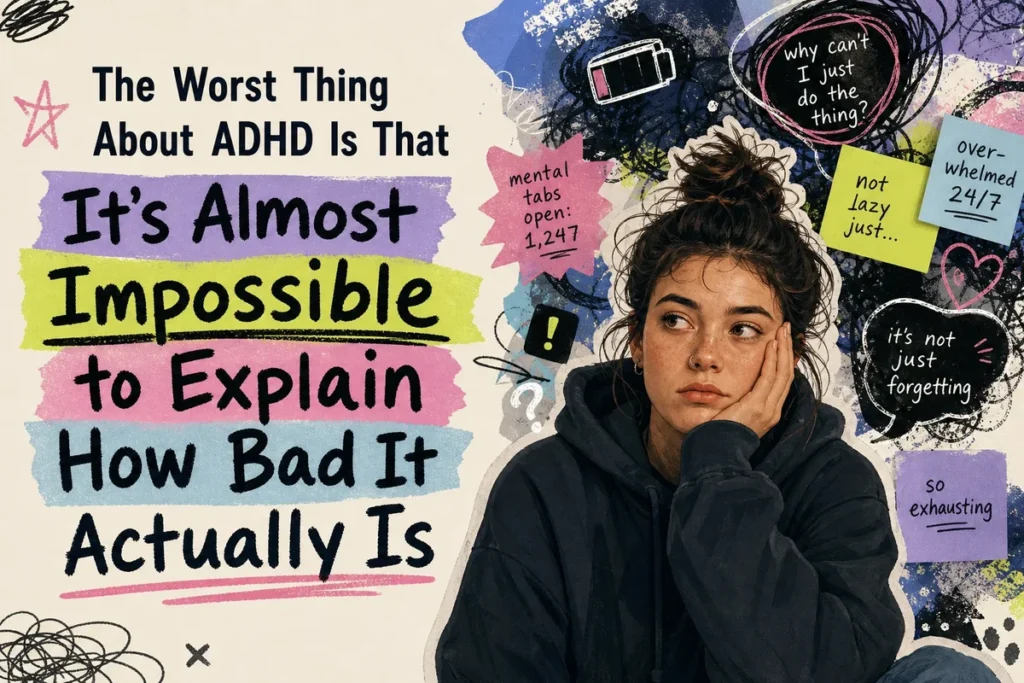
The Worst Thing About ADHD Is That It's Almost Impossible to Explain How Bad It Actually Is

You're standing in your bathroom at 12:30 at night, holding a toothbrush, staring at nothing. You've been there for thirty minutes. You're so tired you keep forgetting to actually brush your teeth, but you can't go to bed until you've done it, but the more tired you get the less you can seem to concentrate long enough to do this one simple thing. And at some point you realize you've been swaying there, half-asleep, toothbrush in hand, for over half an hour. Neither brushing your teeth nor going to bed. Just stuck in the space between.
This is what ADHD invisible suffering actually looks like. Not the "oh I'm so random" version. Not the "squirrel!" joke version. The version where you ask yourself "what's wrong with me?" and you already know the answer before you finish thinking the question. You know exactly what's wrong. And it's something you can never fully escape. And it will follow you through every day of your life. And when you try to tell someone about it, they hear "I was too tired to brush my teeth" and think you're being dramatic.
That gap between what you experience and what other people hear is the cruelest part of this whole thing.
Why ADHD Invisible Suffering Feels Impossible to Articulate
Here's the thing: you know how bad it is. You live inside it every single day. But the second you open your mouth to explain, the words betray you. They come out sounding like excuses. Like complaints about normal human problems. Like you're just not trying hard enough.
When you say "I forgot," they hear carelessness. When you say "I couldn't start," they hear laziness. When you say "I was stuck," they hear that you didn't really want it enough. The language we have for ADHD experiences was invented by people who don't have ADHD, and it was designed to describe moral failings, not neurological differences.
This is why ADHD invisible suffering is so isolating. You're not dealing with one big crisis that people can understand and rally around. You're dealing with a thousand small moments of falling short, every single day, that individually sound like nothing but collectively feel like drowning. Every little mess up builds on the last one. You feel stuck. You feel like a failure. You start to believe that you're just going to keep messing up your entire life because that's all you are: someone who can't get it right.
And when someone asks why you're so down, what do you say? How do you compress years of accumulated small failures into a sentence that doesn't make you sound like you're exaggerating?
You don't. You say "I'm fine." And then you stay quiet.
The Accumulation Problem That No One Sees
People without ADHD don't understand the math of constant small failures. They think in isolated incidents. You forgot to reply to that text? That's one thing. You missed that deadline? That's another thing. You lost your keys again? Separate incident.
But for you, it's never separate. Every single mistake lands on a pile that's been growing since childhood. The shame compounds. Today's forgotten text sits on top of yesterday's missed call, which sits on top of last week's late assignment, which sits on top of years of "you have so much potential if you'd just apply yourself."
Research backs this up: a 2021 study in the Journal of Attention Disorders found that adults with ADHD experience significantly higher rates of chronic stress and emotional exhaustion than their neurotypical peers, even when controlling for life circumstances.1 It's not that your problems are bigger. It's that they never stop accumulating. There's no clean slate. No fresh start. Just the pile getting taller.
When you try to explain why you're exhausted, people hear "I had a bad day." What you actually mean is: I am carrying the weight of every day like this that came before, and I can feel every single one of them.
Not for one second can I be normal. Not for one. I never know how to explain this to people whenever they ask me why I feel so down or so low, so I just stay quiet and say I'm fine.
That silence isn't peace. It's giving up on being understood.
Why "Just Explain It" Doesn't Work
You've probably tried. You've probably sat someone down, someone who matters to you, and attempted to lay it all out. Maybe you even found the perfect metaphor. Maybe you thought this time they'd really get it.
And then you watched their face do that thing. The slight tightening around the eyes. The polite nod that means "okay, but can't you just try harder?" The response that technically validates your experience while completely missing the point.
Here's why this keeps happening: ADHD is hard to explain because the individual symptoms sound trivially ordinary. Everyone forgets things sometimes. Everyone procrastinates occasionally. Everyone has days where they can't focus. When you describe your experience using those same words, neurotypical people automatically compare it to their own experience of those things. And since their experience is manageable, temporary, and fixable with a little effort, they assume yours is too.
They don't realize that their "I couldn't focus today" means they were distracted during a boring meeting, while your "I couldn't focus" means you sat paralyzed for six hours knowing exactly what you needed to do, wanting desperately to do it, and being physically unable to make your brain cooperate.
The words are the same. The experiences are not even close.
The Translation Problem: ADHD symptoms are described using vocabulary that neurotypical people interpret through neurotypical experience. The same word means fundamentally different things depending on which brain is processing it.
ADHD Hard to Explain: The Invisibility Tax
The invisibility of ADHD isn't just frustrating. It's expensive. It costs you in ways that are hard to quantify but impossible to ignore.
It costs you relationships, because people get tired of behavior they interpret as not caring. It costs you opportunities, because your track record includes too many mysterious gaps and unexplained failures. It costs you self-trust, because even you start to wonder if maybe everyone else is right and you really could just try harder.
The invisibility tax is the extra energy you spend masking, compensating, and managing perceptions. It's the constant work of appearing functional enough that people don't write you off completely. It's knowing that if you actually let people see how hard basic tasks are for you, they'd never take you seriously again.
So you perform normalcy. You exhaust yourself pretending. And then when you're too depleted to maintain the act, people are confused because "you seemed fine yesterday."
You weren't fine yesterday. You were spending tomorrow's energy to appear fine today. Now you're paying the interest.
The Specific Language Gap
Part of the problem with ADHD invisible suffering is that we don't have good words for what's actually happening. The clinical terms are too technical. The casual terms are too dismissive. And the truthful descriptions sound unbelievable.
What do you call it when you know you need to do something, you want to do it, nothing is stopping you, and you still cannot make your body move toward it? "Procrastination" implies a choice. "Avoidance" implies fear. Neither word captures the experience of being trapped in your own skull while time passes and the deadline approaches and you watch yourself not doing the thing with a kind of helpless horror.
What do you call the way your brain latches onto something unimportant and won't let go, even as urgent tasks pile up? "Distraction" sounds so passive, like something is being done to you. But it doesn't capture the active, almost violent way that ADHD attention works, the way it grabs things without your permission and holds them hostage.
The vocabulary of ADHD was created by outside observers describing behaviors they didn't understand. It was never designed to communicate internal experience. This is why even the most articulate person with ADHD struggles to convey what it's actually like: the words themselves were built to obscure rather than illuminate.
What Actually Helps When Words Fail
If you're reading this, you've probably experienced the specific frustration of knowing something is true about your experience and being unable to make anyone else understand it. Here are some approaches that work better than trying to explain from scratch every time.
First: stop trying to explain the diagnosis. Start describing specific moments. The toothbrush story at the beginning of this article works because it's concrete. It's a scene someone can picture. It's harder to dismiss than "I have trouble with executive function." When someone asks what ADHD is like for you, give them a single vivid example from the last 24 hours. Not a definition. A scene.
Second: separate education from emergency. Don't try to explain ADHD invisible suffering in the middle of a crisis when you need immediate support. That's the worst time to attempt a teaching moment. Instead, find a calm time when nothing is wrong and share a resource that explains it better than you can in the moment. An article. A video. A firsthand account from someone else. Build understanding before you need it.
Third: accept that some people will never get it. This sounds harsh, but it's actually liberating. Not everyone in your life needs to fully understand what you're dealing with. Some people can be in your life for specific purposes without being your emotional support system. Save your explanatory energy for the relationships where mutual understanding actually matters.
More people need to understand ADHD and the struggle that comes with it. But you don't have to be the one educating every single person, every single time, from exhaustion and desperation.
The Relief of Being Seen
There's a reason ADHD communities online explode every time someone posts about the unexplainable parts of this condition. Thousands of people upvoting and commenting "this is exactly it" and "I've never been able to put this into words." That response isn't just validation. It's the relief of finally being seen by someone who already gets it.
When you read something that perfectly describes your experience, you don't have to translate. You don't have to convince. You just know that the person who wrote it understands, and everyone who's agreeing understands, and for that moment you're not alone in the incommunicable thing.
That feeling matters. It's not a substitute for help, but it's a foundation for it. Research on ADHD and social support suggests that perceived understanding from others significantly reduces the emotional burden of the condition.2 The loneliness of not being understood is itself a stressor that makes everything harder.
Finding your people, even online, even in comment sections, is not just nice to have. It's part of how you survive this.
You're Not Bad At Explaining: The problem isn't your communication skills. It's that ADHD internal experience is genuinely difficult to convey to people who haven't lived it. The failure to be understood is a feature of the disability, not a personal failing.
Living With What Can't Be Fully Communicated
Here's the part no one wants to say: you may never be able to make the important people in your life fully understand what you deal with. Not because they're bad people. Not because you're explaining it wrong. But because ADHD invisible suffering is exactly that: invisible. Internal. Experiential in a way that resists translation.
This doesn't mean give up on being understood. It means adjust your expectations for what "understood" looks like. Maybe full comprehension isn't possible, but practical accommodation is. Maybe deep empathy isn't available, but basic respect is. Maybe "I believe you even though I don't fully get it" is the best you'll get from some people, and that's actually enough.
The goal isn't to make neurotypical people feel what you feel. That's probably impossible. The goal is to get the support and accommodation you need to function, and to have enough people in your corner who trust your self-report even when they can't personally relate to it.
And for the moments when you need someone who actually gets it: that's what spaces like this are for. That's what the community is for. That's why you screenshot posts that describe your experience perfectly and save them for the days when you need to feel less alone.
You're not making this up. You're not exaggerating. You're not being dramatic. The worst thing about ADHD really is that it's almost impossible to explain how bad it actually is. But at least here, right now, reading this, you don't have to explain. You already know. And so do all the other people reading alongside you, recognizing themselves in every word.
That has to count for something.
1 Combs, M. A., et al. (2021). Perceived Stress and ADHD Symptoms in Adults. Journal of Attention Disorders, 25(11), 1536-1545.
2 Sibley, M. H., et al. (2022). Social Support and Emotional Functioning in Adults with ADHD. Journal of Clinical Psychology, 78(3), 521-537.
Rate this article
Was this a useful hit?