The Part of ADHD That Is Hardest to Live With Is Probably Not the One You Think It Is

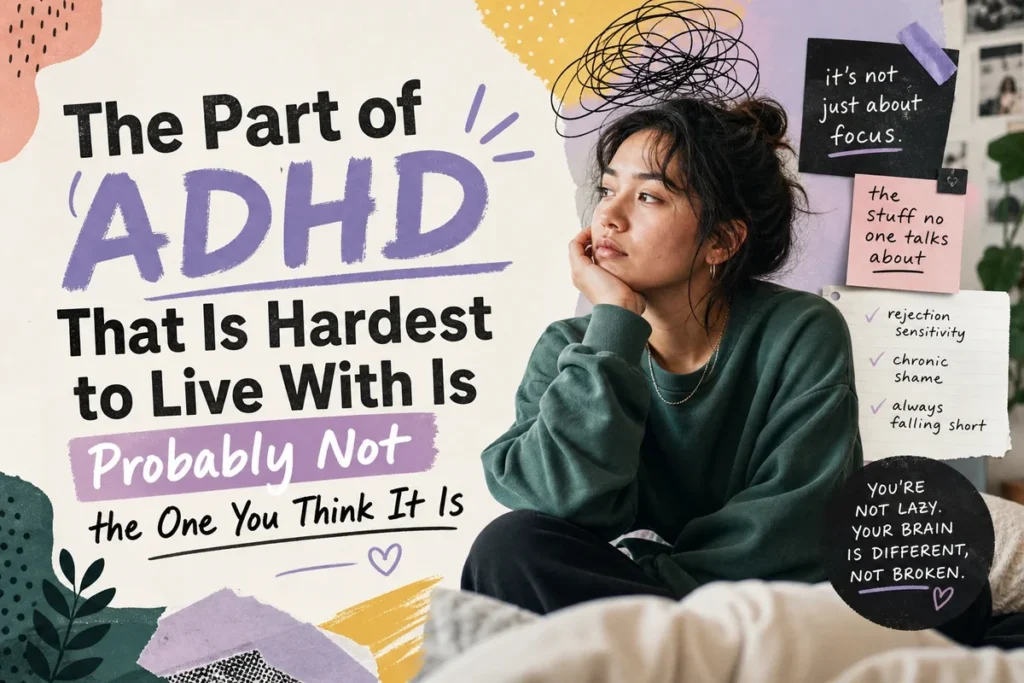
You know that feeling when a small inconvenience hits and your brain treats it like a five-alarm emergency? When someone cancels plans and the disappointment crashes through you like actual grief? When you cannot stop replaying a minor conflict for three days straight, feeling the anger or hurt at full intensity every single time? You are not being dramatic. You are not too sensitive. You are experiencing what is quietly becoming recognised as the most disabling part of ADHD for adults: emotional dysregulation.
Here is the thing nobody told you when you got diagnosed, or when you started suspecting, or when you fell down the ADHD TikTok rabbit hole at 2am: the diagnostic criteria barely mention emotions. The official checklist is all about attention and hyperactivity and impulsivity. So you probably thought the hardest part would be losing your keys, or struggling to focus in meetings, or procrastinating on important tasks. And those things are hard. But for most adults with ADHD, the emotional dysregulation hardest symptom is the one that actually wrecks their relationships, their self-esteem, and their ability to just exist in the world without feeling exhausted.
Why ADHD Emotional Dysregulation Is the Hardest Symptom Nobody Prepared You For
When researchers actually ask adults with ADHD what impacts their quality of life most, emotional dysregulation consistently tops the list. A 2014 study in the Journal of Clinical Psychiatry found that emotional symptoms were more impairing than the classic inattention and hyperactivity symptoms for the majority of adults surveyed.1 Another study found that emotional dysregulation, not attention problems, was the strongest predictor of occupational impairment and relationship difficulties.
So why did nobody warn you? Because for decades, ADHD was studied primarily in hyperactive little boys whose emotional outbursts were chalked up to immaturity rather than a core feature of the condition. The diagnostic criteria were built around what teachers and parents could observe in a classroom: fidgeting, interrupting, not listening. Internal experiences like "I feel everything at maximum volume all the time" did not make the cut.
The result is a generation of adults who got diagnosed or started suspecting ADHD and thought they finally understood their brain, only to discover that the symptom destroying their lives was not even on the official list.
What Is Actually Happening in Your Brain
Your prefrontal cortex is supposed to act like a volume knob for your emotions. When something triggers an emotional response in your limbic system, the prefrontal cortex is meant to step in and regulate: "Okay, this is annoying, but it is not actually catastrophic. Let us calm down." In ADHD brains, that volume knob is faulty. The prefrontal cortex is underactive, which means emotional signals from your limbic system hit you at full blast without the usual filtering.
This is the ADHD emotional regulation brain mechanism that explains why a mildly frustrating email can send you into a rage spiral, or why a friend's offhand comment can feel like a betrayal. Your brain is not overreacting. It is receiving the signal at a different intensity than neurotypical brains, and it lacks the automatic dampening system that would scale the response appropriately.
The intensity is real. The signal is real. What is different is your brain's ability to regulate it before it floods your whole system.
Neuroimaging studies show that people with ADHD have reduced connectivity between the prefrontal cortex and the amygdala, the brain's alarm center. This means when your amygdala fires (which it does, constantly, because that is its job), the "stand down" message from your prefrontal cortex either arrives late, arrives weakened, or does not arrive at all.
The Exhaustion of Feeling Everything Too Intensely
ADHD feeling everything too intensely is not just about anger or frustration. It is about every emotion. Joy that makes you want to vibrate out of your skin. Excitement that keeps you awake for hours. Sadness that feels like physical weight on your chest. Rejection that genuinely hurts, in your body, like a wound.
This intensity is not sustainable. You are essentially running emotional marathons every day while everyone around you seems to be taking casual strolls. The exhaustion is not laziness or weakness. It is a predictable consequence of your nervous system processing emotions without the built-in regulation that other people take for granted.
And then comes the second layer: the shame. Because you have been told your whole life to calm down, to stop overreacting, to not be so sensitive. You have internalised the message that your emotional responses are wrong, that you should be able to control them, that your inability to stay calm is a character flaw. So on top of the exhaustion of feeling everything at maximum volume, you carry the weight of believing there is something fundamentally broken about you.
The cruel irony: Trying to suppress your emotions actually makes dysregulation worse. The energy spent fighting the feeling depletes the same executive function resources you need to regulate it.
Why This Destroys Relationships
Here is where emotional dysregulation becomes genuinely dangerous to your life, not just your comfort. Relationships require the ability to pause between stimulus and response. They require not saying the thing you will regret when you are flooded. They require being able to receive criticism without your brain interpreting it as an existential attack.
When you cannot regulate your emotional responses, conflicts escalate faster than you can catch them. You say things at maximum intensity that you would have calibrated differently if you had access to that volume knob. You withdraw completely because you cannot trust yourself not to explode. You avoid bringing up issues because you know once you start talking, the emotions will take over and the conversation will go sideways.
Partners, friends, and family members start walking on eggshells. Or they stop trying to communicate honestly because they have learned it always ends badly. The relationship becomes defined by your dysregulation rather than by the connection you actually want to build.
This is why ADHD emotions worst symptom research keeps pointing to relationships as the area of greatest impact. It is not because ADHD people are bad at loving others. It is because the emotional dysregulation creates a constant interference pattern in communication that eventually erodes trust and intimacy.
The Myth of "Just Calm Down"
Every ADHD person has heard it. Calm down. Take a breath. Think before you speak. Just relax. And every ADHD person has experienced the particular fury of being told to do something their brain is literally incapable of doing in that moment.
Here is the neuroscience that makes "just calm down" insulting: the prefrontal cortex, which is what you would use to consciously calm yourself down, is the exact part of your brain that is underperforming. Telling someone with ADHD to calm down is like telling someone with a broken leg to just walk it off. The tool you are asking them to use is the tool that is impaired.
This does not mean regulation is impossible. It means the strategies that work for neurotypical people, the ones that rely on cognitive override of emotional states, are not going to work the same way for you. You need different tools.
You cannot think your way out of dysregulation while you are dysregulated. You have to work with your nervous system, not against it.
What Actually Helps: Working With Your Brain
The good news buried in all this research is that emotional dysregulation responds to treatment. Not perfectly, not immediately, but meaningfully. Here is what the evidence actually supports:
Medication: Stimulant medications help with emotional regulation for the same reason they help with attention: they increase dopamine and norepinephrine activity in the prefrontal cortex. This strengthens the volume knob. Many people report that the first thing they notice on medication is not better focus, but calmer emotions. Non-stimulant medications like guanfacine specifically target the norepinephrine system and are sometimes prescribed explicitly for emotional dysregulation.
DBT skills: Dialectical Behavior Therapy was developed for borderline personality disorder, but its skills for emotional regulation are remarkably effective for ADHD. The focus on distress tolerance and emotion regulation without relying purely on cognitive control makes it more ADHD-friendly than traditional CBT approaches.
Physical intervention: When you are flooded, your thinking brain is offline. Physical strategies, like splashing cold water on your face, holding ice, doing intense exercise, or taking slow breaths with extended exhales, work because they activate the parasympathetic nervous system directly. You are not trying to think your way calm, you are triggering a physiological calming response.
Externalising the emotion: Naming the emotion out loud, writing it down, texting it to yourself, or describing it in third person creates distance. "I am furious" hits different than "Sarah is noticing that she is experiencing intense anger right now." This is not a trick. It actually shifts activity to the prefrontal cortex.
The 90-second rule: Neurochemically, an emotion lasts about 90 seconds if you do not feed it with thoughts. This does not mean you will be fine in 90 seconds. It means if you can avoid ruminating or acting on the feeling for 90 seconds, the initial surge will pass and you will be working with a lower-intensity version.
The Validation You Actually Need
Nobody is going to tell you to "embrace your emotional dysregulation" because that would be absurd. It genuinely impairs your life. It damages relationships you care about. It makes every day harder than it needs to be.
But here is what is true: you are not broken. You are not too sensitive. You are not a bad person because you have intense emotional reactions and struggle to control them. You have a brain with a faulty regulation system, and that is a neurological reality, not a moral failure.
The research validating emotional dysregulation as a core ADHD feature is relatively recent, which means you probably spent years, maybe decades, believing your emotions were a character flaw rather than a symptom. That is a lot of shame to carry. Recognising that ADHD emotional dysregulation hardest symptom is literally the hardest part of the condition for most adults does not fix anything immediately. But it does change the story you tell yourself about why you struggle.
You are not failing at being a normal person. You are fighting a battle that most people do not even know exists, with a brain that was not given the standard equipment for this fight. That context matters.
Finding Rest in the Middle of It
There was a line in a Reddit post that stuck with me: "I just want to rest for two seconds." That is not asking for much. And yet for ADHD brains running emotional marathons every day, it feels impossible.
Rest, for you, might need to look different than it does for other people. It might mean complete sensory reduction: dark room, no noise, no input. It might mean high-intensity exercise that finally quiets the emotional noise through physical exhaustion. It might mean stimming or fidgeting or whatever your body needs to discharge the constant low-grade activation.
What it probably cannot look like is "just relaxing" in the way neurotypical people mean it. Your nervous system does not work like that. Finding rest means understanding what actually calms your specific brain, not what calming is supposed to look like.
You deserve rest. The fact that your brain makes it harder to access does not mean you need it less. It means you need it more, and you need different strategies to get there.
Living with ADHD emotional dysregulation as the hardest symptom is genuinely difficult. But it is also manageable in ways you might not have been taught yet. The strategies exist. The medications help. The understanding is growing. You are not stuck feeling everything at maximum volume forever with no recourse.
You just need tools that work with your brain, people who understand what you are dealing with, and permission to stop blaming yourself for a neurological difference you did not choose. Start there.
1 Surman, C.B., et al. (2013). "Deficient Emotional Self-Regulation and Adult Attention Deficit Hyperactivity Disorder." Journal of Clinical Psychiatry.
Rate this article
Was this a useful hit?