ADHD Dental Anxiety Is Not Just Fear. It’s Sensory Overload Plus Executive Dysfunction Plus Cost Panic.

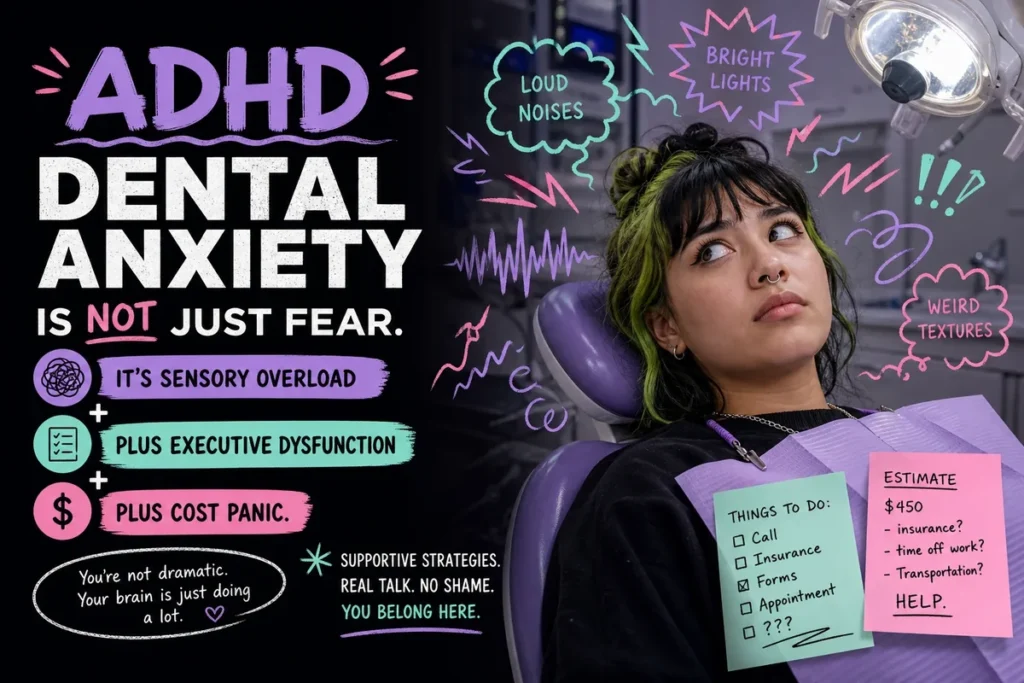
You brush your teeth every night. You floss when you remember, which is sometimes. And somewhere in the back of your mind there is a tooth that has been feeling a little off for about eight months, and a dentist appointment that you have “been meaning to make” since before you can accurately remember. Every time it surfaces, you feel a hot little flash of shame, and then your brain slides right off it like it’s coated in oil. That’s ADHD dental anxiety, and it’s not the same thing as being scared of the drill.
Most advice about dental fear assumes one problem: you’re afraid. So the fix is breathing exercises and a calming playlist. But if you have ADHD, fear is usually only one third of what’s going on. The other two thirds are sensory and logistical, and nobody is talking about them when they tell you to “just book it.”
Let’s pull the pile apart, because a pile is much harder to move than three separate things.
Why ADHD Dental Anxiety Is Not Just Fear
Dental phobia is a real and well-documented thing. Plenty of people, ADHD or not, feel real dread about needles, pain, or being helpless in a reclined chair. If that’s you, it counts.
But here’s the pattern that shows up again and again among ADHD adults: they don’t describe one big scary feeling. They describe a tangle. The sound is awful. The phone call feels impossible. The bill feels like a threat. The guilt about the years that have passed makes every step worse. Any one of those would be manageable alone. Together, they create something that looks like avoidance from the outside and feels like a brick wall from the inside.
Research backs up the general link. A large body of work shows that ADHD is associated with poorer oral health outcomes, including more cavities and gum problems, and with lower rates of routine dental attendance.1 That isn’t because people with ADHD don’t care about their teeth. It’s because the whole system of preventive care is built around skills that ADHD makes harder: planning ahead, remembering, tolerating waiting, and pushing through unpleasant sensory input.
ADHD dental anxiety isn’t a character flaw or a lack of maturity. It’s three separate barriers stacked so tightly that they look like one.
Layer One: The Sensory Assault
Think about what a dental office actually is, sensory-wise. Bright overhead light aimed directly at your face. A high-pitched whine from a drill or scaler that you feel in your skull. Strong mint and chemical tastes. The scrape of metal on enamel. A stranger’s gloved hands inside your mouth, which is one of the most sensitive, nerve-dense parts of your body. Water pooling at the back of your throat. Someone talking to you while you cannot answer.
For a brain that already has trouble filtering sensory input, that’s not a mildly uncomfortable afternoon. It’s a stack of alarms going off at once. Sensory processing differences are very common in ADHD, and studies have found that a significant share of people with ADHD report atypical sensory responses, including over-reactivity to sound, touch, and taste.2 If you’ve ever felt your whole body clench at the sound of a hygienist’s tool, that isn’t drama. That’s your nervous system reading the room accurately and deciding it’s a threat.
This is the piece people most often miss when they search for an ADHD dentist or try to explain why cleanings feel unbearable. You might not be scared of pain at all. You might be dealing with sensory issues at the dentist that turn a routine cleaning into an hour of white-knuckled endurance. And because the endurance costs so much, your brain starts protecting you by making the whole thing feel like a bad idea before you even get near it.
Layer Two: The Appointment Is a Boss Fight
Now look at what it takes to even get into that chair. You have to find a dentist. You have to check whether they take your insurance, if you have any. You have to call during business hours, which means either taking a call at work or finding a private moment, and you have to talk to a human being on the phone. Then you have to choose a date, put it in a calendar, remember it, arrange your day around it, and get there on time.
Every step in that chain is a separate executive function demand. Initiating, planning, remembering, sequencing, time management. It’s basically a checklist of the things ADHD makes harder, wrapped around something you already dread.
This is where ADHD healthcare avoidance really lives. It’s not that you decided to skip care. It’s that the task has no obvious first step, the deadline is fuzzy, and nothing bad happens today if you don’t do it. Your brain runs on urgency and interest, and “make a dentist appointment” has neither. So it sits on the list, getting heavier, and the longer it sits the more shame gets attached to it.
Layer Three: Cost Panic
Then there’s the money. Dental care in many places is expensive, often sits outside regular health coverage, and comes with unpredictable bills. You don’t know what they’ll find. You don’t know what it will cost. And you have a sneaking suspicion that after this long, they will find something.
ADHD makes financial stress worse in a few specific ways. Impulse spending, forgotten bills, and unpredictable income are common, so many ADHD adults are already carrying some money anxiety. An open-ended, possibly large dental bill hits a system that’s already on edge. And if you’re in your late teens or twenties, maybe newly off a parent’s insurance plan or in a first job without benefits, you may honestly not have the cushion to absorb it.
So the avoidance is partly rational. Not knowing the number feels safer than learning the number. That’s a very human move, and it’s also how a small cavity turns into a root canal.
The Shame Spiral That Ties It Together
Here’s the cruel part. Every month you avoid the dentist, the situation feels worse. You imagine the hygienist’s face. You rehearse the lecture. You picture them asking “when was the last time you came in?” and you having to say a number that sounds like a confession.
That anticipated judgment is a huge part of ADHD dental anxiety. Many people with ADHD have spent their whole lives being told they’re lazy or irresponsible, and a dentist who sighs at your X-rays can feel like the same old verdict in a new outfit. So you avoid the setting where you expect to be judged. Which makes the problem bigger. Which makes the judgment feel more likely.
Reality check: Dentists see people who haven’t come in for years every single day. To them, it’s Tuesday. The shame you’re carrying is almost always heavier than anything that will actually be said in the room.
How to Break Down ADHD Dental Anxiety Into Pieces You Can Move
The trick is to stop treating this as one giant task called “go to the dentist” and start treating it as three separate problems with three separate solutions. Do them in whatever order feels least awful.
For the sensory layer: You are allowed to ask for accommodations, and a good dental office will not blink. Ask if you can wear headphones and listen to music or a podcast. Bring sunglasses to cut the overhead light. Ask for a numbing gel before anything else, and ask if they can use a less minty prophy paste. Agree on a hand signal so you can pause at any time. That last one matters more than it sounds, because a lot of sensory distress comes from the feeling of being trapped. Having a stop button changes how your nervous system reads the situation. Some practices specifically market themselves as sensory-friendly or anxiety-friendly, so searching for that phrase when you look for an ADHD dentist can save you a lot of pain.
For the executive function layer: Shrink the task until it’s almost embarrassing. Not “book an appointment.” Just “find the number.” Then, on a different day, “send one text or fill in one online form.” Many offices now let you book online, which removes the phone call entirely. If you must call, write your script first. Something like: “Hi, I’d like to book a new patient appointment. It’s been a while since my last visit and I get anxious, so I’d appreciate a gentle approach.” That one sentence does a surprising amount of work, because it tells the office how to treat you before you ever sit down.
Once it’s booked, treat the appointment like a flight. Put it in your calendar with two alerts, one the day before and one two hours prior. Tell one person so someone else is holding the information too. If you can, book the first slot of the day so there’s less time for dread to build.
For the cost layer: Call and ask for the price of a basic exam and cleaning before you book. You are allowed to ask what things cost, and knowing the number removes the fog. Ask about payment plans, sliding scale fees, and new patient specials. If money is tight, dental schools and community clinics often offer significantly reduced rates, with supervised students doing the work. Some regions also have public or low-income dental programs worth a quick search. Knowing the real number, even if it’s not small, is nearly always less frightening than the imaginary one.
What to Say in the Chair
You don’t have to arrive with a polished story. You just need a few honest sentences. Something like: “I have ADHD and I’m sensory sensitive, so noise and light are hard for me. Can you tell me what you’re about to do before you do it?” Narrating steps is a small ask that makes a big difference, because unpredictability is a major fuel for both anxiety and sensory overwhelm.
If you need to stop, stop. If you can only handle a cleaning today and the rest next time, that’s a legitimate plan. Getting through one imperfect visit beats avoiding a perfect one for another three years. Progress here counts even when it’s partial.
If It’s Been Years, Start Here
Maybe you got your ADHD Late Discovery in your twenties and you’re now realizing that half of your adult avoidance patterns make sense. The dentist is often one of the loudest examples. Understanding why you’ve been avoiding it can be a relief on its own, because it swaps the story “I’m irresponsible” for “I have a real mismatch between how this system is built and how my brain works.”
That reframe doesn’t fix your teeth. But it changes what you do next. Instead of white-knuckling your way toward a guilt-driven, all-or-nothing appointment, you can build a plan that accounts for how your brain actually works: sensory accommodations, a tiny first step, a known price, and a script.
You don’t need to conquer your fear. You need to lower three barriers, one at a time, until the appointment becomes something you can actually do.
Start small: Today’s only job is to save the office’s number or booking link somewhere you can find it. Not call. Not book. Just save it. Tomorrow’s job can be the next tiny step.
The Bottom Line on ADHD Dental Anxiety
ADHD dental anxiety is not you being dramatic, lazy, or bad at adulthood. It’s a sensory system that gets overwhelmed, an executive function system that can’t find the first step, and a money fear that makes not-knowing feel safer. Put together, those things can keep a person away from the dentist for years.
The good news is that each layer has a workaround. Ask for sensory accommodations. Shrink the task to one micro-step. Get the price up front. Then let the appointment be imperfect. If your mouth has been quietly nagging at you, this is your sign to save that number today, and let the rest follow one small step at a time.
1 Studies on ADHD and oral health, including reviews published in dental and pediatric journals, consistently associate ADHD with higher rates of tooth decay and lower rates of regular dental visits.
2 Research on sensory processing in ADHD, including work by Ghanizadeh and others, reports elevated rates of sensory over-responsivity among people with ADHD compared with those without.
Rate this article
Was this a useful hit?