ADHD People Write With a Lot of Commas, and There Is Actually a Neurological Reason for That

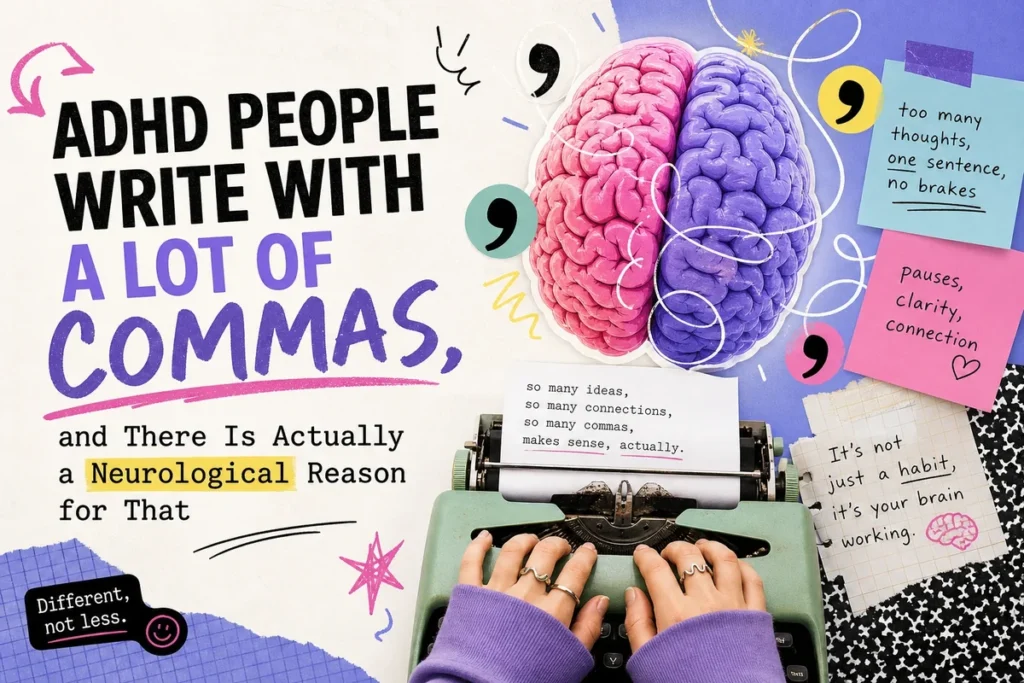
You have done it again. You wrote what you thought was a straightforward text message and it turned into three paragraphs, four commas, two sets of parentheses, and an ellipsis you are not entirely sure how to use. You hit send anyway. Then you scroll back through your notes app, your emails, your late-night Discord rants, and you notice the same thing everywhere: commas. So many commas. Dashes that interrupt your own sentences. Thoughts that branch into other thoughts before the first one finishes. You wonder if you failed English class without realizing it, or if maybe, just maybe, this is an ADHD writing style commas dashes situation that nobody told you about.
It is. And there is a neurological reason your writing looks like a roadmap of your actual brain.
Your ADHD Writing Style: Commas, Dashes, and the Spiral of Thought
The way you write is not random. It is not sloppy. It is a direct transcript of how your brain actually processes information: associatively, not linearly. Neurotypical writing guides teach you to think of an essay like a straight hallway. Introduction, body, conclusion. One idea leads to the next in a neat sequence. Your brain does not work that way. Your brain is more like a house where every room has six doors, and opening any one of them reveals three more rooms you did not know existed.
When you write, you are trying to capture that architecture on a flat page. And the tools you reach for, instinctively, without thinking about it, are commas, dashes, parentheses, ellipses. These are not errors. They are load-bearing walls. They are how you hold multiple related ideas in tension without losing any of them.
Research on ADHD cognition confirms this. A 2020 study in the Journal of Attention Disorders found that adults with ADHD show distinct patterns in working memory processing, particularly in how they hold and manipulate verbal information.1 Working memory is the mental workspace where you keep ideas while you are using them. For most people, it functions like a notepad: you write something down, work with it, move to the next thing. For ADHD brains, it is more like a whiteboard covered in sticky notes, each one connected to five others by invisible string.
Your commas are those strings made visible.
Why Long Sentences Physically Hurt to Read (When You Have ADHD)
Here is something that will make you feel less broken: long sentences are genuinely harder for ADHD brains to process, and your comma habit is an adaptation to that reality.
When you read a long sentence without breaks, your working memory has to hold the entire structure in place until you reach the period. Only then can you process the complete meaning. For neurotypical readers, this is manageable. For ADHD readers, it is like trying to hold water in your hands while someone keeps pouring more.
Commas create breathing room. They break a long thought into smaller chunks, each one processable on its own before you move to the next. When you write with many commas, you are unconsciously accommodating your own reading style. You are building in the pauses your brain needs. You are being considerate to future you, and to every other ADHD person who might read what you wrote.
Your punctuation is not a mistake. It is a cognitive accommodation you invented for yourself without anyone teaching you how.
This is why reading academic papers often feels like wading through concrete. Those sentences are built for brains that can hold thirteen clauses in suspension. Your brain cannot do that. So it starts to skim, to drift, to lose the thread entirely. And then you feel stupid, when actually, you are just encountering writing that was designed without you in mind.
The Associative Brain and Why Your Thoughts Have Branches
Linear thinking moves like a train on tracks. Point A to Point B to Point C. You get there eventually, and you do not see the scenery on either side. Associative thinking, which is the dominant mode for most ADHD brains, moves like a bird. You start at Point A, but something in the periphery catches your attention, and suddenly you are at Point F, which connects to Point D, which reminds you of Point A but from a completely different angle.
When you try to write this down, you face an impossible translation problem. Language is linear. It has to be. One word comes after another. You cannot type two sentences simultaneously (yet). But your thoughts are not linear. They are networked. They exist in relation to each other, not in sequence.
So you improvise. You use commas to insert related ideas without breaking the sentence. You use dashes to add context that feels essential but does not fit the grammar. You use parentheses to hold the side thoughts that keep interrupting the main thought. You use ellipses to indicate that the thought trails off, that there is more you could say, that the sentence is not really finished, it is just stopping.
This is not bad writing: This is a writing style shaped by ADHD thought patterns. The punctuation is doing real work, holding together a complex network of ideas that would otherwise collapse into chaos or get lost entirely.
You might look at your own writing and think it is messy, disorganized, unprofessional. That is because you have been taught to evaluate writing by neurotypical standards. By those standards, your writing has too many interruptions, too many asides, too many moments where you forget what you were originally saying. But by the standards of accurately representing how your brain actually works, your writing is precise. It is honest. It captures the texture of ADHD cognition in a way that sanitized, edited prose never could.
ADHD Writing Style Commas Dashes: The Neurological Evidence
Let's talk about what is actually happening in your brain when you write.
Executive function, which governs planning, organization, and sequential thought, is consistently implicated in ADHD. The prefrontal cortex, which manages these functions, shows structural and functional differences in ADHD brains.2 This affects writing in multiple ways: difficulty outlining before you write, trouble staying on a single topic, challenges with editing because you cannot always see the structure of your own work.
But here is the part that does not get talked about enough: ADHD brains often show enhanced associative processing. You make connections between ideas that other people miss. You see patterns across domains. You think laterally, creatively, in ways that linear thinkers cannot easily replicate.
Your ADHD writing style with all its commas and dashes is a direct output of this cognitive profile. The commas are not random. They mark the places where your brain made a leap, where you connected two ideas that are genuinely related but would normally be separated by paragraph breaks or transition sentences. The dashes indicate urgency, the sense that this additional information cannot wait, it has to be here, right now, or you will forget to include it.
The parentheses are perhaps the most ADHD punctuation of all. They say: I know this is a side thought, I know it interrupts the flow, but it is important and I refuse to lose it.
Why Editing Feels Impossible
Writing the first draft is hard. Editing is harder. And for ADHD brains, editing can feel almost physically painful, like trying to force your brain into a shape it was not designed to hold.
Part of this is working memory again. Editing requires you to hold the structure of your entire piece in mind while also zooming in on individual sentences. You need to see both the forest and the trees at the same time. ADHD brains struggle with this dual focus. You either get lost in the details and forget the overall argument, or you see the big picture but cannot force yourself to actually make the line-by-line changes.
Part of it is also emotional. Your first draft came from somewhere real. It captured your actual thoughts in the moment you had them. Editing feels like betraying that authenticity, smoothing out the rough edges that made the writing sound like you.
Editing is not about removing your voice. It is about making your voice clearer for people who do not live inside your head.
Here is a reframe that might help: editing is translation. Your first draft is written in the language of your own brain, with all its commas and dashes and associative leaps. Editing is the process of translating that into a version that other brains can follow without getting lost. You are not removing your ideas. You are building better roads to them.
The Verbal Processing Connection
Many people with ADHD process information verbally. They think by talking, not before talking. The thought does not fully exist until it is spoken out loud or written down. This is ADHD verbal processing shaping written expression in real time.
When you write, you might be essentially talking on the page. The commas are where you would pause in speech. The dashes are where you would interrupt yourself to add context. The ellipses are where you would trail off and think for a moment. Your writing sounds like you because it is you, transcribed directly from your verbal mind.
This is why your texts are so long. This is why your emails sprawl. This is why your essays read like a conversation. You are not writing, exactly. You are thinking out loud, and the page is catching it.
The problem comes when you try to write in contexts that demand a different style. Academic papers. Professional emails. Cover letters. These require you to suppress your natural verbal processing and produce something that sounds more formal, more linear, more neurotypical. It feels fake. It feels like wearing someone else's voice.
The trick is to separate drafting from editing. Let your first draft be verbal, associative, full of commas. Get your thoughts out in your own language first. Then, in a separate editing pass, translate it into whatever register the context requires. You are not changing who you are. You are code-switching, the same way you might speak differently to your boss than to your friends.
Your Writing Is Not Broken
You have probably spent years thinking your writing was somehow wrong. Too rambling. Too long. Too full of punctuation that elementary school did not teach you how to use. You have looked at other people's clean, concise prose and wondered why yours always sprawls.
Here is the truth: your writing is a direct representation of ADHD cognitive style in written language. The commas, dashes, and parentheses are doing real cognitive work. They are holding your complex, networked, associative thoughts on a linear page. They are accommodating your working memory. They are capturing connections that would get lost in more conventional prose.
Your ADHD thought patterns and writing output are linked: The way you write is the way you think, made visible. Learn to work with it instead of against it, and your writing gets stronger, not weaker.
Some of the most interesting writers in history wrote associatively. Virginia Woolf's stream of consciousness, David Foster Wallace's footnotes within footnotes, the way Hunter S. Thompson's sentences sprawled across pages. These are not failures of craft. They are styles that capture how certain brains actually work. Your comma-heavy texts exist on the same spectrum.
That does not mean you should never edit. It does not mean every piece of writing should look like your first draft. But it means you can stop treating your natural style as a problem to be fixed. Start treating it as a starting point, a raw material, a genuine cognitive asset that needs shaping rather than suppression.
Working With Your ADHD Writing Style
Now that you understand why you write the way you do, here is how to work with it instead of against it.
For first drafts, let yourself go. Do not police your commas while you are generating ideas. Do not stop to edit every sentence before you write the next one. Get everything out first. Let it be messy. Let it sprawl. The first draft is for you, and your brain gets to talk however it wants.
For editing, give yourself distance. Come back the next day if you can. Read your writing out loud. Your ear will catch things your eyes miss, especially rhythm problems and places where the commas actually are excessive rather than structural. Print it out if you can. Your brain processes physical text differently than pixels.
For important writing, consider getting a second reader. Not a grammar checker, a human who can tell you when your associative leaps are clear and when they are confusing. Other people cannot read your mind. Sometimes the connection you made is obvious to you but invisible to readers who were not there when you wrote it.
And for low-stakes writing, the texts, the Discord messages, the journal entries: let yourself write in your natural voice. Those commas are part of you. They are how your brain talks on the page. There is no reason to sand them down when you are just communicating with people who care about you.
Your ADHD writing style with all its commas and dashes is not a flaw to overcome. It is a window into how you think. And once you understand the neurological reasons behind it, you can start using it intentionally instead of fighting it constantly. The commas are not going anywhere. They are just waiting for you to see them as the tools they actually are.
1 Alderson, R.M., et al. (2020). Working Memory Deficits in Adults with ADHD: A Meta-Analytic Review. Journal of Attention Disorders.
2 Arnsten, A.F. (2009). The Neurobiology of Executive Functions: Prefrontal Cortical Circuitry. Biological Psychiatry.
Rate this article
Was this a useful hit?