ADHD Brains Are Overrepresented in Debt. This Is the Neurological Reason Why.

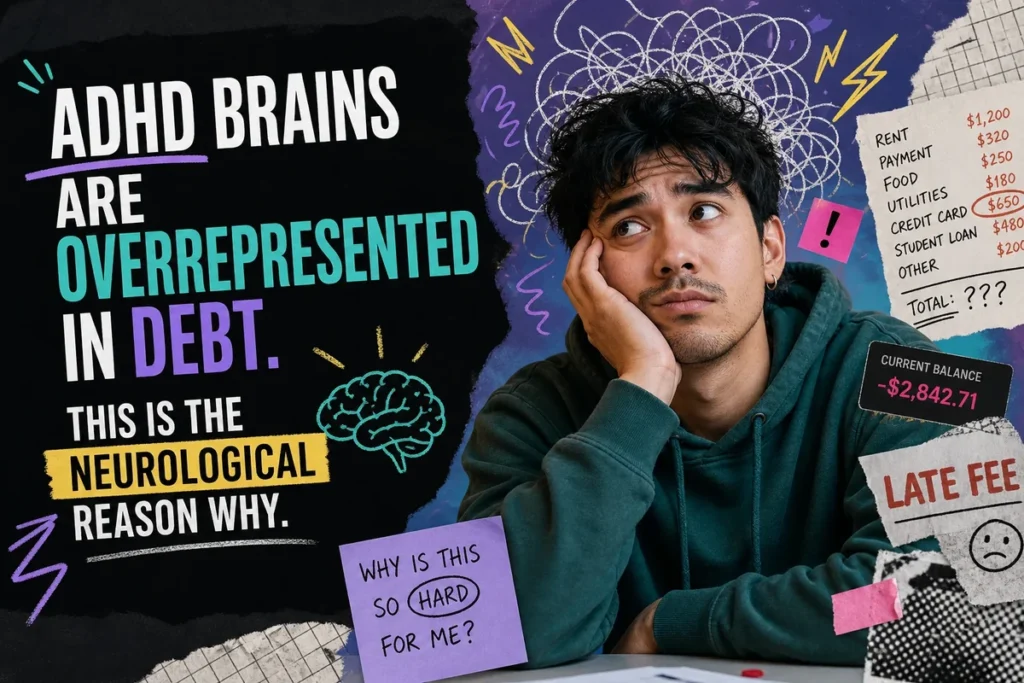
Adults with ADHD are significantly overrepresented in the lowest income quintiles in population surveys, and the relationship between ADHD and debt is not explained by spending habits in the casual sense. It is explained by three separate neurological systems failing at the same time, in the same financial moments, for decades. The debt is not the result of laziness or poor values. It is the predictable output of a brain whose inhibitory control, working memory, and reward-processing circuits are all running with structural disadvantages at every point where money decisions get made. Understanding why this happens is not just validating. It changes what the actual solution looks like.
The Income Gap Comes First
Before the debt even begins to accumulate, many adults with ADHD are working with a compressed income baseline. Research consistently links ADHD to significant occupational underperformance relative to measured ability. Employment instability, difficulty sustaining performance across the long stretches of routine that most careers require, and the chronic friction of executive function demands in workplace settings all contribute to a measurable earnings gap. The 2009 Adult Psychiatric Morbidity Survey in England found that screening positive for ADHD traits was strongly associated with belonging to the lowest household income quintile, a pattern that held even after controlling for age and other demographic factors.
This matters for the debt conversation because debt is not only a spending problem. It is an income problem with a spending component on top. When your income is structurally lower than your earning potential because untreated or under-supported ADHD has created friction at every career inflection point, the margin for financial error is narrower from the start. A missed bill that a person with higher income absorbs as a minor annoyance becomes a cascading event for someone who was already operating close to the limit. The neurological vulnerabilities do not change based on income level. But the consequences of those vulnerabilities are not evenly distributed.
ADHD does not just affect how you spend money. It affects how much money you are likely to have access to in the first place, and that compression of margin is where debt spirals typically begin.
Why Working Memory Turns Bills Into Landmines
The most underappreciated driver of ADHD debt is not impulsive spending. It is working memory failure at routine financial moments. Working memory is the brain’s active workspace, the system that holds information in mind long enough to act on it. In ADHD, working memory deficits are among the most consistently documented findings in the research literature, with impairments identified across both verbal and spatial domains in multiple meta-analyses. In practical financial terms, this impairment is costly.
You receive a bill. It registers. You intend to pay it. But it is not in front of you right now, and the working memory system that should be flagging it as a pending obligation is not reliably maintaining that flag. The bill falls out of active awareness. Not because you do not care about it. Not because you forgot it existed entirely. But because your brain’s active workspace did not hold the priority marker long enough for it to translate into action. The due date arrives. The late fee appears. And if this is the third time it has happened this quarter, the shame arrives alongside the fee, and that shame creates its own neurological problem, which we will get to shortly.
Working memory and response inhibition interact in a way that makes this worse. Research using structural equation modelling by Ikegami et al. (2026, BMC Psychology) traced a sequential cascade: steeper delay discounting reduces sustained attention, which compounds with working memory errors, which together produce significantly poorer decision-making under risk. This is not a single-point failure. It is a chain of impairments that reinforce each other, and the chain operates below the threshold of conscious awareness. You are not deciding to forget the bill. The system that should be producing the internal reminder is not generating the signal.
The working memory trap in financial terms: Every bill you manage manually is a working memory task. Every subscription you pay by logging in is a working memory task. Every rent payment that is not automated is a working memory task. For a brain with documented working memory impairments, this multiplies into dozens of potential failure points per month, and statistical inevitability means at least one will detonate.
The Delay Discounting Problem Makes Debt Feel Logical
Why does debt accumulate rather than just plateau? Why does the person with ADHD who genuinely wants to get out of debt keep making decisions that deepen it? The answer is in a well-established feature of ADHD neurobiology called delay discounting, and understanding it removes the moral charge from the behavior entirely.
Delay discounting is the cognitive process of valuing future rewards less as they become more distant in time. Everyone does this. The ADHD brain tends to do it more steeply and more aggressively. Research by Scheres et al. (2008) and Marco et al. (2009) consistently documents that people with ADHD display a steeper temporal discount curve than neurotypical controls, meaning the brain mathematically devalues future consequences much faster. A $200 consequence in three months does not feel like $200 to an ADHD brain at the moment of decision. It is discounted by the distance, and the more emotionally aversive the consequence, the greater the tendency to push it into an abstract future.
This is why putting a purchase on a credit card can feel neurologically rational in the moment. The debt does not exist in the same sensory reality as the item you are holding right now. The future minimum payment is abstract. The present purchase is concrete. The prefrontal cortex, which in a neurotypical brain would be generating an inhibitory signal and running a quick calculation of long-term cost, is structurally underactivated in ADHD. Neuroimaging research has linked delay discounting in ADHD to hypofunction across a prefrontal network including ventrolateral, dorsolateral, orbital, and ventromedial prefrontal regions. The brake is weaker, the future is hazier, and the present is louder. That is the debt-generating formula.
What Happens in the Brain When You Avoid Opening the Envelope
This is where ADHD debt becomes a spiral rather than a steady accumulation. The working memory failure and delay discounting create debt. But the emotional dysregulation that is increasingly recognized as a core feature of ADHD, not just a comorbid pattern, is what keeps the debt growing after the person is already aware it exists.
Barkley (2010, Journal of the American Academy of Child and Adolescent Psychiatry) documented the unique contribution of emotional impulsiveness to impairment in major life activities in adults with ADHD, finding that emotional self-regulation deficits contributed independently to functional outcomes beyond core attentional traits. In practical terms: people with ADHD do not just experience awareness of a financial problem. They experience it as a flood of shame, dread, and self-directed anger that the emotional regulation system is poorly equipped to modulate.
The result is avoidance. The bill stays unopened. The bank app does not get checked. The overdue notice gets moved to a pile that is also not opened. This is not irrational in the short term. It is the brain’s regulatory system doing exactly what it is designed to do: minimizing exposure to stimuli that generate overwhelming negative affect. The Sonuga-Barke delay aversion model of ADHD (2002, 2003) describes precisely this dynamic: people with ADHD learn to associate delay cues with failure, and escape from situations associated with delay becomes a form of negative reinforcement. Avoidance reduces the immediate distress. The debt, meanwhile, continues to compound.
The shame of having debt is not separate from the debt growing. The shame is the mechanism by which the debt grows. Every avoided bank statement is a neurologically coherent response to an overwhelmed emotion regulation system.
This pattern is one of the most frequently described financial experiences in the ADHD community: not simply forgetting to pay bills, but actively dreading the act of checking what has accumulated. It is the same avoidance loop that affects overdue emails, unanswered messages, and unopened letters from institutions. The financial version just carries the heaviest compound interest.
Does ADHD Directly Cause Debt or Does It Create the Conditions for It?
The honest answer is both, and the distinction matters for how you approach recovery. ADHD does not guarantee debt. Many adults with ADHD, particularly those with strong external scaffolding, supportive relationships, earlier diagnosis, or careers that happen to align with their neurological strengths, manage their finances without significant debt. What ADHD does is create a consistently elevated baseline probability of each of the inputs that lead to debt: income suppression, working memory failures at bill-payment moments, impulsive spending driven by dopamine-seeking, delay discounting that makes credit feel like a reasonable choice, and avoidance loops triggered by shame.
The neuroeconomic research is precise on this point: people with ADHD tend toward suboptimal decision-making across economic contexts, consistently choosing options with lower expected value even when better alternatives are visible. This pattern is not simply about impulsivity or risk appetite. It reflects documented hypoactivation of the prefrontal cortex, the striatum, and the anterior cingulate cortex, three regions responsible for evaluating options, processing feedback, and generating inhibitory control. Specific brain regions affected by ADHD, including the prefrontal cortex and anterior cingulate cortex, play crucial roles in executive functions, reward processing, and response inhibition, and impairments in these systems directly impact financial decision-making quality.
Three systems, one outcome: Working memory failure misses bills. Delay discounting makes credit feel rational. Shame avoidance keeps bad situations invisible. These three mechanisms are independent, they stack, and they are all downstream of documented neurological differences, not character failures.
Why Willpower-Based Solutions Always Fail This Problem
Willpower-based financial advice treats debt as a motivation problem. It is not. It is a structural problem at the level of brain architecture, and willpower is not a mechanism that overrides prefrontal hypoactivation. The prefrontal cortex is the neural substrate of willpower. It is also the region that is underactivated in ADHD during precisely the moments when financial self-regulation is required: when an impulse purchase presents itself, when a bill is due and needs to be paid, when a monthly budget needs to be reviewed.
Telling someone with ADHD to use more willpower to manage their finances is a category error about what kind of problem is actually present. The research on working memory supports evidence-based interventions including external reminders, automation, and structured environments that reduce the cognitive load required for routine financial tasks. These approaches work not by strengthening willpower, but by removing the situations in which willpower would need to operate. Automaticity replaces volition. The bill gets paid because the system is set up to pay it without requiring your working memory to generate the action every month.
Standard advice like “just check your balance every day” or “make a commitment to avoid your credit card” assumes consistent access to the sustained attention and inhibitory control needed to maintain that commitment. Ikegami et al. (2026) demonstrated that both of these executive functions, sustained attention and inhibitory control, follow documented impairment pathways in ADHD that operate through the same structural cascade as suboptimal decision-making. Committing to a behavior does not repair the cascade. Building an environment that bypasses it does.
The most effective financial interventions for ADHD brains are the ones that remove the human from the decision loop entirely, not because the person cannot be trusted, but because the decision loop itself is the broken component.
The Compassion Framework Is Not Soft. It Is Mechanistic.
Arguing for compassion over willpower in the context of ADHD debt is not a therapeutic nicety. It is a mechanistic claim with a specific evidence base. Shame-based approaches to debt management, the ones that rely on the person feeling bad enough to change, actively worsen ADHD debt outcomes through a specific neurological pathway. Shame activates avoidance. Avoidance prevents the behavioral contact with the financial problem that is necessary for any change to occur. More shame produces more avoidance, which produces more debt. The cycle is traceable through the same delay aversion and emotional dysregulation research that explains why the debt started in the first place.
Compassion, as a practical approach, means starting from an accurate model of what is actually wrong. The person with ADHD who is in debt is not lacking moral fiber. They are operating with documented impairments in inhibitory control, working memory, delay discounting, and emotional self-regulation, all of which stack against sound financial management. The solution that follows from this model looks different from the willpower solution: it involves automation over manual action, external visibility over internal tracking, system design over commitment, and small structural changes over large motivational declarations.
This framing also connects to a broader understanding of financial functioning for neurodivergent adults. The ADHD Money pillar is grounded in the idea that most standard financial advice assumes cognitive architecture that ADHD brains do not consistently have access to. Building financial stability with ADHD means designing around how the brain actually works, not how conventional personal finance books assume it should work.
What the Exit from Debt Actually Looks Like for an ADHD Brain
Exits from ADHD debt that work tend to share structural features regardless of the specific approach taken. They reduce the number of active decisions required. They make the financial situation visible without requiring the person to voluntarily seek out distressing information. They use external scaffolding to replace internal working memory functions. And they are not built on sustained motivation, because sustained motivation is one of the cognitive functions most reliably disrupted by ADHD.
Automation is the single most evidence-consistent tool for ADHD financial recovery. Every bill that moves from manual to automatic removes a working memory obligation and eliminates a late fee risk. Every spending alert that notifies you at a threshold replaces the internal monitoring your prefrontal cortex is not reliably generating. Every debt with a fixed automatic payment becomes a debt that is shrinking without requiring you to make an active decision every month. The goal is to make the financially responsible action the path of least resistance, rather than requiring active executive function engagement every single time.
Visibility tools serve the ADHD brain by compensating for object permanence failures. A physical debt tracker, a single number written where you will regularly see it, or a weekly scheduled ten-minute finance review treated as a non-negotiable appointment rather than an optional check-in all serve the same neurological function: they make the invisible visible. Research on working memory in ADHD consistently confirms that out-of-sight genuinely tends to become out-of-mind. Debt that is not regularly made visible risks being neurologically deprioritized. This is not denial in the psychological sense. It is object permanence, the same cognitive feature that explains why a phone reminder works and a mental note to yourself often does not.
The deeper work, addressing income instability, employment friction, and the career ceiling that unmanaged ADHD can impose, operates at a systems level. The ADHD Systems pillar covers how to build low-friction structures that compensate for executive function deficits across domains including work and financial management. Building those structures does not require becoming a different kind of person. It requires designing your environment to do the cognitive work your brain is not reliably doing on its own.
This Is Not About Lowering the Bar
Understanding ADHD debt as a neurological outcome rather than a character outcome is not about lowering expectations or making excuses for financial behavior that causes real harm to your life. It is about targeting the correct mechanism. If the problem is willpower, the solution is motivation. If the problem is prefrontal hypoactivation compounding with working memory deficits and delay discounting, the solution is structural design. One of those interventions can actually close the gap. The other has been failing people with ADHD for decades while generating additional shame in the process.
The person sitting with their bank account open, ashamed of a number they do not fully understand how they arrived at, is not looking at the product of their character. They are looking at the product of a brain that has been navigating a financial system built for a different kind of nervous system, without adequate tools, and often without even knowing that the difficulty was neurological rather than personal. That context does not make the debt disappear. But it makes the next decision, the one about what to actually do, a genuinely different kind of decision. One built on the right foundation, and therefore one that has a realistic chance of working.
Quick Dopamine Hits:
- Set up one automatic minimum payment today for any bill you currently pay manually. Open your bank’s app right now and schedule it before you do anything else.
- Write the total of your debt somewhere visible, not to punish yourself, but because ADHD brains cannot act on what they cannot see. One number. Stick it to your monitor or phone case.
- Pick one account only and set a spending alert for 80% of your typical monthly balance. One alert, one account. You are not building a system today, you are adding one external signal to replace the internal one your brain is not generating.
Rate this article
Was this a useful hit?