Is It an ADHD Thing That You Notice You Are Thirsty Only Once You Have a Headache?

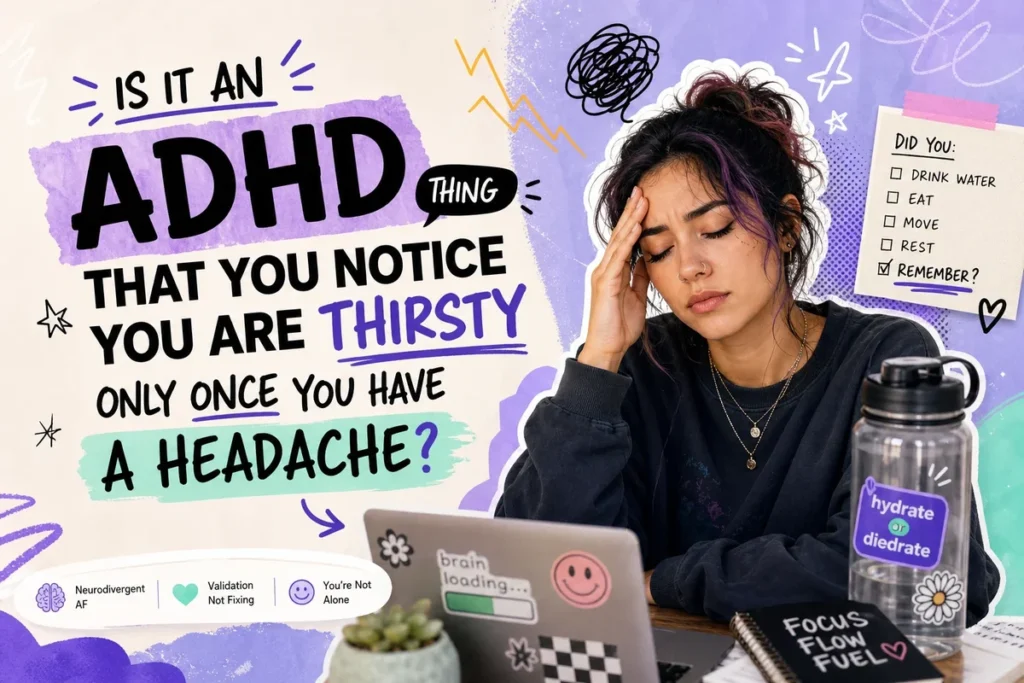
You are working at your desk when your temples start to squeeze. The dull ache settles behind your eyes and you realise, with a strange detachment, that you cannot remember the last time you drank anything. You check your water bottle and find it still full from this morning. Eight hours ago. The headache is not a mystery: you are dehydrated. The mystery is why you never felt thirsty until your skull started to protest.
Yes, this is an ADHD thing. It has a name: interoceptive awareness deficit. Your brain's ability to register and relay internal body signals is muted compared to neurotypical brains. The thirst signal was there, but it did not reach your conscious awareness until the dehydration became severe enough to cause pain. The headache is not the first symptom. It is the first symptom loud enough to break through.
What ADHD Thirst Awareness Actually Looks Like
This is not about being careless with your health. People who experience this are not ignoring their thirst. They genuinely do not feel it. The sensation that should prompt "I need water" gets filtered out by a brain that is busy attending to other stimuli: the task on screen, the conversation in the next room, the fifty-seven thoughts cycling through the background.
You might go an entire workday without a drink and only realise it when someone points out your untouched glass. You might finish a long hike and feel suddenly dizzy, wondering why you did not think to hydrate along the way. You might wake up parched at 3am, confused about how you forgot to drink anything after dinner.
The pattern repeats across different contexts: at home, at work, during exercise, during leisure. It is not situational carelessness. It is a consistent gap between what your body needs and what your brain communicates.
The Neuroscience of Interoception and ADHD
Interoception is your brain's ability to perceive internal body states. Hunger, thirst, temperature, heart rate, the need to use the bathroom: all of these rely on interoceptive signals traveling from your body to the insular cortex, a region deep in the brain responsible for making sense of what is happening inside you.
In ADHD, this system is often impaired. The brain's executive function networks, which are already working overtime just to manage attention and impulse control, do not have the bandwidth to process low-level body signals with the same priority as neurotypical brains. Research into executive functioning skills in ADHD shows that the regulation of attention extends beyond external stimuli to internal ones as well.1
Think of it this way: your brain has a bouncer at the door of conscious awareness. In neurotypical brains, the bouncer lets the "I'm thirsty" message through fairly early. In ADHD brains, that message gets stuck in line behind everything else competing for attention. By the time it reaches the front, the dehydration has escalated from "mildly thirsty" to "headache."
Interoception is not intuition: It is a measurable neurological function. People with ADHD often score lower on interoceptive accuracy tests, meaning they are objectively less aware of internal signals like heartbeat, hunger, and thirst.
Why Standard Advice About Staying Hydrated Fails
You have heard the advice. Drink eight glasses a day. Listen to your body. Drink when you feel thirsty. For someone with ADHD thirst awareness deficits, this advice is almost useless. The entire premise assumes you will feel thirsty before dehydration sets in. You do not.
Telling someone with impaired interoception to "drink when they feel thirsty" is like telling someone with poor eyesight to "just look more carefully." The signal is not weak because you are not paying attention. The signal is genuinely muted at a neurological level.
The advice to "keep track" of your water intake also fails because it relies on working memory, another executive function that ADHD disrupts. You might start the day with good intentions, drink one glass, get absorbed in something, and forget the glass exists until you are already symptomatic.
The problem is not remembering to drink water. The problem is remembering to remember to drink water.
The Same Mechanism Behind Forgetting to Eat
If this experience sounds familiar, you have probably noticed it applies to more than just thirst. Many people with ADHD report skipping meals not out of choice but because they simply do not register hunger until it becomes something more urgent: irritability, shakiness, a sudden crash in energy or focus.
This is the same interoceptive system failing in the same way. The hunger signal gets filtered out until it reaches a critical threshold. What should have been "I'm getting hungry, I should eat soon" arrives as "I'm suddenly starving and furious and I need food immediately."
ADHD dehydration follows the same pattern. The gentle nudge of thirst never registers. The body escalates to more extreme signals: headache, fatigue, difficulty concentrating. You only respond to the emergency because the emergency is the first signal loud enough to reach you.
How ADHD Interoception Affects Your Daily Life
This is not just about water. Once you understand interoceptive deficits, you start seeing them everywhere in ADHD.
You might not notice you are cold until you are shivering. You might not notice you are tired until you are falling asleep mid-task. You might not notice pain until it becomes severe. You might not notice you need to use the bathroom until it becomes urgent.
This has real consequences. Chronic mild dehydration can worsen ADHD symptoms: it impairs concentration, increases fatigue, and can contribute to headaches that make focusing even harder. The very thing your brain fails to notice can make your brain function worse, creating a feedback loop that is easy to miss because you do not feel the initial cause.
People with late discovery ADHD often look back and realise they have spent decades in mild physical discomfort without knowing it. The body signals were always there. The brain just was not relaying them.
External Systems Bypass Internal Signal Failure
The solution is not to try harder to feel your thirst. You cannot willpower your way past a neurological difference. Instead, you build external systems that bypass the broken signal entirely.
Timers work because they do not rely on your body telling you anything. A phone alarm every 90 minutes that says "drink water" gives you an external prompt that your internal system is not providing. You do not need to feel thirsty. You just need to respond to the timer.
Visual cues work because they keep the task in your environment. A water bottle on your desk, in your line of sight, serves as a constant reminder that drinking water is a thing you should be doing. Out of sight is out of mind for ADHD brains. Keep the water visible.
Habit stacking works because it attaches the new behaviour to something you already do reliably. Every time you sit down at your desk, take a drink. Every time you finish a meeting, refill your glass. The trigger is external and consistent, not dependent on a body signal that may never arrive.
Build systems that assume you will never feel thirsty. Design your environment for the brain you actually have, not the brain that would feel its own needs.
ADHD Body Signals and the Bigger Picture
Understanding ADHD thirst awareness as part of a larger interoceptive pattern changes how you approach self-care. It reframes the question from "why am I so bad at taking care of myself" to "what signals is my brain filtering out, and how can I compensate?"
This is not a moral failing. ADHD is a neurodevelopmental disorder that shapes how the brain develops and functions.2 The parts of your brain responsible for executive function, the ability to plan, organise, and carry out tasks, are also involved in processing internal body states. When that system is dysregulated, body signals get lost.
The good news is that external systems can do the job your interoception is not doing. The bad news is that you have to set them up deliberately, because your brain will not remind you. But once the systems are in place, they run on autopilot.
This is not about discipline: It is about architecture. You are building scaffolding around a neurological gap, not training yourself to be "better" at feeling things your brain genuinely does not register.
What Actually Helps With ADHD Dehydration
Here is what works, based on how ADHD brains actually function.
First, make water physically present. A water bottle on your desk, in your bag, next to your bed. If you have to get up and walk to the kitchen, you will not do it until you are already symptomatic. Eliminate the friction entirely.
Second, set timers that do not rely on you remembering anything. A recurring alarm every 60 to 90 minutes with a specific label like "water check" or "hydration" serves as the thirst signal your brain is not generating. Treat the timer as non-negotiable. When it goes off, drink, regardless of whether you feel you need it.
Third, use apps that gamify hydration if that works for your brain. Some people find that tracking water intake with a satisfying visual (filling a virtual bottle, for example) provides enough dopamine to maintain the habit. Others find apps annoying and do better with simple timers. Know which type you are.
Fourth, accept that you may never "feel" thirsty in the way other people describe. This is not a personal failure. Your interoception works differently. Stop waiting for a signal that is not coming and start drinking water on a schedule.
The Headache Is Information, Not Punishment
When the headache arrives, it is easy to feel frustrated with yourself. How did you let it get this bad? Why can you not just remember to drink water like a normal person?
Reframe the headache. It is not evidence of your failure. It is information about how your brain processes signals. The headache tells you that your interoceptive system routes thirst through the pain pathway because the gentler signals do not register. That is useful data. It tells you exactly where your system breaks down and where you need external support.
The goal is not to feel thirsty. The goal is to stay hydrated despite not feeling thirsty. Once you stop waiting for a sensation that is not coming and start building systems that work without it, the headaches become less frequent. Not because you fixed your interoception, but because you stopped relying on it.
Your brain filters out thirst signals until they reach emergency volume. That is not a character flaw. It is neurology. Work with the brain you have: set a timer, keep water visible, drink on schedule. The headache is the last signal in the chain. You can intervene much earlier once you stop waiting for the signal that never comes.
Rate this article
Was this a useful hit?