Is It an ADHD Thing That You Can Go From Genuinely Happy to Completely Low and Back Multiple Times in a Single Day?

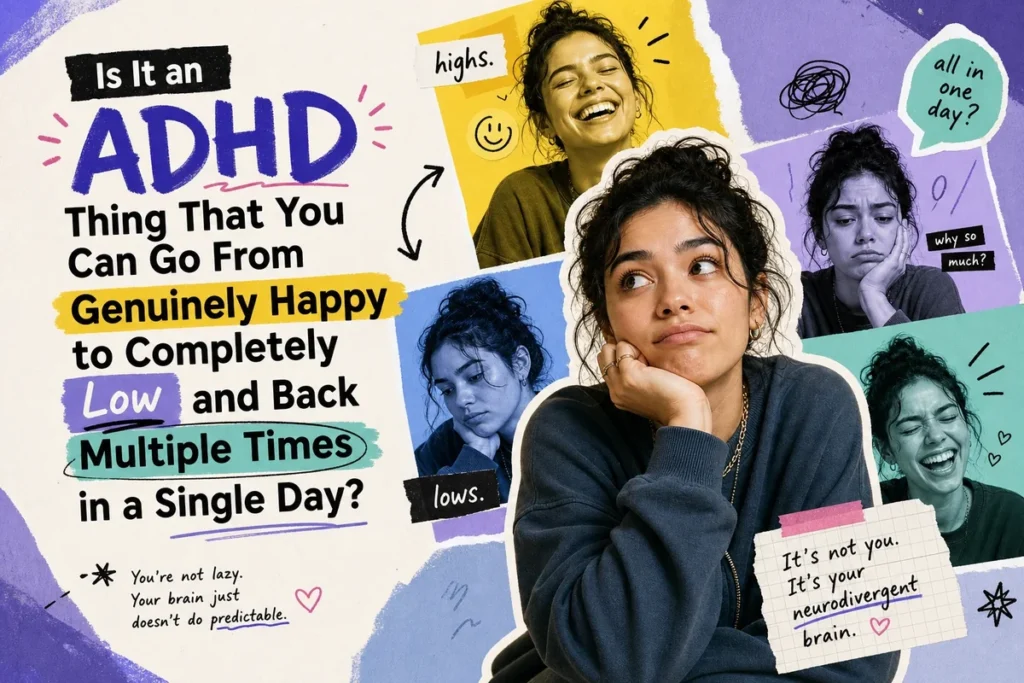
You are mid-laugh in the kitchen, planning something you are properly excited about, and then something shifts. Nothing happened. Nobody said anything. But the floor of your mood drops out and suddenly everything feels heavy, pointless, and a bit grey. An hour later you are fine again, maybe even buzzing, and you are left wondering which version of you was the real one. Some days the low sticks around for a day or two before it lets go. Other days you flip three times before dinner. You do not always have a trigger. Sometimes the sadness just arrives, like a door opening in your head.
Yes, this is an ADHD thing. It is called emotional dysregulation, and the fast, intense version of it is often described as emotional lability: your feelings arrive quickly, hit hard, and your brain is slow to bring them back to baseline. ADHD mood swings in the same day are one of the most common and least talked about parts of the condition.
ADHD mood swings in the same day are not a character flaw
Most people think of ADHD as an attention problem. Focus, forgetfulness, fidgeting, lost keys. That is the version that made it into the textbooks and the school report cards. But emotional dysregulation sits much closer to the centre of ADHD than most people realise, and plenty of researchers argue it should be treated as a core feature, not a side effect.
Emotional dysregulation means that your emotional responses are faster, bigger, or longer-lasting than the situation seems to call for, and that the usual brakes do not engage as quickly. It is not that you feel more than other people in some mystical way. It is that the system which is supposed to dampen, sort, and settle emotions is running on a different setup.
That means your mood can follow your internal weather instead of your external circumstances. A small thing happens, or nothing happens, and the feeling goes all the way up or all the way down. Then it moves again.
ADHD mood swings in the same day are not a sign that you are unstable or dramatic. They are a sign that your brain's emotional braking system works differently.
What is happening in your brain when your mood flips this fast
Emotion regulation depends on a conversation between two areas. The amygdala and related limbic structures generate the raw emotional reaction. The prefrontal cortex steps in afterwards to label it, put it in context, and turn the volume up or down. In ADHD, the prefrontal cortex is the region most associated with differences in development and activity. It is the same region responsible for planning, impulse control, and working memory.
So when the limbic system fires, the part of the brain that would normally say "this is a small thing, let's settle" is slower, less consistent, or already busy. The emotion gets a head start. It does not wait for context. By the time your brain catches up, you are already in it.
Dopamine and noradrenaline matter here too. Both help stabilise attention and mood, and both work differently in ADHD brains. When the signal is inconsistent, your emotional baseline is inconsistent. You do not get a steady hum. You get peaks and drops.
Why the low can arrive for no reason at all
One of the most disorienting parts of ADHD emotional cycling is the lack of a visible cause. You can handle a stressful event fine and then crumble over nothing. That is because the trigger is often internal or delayed.
Your brain may be reacting to something that happened hours ago. It may be responding to a dip in energy after a burst of hyperfocus. It may be a dopamine drop after something exciting ended. It may be tiredness, hunger, a sensory overload you did not clock, or a thought that flickered past too fast to notice but left a mood behind.
With ADHD, interoception, the ability to read your own body signals, is often patchy. You might not notice you are exhausted, hungry, or overstimulated until the feeling has already turned into sadness or irritability. The emotion becomes the alarm bell for a need you never registered.
So the low that "came from nowhere" often has a source. It just got to you before your awareness did.
ADHD happiness and depression cycling versus bipolar disorder
If you have ever wondered whether this is bipolar, you are in good company, because the two get confused constantly. The difference is mostly about timescale and structure.
Bipolar mood episodes typically last days to weeks. Manic or hypomanic episodes involve a sustained change in sleep, energy, and behaviour. Depressive episodes last at least two weeks. The mood state is a sustained shift that colours everything.
ADHD mood changes are usually reactive, short, and fast. They can shift within minutes or hours. They tend to be tied, even loosely, to what is happening around you or inside you. And between the shifts, you often return to a fairly normal baseline.
That said, ADHD and mood disorders do overlap, and one does not rule out the other. If your lows last for weeks, if your highs come with days of almost no sleep, or if you have thoughts of harming yourself, that is worth taking to a clinician who understands both conditions. It is not an either-or situation, and good assessment looks at the pattern over time.
When ADHD looks like depression
There is another layer. Years of unrecognised ADHD can produce a state that looks very like depression. Researchers writing about adult ADHD have pointed out that persistent frustration, chronic self-criticism, feelings of inadequacy, and emotional exhaustion can build into a depressive-like state that mimics the core symptoms of major depression. In those cases, the low mood is often a consequence of living with untreated ADHD, not a separate primary mood disorder.1
This matters most for people who have gone through Late Discovery. If you spent decades working twice as hard to look like you were coping, your emotional system has been running hot for a very long time. The lows can be partly the cost of the effort, partly the shame of the gap between your potential and your output, and partly the neurobiology itself.
It also means that treating only the depression, without understanding the ADHD underneath, often leaves you with the same whiplash and a confusing sense that the treatment is not quite fitting.
Worth tracking: If your ADHD mood swings in the same day are tied to rejection, criticism, or feeling like you failed, that points toward rejection sensitivity, a related pattern where perceived disapproval can trigger intense emotional pain within seconds.
The exhausting part nobody sees
The swings themselves are hard. The effort to hide them is harder. Most ADHDers learn early to mask the shifts: smile through the crash, stay composed while the inside churns, apologise for a mood that has already passed. It is a full-time job on top of everything else.
It is also hard on the people around you. A partner or friend sees you glowing at lunch and shut down by evening and has no map for it. They may take it personally, or assume they did something wrong, or decide you are unpredictable. You end up explaining a feeling that you barely understand yourself.
And there is a particular kind of self-doubt that comes with it. When your mood changes this fast, it is hard to trust any version of your own judgement. Was I really happy? Is this sadness real? Which one do I believe when I am making a decision? That uncertainty is draining in its own right.
Why the standard advice does not work
"Just think positive." "Go for a walk." "Don't let it get to you." The standard advice assumes that the feeling is a thought you can talk yourself out of. With ADHD emotional dysregulation, the feeling arrives before the thought. Reasoning with it in the moment is like trying to argue with weather.
Another common suggestion is to find the root cause and fix it. Sometimes there is one. Often there is not, or it is a tangle of small things. Spending an hour investigating why you feel low can make the low worse, especially if you end up concluding that something is deeply wrong with you.
What helps is working with the speed of the system instead of against it. That means shortening the gap between noticing and responding, lowering the cost of a bad hour, and building a baseline that makes the swings smaller.
What actually helps with ADHD emotional lability
Start with the physical floor. Sleep, food, movement, and light have an outsized effect on emotional reactivity in ADHD. A skipped meal or a bad night can turn a minor wobble into a full drop. This is not a lifestyle lecture. It is basic maintenance for a nervous system with less margin.
Next, label it early. Naming an emotion, even badly, engages the prefrontal regions that regulate it. "This is a mood drop" is more useful than "my life is falling apart." It gives the feeling a size and a shape, and it implies an end.
Then delay the big decisions. If you can wait twenty minutes, or an hour, before sending the message, quitting the project, or deciding what the dip means about your relationship, you will often find the feeling has moved. Treat the low as information about your state, not a verdict about your life.
Tracking helps more than most people expect. Write down the time and the mood when it shifts. After a week you may see that the drops cluster after meetings, after lunch, after screens, or after the high of a good conversation. Patterns make the unpredictable feel manageable.
Finally, talk to someone who understands ADHD. Medication, particularly stimulants, often reduces emotional reactivity along with attention symptoms, and therapy approaches that build emotion regulation skills can make a real difference. If your mood swings are affecting your relationships, work, or safety, that is a good enough reason to get assessed or to revisit your treatment.
So if you have been asking whether ADHD mood swings in the same day are normal for you, the answer is that they are a recognised part of how an ADHD nervous system works, not proof that you are broken or unstable. The practical shift is to stop treating each swing as a crisis to solve and start treating it as a fast-moving signal to track: note the time, name the mood, check the basics, and wait before you decide what it means.
Rate this article
Was this a useful hit?