Is It an ADHD Thing That Doing the Same Task More Than a Few Times Becomes Almost Physically Unbearable?

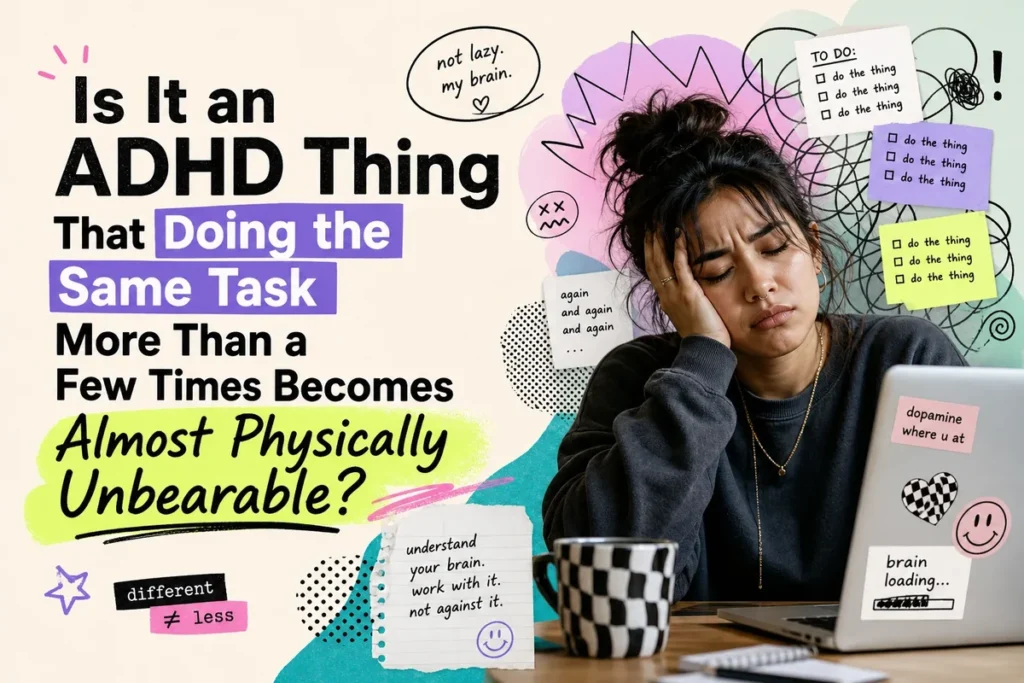
You started the task and it was fine. Maybe even good. You were into it for the first hour, the first week, the first few rounds. Then something flipped. The same spreadsheet, the same dishes, the same show you were obsessed with, the same hobby you picked because you loved it. Now your skin feels tight just looking at it. Your body wants out. It is not that you are tired, exactly. It is a heavy, itchy, "nope, we are doing something else" feeling, and it shows up even when the thing in front of you is something you chose. You switch, and the relief is instant. Then you feel strange about it, because you cannot explain why something you liked became unbearable.
Yes, this is an ADHD thing. It is ADHD repetition intolerance, a pattern driven by fast habituation and a reward system that stops responding to familiar tasks.
What ADHD repetition intolerance actually feels like
People describe it in different ways, but the details are consistent. It is not laziness, and it is not quite boredom either. Boredom is a flat feeling. This is closer to resistance. A kind of mental static that builds the longer you stay on one thing.
It can hit after a few hours or after a few repetitions. It can show up with work, with chores, with social plans, with games, with scrolling. Some people notice it most with things they genuinely love, which makes it more confusing. You are not bailing on something you hate. You are bailing on something you liked ten minutes ago.
Many people end up giving it a name of their own, like "same-thing fatigue." The fact that so many of us invent a label for it tells you how recurring and recognisable it is.
ADHD repetition intolerance is not a character flaw. It is your brain refusing to keep paying attention to a signal it has already filed as "known."
Why your brain habituates faster
Every brain habituates. When something stays the same, the response to it fades. That is how you stop noticing the hum of a fridge or the feel of your clothes. It is efficient.
The ADHD brain appears to run this process faster, especially for rewards. Research on dopamine-related motivation in ADHD points to difficulties in how reinforcement is learned and used, including in the medial frontal cortex, a region involved in tracking whether an action is worth continuing.1 If the reward signal attached to a task shrinks quickly, the task stops feeling worth doing, even when you know it matters.
In plain terms: novelty is what makes the signal loud. Repetition turns it down. By the third or fourth round, your brain is getting almost nothing back for the effort it is spending.
Why it feels physical, not just mental
The "almost physically unbearable" part is not an exaggeration. When a task loses its reward value, your brain still has to push you through it using effort alone. That is the expensive route. It leans on executive function, and executive function is exactly what ADHD makes harder to run on demand.
So you get the combination: low reward, high effort, and a nervous system that reads that mismatch as discomfort. The restlessness, the tightness, the urge to get up, the sudden need for water or a snack or your phone. These are not random. They are your body trying to find a way out of a low-reward state.
The pattern to look for: if the aversion builds with repetition and drops the moment something new appears, you are looking at ADHD repetition intolerance, not a loss of interest in the thing itself.
Why novelty requirements show up everywhere in ADHD
Clinical descriptions of ADHD have long noted that symptoms tend to get worse in situations that require sustained effort or lack intrinsic appeal or novelty, including monotonous and repetitive tasks. They also note that signs can be minimal in a novel setting or under very strict control.2
That is the same thing you are living, described from the outside. It explains why you can focus for hours on a brand new project and then struggle to finish the last ten percent. It explains why a new job feels easy for three months. It explains why routines you design yourself fall apart right around the point they become routines.
This is the heart of the ADHD novelty requirement for tasks. It is not that you cannot do the work. It is that the conditions that make work doable keep expiring.
Why the standard advice makes it worse
Most productivity advice assumes a stable engine. Build a routine, repeat it daily, let habit take over. For a brain that habituates quickly, this is close to the opposite of what works.
Telling someone with ADHD repetition intolerance to "just stick with it" is like telling someone to keep listening to a sound that has already faded. The effort is real. The payoff is not arriving.
Streaks, rigid schedules, and identical morning routines can also backfire. The first week feels great. By the third week the routine itself has become the thing you resist, and then you feel like you failed, when what actually happened is predictable. The system ran out of novelty.
ADHD routine aversion is often misread as a discipline problem. It is a design problem. The routine was built for a brain that does not work like yours.
What helps with ADHD repetition intolerance
The goal is not to eliminate the urge to switch. It is to give your brain enough variation to keep the signal alive while the work still gets done.
Change one variable at a time. Same task, new location. Same task, new music. Same task, standing instead of sitting. Small changes can restore a bit of novelty without costing you the progress you have built.
Rotate on purpose. If you know you will want to switch after ninety minutes, plan the switch. Move to a second task you already have lined up. A planned rotation keeps momentum. An escape resets it to zero.
Add friction to the exit and a game to the entry. Gamify repetitive tasks: race a timer, change the order, set a small rule. It sounds silly. It works because it gives your reward system something to respond to.
Use external structure that changes. Body doubling, a new playlist, a different accountability partner. Anything that brings in a fresh signal from outside helps when your internal one has gone quiet.
Finally, finish in smaller loops. The shorter the cycle, the less time habituation has to take hold. Ten-minute sprints with visible endpoints often work better than open-ended blocks.
When to take it seriously
Occasional boredom is universal. What marks ADHD repetition intolerance is the intensity, the speed, and the consistency. If it affects your job, your relationships, or your ability to maintain things you care about, it is worth bringing up with a clinician who understands adult ADHD.
Many adults hear about this pattern for the first time through Late Discovery. Looking back, it explains the abandoned hobbies, the job changes, the half-finished projects, and the shame that came with all of them. Naming it does not fix it, but it changes the question from "what is wrong with me?" to "what does my brain need to keep going?"
The practical shift is this: stop treating your resistance to repetition as a verdict on your character. If ADHD repetition intolerance is how your brain works, then the job is to build work and routines that change often enough to stay interesting, and to plan your switches before your brain forces them.
1 Findings on deficient reinforcement learning in the medial frontal cortex as a model of dopamine-related motivational deficits in ADHD. 2 Clinical overview, "Attention-deficit/hyperactivity disorder: a closer look."
Rate this article
Was this a useful hit?