Is It an ADHD Thing That You Sometimes Get So Overstimulated and Angry That Your Body Just Forces You to Sleep?

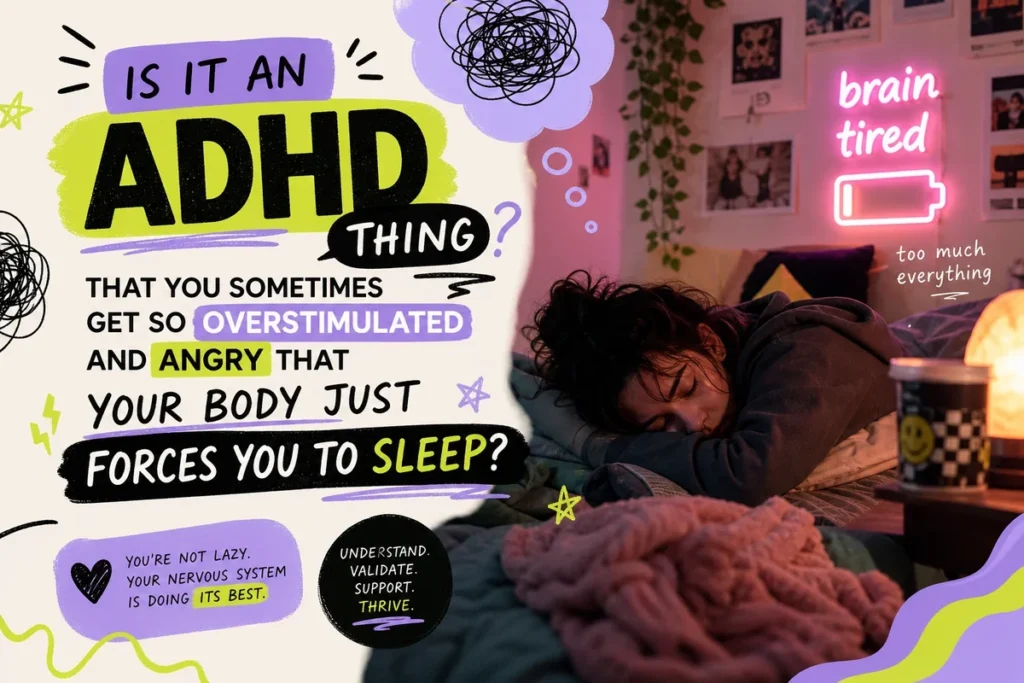
Something goes wrong. Maybe it is a comment that landed badly, a plan that fell apart, or one more noise on top of a day full of noise. Your chest goes hot. Your jaw locks. You can feel the anger climbing, and you know that if you stay in the room you will say something sharp to someone who does not deserve it. So you leave. You get into bed, pull the covers up, maybe scroll your phone for a while, maybe not. And somewhere in there, without deciding to, you are asleep. When you wake up the anger is gone, replaced by a flat, heavy quiet. Someone in your life says they do not understand it. Honestly, you do not fully understand it either.
Yes, this is an ADHD thing. The rage nap is the crash that follows emotional flooding in a nervous system that struggles to regulate intense feeling, and it is a real physiological response, not a mood or a character flaw.
What an ADHD rage nap actually is
The term is informal. You will not find "rage nap" in a diagnostic manual. But the pattern is easy to describe: a surge of anger or overstimulation, a retreat from other people, and then a sleep that feels less like choice and more like a circuit breaker tripping.
People in the ADHD community describe it in a few flavours. Some go numb and disconnected first, a kind of dissociation that is quieter and more nuanced than the movie version. Others are overloaded by several things stacking up, then exhausted, then out cold. Some are still angry when they fall asleep. All of them describe the same thing: the body ends the episode when the mind cannot.
The ADHD rage nap is not you avoiding the problem. It is your nervous system running out of fuel in the middle of the problem.
Why ADHD anger burns through so much energy
Emotional regulation is part of executive function. The brain regions that help you notice a feeling, put a small gap between the feeling and your reaction, and then dial the intensity down all rely on the same systems that ADHD affects. Public health sources describe ADHD as a neurodevelopmental condition that shapes the parts of the brain responsible for managing attention, impulses, and emotions.1
When that braking system is less reliable, anger does not arrive at a manageable size. It arrives at full volume, fast. Your heart rate jumps, your muscles tense, your stress hormones surge, and your brain pours effort into two jobs at once: feeling the thing and trying not to act on it. Holding back is work. For an ADHD brain, that work is expensive.
Think of it as a sprint you did not train for. The anger itself is the sprint. The ADHD rage nap exhaustion anger cycle is what happens at the finish line, when your body demands the recovery it was denied the whole way through.
Overstimulation is the accelerant
Anger rarely shows up alone. It tends to arrive on top of a pile: a loud day, a full inbox, too many people, too many tabs open in your head. By the time the final irritation lands, your capacity is already close to zero.
Many ADHDers describe it with a money metaphor. When you live paycheck to paycheck, any unexpected expense becomes a crisis, because there is no buffer. ADHD energy works the same way. You spend your focus, patience, and emotional control all day, and one extra problem does not feel like one extra problem. It feels like the whole account has been overdrawn.
This is why ADHD overstimulation shutdown and anger so often travel together. Sensory load and emotional load draw from the same limited reserve. When the reserve empties, the system does not politely taper off. It crashes.
Why the anger can feel disproportionate: You are rarely reacting to the one thing in front of you. You are reacting to the one thing plus everything you absorbed and suppressed since morning. The size of the response matches the total load, not the trigger.
Why your body forces sleep instead of letting you calm down
Sleep is not a random outcome here. After a flood of stress hormones and a long stretch of effortful suppression, the nervous system needs to shift out of high alert. Sleep is the most complete way it knows to do that. It cuts off input, lowers arousal, and gives the brain a chance to settle.
There is also a baseline issue. Research on ADHD and sleep estimates that roughly 80% of adults with ADHD have a co-occurring sleep disorder, with problems like delayed sleep phase, insomnia, and restless legs being common.2 If you are already running on poor or mistimed sleep, your reserves start the day lower. That makes the crash after an emotional spike steeper and harder to resist.
Some researchers have also suggested that ADHD may involve irregular arousal regulation, meaning the brain has a harder time moving smoothly between alert and calm states. A rage nap fits that picture. You go from fully activated to fully off, with very little middle ground.
Is the rage nap avoidance or something else?
The person who told you it does not make sense may be reading it as sulking, dodging, or refusing to deal with things. That is understandable from outside, because from outside it looks like you walked away.
But look at what the retreat is actually doing. You leave because you know you are not safe to talk to. You protect other people from a version of you that you do not like. That is not avoidance of responsibility. It is a form of self-awareness, even if it is crude and automatic.
The honest caveat is that it can become a pattern that stops you from ever repairing or resolving the thing that set you off. Rest is legitimate. Never returning to the conversation is where it can start costing you. The goal is not to stop the nap. It is to make sure the nap is a pause and not the entire response.
When it might be something more than ADHD
Not every shutdown is the same. Some people find that their rage nap looks more like dissociation, going numb, foggy, or detached before they fall asleep. This overlaps with how some autistic people experience overload, and plenty of people have both ADHD and autism. If sensory input seems to be a major trigger for you, that is worth exploring.
Chronic exhaustion, low mood, and very heavy sleepiness can also point to depression, sleep apnea, or other sleep disorders, all of which are more common alongside ADHD. If you are sleeping long hours regularly, not just after blow-ups, tell a clinician. Late Discovery of ADHD often means years of these overlapping issues being misread as separate problems.
What actually helps: working with the crash
The usual advice is to count to ten, breathe deeply, or talk it out in the moment. That assumes your regulation system is online. During a flood, it often is not. You cannot reason your way out of a body that is already past capacity.
What helps is working earlier and more practically. First, learn your early signals: the jaw, the heat, the shortened sentences. The sooner you catch them, the more options you have. Second, reduce input fast. Leave the room, turn off the noise, put the phone down. You are not being dramatic. You are lowering the load so the crash is smaller.
Third, build a script for the people around you. A short line like "I am overloaded, not angry at you, back in an hour" does more than any apology afterward. It turns an unexplained disappearance into a clear signal.
Fourth, give your body a safer outlet before the wall. Several people describe physical tasks like doing dishes or cleaning as a surprisingly effective way to burn off the anger. Movement uses the same energy the anger created, which can make the crash gentler.
Finally, protect your baseline. Consistent sleep, regular meals, and fewer stacked demands will not remove the rage nap, but they raise the floor that you are falling from.
You cannot always prevent the flood. You can make sure it hits a rested nervous system with an exit already planned.
The takeaway on the ADHD rage nap
If you have ever wondered whether your ADHD rage nap exhaustion anger cycle is a quirk or a symptom, treat it as information. It tells you how fast your reserves drain and where your limits sit. The shift to make is small: stop judging the nap as a failure to cope, and start treating it as the final stage of a process you can interrupt earlier. Notice the first sign of heat, lower the input, say your one-line script, and rest without guilt. Then, once you are back, return to the thing that started it.
1 NIH MedlinePlus Magazine, "Understanding ADHD: What you need to know."
2 Kooij, J.J.S. (2021). "Is ADHD a Sleep Disorder? Can ADHD Improve by Treating Comorbid Sleep Disorder(s)? A Research Update." European Psychiatry.
Rate this article
Was this a useful hit?