Is It an ADHD Thing That You Picked Up Your Phone for One Specific Reason and an Hour Later You Have No Idea What It Was?

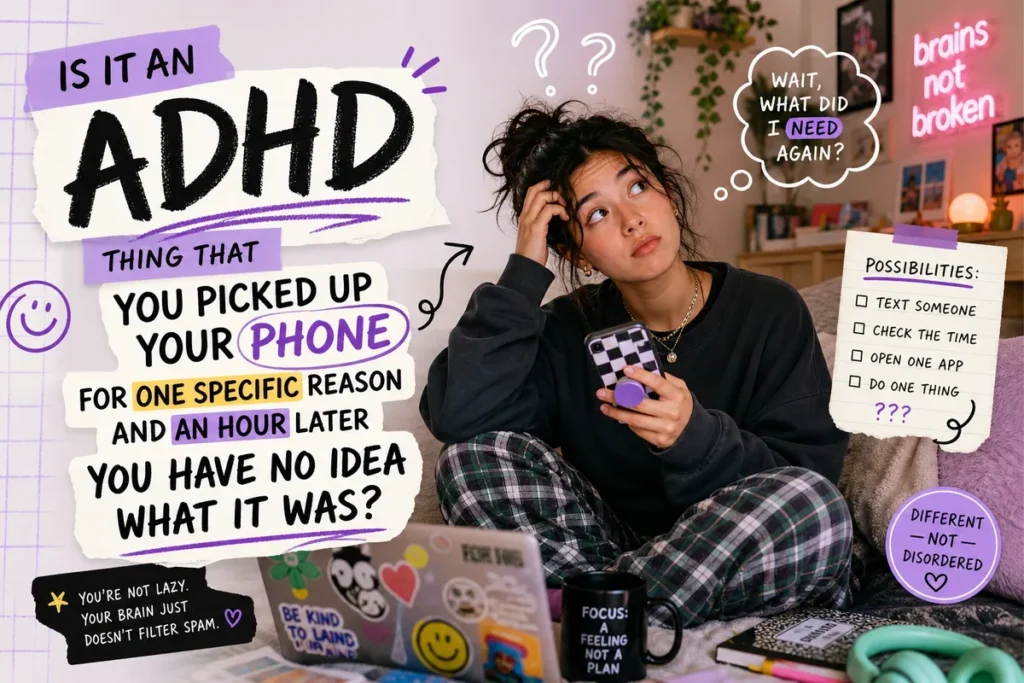
You pick up your phone to set a reminder. Just one. You unlock it, and your thumb lands on email instead. There are three unread messages, so you read them. One of them mentions a bank charge, so you open your banking app. Then something in your feed catches your eye. You put the phone down, and two minutes or sixty later, you remember: the reminder. You pick the phone up again, open the reminders app, and your fingers hover over the keyboard. The thing you needed to write down is gone. Not faded. Gone.
Yes, this is an ADHD thing. It is a working memory failure colliding with a device engineered to exploit the exact way your attention system works, and it is one of the most common forms of ADHD phone distraction working memory trouble there is.
What is actually happening when the intention vanishes
Working memory is the mental sticky note. It holds a small piece of information, like "open reminders and write down the dentist appointment", just long enough for you to act on it. In most brains, that note stays pinned while the hand does the work of unlocking a phone and finding an app.
In an ADHD brain, the note is much easier to knock off. Working memory is one of the executive functions most consistently affected in ADHD, and it relies heavily on prefrontal circuits that run on dopamine and norepinephrine. When those signals are low or inconsistent, the held information has a weaker grip. Anything new and interesting can displace it.
That is the key detail. You did not forget because you do not care. You forgot because your working memory held the intention for a few seconds, and then something louder arrived.
ADHD phone distraction working memory trouble is not a character flaw. It is a pinned note in a brain that struggles to keep notes pinned, handed a device that throws confetti.
Why the phone is the worst possible place to hold an intention
Think about what a phone is. It is a single rectangle that contains your email, your money, your friends, your news, your entertainment, your shopping, and your calendar. Every one of those is a possible detour, and most of them are more immediately rewarding than "write down the dentist appointment."
An ADHD brain is built to chase novelty and fast reward. The interest-based nervous system, as many ADHD clinicians describe it, responds to what is new, urgent, or stimulating, not to what is merely important. A red badge on an app is new. A message is social and urgent. A reminder you set for yourself is neither.
So the moment you unlock the screen, your intention is competing against a wall of cues. It loses almost every time, and it loses silently. You do not decide to abandon it. It just stops being on the note.
Task switching: the cost nobody sees
Every jump between apps is a small act of task switching. Your brain has to drop one goal, load another, and keep track of which one is supposed to be in charge. People with ADHD tend to find this switching more costly, and the original goal is the thing most likely to get dropped in transit.
Here is what that looks like in practice. You intended to open reminders (goal A). You see an email notification (goal B). Opening it feels like a tiny, harmless detour, but your brain does not hold goal A in the background the way a neurotypical brain often can. When you finish with the email, goal A has no trace. You are now on goal C, which was triggered by something inside the email.
This is the mechanism behind ADHD task switching on your phone. It is not one big distraction. It is a chain of small ones, and the chain has no memory of where it started.
Notifications are built to exploit your attention system
Notifications are not neutral. Apps are designed to pull your attention using the same cues that capture an ADHD brain most easily: novelty, variable reward, and social urgency. You never know whether the next swipe will give you something great, boring, or upsetting, and that unpredictability is exactly what keeps the dopamine system hooked.
Research backs up the connection between ADHD traits and phone use. A 2020 study by Panagiotidi and Overton at the University of Sheffield looked at 273 adults and found that ADHD symptoms predicted problematic mobile phone use and smartphone addiction risk. Higher levels of inattention were especially linked to greater risk, particularly in younger adults.
That does not mean your phone use is a moral failing or an addiction in the dramatic sense. It means the overlap is real, and measurable, and not a figment of your frustration.
Why it feels so personal: The phone gets you at the exact point your working memory is weakest, which is the gap between having an intention and acting on it. That gap is only a few seconds wide, and it is enough.
Why blanking on the reminder is the cruelest part
The most maddening moment is the second attempt. You go back to the reminders app, open it, and your mind is blank. You know you needed to write something. You remember the feeling of needing to write something. The content is missing.
That is working memory in its purest form. The intention was never stored anywhere durable. It lived in a fragile buffer, and when the buffer was overwritten, nothing was left to retrieve. This is also why people with ADHD can remember it again later, in the shower or while driving, when the mind is quiet and the right cue accidentally reappears.
It is also why trying harder rarely works. You cannot concentrate your way into retrieving something that was never encoded. The fix has to happen earlier, before the note gets knocked off.
Why the standard advice about ADHD phone distraction fails
The usual advice is to use more willpower, put the phone in another room, or just write things down. These all sound reasonable, and all of them have a problem.
Willpower is itself an executive function, so asking an ADHD brain to rely on it is asking the weakest system to fix itself. Putting the phone in another room works in some cases, but most of us need the phone for the task we are trying to remember. And "just write it down" assumes you can get to the writing step without being derailed, which is the very thing that fails.
Better advice works with the way your brain operates. It reduces the number of steps between intention and action, cuts the competing cues, and moves the memory out of your head and into the environment. Small hooks by the front door work for the same reason: the cue is physical, it is where you will be, and it does not depend on you remembering to look for it.
What actually helps
Start by shrinking the gap. The shorter the distance between "I need to remember this" and "I have recorded it," the less time the note has to fall off. Voice assistants are useful here, because you can speak the intention without unlocking the phone or seeing a single notification. Be specific, with a time and a date, so the reminder triggers on its own instead of waiting for you to remember it exists.
Next, reduce the cues. Turn off badges and non-essential notifications, and move your reminders app to the first screen where it is the only thing you see. If the first thing your eyes land on is the tool you came for, your thumb has a much better chance of going there.
Finally, use physical anchors. Say the intention out loud as you reach for the phone. Put a sticky note on the screen. Leave the phone face down on top of the thing you need to do. These work because they keep the intention alive in the world, not just in your head, and that is where an ADHD brain holds information best.
The next time you lose an hour after picking up your phone, treat it as data, not a verdict. The failure point is the few seconds between intention and action, so build your system around those seconds. That is the practical answer to ADHD phone distraction working memory trouble: stop asking your memory to carry the intention, and put it somewhere it cannot be knocked off.
Rate this article
Was this a useful hit?