Is It an ADHD Thing That You Spend All Day in Paralysis and Then Decide to Fix Your Entire Life at 2 AM?

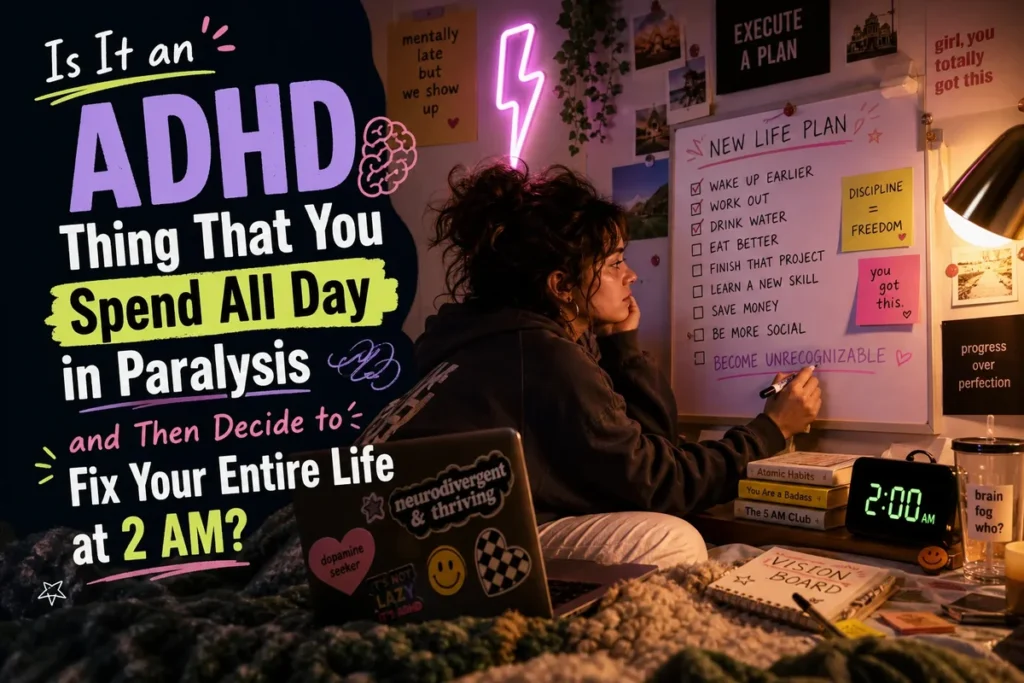
You spend the whole day circling a sink with three dishes in it. You know they are there. You walk past them, you look at them, you feel the weight of them, and somehow they have become a task the size of a house. Hours go by. You scroll, you stare at the wall, you tell yourself you will do it after this one thing. Then it is 1:47 AM, the apartment is quiet, and your brain announces that tonight is the night you clean the whole kitchen, scrub the baseboards, rearrange the pantry by vibe, redo your budget, and become a new person.
Yes, this is an ADHD thing. It is a delayed activation threshold, layered on top of a body clock that runs late, and the ADHD 2am productivity burst is what it looks like when the two finally line up.
The ADHD 2am Productivity Burst Is Not Random
It feels random. One minute you cannot lift a single plate, and the next you are on your knees scrubbing grout and feeling like a genius. The lack of warning is exactly what makes people doubt themselves. If you can do all of this at 2 AM, surely you could have done a fraction of it at 2 PM. Surely you are just lazy, or dramatic, or choosing this.
You are not choosing it. The pattern is consistent enough that it has a mechanism, and the mechanism has very little to do with willpower.
Your brain did not suddenly become capable at 1:47 AM. It became activated. Those are different things. The capability was there all day. What was missing was the neurochemical push that turns "I know I should" into "I am doing it now."
Why You Cannot Start During the Day
The ADHD brain runs on an interest-based nervous system, not an importance-based one. Neurotypical brains can generate enough drive from "this needs to be done" or "there will be consequences." Yours often cannot. Dopamine and norepinephrine, the chemicals that regulate motivation, effort, and alertness, are regulated differently in ADHD, so a task has to clear a higher bar before your brain will engage with it.
A dull, low-reward chore like dishes sits well below that bar. Worse, it can feel physically heavy, because your brain is also forecasting the effort without feeling any of the payoff. The task starts to feel like "too much" not because it is large, but because the part of you that translates intention into action is not firing.
Staring at three dishes for six hours is not a character flaw. It is an activation problem, and the ADHD 2am productivity burst is what happens when activation finally arrives.
That is paralysis. Not laziness, not avoidance in the ordinary sense, but a stuck state where you want to move and the machinery will not turn over. Many people describe it as being aware of everything they should do while being unable to access any of it.
Why Your Brain Finally Switches On Late at Night
By the time the evening arrives, several things have quietly changed. The demands of the day have stopped. Nobody is texting you, nobody expects anything, and the background pressure of other people's timelines has dropped. For an ADHD brain, that matters more than it sounds, because the world's constant interruptions are often part of what keeps you in a frozen, overstimulated, or underwhelmed state.
At the same time, stimulation has been building all day. Scrolling, noise, half-started tasks, worry, and the low hum of unfinished business all add up. Eventually the total input crosses your threshold, and the brain flips from idle to engaged. The task that felt impossible at noon now looks interesting, even exciting, because the novelty of the idea and the quiet of the hour are doing the work that motivation could not.
Add urgency to it. It is late, you are behind, and you feel the sudden pressure of a deadline you invented. Urgency is one of the few reliable triggers for the ADHD nervous system. Late at night, guilt, curiosity, and pressure all arrive together, and together they can provide the push that a calm Tuesday afternoon never will.
ADHD Night Owl Life Planning and the Body Clock
There is also a plain biological reason that late evening is when you come alive. Researchers have increasingly described circadian rhythm disruption as a significant feature in a large subgroup of people with ADHD. A recent review of the evidence on ADHD and circadian rhythms reports a strong association between ADHD and an evening chronotype, meaning a body clock that runs later than average.1
The numbers in that review are striking. Sleep disturbances affect up to 80 percent of adults with ADHD, delayed sleep-wake timing shows up in up to 78 percent, and the release of melatonin, the hormone that signals your body to wind down, is delayed by about 90 minutes in adults compared to controls.1
Put that together and the picture changes. At 11 PM, when a neurotypical body is preparing for sleep, yours may be only just reaching its alert window. What looks like "waking up at night" is often your biology arriving on schedule, just a schedule that does not match the one the world runs on. This is why ADHD night owl life planning feels so natural: it is when your brain is actually online.
Why mornings are so hard: If your body clock is shifted later, waking at 7 AM can mean being pulled out of biological night. Your brain is still in low-alertness mode, so the morning paralysis is not a lack of discipline. It is a timing mismatch.
ADHD Late Night Executive Function Has a Catch
Here is the part that stings. The person who made the plan at 2 AM and the person who wakes up the next morning feel like two different people. Because, neurologically, they are in very different states.
At night, the activation is high, the ideas feel vivid, and the whole project seems doable. Executive function, the set of skills that handles planning, sequencing, and follow-through, is borrowing energy from that surge. You can see the end result clearly, and you feel capable of building it.
By morning, the surge is gone. You are underslept, the novelty has worn off, and the plan that looked elegant now looks like a mountain. The baseboards are half scrubbed. The budget spreadsheet has four tabs and no formulas. The color-coding system makes sense only to the version of you who was up at 2 AM. The momentum does not carry over, and when you cannot find it, shame fills the gap.
Several people describe a similar pattern with longer projects: a few days of intense, fast engagement, then a sudden shutdown the moment the interesting part ends and the routine part begins. The brain does not slowly fade. It goes dark, as if a plug has been pulled, and the project is abandoned until another surge arrives. That is not a lack of commitment. It is what an interest-driven system does when the interest drops out.
Why the Standard Advice Fails You
The usual advice is to go to bed earlier, build a morning routine, and just do the hard thing first. It sounds sensible, and for a brain with a typical body clock and typical dopamine regulation, it may work.
For you, it asks your brain to produce its highest effort at the exact time it is least equipped to. Telling a night owl to become a morning person by willpower is like telling someone to run faster by wanting it more. It ignores the biology and then blames you for the result.
The other piece of advice, "just break it into small steps," fails for a different reason. You usually know what the steps are. Knowing the steps is not the problem. Starting is. A list of ten tiny steps can still feel like ten walls, because the gap between thinking and doing is the thing that is impaired, not your ability to plan.
And then there is the shame loop. When you cannot reproduce the 2 AM energy on demand, you decide you are inconsistent, unreliable, or broken. Many adults who go through a Late Discovery of their ADHD describe decades of this: being told they have potential, watching the bursts come and go, and concluding the problem is character. It is not. It is a pattern with a cause.
How to Work With the 2 AM Surge Instead of Against It
You will probably never fully control when activation arrives. The goal is not to eliminate the burst. It is to make it useful, and to stop it from costing you the next day.
Start by treating the surge as a limited resource. When it shows up, choose one thing that actually matters and do that first, before the baseboards. The brain at 2 AM will happily pick the most stimulating project, not the most useful one. If you name the priority in advance, even in a note on your phone, you can direct the energy instead of just riding it.
Then stop before you crash. The instinct is to keep going until the energy runs out, because it feels so rare. But finishing in total exhaustion guarantees a flat morning. Ending while you still have some interest left makes it easier to return. Leave the next step visible and obvious, like a tool on the counter or a document open on your screen, so tomorrow's start requires almost no decision.
Finally, build in external stimulation for the daytime. Music, a body double, a timer, a phone call while you fold laundry, a change of room. These are not tricks or crutches. They are ways of raising stimulation to the level your brain needs, so that activation does not have to wait for midnight.
And if sleep timing is wrecking your days, that is worth raising with a clinician. Light exposure, melatonin timing, and medication schedules can all affect a delayed body clock, and the research on chronotherapy for ADHD is still developing.1
What to Take From the ADHD 2am Productivity Burst
The ADHD 2am productivity burst is not proof that you could be fine if you just tried harder. It is proof that your brain works, and that it needs a particular set of conditions to switch on. Silence, urgency, novelty, and a body clock that has finally come online are doing what motivation could not.
So stop judging yourself by the day shift's output, and start designing around the night one. Take the plan you made at 2 AM, cut it down to a single task, and put it where tomorrow's version of you can start it in under two minutes. That one change turns the burst from a story about chaos into something you can actually use.
1 "ADHD as a circadian rhythm disorder: evidence and implications for chronotherapy." Review of evidence on evening chronotype, sleep disturbance, and delayed melatonin onset in ADHD.
Rate this article
Was this a useful hit?