Is It an ADHD Thing That You Become Completely Fixated on a New Person in a Way That Feels Out of Your Control?

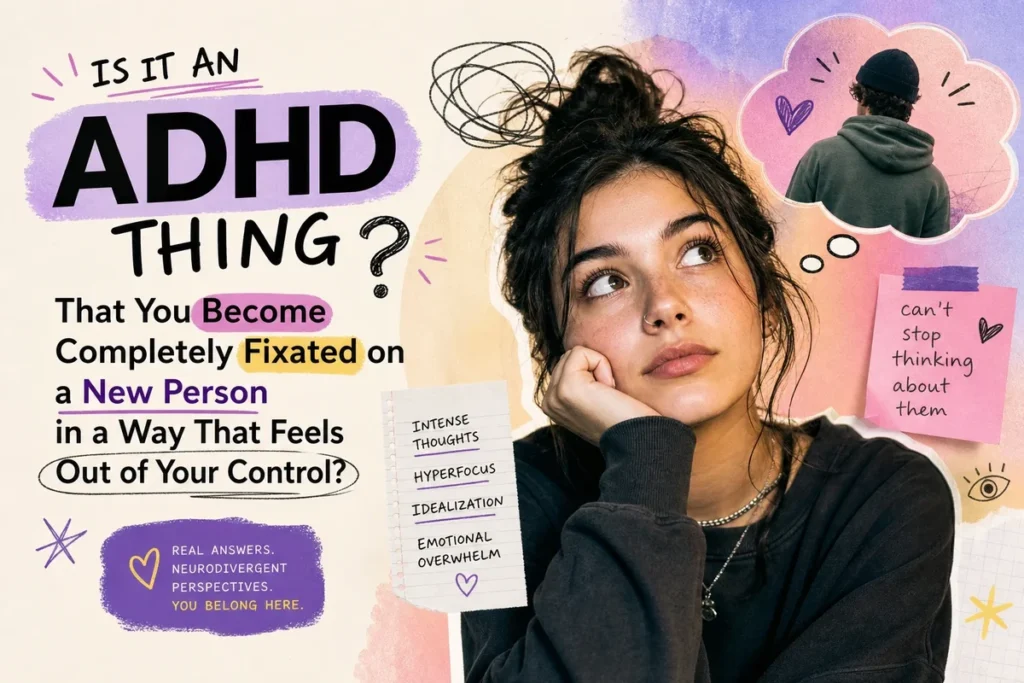
You met them on Tuesday. By Thursday you know the exact way they laugh, and you have replayed the conversation by the coffee machine about forty times. You are analysing the pause before they said goodbye. You are drafting messages in the shower. You check whether they have been online. Your work is sliding, your food is going cold, and a quiet voice is asking why this person has taken over your entire brain when you barely know them.
Yes, this is an ADHD thing. What you are describing is interest-based hyperfocus pointed at a person, and for many ADHD brains it looks and feels a lot like limerence.
What ADHD person hyperfixation limerence actually looks like
Limerence is the term for an involuntary state of intense romantic preoccupation: constant thoughts about one person, craving their attention, and emotional swings that depend on how they seem to feel about you. It is not an official diagnosis, and it is not exclusive to ADHD. But the description fits what many ADHDers report almost exactly.
The ADHD version often has a particular texture. It is not always romantic. It can be a new friend, a mentor, a coworker, or someone you admire from a distance. It can arrive in the middle of a loving, stable relationship and feel baffling. People in online ADHD communities describe falling intensely for someone new every few years, despite being committed and happy, and feeling horrified by how fast it flips.
The common thread is not the type of relationship. It is the quality of the attention: total, involuntary and absorbing.
ADHD person hyperfixation limerence is not you being dramatic or disloyal. It is your brain's reward and attention system doing what it does with anything novel, rewarding and emotionally charged.
Why your brain treats a new person like a new special interest
ADHD is a neurodevelopmental condition that affects executive function, which includes managing attention, impulses and emotions. A big part of how that plays out is that ADHD attention is not controlled by importance. It is driven by interest, novelty, urgency and challenge.
Think about what a new person offers. They are novel. They are unpredictable. They produce social feedback you cannot forecast. Every message is a small reward that arrives on an uncertain schedule. For a brain that runs low on baseline dopamine signalling, that is about as compelling as it gets.
When you hyperfocus on a game, a hobby or a rabbit hole, you lose hours and the rest of the world goes quiet. A person can trigger the same lock, except now the rabbit hole talks back, and the stakes feel emotional rather than intellectual. That is why ADHD hyperfocus in people and relationships can feel so much heavier than hyperfocus on a project.
Why it feels out of your control
It feels out of your control because the system that would normally pull your attention back is the one ADHD affects. Executive function is what lets most people notice a thought loop, label it as unhelpful and redirect. In ADHD, that braking mechanism is weaker, especially when emotion and reward are involved.
So the thought arrives, and you follow it. Then you follow the next one. You are not choosing to ruminate, in the same way you do not choose to lose three hours to a documentary series. The attention is simply captured.
Emotional regulation plays a role too. ADHD brains tend to experience feelings at higher intensity and with slower recovery. A good interaction can feel euphoric. A slow reply can feel like a drop in the floor. That swing keeps the loop fuelled, because each emotional high and low demands more analysis.
The replay machine: analysing every interaction
One of the most exhausting parts of ADHD obsessive thinking about a new person is the replay. You run the conversation back, looking for evidence. Did they mean that? Why did they use that emoji? Was the pause warm or awkward?
This is partly working memory and partly pattern-seeking. The ADHD brain is built to chase unfinished loops. An ambiguous interaction is an open loop, and without a clear resolution your brain keeps reopening it, hoping to close it. Because you can never get certainty from a text message, the loop never closes.
The replay also borrows from rejection sensitivity. If you are primed to expect disapproval, you scan every interaction for signs of it. That makes neutral moments feel threatening and warm moments feel fragile.
The open loop problem: Ambiguity feeds ADHD fixation. The less clear you are about where you stand with someone, the more your brain will keep working at it. Clarity, even small clarity, is often more calming than reassurance.
Where anxious attachment overlaps with ADHD attachment intensity
Many ADHDers notice that this pattern resembles anxious attachment: needing contact, reading too much into silence, feeling relief only when the other person responds. The overlap is real, and research on adult ADHD and romantic relationships consistently finds higher levels of relationship distress and difficulty with emotional regulation. A qualitative study of people with ADHD describing their romantic lives found a recurring theme of not understanding their own behaviour in relationships, and of understanding it finally being transformative.
The two things can feed each other. ADHD gives you the intensity and the weak brakes. A history of feeling misunderstood, criticised or too much can add a layer of fear around abandonment. Together they make a new person feel like both a thrill and a threat.
It helps to separate the strands. Some of this is neurology, some of it is learned. You can work on the learned part, and you can work with the neurological part, but they need different approaches.
The flip side: when people disappear from your head
Here is a detail that confuses many ADHDers. The same brain that fixates on a new person can forget people who are right there in your life. Out of sight can become out of mind. You love your partner, your family, your friends, but when they are not in front of you, they fade, and when you see them it is like no time has passed.
These are two sides of the same attention system. ADHD attention is not evenly distributed. It surges toward whatever is novel and vivid, and it recedes from whatever is familiar and stable. A new person is vivid. A long-term partner is predictable, and predictability does not generate the same dopamine signal.
That is not a measure of how much you love someone. But it does explain why a new person can feel more intense than someone you have loved for years, and why mistaking that intensity for a deeper connection can be so tempting.
Why the standard advice fails
The usual advice is to just stop thinking about it, go no contact, or distract yourself. For an ADHD brain, those tend to backfire.
Trying to suppress a thought gives it more weight. Cutting contact abruptly can spike the craving and the rumination, because the loop stays open with no data. Telling yourself it is not real can make you feel ashamed, and shame is one of the strongest fuels for emotional spirals.
There is also the problem of treating this as a character flaw. If you believe you are obsessive or unstable, you will respond to the fixation with panic or self-criticism, and that raises the emotional temperature. A calmer, more accurate story works better: this is a hyperfocus pattern, it has a mechanism, and it will pass in intensity as novelty fades.
What actually helps with ADHD hyperfocus on people
Start by naming it. Saying to yourself that this is hyperfocus on a person, not proof of destiny, does real work. It separates the feeling from the decision. You can feel a powerful pull and still choose not to act on it.
Contain it instead of fighting it. Give the thoughts a scheduled place to go, like a ten-minute writing session, then close it. This honours the brain's need for an outlet without letting the loop run all day.
Feed other reward sources. Fixation thrives when the rest of your life is under-stimulating. Movement, a novel project, a body-doubling session or time with other people all compete for the same dopamine pathway.
Watch the behaviours rather than the feelings. You do not control when the intensity arrives, but you do control whether you check their profile, send the fifth message or make big decisions at midnight. If you are in a committed relationship, a trusted therapist who understands ADHD can help you talk about this without it becoming a crisis. Medication and treatment for ADHD can also reduce the intensity of emotional swings for some people, which is worth raising with your clinician.
The next time a new person takes over your head, the useful question is not what is wrong with you or whether this person is the one. It is simply: is this ADHD person hyperfixation limerence, and what does my brain need right now to settle? Treat the pull as information about your attention system, not a verdict on your life, and decide what to do about the person once the intensity has had time to drop.
Rate this article
Was this a useful hit?