Why Does the Gap Between Hyperfixations Feel Like Torture? Is This an ADHD Thing?

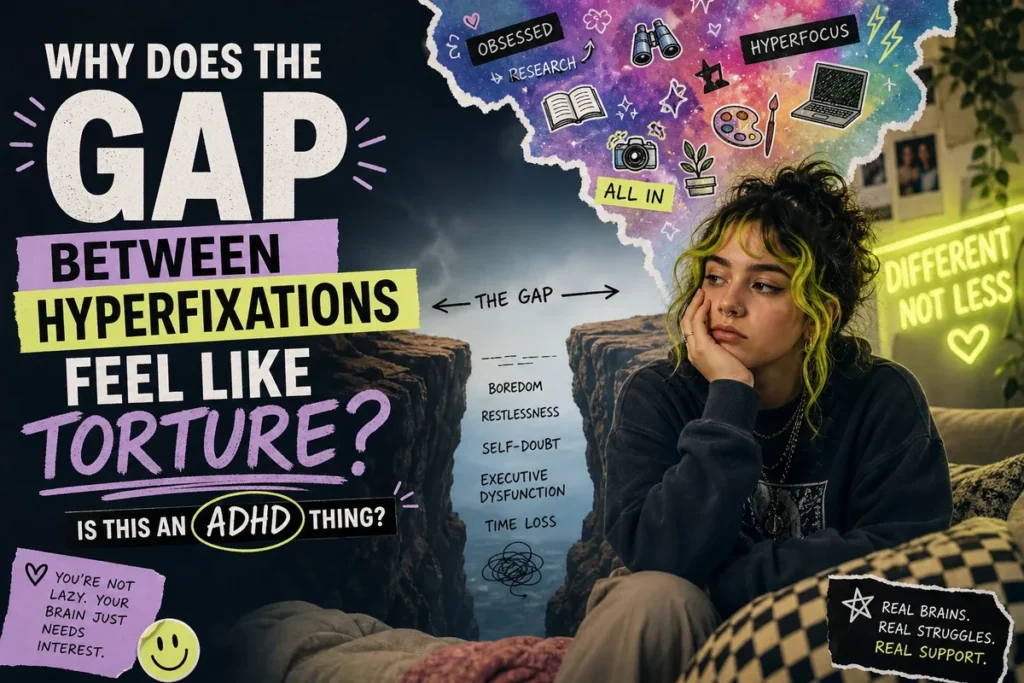
Your last obsession is over. You did not decide that. One day you opened the thing you loved for weeks, the game, the project, the rabbit hole, and it felt like chewing paper. Now it is a week later and you are pacing the apartment, opening the fridge for no reason, scrolling past everything, picking up hobbies and putting them down in ninety seconds. Nothing is wrong exactly. Nothing is right either. You feel stir crazy, like your brain is a car idling in neutral while the engine screams. You would genuinely do almost anything for something new to care about.
Yes, this is an ADHD thing. It is interest-based under-stimulation: when a hyperfixation ends, your brain loses its main source of motivation and engagement, and the ADHD hyperfixation gap feels empty because, neurologically, it is.
Why the ADHD hyperfixation gap feels empty, not just boring
Neurotypical boredom is mild. It is a low hum you can ignore by checking your phone or waiting it out. The ADHD version is different. It feels physical and urgent, like something is missing and you cannot name it.
That is because ADHD brains run on a different fuel system. Research on the ADHD brain consistently points to differences in dopamine signalling, the chemical system involved in motivation, reward, and the feeling that something is worth doing. Many people with ADHD describe an interest-based nervous system: importance, deadlines, and rewards matter less than whether something is novel, challenging, urgent, or genuinely interesting.
During a hyperfixation, that system is fully fed. Attention locks on without effort. Hours disappear. You feel capable, curious, and alive. When the fixation fades, the supply drops, and you do not return to a neutral baseline. You drop below it, because you have just lost the thing that was doing the regulating.
The ADHD hyperfixation gap feels empty because your brain has lost its main source of effortless motivation, and ordinary life does not produce enough stimulation to replace it.
What is actually happening when an interest dies
Interests do not fade because you failed or got lazy. Novelty is a large part of what drives dopamine in ADHD. At the start of an interest, everything is new: each video teaches you something, each purchase opens a door, each skill level feels like progress. The reward signal is strong.
Over weeks, the novelty wears off. The learning curve flattens. The same actions produce a smaller hit. Your brain, which has been rewarded heavily for engagement, starts to treat the interest as depleted and pulls its attention away. Often this happens quickly and without warning, which is why it feels like the interest was switched off rather than outgrown.
Then you are in the gap. The old thing no longer pays out, and the new thing has not arrived. Your brain keeps searching for a target, and the searching itself is uncomfortable.
Why ADHD between interests can feel like depression
Many people describe this stretch as depressive: flat, purposeless, heavy. That is not you being dramatic. The same dopamine system that fuels interest also contributes to mood, drive, and the sense that your days have meaning.
ADHD between interests depression is often not clinical depression, but it can look and feel very similar. You lose appetite for things you usually enjoy. You sleep oddly. You feel like a blank version of yourself. The difference is usually the trigger and the exit: this low tends to arrive when an interest ends and lifts quickly when a new one catches. Depression tends to be more persistent and does not lift because something exciting appears.
If the flatness lasts weeks or months regardless of what you try, or if it comes with hopelessness, talk to a clinician. ADHD and depression often coexist, and treating one does not automatically treat the other.
Worth separating: A gap that lifts when something new grabs you points to under-stimulation. A low that stays put even when you are interested in things points to something that deserves a proper conversation with a professional.
Why the gap feels threatening to your sense of self
There is another layer, and it is the one people rarely say out loud. For many ADHDers, interests are not a hobby. They are an identity. You are the person who knows everything about that game, that history, that craft. Your interests give you a way to talk to people, a reason to get up, a story about who you are.
When the interest disappears, so does that version of you. The gap is not only empty time. It can feel like you have no personality, no direction, nothing that makes you interesting. That is why the ADHD interest void feels so much worse than simply having nothing to do. Your sense of self was borrowing structure from the obsession, and now the structure is gone.
This also explains the desperation to find something new. You are not just bored. Part of you is trying to rebuild who you are, fast, before the emptiness settles in.
Why ADHD boredom without a special interest is so hard to tolerate
Research on ADHD and emotional regulation shows that people with ADHD often experience emotions more intensely and recover from them less easily. Discomfort that a neurotypical person might shrug off can feel overwhelming when your regulation system is already strained. Understimulation is one of those discomforts.
ADHD boredom without a special interest is not passive. It comes with restlessness, irritability, and a pull toward anything that offers quick relief: snacking, doomscrolling, impulse buying, starting five projects at once. Your brain wants stimulation, and it will accept a poor substitute if the good one is not available.
That is why the gap often produces behaviours you later regret. You are not weak. You are a nervous system hunting for fuel.
Why the standard advice makes it worse
People will tell you to relax, enjoy the downtime, or use the break to catch up on chores. For an ADHD brain in the gap, that advice is almost insulting. Chores are the least stimulating thing you could possibly do, and rest feels impossible when you are this restless.
Another common tip is to pick something and commit. That runs into the same wall: you cannot force interest. You can create conditions where interest is more likely, but willpower alone does not manufacture it. Trying to choose a passion from the outside, like picking a hobby from a list, often produces a few dull days and more self-criticism.
The better frame is to treat the gap as a search phase, not a failure phase. Your job is not to fix the emptiness. It is to expose your brain to enough novelty that something catches.
What actually helps you through the gap
Start by lowering the stakes. Sample, do not commit. Give yourself permission to try twenty things for ten minutes each. Interests tend to arrive through small contact: a video that pulls you in, a conversation that sparks a question, an object you suddenly want to understand.
Use your past as a map. Look at your previous fixations and ask what they had in common. Maybe they all involved building systems, collecting information, or making something with your hands. That pattern shows you what kind of novelty your brain responds to, which narrows the search.
Add stimulation that is not a fixation. Movement, music, new places, and talking to people who are enthusiastic about something all raise arousal and can nudge your brain toward catching on. If you take ADHD medication, notice whether the gap feels different on and off it. Many people find that medication makes it easier to direct attention rather than waiting for an interest to seize it, which can soften the cliff edge between obsessions. That is a conversation to have with your prescriber.
Finally, keep a few low-effort fallback interests in rotation. A small pile of old favourites you can dip into when nothing new is available will not replace a full fixation, but it can take the edge off while you wait.
The ADHD hyperfixation gap feels empty because your brain depends on interest to run, not because something is wrong with you. Next time the gap opens, stop trying to feel better and start trying to feed your brain something new in small, cheap, low-commitment doses. You are not waiting for a personality to return. You are collecting samples until one of them catches.
Rate this article
Was this a useful hit?