Is It an ADHD Thing That You Cannot Think When Someone Is Watching You Work?

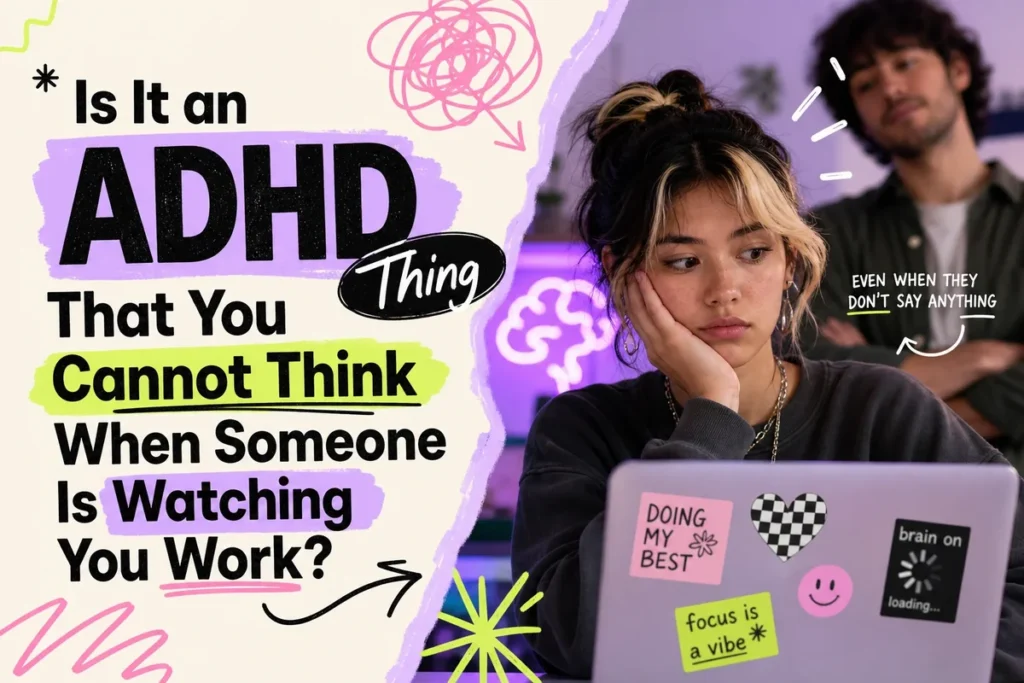
You're typing an email. A normal email, nothing complicated. Then your coworker walks up behind you and stands there, waiting. Suddenly you cannot remember how sentences work. Your fingers hover over the keyboard. The words that were flowing a moment ago have evaporated. You're staring at the screen, hyperaware of them breathing, of their eyes on your hands, of the silence stretching. Your brain has gone completely, devastatingly blank. Not because the task is hard. Because you are being watched.
Yes, this is an ADHD thing. It's called observation-induced cognitive interference, and it happens because the awareness of being watched occupies the exact same limited working memory capacity your ADHD brain desperately needs to perform the task itself. You're not being dramatic. You're not bad at your job. Your brain is literally trying to run two demanding processes on a system that barely has enough RAM for one.
Why ADHD Performance Anxiety Working Feels Like a System Crash
Working memory is the brain's scratchpad. It's where you hold the thing you're currently doing while you figure out the next step. Neurotypical brains have a reasonably spacious scratchpad. ADHD brains do not. Research consistently shows that ADHD involves deficits in working memory capacity, which means there's less mental space available for juggling multiple pieces of information at once.1
When you're working alone, that limited scratchpad is dedicated to the task. You're holding the sentence structure, the point you want to make, the word you're looking for. It's already a lot. It's already at capacity.
Then someone starts watching.
Now your brain has to track: their presence, their location, their possible judgment, your performance, what they might be thinking, whether you're taking too long, whether you look competent, whether your hands are shaking. That's not paranoia. That's your nervous system registering a social threat and allocating cognitive resources to monitor it. Except those resources were already being used.
Something has to give. Usually, it's the task.
The Paradox: Body Doubling Works for Some, Observation Destroys Others
Here's what makes this confusing: body doubling is a well-known ADHD strategy. Having another person present, even silently, can help some people with ADHD stay on task. The presence provides external accountability, a gentle anchor that keeps the wandering mind tethered to the work.
So why does being watched have the opposite effect for you?
The difference is observation versus presence. Body doubling works when the other person is doing their own thing. They're not paying attention to you. They're just existing in the same space, providing ambient accountability without scrutiny. The moment their attention shifts to you, to what you're doing, to how you're doing it, the dynamic changes entirely.
Presence is grounding. Observation is surveillance. Your nervous system knows the difference, even when your conscious mind doesn't.
Some ADHD brains thrive with presence and crumble under observation. Others need complete invisibility to function. Both responses are real, both are rooted in neurology, and neither is wrong.
What's Actually Happening in Your Brain
ADHD affects the parts of the brain responsible for executive function: planning, organizing, carrying out tasks, managing impulses, and regulating emotions.1 These functions require sustained focus and the ability to filter out irrelevant information.
When someone watches you work, their presence becomes information your brain cannot filter out. Neurotypical brains can push that awareness to the background, continuing the task with minimal interference. ADHD brains struggle to deprioritize anything that registers as socially significant.
The observer becomes a competing stimulus. And ADHD brains are notoriously bad at choosing between competing stimuli. Instead of smoothly filtering one out, your attention fractures. Part of your mind stays on the email. Part monitors the observer. Part starts catastrophizing about what they're thinking. Part tries to perform competence while simultaneously losing the ability to be competent.
You're not distracted by the person. You're cognitively split by them. Your working memory is now serving two masters, and it cannot do both.
This is why the experience feels so different from normal distraction. It's not that your mind wanders to something more interesting. It's that your mind is forcibly occupied by something you cannot ignore, even though you desperately want to.
ADHD Performance Anxiety Working Is Not Regular Performance Anxiety
You might think this is just stage fright or social anxiety. It's related, but it's not the same.
Regular performance anxiety is emotional. You feel nervous, your heart races, but your cognitive abilities often remain intact. Some people actually perform better under pressure. The adrenaline sharpens them.
ADHD observation dysregulation is cognitive. Your working memory physically cannot hold the task and the observer simultaneously. It's not that you're too nervous to think. It's that the thinking apparatus itself has been hijacked. You could feel perfectly calm emotionally and still go blank, because the problem isn't your feelings. It's your processing capacity.
This is why the advice to "just relax" or "don't worry about them" is useless. You could relax completely and still lose the thread. The observer's presence is drawing on cognitive resources regardless of your emotional state.
The inverse matters too: Some people with ADHD experience the opposite. Being observed provides enough external pressure to activate their focus systems. If that's you, observation might be a tool, not a threat. Neither response is more valid. Both are ADHD. Know which one you are.
Why Standard Advice Fails
"Just ignore them." You can't. Ignoring requires filtering, and filtering is what's already failing.
"Practice until it's automatic." This helps for some tasks, but ADHD brains don't automate the way neurotypical brains do. What's automatic today might require full conscious attention tomorrow. You can't rely on autopilot.
"Get comfortable with being watched." Exposure therapy works for fear. This isn't primarily fear. It's cognitive overload. You can become less emotionally reactive to observation and still lose your working memory to it.
"Work in public to build tolerance." For some ADHD brains, this makes things worse. Every public session becomes a performance, draining cognitive resources that should go to the work itself.
The standard advice assumes the problem is emotional and the solution is psychological. But when the problem is neurological, the solution needs to be structural.
What Actually Helps When You Can't Work Watched
The goal isn't to fix yourself. The goal is to reduce observation or reduce its cognitive cost.
Create physical barriers. Sit with your back to the wall. Angle your screen away from foot traffic. Use headphones as a social signal that you're unavailable. Close the door. These aren't antisocial behaviors. They're accommodations for a brain that processes observation as interference.
Request asynchronous review. If someone needs to see your work, ask them to wait until you're done. "I'll send this to you in ten minutes" is a complete sentence. You don't owe real-time observation access to anyone who doesn't absolutely need it.
Externalize your process. When you must work observed, try narrating what you're doing out loud. "Okay, I'm looking for the file... now I'm checking the numbers..." This sounds strange, but it works because narration moves the task from internal working memory to external shared space. The observer becomes part of the process rather than a threat to it.
The most important thing you can do is stop treating this as a personal failing. You're not unprofessional for needing privacy to think. You have a brain that runs on limited working memory, and observation consumes it.
Name it when you can. "I focus better without someone watching. Give me five minutes and I'll walk you through it." This isn't making excuses. It's communicating your operating requirements. Some people need quiet. Some need music. You need not to be watched. That's a legitimate need.
The Professional Camouflage Problem
Many people with ADHD, especially those discovered late in life, have learned to perform competence under observation through sheer force of will. You've developed workarounds. You've learned to smile and say "let me just check on that" to buy time. You've masked the cognitive crash happening behind your eyes.
This works, until it doesn't. The cost of performing competence while cognitively overloaded is exhaustion. You might get through the observed moment, but you'll pay for it afterward. The task will take longer. Your energy will be depleted. You might need to redo work you did wrong while being watched.
Professional success often masks neurodevelopmental differences. High achievers with ADHD can appear to function normally because they've compensated so hard for so long. But compensation isn't cure. And observation-induced cognitive interference doesn't care how good you are at your job when no one's looking.
Late discovery context: If you were identified with ADHD as an adult, you may have decades of experience white-knuckling through observation. You've learned to hide the shutdown. That doesn't mean it wasn't happening. And it doesn't mean you have to keep hiding it forever.
This Is Not About Confidence
There's a temptation to frame this as an insecurity problem. "If you were more confident, being watched wouldn't bother you." This is wrong in the same way saying "if you tried harder, you could pay attention" is wrong.
Confidence doesn't expand working memory capacity. Self-esteem doesn't create cognitive resources that weren't there. You can be completely confident in your abilities and still lose access to those abilities when observation consumes your processing power.
This is not a mindset issue. This is a bandwidth issue. And bandwidth has physical limits.
Recognizing Your Pattern
Pay attention to which type of observation disrupts you. Is it anyone watching? Or specific people? Does it matter if they're evaluating you or just present? Does the disruption happen with strangers, or only with people whose opinions you care about?
For some ADHD brains, all observation is equal. The mere presence of eyes on the work is enough. For others, it's specific to authority figures, or romantic partners, or critical colleagues. Knowing your pattern helps you predict where accommodation is most needed.
Also notice: are there conditions where observation helps? Some people with ADHD find that working with a "silent witness" who isn't paying attention to them specifically is grounding. The presence without the scrutiny provides accountability without interference. If that's you, body doubling is a tool worth using, just with clear boundaries about observation.
What to Take From This
Your inability to think when someone watches you work is not unprofessional, not neurotic, and not imaginary. It's a predictable consequence of limited working memory meeting social surveillance. The observer's presence is processed as information, and that information uses up cognitive resources that were already stretched thin.
You don't need to learn to be comfortable being watched. You need to design your work environment so that observation happens on your terms, at moments when you have cognitive resources to spare. That might mean physical barriers, time boundaries, or honest conversations about how you work best. It might mean accepting that you function differently and building your workflow around that reality instead of against it.
When ADHD performance anxiety working shuts down your brain, the solution isn't to force your brain to perform anyway. The solution is to remove the observer, or to reduce the cognitive cost of their presence, so your limited working memory can go where it was always meant to go: into the actual work.
Rate this article
Was this a useful hit?