Is It an ADHD Thing That You Cannot Begin Until the Environment, Your Mood, and the Lighting Are All Exactly Right?

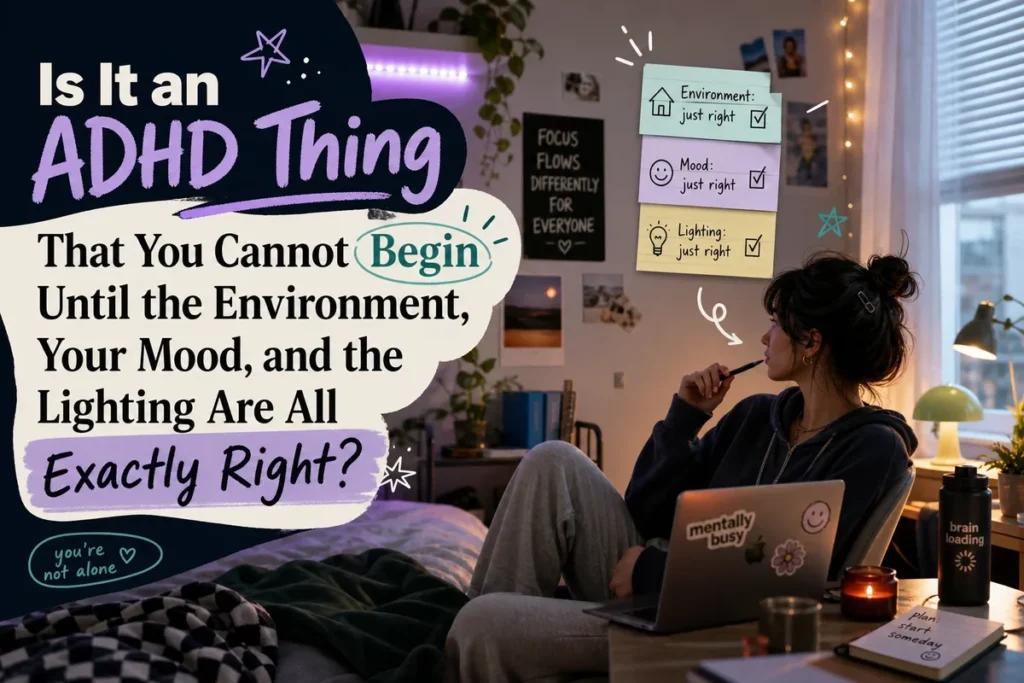
You know exactly what you need to do. The laundry basket has been sitting there for three days. But you cannot touch it because it is Tuesday evening and laundry happens on lazy Sunday afternoons when the light comes through the window at that specific angle and you have nowhere to be for the next four hours. Cooking dinner requires comfy clothes, a simmering background show, zero time pressure, and the particular feeling of having already handled everything else. You cannot just start. The vibe is wrong. And when you force yourself to begin anyway, something in your chest tightens and the task becomes almost physically painful, like dragging your body through wet concrete.
Yes, this is an ADHD thing. It is called a task initiation deficit, and the elaborate environmental and emotional conditions your brain demands are not perfectionism, procrastination, or laziness. They are your prefrontal cortex searching for external scaffolding to overcome an internal starting barrier that neurotypical brains do not face.
Why ADHD Environmental Conditions Focus Feels Like a Prerequisite Checklist
The ADHD brain does not produce dopamine on demand the way a typical brain does. Dopamine is the neurochemical that signals "this task is worth engaging with." For most people, deciding to start a task triggers a small dopamine release that makes the starting feel possible. For the ADHD brain, that signal is weak, delayed, or absent entirely.
So the brain goes hunting. It scans the environment for anything that might generate activation energy: the right music, the right lighting, the right emotional state, the right temperature, the right level of external pressure or its absence. Each condition you stack is an attempt to manufacture enough neurochemical engagement to overcome the initiation threshold. You are not being picky. You are being resourceful with a system that does not self-start.
This is why the vibe dependency feels so specific and non-negotiable. The Sunday afternoon feeling for laundry is not arbitrary. It is the only context where your brain has successfully initiated that task before, so it has learned to associate those conditions with activation. Without them, you are trying to start a car with no battery.
The Startup Ritual Is Not a Luxury
People without ADHD often see the elaborate pre-task setup and think: just skip all that and start. They do not understand that for you, skipping the ritual means skipping the only mechanism you have for generating starting energy. The playlist selection, the desk clearing, the temperature adjustment, the clothing change: these are not delays. They are activation attempts.
Research on ADHD describes the core difficulty as problems starting, staying with, or completing tasks. What this clinical language misses is the desperation of sitting in front of a task for hours, knowing what to do, unable to begin. The startup ritual is the workaround you invented without knowing why you needed it.
I do so many things to please my ADHD that make no sense to anyone else. They are just second nature now. When people ask why, I cannot explain it because "that is what works for me" sounds like an excuse for something they think should be simpler.
The problem is that these rituals are often tedious, time-consuming, and fragile. If one element is missing, the whole thing collapses. The playlist is not on your phone. Someone is home when you need silence. The weather is wrong for the light you need. And suddenly you cannot start at all.
ADHD Vibe Dependent Productivity Is a Pattern Recognition Strategy
Your brain has learned, through years of experience, which environmental and emotional contexts correlate with successful task completion. It has encoded those contexts as prerequisites because it has no other reliable way to predict when activation will be available.
This is not irrational. It is actually sophisticated pattern recognition. The ADHD brain, lacking internal consistency in dopamine regulation, has learned to rely on external consistency instead. If cooking only happens successfully when you are in comfy clothes with a show on and no time pressure, then your brain codes those conditions as the cooking context. Without them, cooking is not cooking. It is some other task that your brain does not recognise.
This explains why forcing yourself to do the task without the vibe feels physically painful. You are not just doing the task in suboptimal conditions. You are doing it without the activation scaffolding your brain depends on. Every action requires conscious effort that should be automatic. Every step feels like resistance.
Why "Just Start" Is Useless Advice for ADHD Environmental Conditions Focus
The standard productivity advice assumes that starting is a decision. You choose to begin, and then you begin. For ADHD, starting is not a decision. It is a threshold that requires sufficient activation energy to cross. Telling someone with ADHD to "just start" is like telling someone with anaemia to "just have more energy." The resource is not available on demand.
The activation threshold: Neurotypical brains generate a small dopamine bump when they decide to do something, making the starting feel natural. ADHD brains often do not get this bump, which is why starting requires external props like the right environment, urgency, or novelty.
This is also why you can sometimes start easily and other times cannot start at all, even for identical tasks. The difference is not willpower. It is whether your brain happened to have enough baseline activation available at that moment. The vibe dependency is an attempt to make that baseline more predictable.
People who discovered their ADHD late in life often have the most elaborate startup rituals because they spent decades trying to force neurotypical strategies and failing. The rituals are compensation. They are the systems you built to survive without knowing why you needed them.
The Sensory Component Is Real and Neurological
ADHD frequently involves differences in sensory processing. The wrong lighting is not just annoying. It is genuinely dysregulating. The wrong temperature makes focus impossible. The wrong background noise creates a cognitive interference pattern that typical brains filter out automatically.
This is why your workspace requirements seem excessive to others. You are not being dramatic when you say you cannot work with the overhead fluorescents on. Your nervous system is processing that input differently, and the energy required to filter it out is energy you do not have available for the actual task.
Tasks without the correct startup are painful and impossible to finish. It is not that I do not want to do them. It is that doing them wrong feels like wearing a shirt made of sandpaper.
The ADHD sensory workspace setup is not about preference. It is about creating conditions where your nervous system can allocate resources to the task rather than to managing environmental discomfort.
What Actually Helps When the Vibe Is Not There
You cannot always wait for the vibe. Life demands tasks on schedules that do not align with your brain's activation patterns. Here are approaches that work with ADHD task initiation conditions rather than against them.
First, identify the minimum viable vibe. You have probably bundled multiple conditions together when only one or two are actually essential. Experiment with removing elements to find which specific condition is doing the heavy lifting. You might discover that laundry only requires the "no time pressure" element, not the full Sunday afternoon package.
Second, create portable vibe triggers. If a specific playlist activates cooking mode, make sure that playlist is accessible everywhere. If a particular hoodie creates the right feeling, keep it designated for task activation. You are building external cues that your brain can recognise as "this is the context where we do this thing."
Third, do the task wrong on purpose. This sounds counterintuitive, but starting wrong is still starting. Fold laundry while standing in the kitchen with no music. The discomfort often triggers your brain to engage properly because now there is a problem to solve. Wrong activation is still activation.
The two-minute ugly start: Commit to doing the task badly for two minutes. Write the email with typos. Cook the meal in your work clothes. The brain often corrects course once it is already engaged, but it cannot correct what never started.
Fourth, externalise the requirement by naming it out loud. Say "I am waiting for cozy Sunday energy" or "I need the no-rush feeling." Sometimes verbalising the condition breaks the spell because you hear how specific it is. Other times, naming it helps you identify a shortcut: what is one thing you could do right now to simulate that feeling for five minutes?
The Vibe Dependency Is a Strength You Have Not Fully Used
Here is what nobody tells you about ADHD environmental conditions focus: once you understand it, you can design your life around it instead of fighting it. Your brain is extremely good at performing when the context is right. The goal is not to eliminate the context dependency. It is to become deliberate about creating the contexts.
Some people with ADHD build their entire careers around this. They structure their work schedules to align with their activation patterns. They choose living spaces based on the vibes they need for different tasks. They invest in environmental controls like lighting, temperature, and sound because those investments pay off in hours of productive engagement.
This is not indulgence. It is accessibility. A person who needs glasses does not apologise for wearing them. A person whose brain requires environmental scaffolding to initiate tasks does not need to apologise for creating that scaffolding.
The vibe you have been waiting for is not going to arrive on its own. But you can learn to manufacture it, shrink it, or substitute it. The first step is understanding that the requirement is real: your brain needs ADHD environmental conditions focus to engage. Now you can stop fighting that truth and start working with it.
Rate this article
Was this a useful hit?